
France Weighs Curfews as Unrest Spills Into the Markets
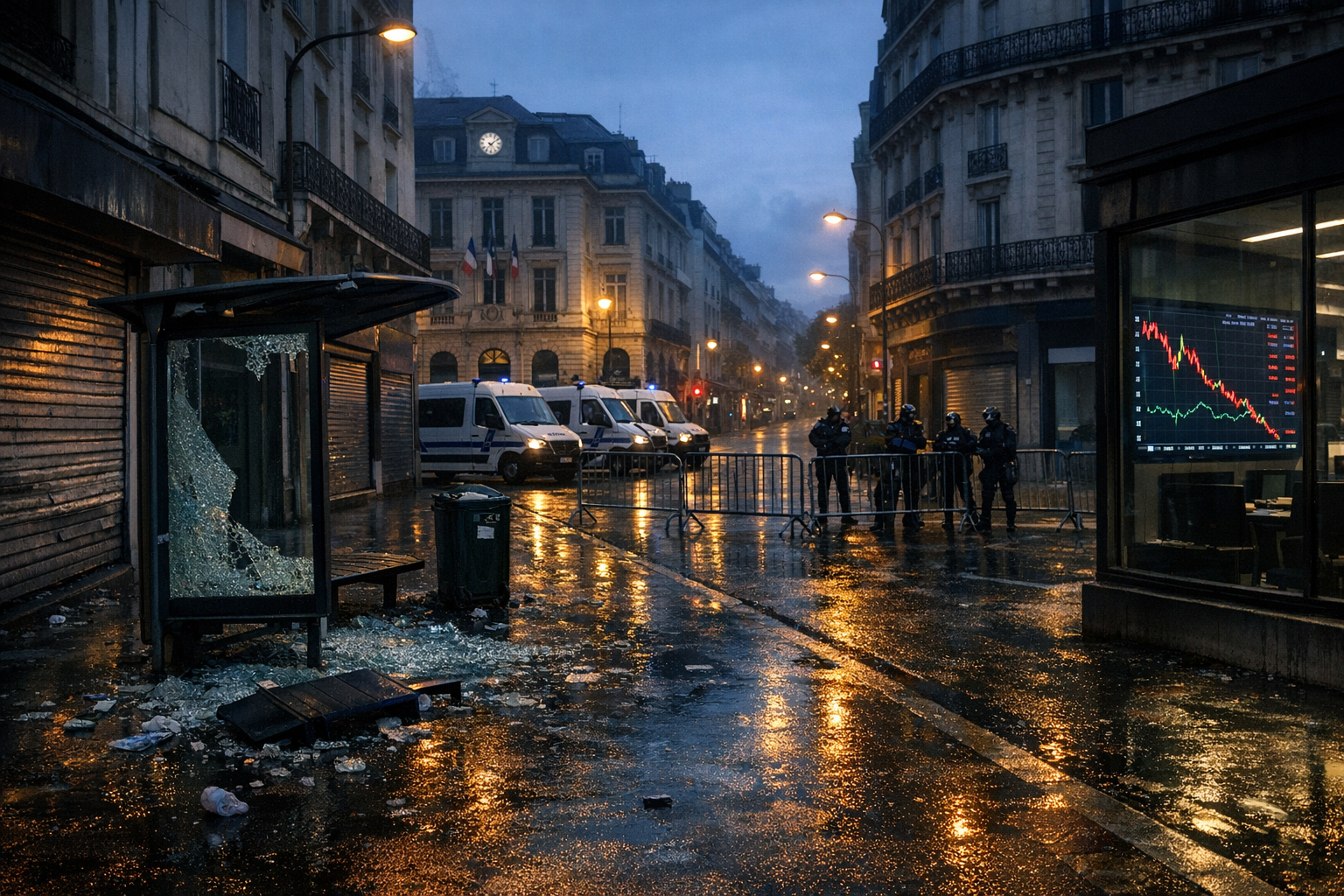
France’s government moved on Monday to authorize localized curfews after a weekend of violent unrest that left public buildings damaged, shops looted and roughly 2,400 people arrested, deepening what has become not only a crisis of public order but also a fresh test of the country’s financial credibility.
After an emergency cabinet meeting, Prime Minister Sébastien Lecornu said regional prefects had been asked to impose “local and partial” curfews in urban areas where disorder remained acute. The aim, he said, was to restore order without shutting down entire cities. At the same time, senior officials conceded that police had been overwhelmed in some places and had, in effect, lost control.
The acknowledgment was striking in a country long accustomed to mass protest, and it underscored how quickly demonstrations that had grown over recent weeks around living costs, school conditions and strains on the social safety net had tipped into a more combustible phase.
President Emmanuel Macron, who on Sunday condemned what he called “unbridled violence,” now faces a familiar but more dangerous French dilemma: how to contain social anger without appearing either absent or authoritarian.
A Weekend of Escalation
The unrest spread across multiple cities over the weekend of Oct. 17 and 18. Protesters erected barricades, torched property and attacked symbols of local authority. Hundreds of shops were looted, according to officials, and municipal buildings were damaged in several places.
French authorities have argued that while the broader movement drew on genuine grievances, more radical elements and criminal groups exploited the gatherings once night fell. Lecornu blamed “the extreme-left” and other actors for intensifying the violence, though the underlying anger reaches far beyond any single faction.
That anger had been building for weeks. What began as largely peaceful demonstrations over rising daily costs and deteriorating public services tapped into a wider sense of erosion: households squeezed by inflation, schools under strain and a welfare state many French voters feel is no longer delivering security in the way it once did.
In France, where street protest remains a central political language, such grievances can simmer for months. But the government is now confronting criticism that it underestimated both the breadth of the movement and the speed with which it could turn volatile.
Investors Deliver Their Own Verdict
As officials tried to reassert control on the streets, investors registered alarm in the markets.
French stocks fell, the euro weakened and government bonds sold off, driving up borrowing costs. Particularly closely watched was the spread between French and German 10-year debt, which widened as investors demanded a higher premium to hold French bonds rather than the eurozone’s benchmark safe asset.
That spread matters because it is more than a market technicality. It is a running measure of confidence in France’s fiscal and political stability, and France entered this week with little margin for fresh doubt. Even before the riots, the government was under pressure over deficits, debt levels and the difficulty of pushing through budget restraint in a fragmented political climate.
The sell-off suggested that investors see the unrest not as an isolated law-and-order episode, but as a development that could worsen existing fiscal vulnerabilities. If the government is forced to spend more to restore calm, compensate damage or respond to social demands, the already difficult task of narrowing the deficit becomes harder. If it refuses, the political anger could intensify.
For France, this is the nerve center of the crisis: the state is being pressed simultaneously by the street and by the bond market.
A Familiar French Tension, in Sharper Form
France has repeatedly shown how quickly economic frustration can become a national political reckoning. The “gilets jaunes” protests that began in 2018 also started with material grievances and evolved into a broader revolt against perceived elite detachment and declining living standards.
This time, too, the symbolism has mattered. Macron has come under criticism from opponents and some commentators who say the government appeared slow to grasp the mood of the country before the weekend exploded into violence. The crisis has revived longstanding accusations that his presidency, though forceful in style, can seem distant from everyday insecurity.
What makes the current episode more perilous is the overlap between social unrest and fiscal anxiety. In past waves of protest, markets did not always react with such immediacy. Now, with Europe still sensitive to debt sustainability and with France already facing scrutiny over its public finances, disorder on the streets is feeding directly into questions about the state’s capacity to govern and pay.
What Comes Next
The immediate question is whether limited curfews can calm the situation without broadening it. French officials insist the measures will be targeted and temporary, not citywide lockdowns. But curfews carry their own political risk in a country wary of collective punishment and suspicious of exceptional police powers.
A broader uncertainty hangs over the week ahead. If violence recedes, the government may yet contain the damage, both politically and financially. If it persists, pressure could grow for tougher steps, including wider protest restrictions or emergency-style measures that would almost certainly inflame the debate over civil liberties.
For investors, the next signal will be whether Monday’s market moves harden into a more sustained repricing of French risk. For Macron’s government, the challenge is larger: proving that it can restore order while persuading a restive public — and increasingly skeptical markets — that France remains governable.
Sources
Further reading and reporting used to add context:
- https://apnews.com/article/75825aafc5412ae389c6d41443b4082e
- https://apnews.com/article/f5ce07c2ef46ad0c02c6ff7018532a59
- https://www.theguardian.com/world/2026/oct/19/france-hit-by-debt-sell-off-as-protests-unnerve-investors
- https://www.theguardian.com/world/france
- https://www.theguardian.com/world/2026/oct/19/french-police-lost-control-during-riots-concedes-interior-minister
- https://www.theguardian.com/business/live/2026/oct/19/exports-lift-china-economic-growth-french-protests-pressure-euro-bonds-latest-business-live-updates?page=with%3Ablock-6ad5b2e08f0877faff4f873a
- https://www.theguardian.com/world/2026/oct/19/monday-briefing-what-you-need-to-know-about-a-weekend-of-chaos-in-france
- https://www.theguardian.com/business/stock-markets
- https://www.theguardian.com/world/2026/oct/10/france-caught-between-bond-markets-student-worker-blockades
- https://www.theguardian.com/world/2026/oct/17/protests-france-high-prices-social-security-gilets-jaunes
- https://bloomberg.com/news/articles/2026-10-02/hedge-funds-exiting-crowded-trades-fueled-rout-in-french-bonds
- https://www.theguardian.com/business/eurozone
- https://www.theguardian.com/business/series/guardian-business-live/2026/oct/19/all
- https://www.theguardian.com/commentisfree/2026/oct/18/france-riot-looting-anger-violence-protest-streets
- https://www.lemonde.fr/en/politics/article/2026/10/19/overwhelmed-and-under-fire-macron-asks-parties-and-unions-to-find-crisis-off-ramp_6758788_5.html
- France's prime minister calls for localized curfews in cities to curb rioting and looting
- France hit by debt sell-off as protests unnerve investors | France | The Guardian
- Nationwide protests in France against high prices and fraying of social security system | France | The Guardian