
A New Front in Europe’s Cyberwarfare: Fear, Food and Fragile Systems
A wave of cyberattacks rippled across Europe on Sunday and Monday, disrupting two very different kinds of civilian infrastructure: the emergency warning apps that people in Ukraine and Russia use during wartime, and the refrigeration systems that keep food safe in supermarkets from Ireland to Sweden.
Taken together, the incidents underscored a widening reality of modern cyberconflict: the most disruptive attacks are often not those that steal secrets or shut down banks, but those that manipulate ordinary systems people rely on to decide whether to flee, whether food is safe to buy, or whether official warnings can be trusted at all.
In Ukraine, officials said hackers breached the country’s public emergency-alert app late Sunday and sent false warnings to users in Kyiv, including alerts of radiation danger, a chemical threat, street fighting and incoming missiles. Some of the messages, according to reports, appeared in both Ukrainian and flawed English. The false alarms arrived as Russia’s war against Ukraine continued and as civilians already living under the pressure of regular air-raid warnings were forced to judge in real time whether the latest alert was genuine.
Russia’s Emergencies Ministry said its own mobile warning app was also struck early Monday, with fake alerts pushed to users before the application was briefly taken offline. Russian officials said the broader public-warning system had not been affected, suggesting the compromise was confined to the mobile channel rather than the sirens or other core alert infrastructure.
That distinction matters. In both countries, officials moved quickly to reassure the public that central warning systems remained intact. But cybersecurity specialists have long warned that in wartime, attacks on the “last mile” of communication — the app on a phone, the notification a family sees in the middle of the night — can be enough to sow panic even without disabling the entire network behind it.
False warnings of nuclear radiation or chemical attack are especially potent in Ukraine, where fears of escalation have hovered over the war for years. Unlike a conventional hack intended to steal data, such messages are aimed at human behavior: to provoke flight, confusion and mistrust, and to make every future alert harder to believe.
Retail Systems Turned Against Themselves
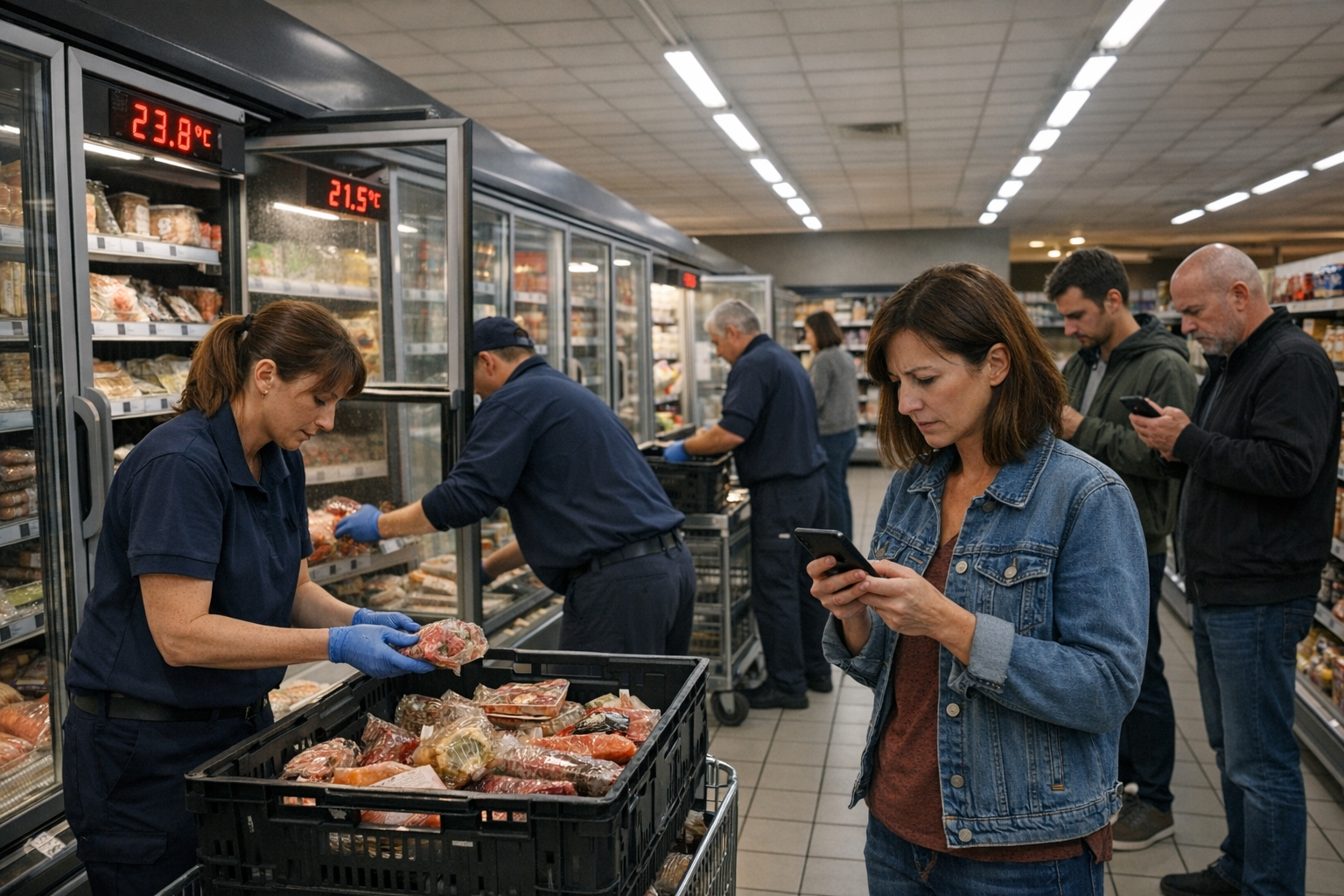
At nearly the same time, retailers in several European countries reported a different kind of digital disruption. Supermarkets and other stores in Belgium, Luxembourg, Sweden, Ireland, Estonia and the Netherlands said refrigeration systems had malfunctioned overnight, with some fridges and freezers warming dramatically after settings were apparently altered remotely.
Retail chains including Delhaize, Carrefour, ICA and Coop confirmed disruptions, and some stores were forced to discard spoiled food. The incidents echoed a major attack in France in mid-October, when cyber intruders were reported to have remotely changed refrigeration settings at hundreds of stores, causing millions of euros in losses and, in some cases, fires.
In the latest wave, temperatures in some cooling units reportedly rose high enough to threaten food safety and interrupt normal store operations. Ikea was among the retailers reported to have been affected in the broader disturbance.
These attacks lacked the immediate psychological force of fake wartime emergency alerts. But they illustrated another unsettling feature of Europe’s digital dependence: even mundane back-room systems, when internet-connected, can become pressure points with immediate physical and economic consequences.
A hacked freezer is not simply an IT problem. It can mean destroyed inventory, health risks, closed stores and supply-chain disruptions. In a sector already operating on thin margins and strict food-safety requirements, even a brief overnight intrusion can quickly become expensive.
Beyond Data Breaches
The incidents also pointed to a shift in cyber risk from traditional office networks to what security experts call operational technology — the software and controllers that run physical processes like refrigeration, heating, factory machinery and building systems.
For years, such systems were often treated as secondary concerns, especially in retail environments where cybersecurity investment tended to focus on payment systems or customer data. But the French refrigeration attack last month, followed by this broader cross-border wave, has heightened concern that attackers may be exploiting weaknesses in internet-connected controllers or legacy industrial systems that were never designed with robust security in mind.
Investigators have not publicly identified who was behind the supermarket disruptions, and it remains unclear whether the latest incidents are directly linked to the French case or reflect copycat operations exploiting the same vulnerabilities. Retailers and authorities are also still trying to determine whether the attacks share a common supplier, management platform or technical method.
The same unanswered questions hover over the emergency-app breaches in Ukraine and Russia. There is no public evidence yet that the two incidents were coordinated, nor is it clear whether attackers penetrated deeper administrative systems or simply gained access to app-based distribution tools. What is clear is that mobile warning channels — now central to how governments communicate danger — are vulnerable enough to be weaponized.
Why It Matters Now
The attacks came at a moment when Europe is already grappling with how to protect civilian infrastructure from both sabotage and systemic digital weakness. In Ukraine, where information warfare has long accompanied missile and drone strikes, a false alert about radiation or chemicals can be as destabilizing as a physical attack in its immediate psychological effect. It exploits the exhaustion and uncertainty of a population already conditioned to react quickly to danger.
In the rest of Europe, the refrigeration disruptions offered a reminder that cyberattacks no longer need to target headline-grabbing institutions to have broad public impact. Interfering with temperature controls in supermarkets may seem a lower-order offense than attacking a power grid, but it reaches directly into daily life, affecting what people can buy and what businesses can safely sell.
Both episodes revealed the same underlying vulnerability: trust in invisible systems. Public-warning apps work only if people believe them. Automated cooling systems work only if retailers can assume they are doing what they appear to be doing. Once that confidence is shaken, the damage extends beyond the immediate outage or false message.
For governments and companies across Europe, the challenge is no longer merely restoring systems after an attack. It is preserving public confidence in the digital tools that increasingly mediate safety, commerce and ordinary life.
Sources
Further reading and reporting used to add context:
- https://apnews.com/article/717372f7bbf4e8a805bc918f06f9730f
- https://apnews.com/article/a8ea5b30d67da47957769f29101fe686
- https://www.techradar.com/pro/trust-us-when-we-say-it-was-spoiled-pentagon-probing-military-freezers-full-of-spoiled-food-as-potential-cyberattack
- https://www.theguardian.com/world/2026/nov/02/hackers-fake-nuclear-chemical-threat-alert-kyiv-ukraine-emergency-app
- https://www.theguardian.com/world/live/2026/nov/02/ukraine-russia-emergency-warning-systems-hack-zelenskyy-streeting-eu-latest-news-updates?page=with%3Ablock-6ae86a468f08f802b2b68477
- https://www.theguardian.com/world/2026/nov/02/supermarket-freezers-across-europe-hit-by-second-suspected-cyber-attack
- https://www.theguardian.com/world/live/2026/nov/02/ukraine-russia-emergency-warning-systems-hack-zelenskyy-streeting-eu-latest-news-updates?source=newscura
- https://www.theguardian.com/world/live/2026/nov/02/ukraine-russia-emergency-warning-systems-hack-zelenskyy-streeting-eu-latest-news-updates?page=with%3Ablock-6ae877f08f08f802b2b6852d
- https://www.aljazeera.com/news/2026/11/2/ukraine-blames-russia-after-air-alert-app-sends-out-false-warnings
- https://therecord.media/cyberattack-grocery-freezers-europe
- https://www.euronews.com/2026/11/02/cyberattack-hits-belgian-supermarket-fridges-and-freezers
- https://www.internazionale.it/ultime-notizie-reuters/2026/11/02/ukrainian-air-force-says-public-air-raid-alert-app-has-been-hacked
- https://meduza.io/en/news/2026/11/02/emergency-alert-apps-hacked-in-russia-and-ukraine-sending-false-warnings-of-nuclear-threats
- https://hromadske.ua/en/war/273612-hackers-send-fake-nuclear-alerts-through-ukrainian-and-russian-emergency-apps-overnight
- https://nltimes.nl/2026/11/02/fridges-freezers-17-dutch-businesses-attacked-large-supermarkets-unaffected
- https://en.wikipedia.org/wiki/Timeline_of_the_Russo-Ukrainian_war_%281_September_2026_%E2%80%93_present%29
- https://en.wikipedia.org/wiki/2026_French_supermarket_refrigerator_hack
- https://www.reddit.com/r/cybersecurity/comments/1x57oku/french_supermarket_fridges_were_pushed_to_50c/
- https://mchs.gov.ru/deyatelnost/press-centr/novosti/5851982
- https://today.rtl.lu/news/luxembourg/delhaize-supermarkets-targeted-by-cyberattack-affecting-refrigeration-1637836789
- https://newsroom.aholddelhaize.com/ahold-delhaize-update-on-status-of-cybersecurity-incident/
- https://www.interfax.ru/russia/1126453
- https://theprint.in/world/russian-emergencies-ministrys-mobile-app-hit-by-cyberattack-tass-says/3087862/
- https://uk.marketscreener.com/news/european-supermarkets-hit-by-new-fridge-cyber-attack-ce785fd8d18af221
- https://www.dutchnews.nl/2026/11/albert-heijn-sister-chain-hit-as-fridge-hacks-spread-in-europe/
- https://globalincidenttracker.com/incident/russian-emergencies-ministrys-mobile-app-hit-by-massive-cyberattack-379393
- https://www.brusselstimes.com/brussels-2/2387865/suspected-cyberattack-hits-fridges-and-freezers-at-dozens-of-belgian-supermarkets
- https://crisis.zone/ukraine-and-russia-report-hacks-of-civilian-alert-apps-with-false-warnings-sent-to-the-public/
- https://assets.danfoss.com/documents/latest/579092/AH553954278717en-000101.pdf
- https://www.aholddelhaize.com/media/f1cjf203/ahold-delhaize-q3-2025-management-prepared-remarks.pdf
- https://www.reddit.com/r/brussels/comments/1xanrtq/why_the_shortages_at_delhaize/
- https://csis-website-prod.s3.amazonaws.com/s3fs-public/2025-05/250502_Significant_Cyber_Events.pdf?VersionId=kv_68iVyiMQQzGZt8dgqYWz35pYv5Zok
- https://www.reddit.com/r/Luxembourg/comments/1x5ptqn/delhaize_supermarkets_across_luxembourg_suspend/
- https://www.reddit.com/r/Gent/comments/1x5lk74/albert_heijns_half_empty/
- https://www.adusa.com/node/7186/pdf
- https://www.themoscowtimes.com/2025/04/01/mass-cyberattack-disrupts-online-services-for-russian-railways-a88556/pdf
- https://www.reddit.com/r/hacking/comments/1x5pis1/ahold_delhaize_cybersecurity_incident/
- https://www.annualreports.com/HostedData/AnnualReportArchive/d/danfoss_2022.pdf
- https://www.reddit.com/r/cybersecurity/comments/1w5i5y2/freeze_the_controller_defrost_the_food_uncovering/
- https://www.investing.com/news/stock-market-news/hackers-heat-french-supermarket-fridges-sparking-fires-and-food-losses-4944916
- https://radar.offseq.com/threat/freeze-the-controller-defrost-the-food-uncovering-vulnerabilities-in-danfoss-refrigeration-controllers-ee6da6a86f7ad878
- https://www.lemonde.fr/en/economy/article/2026/10/13/a-disastrous-day-for-french-supermarkets-after-massive-cyberattack-targets-refrigeration-systems_6758535_19.html?trk=article-ssr-frontend-pulse_little-text-block
- https://www.reutersconnect.com/item/investigators-hunt-french-supermarket-fridge-hackers-no-claim-of-responsibility/dGFnOnJldXRlcnMuY29tLDIwMjY6bmV3c21sX1ZBOTkxMDEzMTAyMDI2UlAx
- https://www.bleepingcomputer.com/news/security/cyberattack-shuts-down-refrigerators-at-french-supermarkets/?trk=article-ssr-frontend-pulse_little-text-block
- https://www.marketscreener.com/news/investigators-hunt-french-supermarket-fridge-hackers-no-claim-of-responsibility-ce785ddddf81ff27
- https://www.linkedin.com/posts/claroty_defcon34-defcon-team82-activity-7492293484792528896-LeX5
- https://infrastructurenews.com.au/story/refrigeration-controller-flaws-threaten-cold-chains
- https://www.danfoss.com/en/service-and-support/coordinated-vulnerability-disclosure/danfoss-security-advisories/?trk=article-ssr-frontend-pulse_little-text-block
- https://cert.cyber.gouv.fr/alerte/CERTFR-2026-ALE-012/?nocache=20261014a
- https://www.cybersecuritydive.com/news/thousands-refrigerator-devices-exposed-french-cyberattack/833117/
- https://www.theregister.com/security/2026/10/15/researchers-warned-attackers-could-defrost-the-food-months-before-french-supermarkets-got-hit/5303425
- https://assets.danfoss.com/documents/latest/52542/BC041586425769en-000602.pdf
- https://fr.wikipedia.org/wiki/Cyberattaque_de_2026_contre_la_grande_distribution_en_France
- https://web-assets.claroty.com/resource-downloads/2021_q1_global_biannual_ics_risk_and_vulnerability_report_2h_2020.pdf
- https://en.wikipedia.org/wiki/2026_in_France
- https://assets.danfoss.com/documents/latest/535265/AO540953778522en-010101.pdf
- Ukraine and Russia say their emergency alert apps sent fake warnings after being hacked
- Supermarket freezers in several European countries hit by apparent cyberattacks
- Hackers heat French supermarket fridges, sparking fires and spoiling food By Reuters
- Hackers send fake nuclear threat alert to Ukraine emergency app | Ukraine | The Guardian