
A New Phase of the A.I. Boom Takes Shape
The artificial intelligence frenzy that first centered on chatbots and cloud software is increasingly spreading into a more concrete and capital-intensive phase: fiber links and lasers inside data centers, government budgets aimed at building national models, and corporate earnings statements that are beginning, however cautiously, to claim real financial gains.
Taken together, recent dealmaking, budget plans and quarterly results suggest that the economics of A.I. are broadening across the full stack. Investors who spent the last two years rewarding companies for promising an A.I. future are now looking for something more tangible: proof that the spending is translating into revenue growth, lower costs or a strategic advantage that competitors will struggle to match.
That shift is visible from Silicon Valley to Seoul.
The Bottlenecks Move Deeper Into the Machine
One of the clearest signs of the new phase came with Marvell’s announcement on Nov. 2 that it would buy Lumentum in an all-stock deal valuing the company at an implied enterprise value of $115 billion. The transaction, expected to close in the first half of 2028, is a bet that the next important constraint in A.I. will not just be chips, but the connections between them.
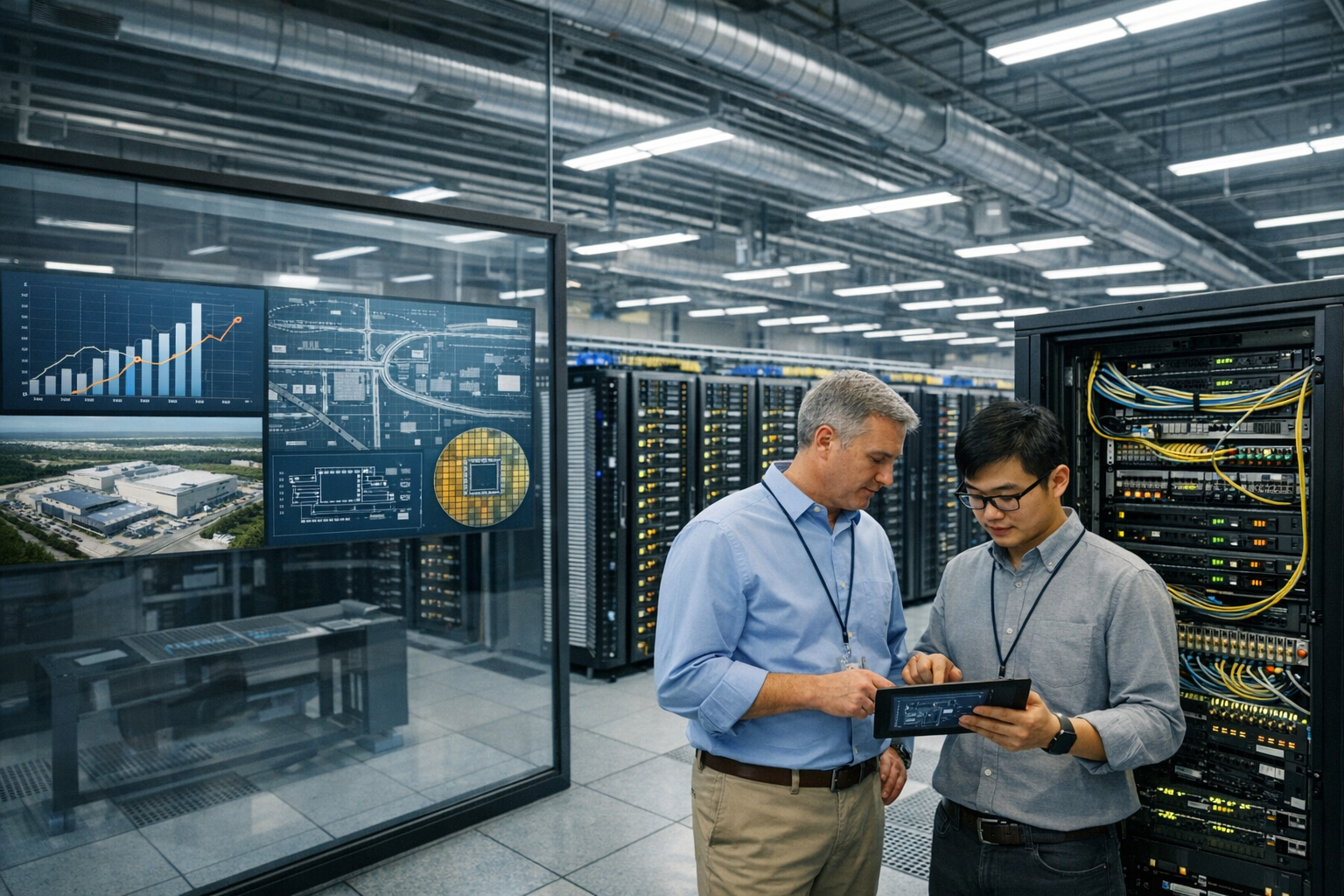
As A.I. systems grow larger, data centers are being forced to move immense quantities of information among processors, switches and memory. That is elevating the importance of optical interconnects — the lasers, photonic components and high-speed networking gear needed to keep these systems running efficiently at scale.
Marvell has argued that combining its custom silicon, switching and electrical networking businesses with Lumentum’s optical technology would position the merged company to pursue a market it estimates at $550 billion. Whether that thesis proves right will depend on how quickly data center architectures shift toward optical designs and whether regulators and shareholders approve a deal with a long runway to completion. But the strategic logic is already clear: in A.I., computing power alone is no longer enough. The wiring matters, too.
That has broader implications for the industry. The first wave of A.I. investment largely rewarded makers of graphics processors and the cloud providers renting access to them. The second wave is starting to lift suppliers of the less glamorous but increasingly indispensable parts of the system: optics, networking, cooling, power and data center infrastructure.
Governments Join the Buildout
South Korea is making a similar wager, though through fiscal policy rather than mergers.
The government has approved a 2027 budget of 820.9 trillion won, a record level, and is sharply increasing spending tied to A.I., semiconductors and data center development. Its A.I. budget is set to rise to 9.4 trillion won, up 84.3 percent from 2026, according to the science ministry. The broader package includes 21.3 trillion won for semiconductors, physical A.I. and A.I. data centers, alongside an ambitious push to build what officials describe as the world’s highest-performance sovereign A.I. model.
The term “sovereign A.I.” has become a catchall for a growing national ambition: ensuring that critical A.I. capabilities, data infrastructure and language models are not controlled entirely by foreign companies. For countries like South Korea, the goal is partly economic and partly strategic. A nation with world-class semiconductor manufacturing and export ambitions does not want to be relegated to consuming A.I. systems built elsewhere.
Yet sovereign A.I. is also a costly proposition. Building advanced domestic models and the infrastructure to support them can duplicate work already being done by global technology companies, and there is no guarantee that state-backed systems will remain competitive. Even so, governments are increasingly treating A.I. capacity the way they once treated energy, telecom networks or chip fabrication: as a national capability too important to leave entirely to market forces.
The Search for Proof in Earnings
If the buildout of hardware and national capacity marks one side of the new A.I. phase, the other is a more practical question: Is any of this paying off?
In recent earnings reports, some large companies have begun answering yes, though the evidence remains uneven. Santander said its A.I. initiatives generated €194 million in business value in the first nine months of 2026. Novartis said A.I.-driven productivity improvements were beginning to appear in its income statement. Other companies have similarly described gains through automation, better customer targeting, software development efficiencies or process improvements.
These disclosures matter because they begin to move the A.I. conversation from aspiration to accounting. For much of the boom, executives could win investor approval simply by announcing pilot projects, partnerships or internal tools. Now, with billions being poured into models, chips and infrastructure, shareholders increasingly want measured returns.
The challenge is that many of the claims are still difficult to audit. Companies often describe “business value” in broad terms, blending cost savings, avoided expenses and projected gains. Productivity gains can take time to show up clearly in margins or revenue. And in some industries, A.I. benefits may be real but diffuse, spread across many functions rather than concentrated in a single line item.
Still, the fact that mainstream companies in banking and pharmaceuticals are now discussing A.I. in terms of profitability rather than novelty suggests a market that is maturing.
Why Meta and Google Are Telling Different A.I. Stories
Nowhere is the pressure to demonstrate payoff more intense than in digital advertising, where A.I. is already shaping the fortunes of the world’s largest internet companies.
Meta said in its latest quarter that artificial intelligence was helping power user engagement and improve ad performance, supporting 26 percent year-over-year growth in advertising revenue. Alphabet, by contrast, reported 12 percent growth in Google Search and other revenue, leaving the gap between Meta’s ad growth and Google’s search expansion at its widest since 2021.
The divergence has sharpened a debate over where A.I. creates immediate business value and where it may first disrupt an incumbent’s existing economics.
For Meta, the near-term use case is relatively straightforward. Better recommendation systems keep users engaged longer, while improved ad targeting and creative tools help marketers convert that attention into sales. A.I. can enhance the core advertising machine without forcing a wholesale change in the business model.
Google’s challenge is more complicated. It remains dominant in search, but generative A.I. is pushing the company to rethink how information is presented to users. That may eventually create new monetization opportunities, but in the near term it raises a delicate balancing act: how to introduce A.I.-driven search formats without undermining the highly profitable structure of traditional search advertising.
Alphabet has pointed to strong A.I.-related demand in Google Cloud, particularly for infrastructure and tensor processing units, suggesting that it is benefiting from the boom even as its core search franchise adapts. But the comparison with Meta underscores an emerging truth of the A.I. era: not every company will monetize the technology on the same timeline, and in some businesses the biggest challenge is protecting an existing cash engine while trying to reinvent it.
From Hype to Heavy Industry
What is becoming visible now is an A.I. economy that looks less like a software trend and more like a full industrial cycle.
The enthusiasm that first attached to conversational bots and foundation models is now spilling into semiconductors, photonics, network architecture, data center construction and public spending plans. At the same time, boards and investors are pressing companies to show that these investments are not merely defensive or speculative, but capable of producing measurable gains.
That does not mean the uncertainties have gone away. The Marvell-Lumentum deal faces a long regulatory and integration path. Corporate claims about A.I. returns remain only partly standardized and often hard to compare. Sovereign model strategies may prove expensive or redundant. And the competitive balance in consumer internet markets could shift again as companies learn how, or whether, to monetize generative A.I. without damaging the businesses they already have.
But the center of gravity is unmistakably changing. The A.I. boom is no longer only about what the technology can say. It is increasingly about what nations will fund, what networks will carry, what factories will build and what earnings statements can finally prove.
Sources
Further reading and reporting used to add context:
- https://www.axios.com/2026/11/02/marvell-lumentum-merger
- https://apnews.com/article/1acf6aff00d4dc084c5243d613307388
- https://www.pcgamer.com/software/ai/we-feel-very-good-about-our-trajectory-here-says-google-as-its-stock-tanks-by-usd500-billion/
- https://www.axios.com/2026/10/29/amazon-stock-earnings-ai
- https://bloomberg.com/news/articles/2026-10-28/marvell-is-said-to-near-deal-for-lumentum-in-ai-related-megadeal
- https://trading-plan.tradeprepared.com/news/rss/Imh0dHBzOi8vd3d3LmNuYmMuY29tLzIwMjYvMTEvMDEvYWktbWV0YS1hZHMtZ29vZ2xlLXNlYXJjaC5odG1sIg%3A1xNYis%3ApZ8OR8HszvuNOB-bhhhyHxs8S7sLntaK7klAWdIsdVk/
- https://aventure.vc/news/2026-11-01-companies-promised-ai-gains-heres-how-the-payoff-showed-up-in-earnings
- https://vector.news/articles/meta-s-ads-growing-over-twice-as-fast-close-the-gap-with-google-02835715c4
- https://www.investing.com/news/economy-news/south-koreas-president-lee-says-interest-rate-rise-is-unavoidable-4883431
- https://www.sec.gov/Archives/edgar/data/1326801/000162828026050705/meta-20260630.htm
- https://www.livemint.com/ai/the-ai-paradox-how-metas-ad-business-is-benefiting-from-artificial-intelligence-but-google-is-suffering-11793590503957.html
- Marvell and Lumentum to Combine, Creating a Category Leader in AI Connectivity
- https://www.spglobal.com/market-intelligence/en/news-insights/research/2026/08/meta-postq-revenue-tops-expectations-but-ai-costs-weigh-on-profitability
- https://allmind.ai/news/4fdcbdd743c4813af3c64980064057ceb1076ce26dbd5a59158de990455da114
- https://vector.news/articles/companies-credit-ai-for-gains-but-can-t-seem-to-prove-it-5faaca9c5e
- https://www.stocktitan.net/sec-filings/MRVL/8-k-marvell-technology-inc-reports-material-event-b5412f92565e.html
- https://investor.marvell.com/_assets/_cd374c2dc2b315cc33f74eeebf563db7/marvell/db/3849/35441/description/marvell-lumentum-combine-investor-presentation-110226.pdf
- https://geroundtable.com/ai-helping-meta-outpace-google-ads/
- https://s21.q4cdn.com/399680738/files/doc_downloads/2025/META-Q2-2025-Prepared-Remarks.pdf
- https://www.williamblair.com/-/media/downloads/eqr/2025/williamblair_digital-advertising-buyer-highlights-improving-macro-sentiment.pdf
- https://www.kiplinger.com/investing/stocks/nasdaq-drops-365-points-on-big-alphabet-miss-stock-market-today
- https://www.axios.com/2026/10/29/microsoft-alphabet-earnings
- https://www.sec.gov/Archives/edgar/data/1652044/000165204426000084/goog-20260930.htm
- https://investor.atmeta.com/investor-news/press-release-details/2026/Meta-Reports-Third-Quarter-2026-Results/default.aspx
- https://www.mois.go.kr/frt/bbs/type010/commonSelectBoardArticle.do?bbsId=BBSMSTR_000000000008&nttId=129203
- https://www.msit.go.kr/eng/bbs/view.do%3Bjsessionid%3DxbAA-pNYabCmXNwinCm4W8BLCUm0wAxybvjr73eC.AP_msit_2?bbsSeqNo=42&mId=4&mPid=2&nttSeqNo=1302&sCode=eng
- https://www.mois.go.kr/frt/bbs/type002/commonSelectBoardArticle.do%3Bjsessionid%3DOzKR3xHFtpOn4S3NszAlPGP_vHWxaUy-WnqVQ54t.node20?bbsId=BBSMSTR_000000000215&nttId=129233
- https://www.publicnow.com/view/D81D65D47E3C04D9E9044F2BA56E63C21F5558E1
- https://www.stocktitan.net/sec-filings/SAN/6-k-banco-santander-s-a-current-report-foreign-issuer-9d9102851e39.html
- https://www.sec.gov/Archives/edgar/data/1652044/000165204426000080/googexhibit991q32026.htm
- https://www.santander.com/en/stories/santander-turns-its-ai-first-strategy-into-measurable-impact-and-extends-ai-access-to-all-185000-employees
- https://www.korea.kr/news/policyNewsView.do?newsId=148971010
- https://www.korea.net/NewsFocus/policies/view?articleId=298880&koreanId=298879
- https://s21.q4cdn.com/399680738/files/doc_financials/2026/q1/META-Q1-2026-Prepared-Remarks.pdf
- https://grkorea.com/sites/default/files/content/articles/files/GR%20Korea%20newsletter_5%20December_0.pdf
- https://www.hannovermesse.de/apollo/hannover_messe_2026/obs/Binary/A1506254/Digital-191226-CRI-AI-research-brief-Davos-compressed_s.pdf
- https://www.publicnow.com/view/005FF7368944E0088CF77505A863A155377F0D4C
- https://www.novartis.com/news/media-releases/novartis-delivered-sales-growth-and-core-margin-expansion-q3-raised-fy-core-operating-income-guidance
- https://www.hkwdb.com/en/news/1259443
- https://www.novartis.com/investors/financial-data/quarterly-results
- https://www.stocktitan.net/sec-filings/LITE/8-k-lumentum-holdings-inc-reports-material-event-43d882457768.html
- https://www.stocktitan.net/articles/marvell-to-buy-lumentum-all-stock-deal-2026
- https://www.stocktitan.net/sec-filings/LITE/425-lumentum-holdings-inc-business-combination-communication-d008374b57b6.html
- https://www.polaris7.io/signals/ai-investments-start-to-pay-off-in-company-earnings
- https://www.sec.gov/Archives/edgar/data/1835632/000183563226000025/mrvl-20260801.htm
- https://econotimes.com/Companies-Report-AI-Gains-but-Most-Do-Not-Quantify-the-Payoff-1767975
- https://www.novartis.com/sites/novartis_com/files/novartis-q1-2026-impact-and-sustainability-update.pdf
- https://www.novartis.com/sites/novartis_com/files/q1-2026-media-release-en.pdf
- https://prod1.novartis.com/sites/novartis_com/files/novartis-annual-report-2025.pdf
- https://evidentinsights.com/api/payload/file-download/EAI-Key-findings_2510-4.pdf
- https://d1io3yog0oux5.cloudfront.net/_348453dc5d6da88eacbbfd0f966d581a/marvell/db/3715/35388/pdf/2026_05_27_corporate_overview_public_FINAL.pdf
- https://www.axios.com/2026/10/02/novartis-china-drug
- https://www.tomshardware.com/tech-industry/standard-chartered-plans-to-cut-7-000-jobs-in-ai-push-lender-wants-to-replace-lower-value-human-capital-and-focus-on-automation
- https://cincodias.elpais.com/companias/2026-10-27/los-beneficios-de-novartis-se-desploman-un-70-en-el-tercer-trimestre-por-el-impacto-de-un-farmaco.html
- https://en.wikipedia.org/wiki/Lumentum
- https://www.msit.go.kr/eng/bbs/view.do?bbsSeqNo=42&mId=4&mPid=2&nttSeqNo=1292&sCode=eng&searchOpt=ALL
- https://www.korea.net/Government/Briefing-Room/Press-Releases/view?articleId=8091&insttCode=A110439&type=O
- https://thesovereignaipowerindex.org/
- https://www.sktelecom.com/en/press/press_detail.do?currentPage=2&idx=1652&type=all
- https://www.koreaherald.com/article/10854743
- https://news.sbs.co.kr/english/endPagePrintPopup.do?news_id=N1008696575
- https://www.prnewswire.com/news-releases/lg-rolls-outs-k-exaone-south-korea-joins-the-global-frontier-ai-race-with-world-class-ai-model-302658264.html
- https://interactives.cnas.org/reports/sovereign-ai-index/?trk=article-ssr-frontend-pulse_little-text-block
- https://news.sktelecom.com/en/2865
- https://news.sktelecom.com/en/3204
- https://www.upstage.ai/blog/en/solar-open-2
- https://asiaai.fyi/guides/south-korea-frontier-models-tracker/
- https://artificialanalysis.ai/downloads/state-of-ai/2025/2025-Year-End-Artificial-Analysis-State-of-AI-Highlights-Report.pdf
- https://cdn.openai.com/global-affairs/f9361fe7-e452-4c78-94dc-e6946c73c858/openai-south-korea-economic-blueprint-october-2025.pdf
- https://www.inss.re.kr/upload/bbs/BBSA05/202511/F20251121132200284.pdf
- https://nvidianews.nvidia.com/_gallery/download_pdf/690450a53d63328acbc5b8c1/
- https://www.brookings.edu/wp-content/uploads/2026/02/20260217_AI_sovereignty_final.pdf
- https://www.kisdi.re.kr/eng/report/e/fileView.do?arrMasterId=3934545&id=1945136&key=m2102103222221
- https://www.reddit.com/r/SMCIDiscussion/comments/1mi4jsd
- https://www.axios.com/2026/07/18/kimi-k3-ai-models-china-us-japan