
Nvidia’s Reprieve Meets New Doubts
Nvidia’s brief comeback rally is colliding with a new set of pressures, underscoring how deeply the chipmaker’s fortunes are bound up with the broader artificial-intelligence economy.
Investors had initially seized on Jensen Huang’s return as chief executive as a sign that one of the market’s most important companies might regain its footing after a jarring leadership crisis. Nvidia’s shares surged after his reinstatement on Nov. 24, helping lift AI-linked stocks that had been battered by questions about lofty valuations and whether the industry’s spending boom could hold.
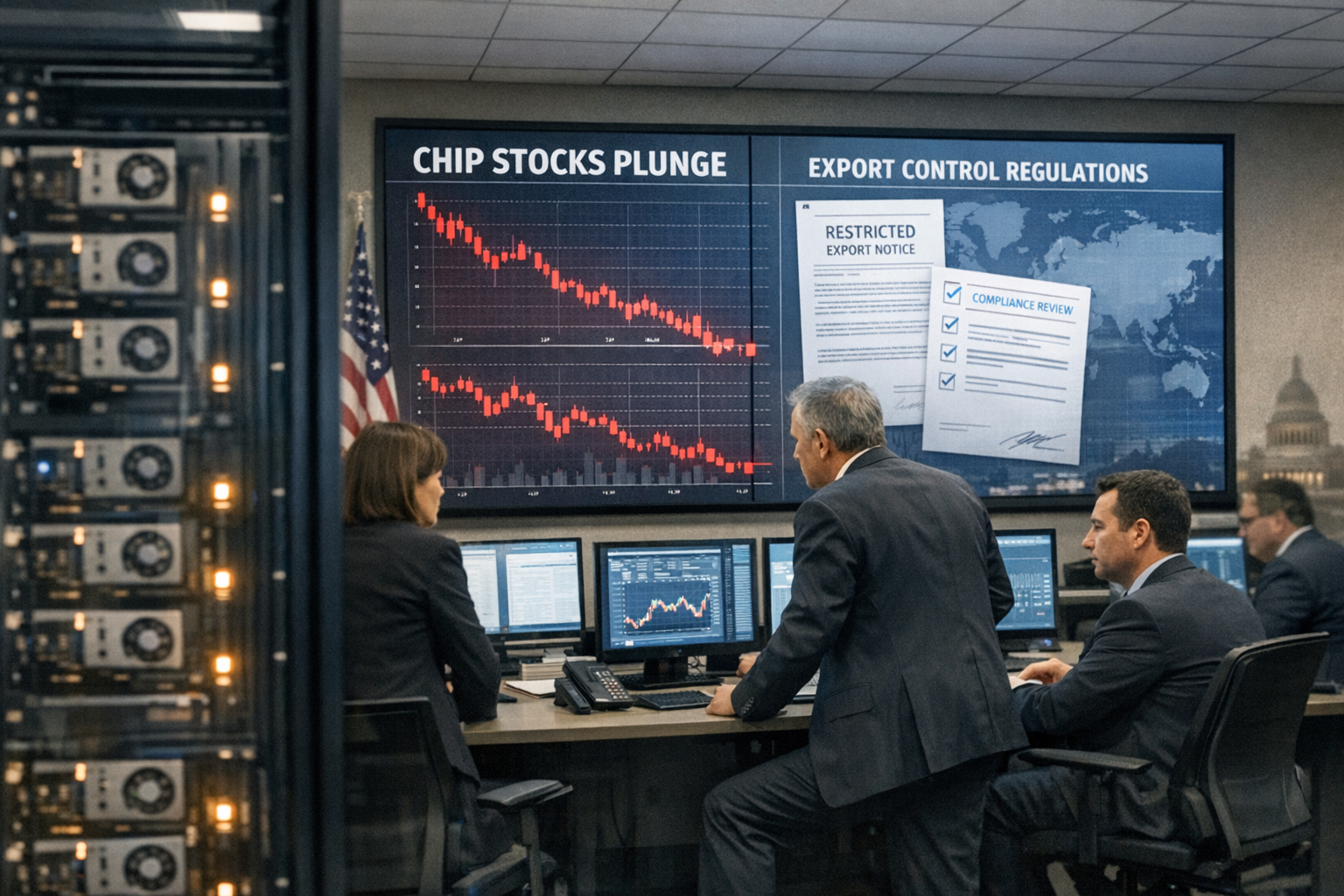
But the relief has quickly given way to a more complicated reckoning. S&P Global Ratings has warned that Nvidia’s credit rating could be cut by one notch within 90 days, citing rising concerns about management and governance. At the same time, the Biden administration’s tightening export controls are making it harder for overseas buyers to use Nvidia-powered computing as an indirect route to serve Chinese customers.
The result is a widening fallout: a company that helped define the AI boom is now facing scrutiny not only over leadership and oversight, but also over the durability of demand for the hardware that has made it indispensable.
A Company Whose Reach Extends Far Beyond Chips
Nvidia’s centrality to the market helps explain why each twist in its saga has resonated far beyond Silicon Valley. The company’s graphics processing units have become the essential hardware for training and running advanced AI models. Its rise has also been tied to a financial ecosystem in which Nvidia has backed start-ups, cloud providers and data-center projects that, in turn, buy its chips.
That interdependence has made the company more than just a semiconductor manufacturer. For many investors, Nvidia became the anchor of the AI trade itself — a proxy not simply for chip demand, but for confidence in the entire buildout of AI infrastructure.
That confidence was shaken when Huang resigned on Nov. 12, setting off a period of uncertainty that rattled the stock and raised fresh questions about succession planning and board oversight. His rapid return less than two weeks later reassured some shareholders who have long viewed him as the company’s strategic and cultural center.
Even the lighter moments of the episode carried that message. Denny’s, the restaurant chain closely associated with Nvidia lore because Huang and his co-founders once discussed the company’s future there, publicly welcomed him back and said a commemorative plaque had been restored. The gesture was playful, but it also served as a reminder of how closely Nvidia’s identity remains entwined with Huang himself.
For admirers, that bond is a source of stability. For credit analysts and governance specialists, it is also a vulnerability.
Governance Fears Move to the Fore
S&P’s warning sharpened those concerns by framing Nvidia’s recent turmoil not as an isolated management hiccup, but as evidence of deeper governance risk. The ratings agency pointed to weaknesses in board independence and oversight following Huang’s departure and swift reinstatement.
A one-notch downgrade would not amount to a financial crisis for Nvidia. But it would carry symbolic weight, particularly for a company whose market influence rests in part on trust — trust from lenders, customers, cloud operators and investors financing huge data-center expansions.
The warning also lands at an awkward moment for the industry. AI stocks have already retreated from their peaks as investors reassess whether the economics of generative AI can justify the scale of current spending. Nvidia has been especially exposed to that debate because its chips sit at the center of nearly every major AI infrastructure plan.
If governance doubts begin to affect how investors price Nvidia’s debt or equity, the consequences could spread. Companies that rely on Nvidia hardware, financing relationships or both could find themselves facing a more cautious market.
Washington Tightens the Net
At the same time, Washington is working to close what it sees as loopholes in semiconductor export controls.
A new Commerce Department rule that took effect on Nov. 19 targets not only direct shipments of advanced chips, but also overseas data centers that provide remote access to significant computing power for companies based in countries of concern, including China. In practical terms, the move aims to prevent Chinese firms from getting the benefits of advanced American chips without physically importing them.
That has already started to reshape behavior in the market. Buyers of Nvidia chips, particularly so-called neocloud companies that rent out GPU capacity, have been told they must rule out Chinese renters if they want to complete purchases, according to people familiar with the matter. The new restrictions impose a heavier compliance burden on cloud operators and data-center groups that had hoped to profit from surging global demand for AI computing.
Administration officials have described the steps as necessary to close loopholes. But for the industry, the rules introduce fresh friction into one of the few areas of technology where spending had still appeared boundless.
The measures also come amid rising political pressure in Washington for even tougher semiconductor controls. Lawmakers in both parties have pushed proposals that would expand export oversight, improve chip tracking and press U.S. allies to adopt stricter limits of their own.
What It Means for the AI Boom
For Nvidia, the policy shift creates a difficult balance. The company remains essential to the AI buildout, but some of the overseas demand pathways that fed that growth are narrowing. If cloud providers can no longer rent advanced GPU capacity to Chinese entities through foreign data centers, a slice of demand may weaken, even as compliance costs rise.
That matters because investors are already debating whether the AI spending wave has become self-reinforcing in unhealthy ways. Nvidia’s role in backing customers that then buy its products has drawn increasing attention during the recent sell-off. Supporters see that ecosystem as evidence of strategic foresight. Critics worry it can mask fragility if confidence drops.
Huang’s return helped arrest that loss of confidence, at least temporarily. But it did not answer the bigger questions hanging over the sector: whether AI customers will keep spending at current levels, whether governments will further constrain the market, and whether Nvidia can preserve its aura of exceptional execution while facing sharper scrutiny over how it is run.
A Symbol of Strength — and Concentration Risk
In China, Huang’s reinstatement was welcomed by some investors as a sign of continuity at a supplier that remains central to global AI development. But it has not been read as a signal that U.S. restrictions might ease. If anything, the latest controls reinforce the opposite conclusion: access to top-tier American computing power is likely to become more difficult, encouraging Chinese companies to intensify efforts toward domestic alternatives.
That dynamic leaves Nvidia in a paradoxical position. It is still the dominant force in AI chips, still capable of moving entire sectors of the market with a single executive change, and still powerful enough that a restaurant chain’s tribute can become part of its corporate narrative. Yet the very concentration of that power — in one company, one executive and one crucial category of hardware — is what now has investors, regulators and analysts on edge.
Whether Nvidia’s recent rebound proves durable may depend less on the symbolism of Huang’s return than on the answers to more prosaic questions: what the board does next, whether S&P follows through on its warning, how aggressively Washington tightens the rules further, and how much of the AI boom can withstand a world of higher scrutiny and harder borders.
For now, Nvidia remains where it has been for much of the past two years: at the center of the AI economy, and at the center of its anxieties.
Sources
Further reading and reporting used to add context:
- https://apnews.com/article/c7ef10c1dbc5fa09668bd4fe0729c613
- https://www.thedailybeast.com/trump-gives-brazen-response-to-grilling-over-sex-mad-ceo
- https://www.axios.com/2026/11/27/vance-rubio-trump-downside-2028
- https://apnews.com/article/a438d0649e3b905804eafb63e9803bb3
- https://apnews.com/article/01ba8c83e7d7d4fa79c22ca5dbc47d22
- https://www.axios.com/2026/11/24/jensen-huang-nvidia-scandal-ceo
- https://www.tomshardware.com/tech-industry/policy/tsmc-reportedly-pauses-shipments-to-chinese-designers-after-u-s-export-rules-flag-decade-old-16nm-and-14nm-nodes-new-bis-controls-threaten-smartphone-tv-and-automotive-chips
- https://www.techradar.com/computing/gpu/rumor-suggests-nvidia-will-cut-gpu-supply-by-20-percent-to-30-percent-over-the-next-few-months-so-if-you-dont-buy-soon-prices-could-get-even-scarier
- https://apnews.com/article/10044b4fb55d3ff20fde9ba9e9acaab1
- https://www.investing.com/news/stock-market-news/silicon-valley-leaders-back-call-for-jensen-huangs-return-to-nvidia-5029956
- S&P warns Nvidia's board may be compromised, puts chipmaker's rating on downgrade watch | MarketScreener
- https://www.investing.com/news/stock-market-news/nvidias-huang-returns-to-cheers-in-china-but-political-hurdles-mount-5048427
- https://qz.com/dennys-jensen-huang-plaque-nvidia-return-112726
- Analysis-Jensen Huang’s return to Nvidia fuels Washington fight over China’s chip access By Reuters
- https://political.org/2026/11/26/dennys-welcomes-jensen-huang-back-as-nvidia-ceo-your-booth-is-waiting/
- https://www.aol.com/articles/denny-celebrates-jensen-huang-return-143131000.html
- https://apnews.com/article/88142455395552afe74caec3399a648b
- https://www.tomshardware.com/tech-industry/policy/nvidia-stops-ai-gpu-shipments-to-southeast-asia-report-claims-data-centers-in-singapore-other-countries-in-trouble-as-commerce-department-requires-cloud-providers-to-obtain-export-license
- https://time.com/article/2026/11/25/nvidia-megaspeed-china-investment/
- https://www.theatlantic.com/podcasts/2026/11/whats-so-important-about-nvidias-chips/689521/?utm_source=openai
- https://theweek.com/tech/lutnick-feels-the-heat-over-nvidia-scandal
- https://www.axios.com/newsletters/axios-san-francisco-2a1d8f07-376a-4a82-bc7a-172c2798dcba
- https://aventure.vc/news/2026-11-26-nvidia-chip-buyers-told-to-rule-out-chinese-renters-to-purchase-gpus-sources-say
- https://www.govinfo.gov/content/pkg/FR-2026-11-19/pdf/2026-23529.pdf
- https://www.tpehub.com/knowledge-and-research/news/nvidia-chip-buyers-told-to-rule-out-chinese-renters-to-purchase-gpus-sources-say
- https://qz.com/nvidia-chip-sellers-neoclouds-chinese-firms-rental-112726
- https://kokoknows.ai/article/cnbc_tech_https___www_cnbc_com_2026_11_26_neoclouds-nvidia-china-ai_html
- https://ismg-cdn.nyc3.cdn.digitaloceanspaces.com/asset_files/external/bis2026-23529interimfinalrulenov192026.pdf
- https://public-inspection.federalregister.gov/2026-00789.pdf
- https://www.8ch.net/qresearch/res/25299261.html
- https://whistlebuzz.com/us/2026/11/26/nvidia-chip-buyers-told-to-exclude-chinese-renters-from-purchasing-gpus/
- https://www.theatlantic.com/ideas/2026/11/gift-guide-ai-apocalypse/689561/?utm_source=openai
- https://www.axios.com/2026/11/23/ai-spending-slowdown
- https://time.com/article/2026/11/23/jensen-huang-return-nvidia-trump/
- https://www.theatlantic.com/ideas/2026/11/ai-bubble-returns-timeline/689504/?utm_source=openai
- https://www.theatlantic.com/technology/2026/11/silicon-valley-shameless-nvidia/689549/?utm_source=openai
- https://moneyweek.com/investments/stock-markets/how-to-protect-against-greater-market-volatility
- https://allnira.online/en-us/news/the-tech-download-will-jensen-huang-s-return-be-the-spark-the-shaky-ai-market-ne-30b6c243aeed22d3cbeeb6e308038bf98542b5cc38d5e21aac90ce48a85aad69
- https://huelv.com/newsroom/78050-the-tech-download-will-jensen-huang-s-return-be-the-spark-the-shaky-ai-market
- https://www.byteseu.com/2550705/
- https://summamoney.com/investing/the-daily/the-tech-download-will-jensen-huangs-return-be-the-spark-the-shaky-ai-market-needs/
- https://biztoc.com/x/b06e5ae57245764c
- https://khanlist.com/story/the-tech-download-will-jensen-huangs-return-be-the-spark-30b6c243
- https://longbridge.com/news/307026126
- https://upside.pandobit.com/en/news/2026/11/the-tech-download-will-jensen-huang-s-return-be-the-spark-the-shaky-ai-market-2486412/
- https://www.investing.com/news/stock-market-news/analysishuangs-stunning-nvidia-return-sparks-relief-for-battered-ai-trade-5046322