
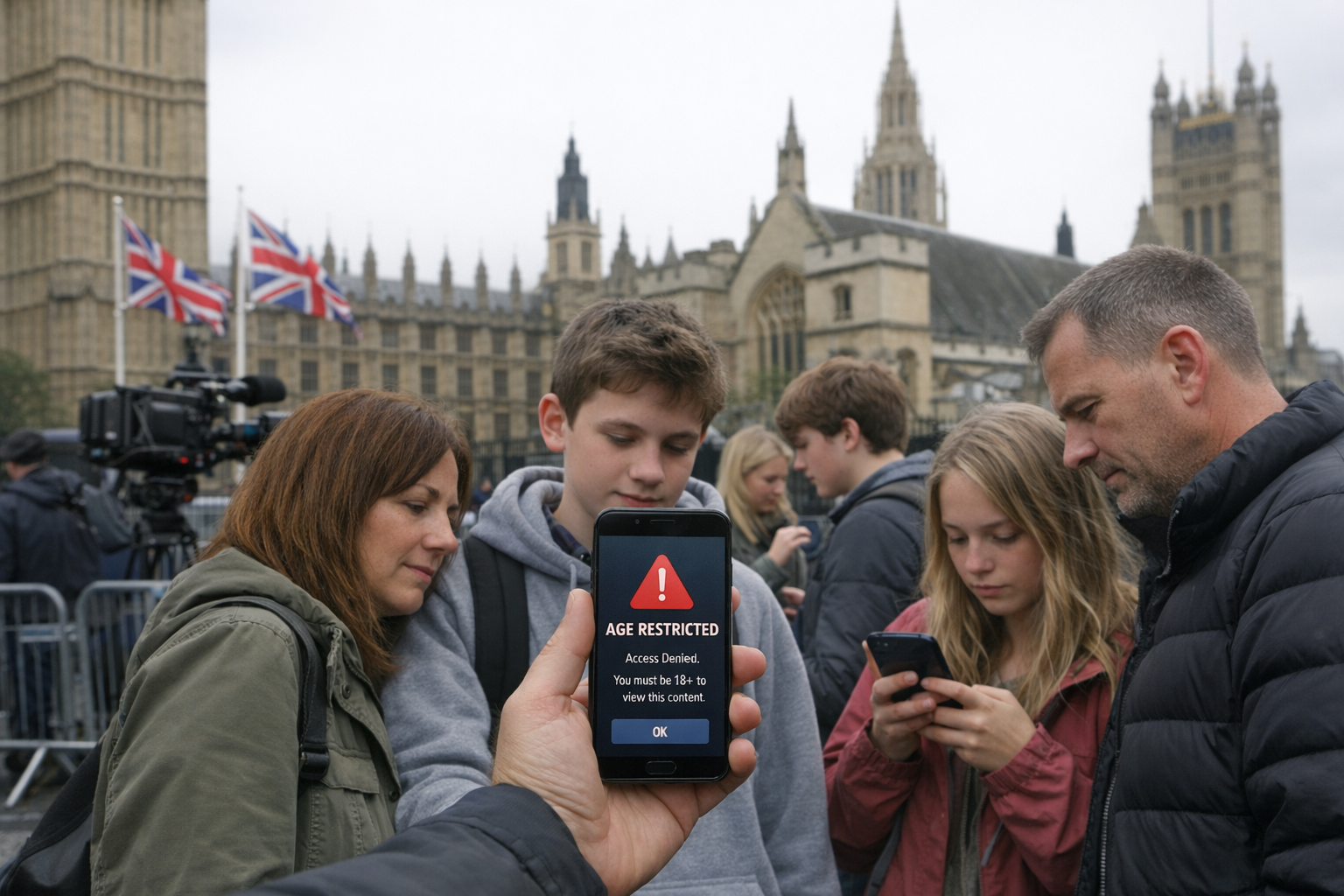
Britain moved on Monday to bar children under 16 from using major social media platforms, opening a new front in the intensifying global battle over how far governments should go to protect young people online.
Prime Minister Keir Starmer said he wanted the ban in force by next spring, casting it as a necessary intervention to “give kids their childhood back” and arguing that social media had left many children less safe and less happy. The proposal would apply to platforms including Snapchat, TikTok, YouTube, Instagram, Facebook and X, according to the government, though messaging services such as WhatsApp and Signal are not currently intended to be covered.
If enacted, the measure would mark a sharp escalation in British tech policy: from trying to police harmful content and design features to cutting off younger teenagers from the largest social media services altogether.
“This might shock you, but it doesn’t shock parents of teenagers; they get around other laws too,” Starmer said, acknowledging that some children would try to evade the restrictions. “Some technology companies want us to think that social media is unchangeable, part of an almost natural order. But we have to resist that kind of learned helplessness.”
A More Sweeping Approach
The government said it plans to introduce legislation before Christmas, with protections expected to take effect in spring 2027. Alongside the age-based ban, officials also announced broader curbs on features seen as particularly risky for minors, including livestreaming and contact from strangers, with some gaming services expected to fall within the wider push.
The proposal goes significantly beyond the existing framework under Britain’s Online Safety Act, which already imposes child-protection duties on platforms and requires age checks in certain circumstances. That law was built around making services safer for children who use them. The new plan is different in kind: It assumes that for younger teenagers, the biggest platforms should not be available at all.
That would place Britain among the most aggressive large democracies in the world on youth social media restrictions. The government has explicitly pointed to Australia, which has already enacted an under-16 ban, as a model. In Canada, lawmakers introduced legislation this month that could move in a similar direction unless platforms can demonstrate that they are safe for children.
Tech Companies Push Back
The announcement brought an immediate backlash from some of the world’s biggest technology companies, which argued that a blanket prohibition could have unintended consequences.
Meta, YouTube and Snapchat said the policy risked pushing teenagers onto smaller or less supervised services rather than protecting them. Their argument reflects a familiar fault line in debates over child online safety: whether it is better to exclude children from mainstream platforms, where regulators can apply pressure and companies have resources to moderate content, or to keep them there under tighter safeguards.
The companies are also likely to press the government over practical questions that remain unresolved, including which services will be covered, who bears legal responsibility for stopping underage users, and what kinds of age-verification systems will be required.
Those details matter. Enforcing a ban of this scale would almost certainly require tougher age-assurance tools, whether through platforms, app stores or device makers, raising concerns from privacy advocates and civil liberties groups about data collection, errors and the possibility that legitimate users could be blocked.
A Rapid Policy Shift
The social media ban is part of a broader, fast-moving effort by Starmer’s government to show it is acting aggressively on children’s digital lives.
Just a week ago, Starmer announced plans to force device makers to block children from sharing or viewing nude images unless industry introduced protections on its own. The government has also said it received more than 100,000 responses to a consultation on children’s social media use, suggesting the issue has become politically resonant well beyond Westminster.
That pressure has been driven in part by mounting parental concern over cyberbullying, sexual exploitation, addictive design, sleep disruption and the effects of constant comparison and algorithmic feeds on adolescent mental health. The evidence on causation remains debated among researchers, but policymakers in Britain and elsewhere have increasingly concluded that waiting for perfect certainty is no longer politically sustainable.
What Comes Next
Much about the British plan remains unsettled. The government has said more detail will come in July, including on other measures still under consideration, such as overnight curfews and limits on infinite scroll for under-18s.
For now, the central unanswered question is whether ministers can turn a politically popular idea into a workable law. Even supporters of a ban concede that teenagers will look for ways around it, using false ages, borrowed accounts or less regulated services. Critics say that reality could leave Britain with a policy that is intrusive without being fully effective.
Still, the significance of Monday’s announcement lies less in whether every teenager can be kept off every app than in the principle the government is embracing. Britain is no longer merely asking Silicon Valley to make social media safer for children. It is moving toward the view that, for millions of younger teenagers, the platforms themselves are the problem.
Sources
Further reading and reporting used to add context:
- https://apnews.com/article/55de428636b586ff5553b604783f6fb3
- https://apnews.com/article/40595c56b1431880bd9a50857408ee83
- https://www.theguardian.com/media/2026/jun/15/social-media-ban-uk-under-16-starmer
- Social media to be banned for under-16s in landmark government move to give kids their childhood back – GOV.UK
- https://www.investing.com/news/stock-market-news/britain-announces-sweeping-social-media-ban-for-under16s-4741351
- Age assurance duties under the Online Safety Act
- https://www.gov.uk/government/collections/online-safety-act
- https://www.ofcom.org.uk/online-safety/protecting-children/enforcement-programme-to-protect-children-from-encountering-pornographic-content-through-the-use-of-age-assurance/?language=en
- https://www.gov.uk/government/news/newguidance-on-screen-use-for-children-aged-5-16
- https://www.itv.com/news/2026-06-14/starmer-vows-to-end-system-failing-our-kids-ahead-of-expected-social-media-ban
- https://www.gov.uk/government/news/children-and-parents-to-pilot-social-media-bans-time-limits-and-curfews-at-home-as-government-tests-next-steps-to-give-uk-kids-their-childhood-back
- New plans to stop children taking, sharing or viewing nude images – GOV.UK
- https://elpais.com/sociedad/2026-06-15/el-reino-unido-anuncia-la-prohibicion-de-las-redes-sociales-para-menores-de-16-anos.html
- https://www.wusf.org/2026-06-15/britain-will-ban-under-16s-from-social-media-apps-including-tiktok-and-youtube
- https://www.theguardian.com/uk-news/2026/jun/12/uk-to-ban-under-16s-from-high-risk-social-media-apps
- https://cadenaser.com/nacional/2026/06/15/reino-unido-prohibira-el-uso-de-las-redes-sociales-a-los-menores-de-16-anos-estan-haciendo-infelices-a-los-ninos-cadena-ser/
- https://www.aftenposten.no/norge/i/wrKjdd/reuters-storbritannia-forbyr-sosiale-medier-for-barn-under-16-aar
- https://www.ofcom.org.uk/siteassets/resources/documents/consultations/category-1-10-weeks/statement-age-assurance-and-childrens-access/statement-age-assurance-and-childrens-access.pdf?v=397036
- https://assets.publishing.service.gov.uk/media/6716222b9242eecc6c849b09/Online_Safety_act_enactment_impact_assessment.pdf
- https://www.reddit.com/r/unitedkingdom/comments/1u69nmp/social_media_to_be_banned_in_uk_for_under16s/
- https://www.reddit.com/r/uknews/comments/1u69uk4/keir_starmer_announces_social_media_ban_for/
- https://apnews.com/article/292444c9dd8773aeb4119aaa9eae5990
- https://www.techradar.com/computing/social-media/the-risks-are-real-measurable-and-increasing-canada-is-the-latest-country-to-move-to-ban-social-media-for-under-16s
- https://www.macrumors.com/2026/06/15/uk-ban-social-media-under-16s/
- https://www.investing.com/news/general-news/uk-to-ban-social-media-for-under16s-with-new-restrictions-4741409
- https://www.videogameschronicle.com/news/uk-government-announces-ban-on-social-media-for-under-16s-including-youtube-and-possibly-twitch/
- https://techcrunch.com/2026/06/14/uk-may-ban-social-media-for-children-under-16/
- https://www.ispreview.co.uk/index.php/2026/06/government-confirms-uk-internet-social-media-ban-for-children-under-16.html
- https://www.itv.com/news/2026-06-14/uk-expected-to-introduce-social-media-ban-for-under-16s
- https://uk.marketscreener.com/news/u-k-to-ban-social-media-for-under-16s-ce7f5cded880f125
- https://uk.marketscreener.com/news/how-will-the-uk-ban-on-social-media-for-under-16s-work-ce7f5cdedb8bf22d