
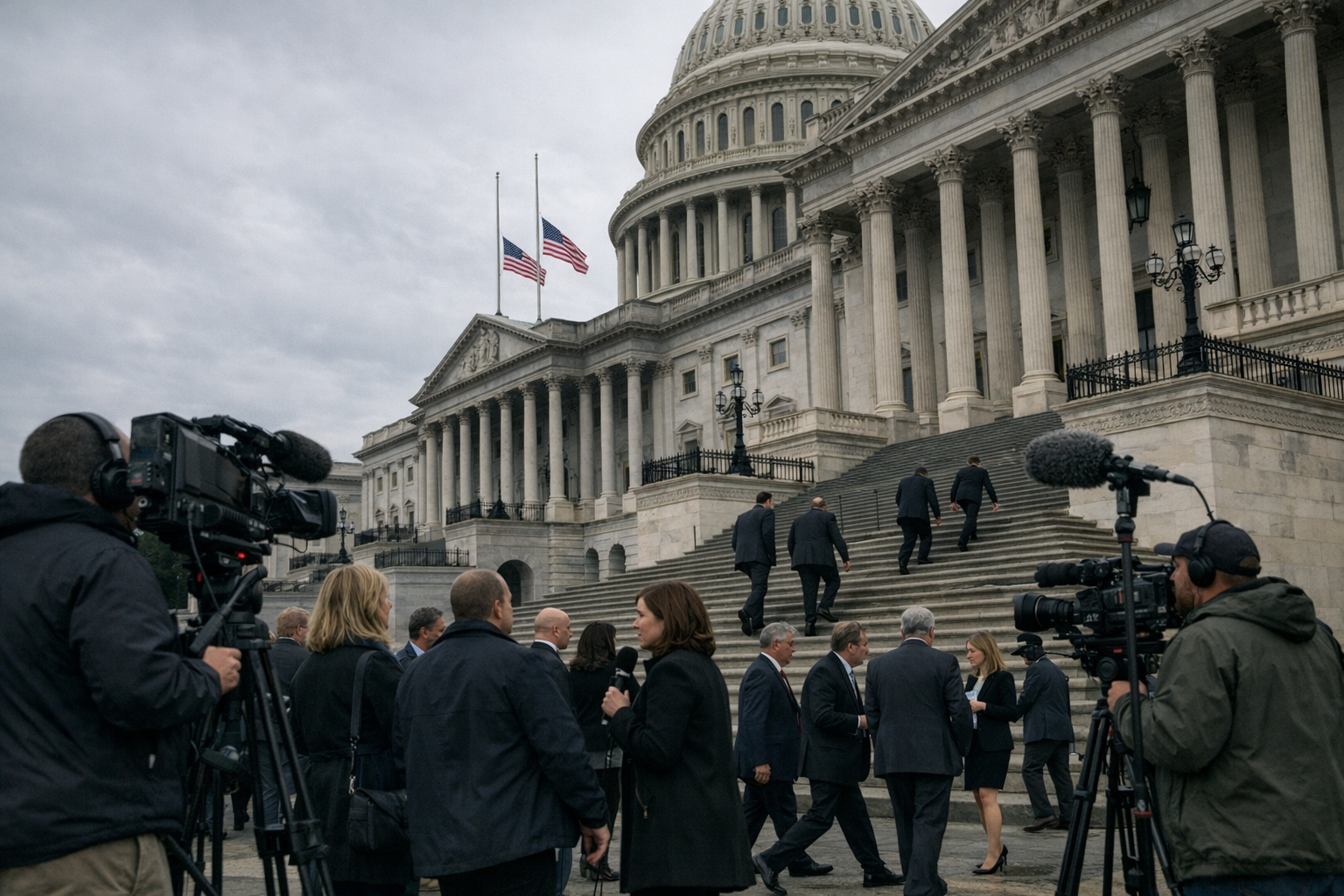
Washington was jolted over the weekend by the sudden death of Senator Lindsey Graham, the South Carolina Republican whose long career made him at once a fixture of the Capitol, a force in Republican foreign-policy debates and, in his later years, one of President Trump’s most dependable allies.
Graham, 71, died after what his office described as a brief illness, shortly after returning from a trip to Ukraine. His death set off a rush of tributes from lawmakers in both parties and from foreign leaders, particularly in Israel and Ukraine, where he had become an unusually visible American advocate.
But even as condolences poured in, the realities of power in Washington and South Carolina asserted themselves almost immediately. In the Senate, Republicans were forced to confront the loss of a veteran vote-counter, negotiator and hawk at a delicate moment in the chamber. Back home, his death opened an abrupt succession fight over a seat he had held since 2003 and had been preparing to defend again this fall.
A Republican mainstay with global reach
For more than two decades in the Senate, Graham built influence that stretched well beyond his home state. He was deeply involved in debates over military force, sanctions, judicial confirmations and the shape of Republican national-security policy. He was one of the chamber’s most outspoken advocates for a muscular American role abroad, especially in support of Israel and, after Russia’s invasion, Ukraine.
That reach was reflected in the reaction to his death. Prime Minister Benjamin Netanyahu of Israel called Graham a great friend of Israel and a close personal ally. President Volodymyr Zelensky of Ukraine praised him as a defender of freedom, underscoring how closely Graham had tied himself to Kyiv’s cause.
The praise also illuminated the complexity of his legacy. To admirers, Graham was a steadfast internationalist in a party that has increasingly wrestled with isolationist impulses. To critics, he was an enthusiastic backer of hard-line policies and interventions whose consequences were often bloody and enduring.
His political transformation at home was equally striking. Once a sharp critic of Mr. Trump during the 2016 Republican primary, Graham later became one of the president’s most loyal defenders in the Senate, helping translate Trump-era politics into legislative and foreign-policy muscle. That evolution made him a singular figure: a traditional Republican hawk who survived, and ultimately thrived, in the populist realignment of his party.
A hole in the Senate at a sensitive moment
Graham’s death comes at a particularly fraught time for Senate Republicans, who are trying to navigate a crowded legislative agenda while looking ahead to the Nov. 3 elections. His absence is more than symbolic. As a senior senator with years of relationships across factions of the party, Graham often played the role of emissary, enforcer and interpreter — especially on issues touching national security and judicial politics.
Losing him now complicates vote-counting and strategy in a chamber where margins and personalities can be decisive. Republicans must now manage not only the immediate arithmetic of a vacancy, but also the disappearance of a lawmaker who could move between Trump-world loyalty and institutional Senate bargaining with unusual ease.
His death may also sharpen internal Republican debates over America’s role overseas. Graham had been among the party’s clearest voices for sustaining support to Ukraine and maintaining an unapologetically pro-Israel line. At a moment when parts of the Republican coalition have grown more skeptical of foreign aid and intervention, his absence removes an influential advocate for the older hawkish tradition.
South Carolina’s succession scramble
The political aftershocks are likely to be felt most intensely in South Carolina, where attention has turned to Gov. Henry McMaster and the question of who will temporarily fill the vacancy.
Under South Carolina law, the governor can appoint an interim senator to serve until Jan. 3 following the next general election. The process for a special primary is expected to begin July 21, setting up a potentially swift and intensely watched contest in a state where the Republican primary is often the decisive battlefield.
Even before any formal announcement, names began circulating among South Carolina Republicans. Representative Nancy Mace has been mentioned as a possible contender, along with other prominent Republicans in the state. McMaster himself has also been drawn into speculation, though as of Monday no decision had been announced on either an appointment or the wider field.
The contest is likely to become an early test of what South Carolina Republicans want after Graham: another national-security conservative in his mold, a more combative Trump-aligned populist, or a figure able to straddle both wings of the party as he eventually did.
The end of a distinctive career
Graham had been seeking a fifth Senate term in 2026, and until this weekend he remained one of the best-known Republicans in the country — at once familiar on Sunday talk shows, influential in private negotiations and unusually active on global flash points for a senator from a safely Republican state.
In Washington, sudden political deaths often collapse public mourning and political calculation into the same moment. That is happening now with Graham. Tributes are still being written, memories are still being shared and allies abroad are still measuring the loss of a powerful friend. Yet the struggle to define what comes next — for Senate Republicans, for South Carolina and for the foreign-policy faction Graham embodied — is already underway.
His death closes one of the more improbable arcs in modern Republican politics: a senator who began as a conservative institutionalist, became an acerbic Trump critic and ended as one of the central figures linking the party’s old establishment to its newer populist era. What fills the space he leaves behind is now one of the most immediate questions in Washington.
Sources
Further reading and reporting used to add context:
- https://apnews.com/article/3a61ea0c1cf28b15660efa9338adcfee
- https://apnews.com/article/5ba55574ce6f087d56999abe3a7f9fdc
- https://www.theatlantic.com/politics/2026/07/lindsey-graham-dies-trump-ally/687894/?utm_source=apple_news
- https://www.thedailybeast.com/lindsey-grahams-death-kicks-off-succession-drama-in-south-carolina-2026-senate-race/
- https://apnews.com/article/316557edcf7cbcde3dcfe3dffcd2d566
- https://www.thedailybeast.com/keystone-kash-patel-makes-eyebrow-raising-claim-about-lindsey-grahams-death/
- https://www.axios.com/2026/07/12/lindsey-graham-nancy-mace-south-carolina-senate
- https://www.thedailybeast.com/even-older-republican-78-eyes-grahams-open-seat/
- https://apnews.com/article/30c9758bfc124c30e8e4db0e4dd719e2
- https://www.washingtonpost.com/national/2026/07/12/lindsey-graham-death-reactions/044ac566-7dd3-11f1-8a16-393bd03340b0_story.html
- https://www.theguardian.com/us-news/2026/jul/12/lindsey-graham-death-tributes
- https://www.cbsnews.com/news/lindsey-graham-us-world-leaders-pay-tribute-following-sudden-death-trump-netanyahu/
- https://www.ernst.senate.gov/news/press-releases/ernst-statement-on-passing-of-sen-graham
- https://www.crapo.senate.gov/media/newsreleases/crapo-statement-on-the-passing-of-lindsey-graham
- https://www.washingtonpost.com/politics/2026/07/12/lindsey-graham-longtime-south-carolina-senator-dies-71/
- https://www.reed.senate.gov/news/releases/reed-statement-on-the-death-of-us-senator-lindsey-graham
- https://www.padilla.senate.gov/newsroom/press-releases/padilla-statement-on-the-passing-of-senator-lindsey-graham/
- https://www.lummis.senate.gov/press-releases/lummis-statement-on-the-death-of-senator-lindsey-graham/
- https://www.ajc.org/news/ajc-statement-on-the-death-of-senator-lindsey-graham
- https://www.cbsnews.com/news/lindsey-graham-process-for-filling-vacancy-in-the-senate-south-carolina/
- https://www.washingtonpost.com/politics/2026/07/12/lindsey-graham-dies-south-carolina/ead388fe-7dbc-11f1-b194-f872dd4ec5aa_story.html
- https://en.wikipedia.org/wiki/2026_United_States_Senate_election_in_South_Carolina
- https://law.justia.com/codes/south-carolina/title-7/chapter-19/section-7-19-20/
- https://www.senate.gov/about/origins-foundations/electing-appointing-senators/vacancies.htm
- https://www.scstatehouse.gov/sess126_2025-2026/prever/841_20260121.htm
- https://www.scstatehouse.gov/sess126_2025-2026/bills/922.htm
- https://www.scstatehouse.gov/sess126_2025-2026/bills/38.htm
- https://www.scstatehouse.gov/Archives/CodeofLaws2018/t07c019.php
- https://www.scstatehouse.gov/sess126_2025-2026/sj26/20260331.htm
- https://www.senate.gov/about/origins-foundations/electing-appointing-senators.htm
- Lindsey Graham dies after ‘sudden illness’; Trump says S.C. senator like family – The Washington Post
- Senate returns to Washington after Sen. Lindsey Graham's death with uncertain agenda
- Who could replace Lindsey Graham? South Carolina's next steps after senator's death