
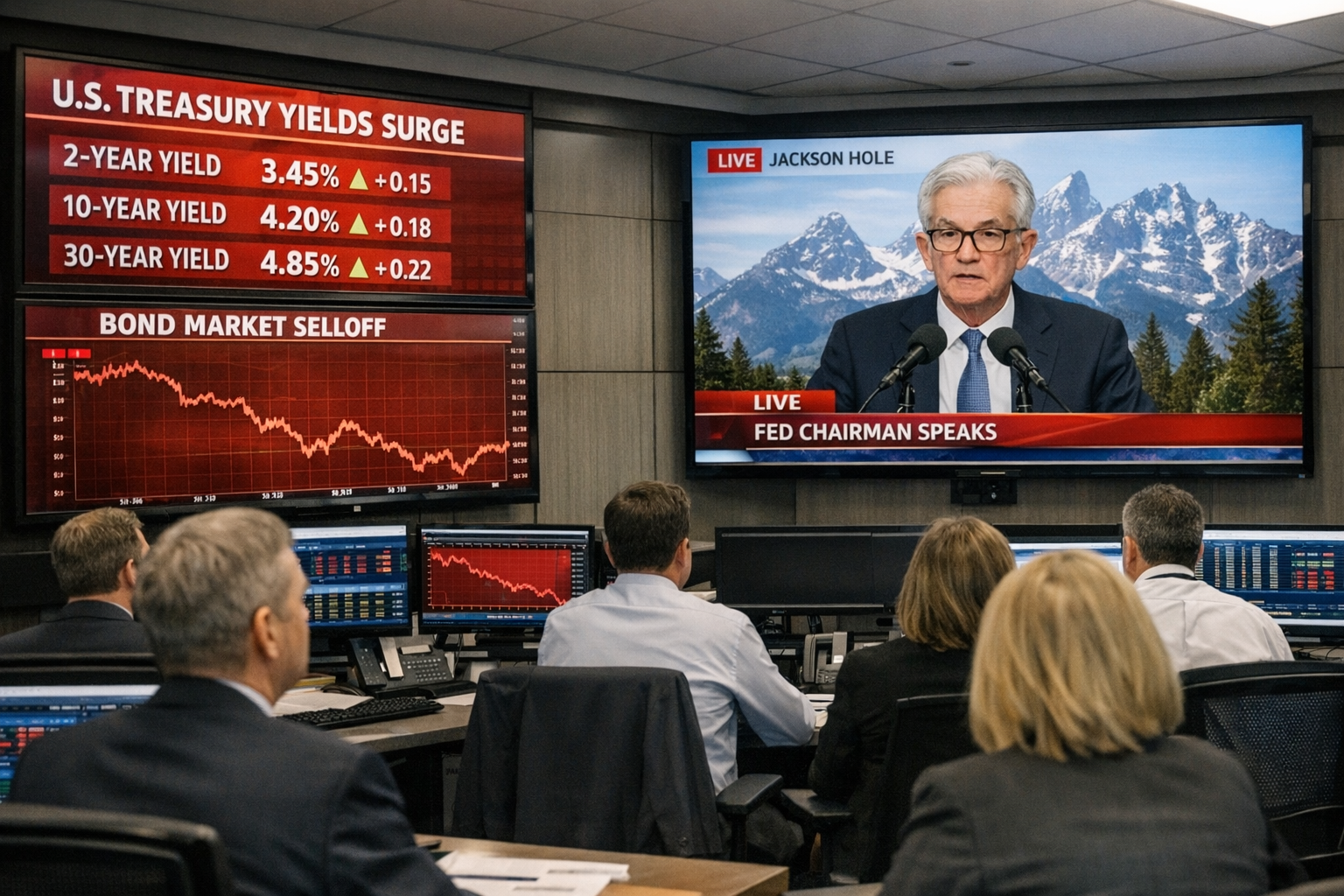
Fed Chair’s Jackson Hole Debut Sends a Clearer Warning on Inflation
Federal Reserve Chair Kevin Warsh used his first appearance at the central bank’s annual Jackson Hole conference on Friday to deliver his strongest signal yet that interest rates could still move higher, jolting bond markets and reviving expectations that policymakers may tighten again as soon as next month.
After weeks of uncertainty about how aggressively Mr. Warsh intended to confront stubborn price pressures, investors seized on a blunt message: inflation remains too high, the Federal Reserve’s job is to restore price stability, and officials may still “have work to do” if progress toward the central bank’s 2 percent target does not come “clearly and at sufficient speed.”
The reaction was swift. Short-dated Treasury yields jumped, led by the policy-sensitive 2-year note, as traders increased bets that the Fed could raise rates at its Sept. 15-16 meeting. The shift suggested that markets, which had recently drawn comfort from some softer economic readings, were forced to reconsider whether the central bank is anywhere near declaring victory over inflation.
A More Explicit Reaction Function
Mr. Warsh’s remarks were closely watched not simply because Jackson Hole often serves as a stage for major policy signals, but because they followed a confusing stretch of Fed communication in which investors struggled to pin down his reaction function.
At a July news conference, market participants came away uncertain about how much weight he was placing on sticky inflation versus signs of moderation elsewhere in the economy. On Friday, he was markedly more direct.
He underscored that annual personal consumption expenditures inflation, the Fed’s preferred gauge, is running at 3.7 percent, with the six-month pace at 4.1 percent — both well above target. He said recent improvements had not shown that underlying inflation trends had “meaningfully improved,” a formulation that markets interpreted as a warning against complacency.
He also stressed that short-term interest rates remain the Fed’s principal tool and indicated that he saw little evidence that current financial conditions are meaningfully restrictive. That point carried particular weight on Wall Street: if policymakers do not believe policy is yet sufficiently constraining demand, the threshold for another rate increase may be lower than investors had assumed.
Why Markets Moved
The sell-off in short-dated Treasuries reflected more than a parsing of tone. It amounted to a repricing of the path of monetary policy.
Yields on shorter-maturity government bonds are highly sensitive to expectations for the Fed’s benchmark rate. When traders hear a central bank chief signal that inflation remains uncomfortably elevated and that existing policy may not be restrictive enough, they tend to push up yields and reassess the odds of further tightening.
That matters because higher short-term yields ripple across the economy, raising borrowing costs for businesses and households and tightening financial conditions even before the Fed acts. Friday’s market move therefore represented both a response to Mr. Warsh’s words and an extension of the policy effect those words were intended to produce.
The speech was especially consequential because it came at a moment when investors had begun to debate whether softer recent data might allow the Fed to stay on hold. Mr. Warsh did not close the door to that outcome, but he made clear that inflation, not market hopes for relief, remains the central bank’s priority.
Inflation, Politics and the Next Decision
The Fed’s dilemma has become more acute as inflation has proved more persistent than many officials and investors expected. While price growth has eased from its peaks, it remains well above the level the central bank considers consistent with long-run stability. Mr. Warsh’s warning suggested that policymakers are wary of repeating past mistakes by easing up too soon.
His stance could also introduce tension beyond financial markets. Calls for lower interest rates have grown louder in Washington, where easier borrowing conditions are often favored for political and economic reasons. A decision to tighten further — or even to maintain an openly hawkish posture — could place the Fed at odds with parts of the broader policy apparatus pressing for relief.
For now, though, the central question is less political than economic: whether the next round of data will justify action.
Before the September meeting, policymakers will receive fresh readings on inflation, job growth and unemployment. Those reports are likely to determine whether Friday’s warning becomes a concrete move. If inflation remains sticky and the labor market stays firm, the case for another hike will strengthen. If price pressures cool convincingly, officials may still choose to wait.
Why Jackson Hole Mattered This Time
Fed chairs have often used Jackson Hole to shape expectations rather than announce immediate decisions, and Mr. Warsh’s debut fit that tradition. But unlike a purely academic address, Friday’s speech had an immediate effect because it answered a pressing question hanging over markets: whether the new chair would tolerate inflation running above target for longer or would lean toward renewed restraint.
His answer, at least for now, was unmistakable. The Fed is not ready to declare the inflation fight over, and investors who had hoped otherwise were reminded that a few softer numbers are not enough to change the central bank’s course.
With the September meeting approaching, Mr. Warsh has moved the debate from whether he would clarify his stance to whether the economy will force him to act on it.
Sources
Further reading and reporting used to add context:
- https://www.axios.com/2026/08/28/kevin-warsh-federal-reserve-jackson-hole
- Fed Chair Warsh signals interest rate hikes are on the table if inflation does not retreat | AP News
- https://apnews.com/article/fa718f6f57b0be019a27c88b01df526d
- https://apnews.com/article/0a655f1c042b059279343443d5802907
- https://www.axios.com/newsletters/axios-am-709c0f20-3279-4586-9151-d0110f2accb4
- https://www.theguardian.com/business/2026/aug/28/kevin-warsh-federal-reserve-inflation
- Keynote remarks by Chairman Warsh at the 2026 Jackson Hole Economic Policy Symposium – Federal Reserve Board
- https://www.federalreserve.gov/newsevents.htm
- https://www.theguardian.com/business/series/guardian-business-live/2026/aug/28/all
- https://www.kitco.com/news/off-the-wire/2026-08-28/equities-rise-2-year-yields-dollar-rate-hike-bets-rise-following-warsh
- https://www.marketscreener.com/news/rate-hike-expectations-rise-on-warsh-speech-at-jackson-hole-ce7858dfde8af62d
- https://www.investing.com/news/economy-news/will-warshs-jackson-hole-speech-be-a-course-correction-or-detour-4880496
- https://www.cbsnews.com/news/kevin-warsh-fed-speech-jackson-hole-inflation/
- https://www.marketscreener.com/news/will-warsh-s-jackson-hole-speech-be-a-course-correction-or-detour-ce7858dfdb8bf62c
- https://www.investing.com/news/economy-news/morning-bid-warsh-heads-into-jackson-hole-hot-seat-4880488
- https://www.washingtonpost.com/business/2026/08/28/fed-chair-warsh-speaks-jackson-hole-conference/
- https://www.boursorama.com/actualite-economique/actualites/texte-discours-de-kevin-warsh-president-de-la-fed-lors-du-symposium-de-jackson-hole-0f58353f664f15c1492683e8f9845ed5
- https://www.reddit.com/r/InnerCircleInvesting/comments/1vyzo1e/market_digest_82626_market_random_shots/
- https://www.reddit.com/r/stockpicksdaily/comments/1w0ukrk/fed_chair_warsh_just_opened_the_door_to_a_rate/