
The trade fight between the United States and Canada has moved beyond customs schedules and into the realm of national symbolism, deepening anxiety along one of the world’s most economically intertwined borders.
Days after trade talks collapsed and the two countries exchanged plans for sweeping new tariffs, President Trump signed an executive order directing federal agencies to refer to Lake Ontario as “Lake America” in official U.S. usage. The order, issued on Thursday, cannot force Canada, international mapmakers or foreign governments to adopt the new name. But it added a fresh provocation to a dispute already unsettling manufacturers, border communities and political leaders on both sides of the frontier.
What began as another round of trade retaliation is now reverberating through the Detroit-Windsor corridor, where factories, warehouses and auto plants have long operated less like separate national economies than as parts of a single industrial system. It is also spilling into electoral politics, becoming a live issue in Michigan races and in Canada, where leaders have cast the latest moves as a challenge not just to commerce but to sovereignty.
A dispute expands
The immediate rupture came after U.S.-Canada trade talks broke down on Aug. 21 and 22. The United States then imposed 50 percent tariffs on about $20 billion of Canadian goods. Canada answered with dollar-for-dollar retaliatory tariffs on roughly $20 billion of American imports, set to begin taking effect Sept. 8 unless negotiations resume.
Mr. Trump has also threatened a far more consequential step: 50 percent tariffs on Canadian cars, trucks and auto parts starting Jan. 1, 2027. That prospect has alarmed business leaders because of how thoroughly the North American auto industry depends on cross-border production. Auto parts can cross the U.S.-Canada border multiple times before a finished vehicle is assembled, meaning each new tariff layer risks magnifying costs for manufacturers and, eventually, consumers.
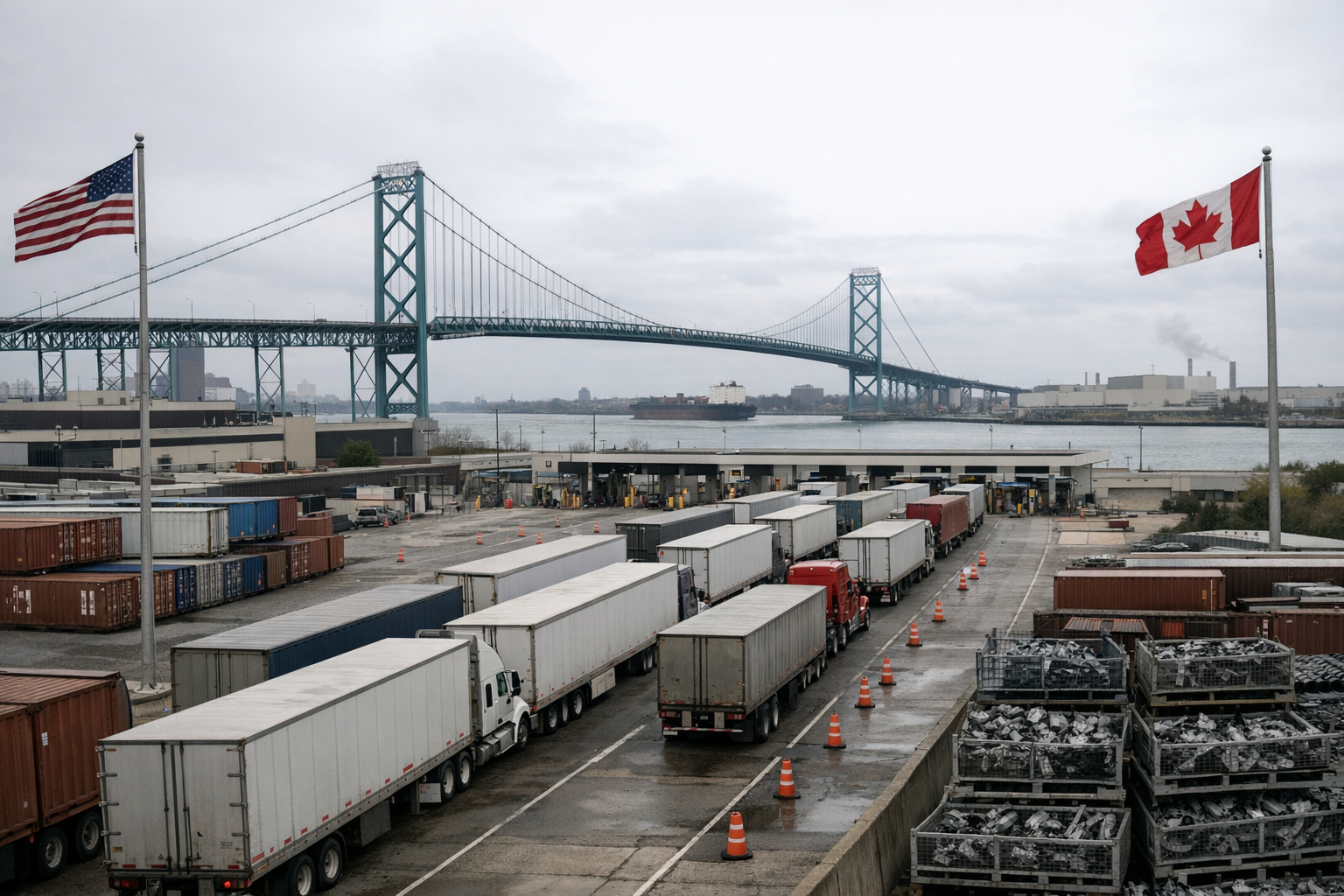
In the Detroit-Windsor region, that interdependence is visible every day. Roughly $1 billion in goods crosses the river separating Michigan and Ontario daily, much of it tied to automotive manufacturing. Engines, stamped metal, electronics and unfinished components move back and forth in a tightly timed choreography that has evolved over decades.
For workers and executives there, the concern is not abstract. A tariff aimed at Canada can quickly become a cost borne in Michigan or Ohio, especially when parts are repeatedly shipped across the border during production. Companies may absorb some of those costs for a time, but prolonged uncertainty can delay investment, squeeze suppliers and threaten jobs in communities that depend on the industry.
Symbolism and sovereignty
The order to rename Lake Ontario added a different kind of pressure point. The lake is shared by the United States and Canada, and Washington’s authority extends only to how federal agencies describe it in American documents, maps and databases. Still, the gesture was widely interpreted as an attempt to inject patriotic symbolism into a trade conflict that has already frayed one of Washington’s closest alliances.
Canadian leaders swiftly rejected the move, framing it as both unserious and intrusive. The episode underscored how the dispute is increasingly being fought not only through tariffs and legal authorities, but through public spectacle.
That matters because symbolism can harden political positions even when both sides have strong economic reasons to compromise. Once a trade disagreement becomes entwined with questions of national pride, backing down becomes more difficult for elected leaders in both countries.
Why Detroit is especially exposed
No American city may feel the strain more acutely than Detroit. The city and neighboring Windsor helped build the modern North American auto economy, and their fortunes remain closely linked. The Ambassador Bridge and the Detroit-Windsor Tunnel are not simply border crossings; they are industrial lifelines.
The United States and Canada traded about $872 billion in goods and services last year, making Canada America’s second-largest trading partner. Much of that commerce is concentrated in sectors — autos, metals, energy and agriculture — where supply chains are integrated and where tariffs can ripple outward quickly.
For Detroit, the danger is that a policy intended to punish Canada ends up punishing the very Midwestern manufacturing base politicians often promise to protect. Industry executives have warned for years that sudden tariff shocks can scramble sourcing decisions and weaken the competitiveness of North American producers against rivals in Europe and Asia.
That risk has taken on added political significance as midterm campaigns gather force in Michigan, where control of Congress could be shaped by a handful of competitive races. In a state where manufacturing remains central to the economy and identity, rising costs, layoffs or idled production lines could turn a trade strategy into an electoral liability.
What comes next
The next inflection point is Sept. 8, when Canada’s retaliatory tariffs are set to begin. Before then, the central question is whether negotiations can restart and prevent the latest measures from taking hold.
Beyond that looms the much larger threat of auto tariffs in 2027. Many businesses are treating that deadline as uncertain, not least because previous rounds of trade pressure were delayed, narrowed or partly softened by exemptions connected to the U.S.-Mexico-Canada Agreement. But the collapse of the latest talks has reopened a conflict many companies had hoped was containable.
The legal impact of the Lake Ontario order is narrower than its political impact. It may alter federal terminology inside the United States, but it does not rewrite geography for Canada or the rest of the world. Yet as a symbol, it is potent enough to reinforce the sense that the dispute is no longer merely about market access or tariff schedules.
For now, the broadest consequence may be a growing realization in both countries that a rupture once treated as temporary is becoming structural. Along the Detroit River, where the border has long functioned as a seam binding two economies together, that prospect feels especially ominous.
Sources
Further reading and reporting used to add context:
- https://www.axios.com/2026/08/27/trump-lake-ontario-lake-america
- https://www.axios.com/2026/08/27/trump-lake-ontario-america-democrats-bill
- https://www.thedailybeast.com/trump-takes-canada-feud-to-new-level-with-bonkers-power-grab/
- https://www.thedailybeast.com/fox-host-trey-gowdy-finds-bonkers-problem-with-donald-trumps-anti-canada-lake-rename/
- https://www.thedailybeast.com/cnn-data-guru-exposes-trumps-embarrassing-lake-problem/
- https://www.thedailybeast.com/trump-gets-a-humiliating-history-lesson-over-his-lake-name-change/
- https://apnews.com/article/65bbd47925365ffd5d9522cf4b2e4bc8
- https://apnews.com/article/3ac58dca0ca83c15605d4dbff146b28a
- https://www.axios.com/2026/08/25/trump-french-language-canada-lake-ontario
- https://apnews.com/article/857ef76b20a766e370d70176135b678e
- https://www.thedailybeast.com/trumps-attempted-lake-ontario-sharpie-troll-immediately-backfires/
- https://www.whitehouse.gov/presidential-actions/2026/08/honoring-the-american-history-of-the-great-lakes-and-renaming-lake-ontario-as-lake-america/
- https://www.investing.com/news/world-news/trump-signs-order-to-rename-lake-ontario-as-lake-america-4879975
- https://www.whitehouse.gov/presidential-actions/executive-orders/
- https://www.whitehouse.gov/presidential-actions/
- https://www.investing.com/news/world-news/trump-threatens-to-change-the-name-of-lake-ontario-to-lake-america-amid-canada-trade-war-4875491
- https://www.whitehouse.gov/presidential-actions/2026/08/declaring-a-national-emergency-to-secure-the-united-states-bulk-power-system/
- https://www.investing.com/news/stock-market-news/exclusivedetroit-automakers-fear-north-american-trade-deal-revamp-could-cost-them-billions-4858794
- https://www.whitehouse.gov/presidential-actions/?s=America+First
- https://www.whitehouse.gov/presidential-actions/executive-orders/?s=energy
- https://www.whitehouse.gov/fact-sheets/2026/08/fact-sheet-president-donald-j-trump-declares-a-national-emergency-to-secure-americas-bulk-power-system/
- https://www.ksl.com/article/51615882/lake-america-trump-mulls-renaming-lake-ontario-expresses-love-for-french-canadians-amid-trade-war
- https://www.washingtonpost.com/politics/2026/08/25/trump-says-us-could-rename-lake-ontario-amid-canada-trade-war/
- https://apnews.com/article/dc7a63a6f455fa35d207a543b64c4706
- https://apnews.com/article/95f59e3ab09f5ee0e68349530ff8c8ea
- https://apnews.com/article/42aad2063ac401f9f554c14bc4ade52d
- Trump's tariffs strain US-Canada ties as taxes hit both economies | AP News
- https://apnews.com/article/3bf0ca9421116797fe20b91a9d097116
- https://apnews.com/article/4f0d3e8f6945cd941cb50972fb657465
- Detroit despairs as ‘insanity’ of Trump’s Canada trade war punishes city | Trump tariffs | The Guardian
- https://www.local10.com/business/2026/07/27/trump-defends-his-tariffs-during-michigan-visit-even-as-businesses-say-theyve-hurt-the-state/
- https://www.michiganpublic.org/politics-government/2026-07-27/trump-defends-his-tariffs-during-michigan-visit-even-as-businesses-say-theyve-hurt-the-state
- https://www.investing.com/news/economy-news/canada-cancels-joint-bridge-celebration-with-us-citing-trump-trade-threats-4804419
- https://www.washingtonpost.com/opinions/2026/02/04/michigan-tariffs-trade-war-canada/
- https://www.reutersconnect.com/item/refile-archive-us-canada-fail-to-reach-a-trade-deal/dGFnOnJldXRlcnMuY29tLDIwMjY6bmV3c21sX1ZBNzE2MzIyMDgyMDI2UlAx
- https://www.investing.com/news/world-news/new-us-canada-bridge-to-open-soon-michigan-republican-says-4786914
- https://nz.news.yahoo.com/auto-tariffs-permanent-roadblock-canada-212228007.html
- https://www.kitco.com/news/off-the-wire/2026-07-24/canada-mark-gordie-howe-bridge-opening-without-us-after-trade-war
- https://www.washingtonpost.com/politics/2026/07/30/trump-michigan-midterms-tariffs-automakers/75567678-8bcb-11f1-8912-d71e69d679d7_story.html
- https://www.reddit.com/r/Detroit/comments/1w0pede/detroit_despairs_as_insanity_of_trumps_canada/
- https://www.local10.com/news/politics/2026/08/24/trump-tells-canada-to-fall-in-line-as-carney-rejects-subordination/
- https://www.inquirer.com/politics/trump-michigan-economic-policy-tariffs-canada-auto-industry-midterms-20260727.html
- https://apnews.com/article/1616459c119d88549b9be8068601aea3
- https://apnews.com/article/4d18583fe52134ca8550652ad9772d2c
- https://apnews.com/article/a180ac85a70bbfb512ea59c224cb6c31
- https://www.axios.com/2026/08/22/us-canada-tariffs-trade-trump-carney
- https://theweek.com/politics/trump-canada-tariffs-trade-war-carney
- https://www.thedailybeast.com/white-house-roasted-after-embarrassing-canada-fail/
- https://www.thedailybeast.com/trump-triggers-republican-panic-as-midterms-near/
- https://www.investing.com/news/economy-news/canada-announces-20-billion-retaliatory-tariffs-on-us-goods-unveils-support-measures-4875679
- https://www.spglobal.com/market-intelligence/en/news-insights/articles/2026/8/us-canada-trade-talks-collapse-as-50-tariffs-take-effect-105309975
- https://www.investing.com/news/stock-market-news/trump-threatens-tariffs-on-all-cars-and-trucks-to-50-amid-canada-trade-spat-4873756
- https://www.investing.com/news/world-news/canada-to-impose-retaliatory-tariffs-across-a-raft-of-us-sectors-carney-says-4872377
- https://www.investing.com/news/commodities-news/us-canadian-trade-teams-to-meet-again-as-tariffs-deadline-looms-4871745
- https://www.reutersconnect.com/item/trump-wants-canada-to-negotiate-in-good-faith-bessent/dGFnOnJldXRlcnMuY29tLDIwMjY6bmV3c21sX1ZBNzU2NDI0MDgyMDI2UlAx
- https://www.reutersconnect.com/item/trump-says-canada-wants-us-state-benefits-as-trade-war-escalates/dGFnOnJldXRlcnMuY29tLDIwMjY6bmV3c21sX09XQ1ZNQzQ0NDk1NS1WSURFTw
- https://www.reutersconnect.com/item/uncaptioned-trump-says-canada-wants-us-state-benefits-as-trade-war-escalates/dGFnOnJldXRlcnMuY29tLDIwMjY6bmV3c21sX09XQ1ZNQzQ0NTAyNC1WSURFTw
- https://www.spglobal.com/energy/en/news-research/latest-news/metals/082426-trump-vows-tariff-retaliation-in-escalating-trade-dispute-with-canada
- https://www.marketscreener.com/news/lake-america-we-ll-stick-to-lake-ontario-says-canada-s-carney-ce7858dfdd89f12c
- https://ca.marketscreener.com/news/canada-announces-20-bln-retaliatory-tariffs-on-u-s-goods-unveils-support-measures-ce7858d8dd81f620
- https://apnews.com/article/810649a0a4143d9042094626c4a36dad
- https://apnews.com/article/c3d2461184a2b8656abd01376452e0d5
- https://apnews.com/article/3228ac85fefbddee31cbb9481ec42a2a
- https://www.axios.com/2026/08/24/canada-trade-inflation
- https://theweek.com/world-news/canada-retaliatory-tariffs-us-politics
- https://www.theatlantic.com/ideas/2026/08/why-us-canada-trade-talks-fell-apart/688386/?utm_source=apple_news
- https://www.thedailybeast.com/murdoch-paper-savages-trump-for-making-his-dumbest-plan-even-dumber/
- https://www.theguardian.com/world/canada
- https://www.theguardian.com/world/2026/aug/26/wednesday-briefing-how-canada-has-turned-a-trade-dispute-into-a-defence-of-its-sovereignty
- https://www.theguardian.com/world/americas/2026/aug/28/all
- https://www.theguardian.com/commentisfree/2026/aug/25/canadians-trade-war-bullied-donald-trump-alliance-rupture
- https://wtop.com/national/2026/07/trump-is-set-to-defend-his-economic-policies-in-michigan-where-new-canadian-tariffs-may-sting/
- https://www.theguardian.com/world/canada/2026/aug/25/all
- https://www.michiganpublic.org/politics-government/2026-07-27/trump-is-set-to-defend-his-economic-policies-in-michigan-where-new-canadian-tariffs-may-sting
- https://www.washingtonpost.com/business/2026/07/27/trump-michigan-tariffs-economy-midterms-gm/ae827700-89a8-11f1-8912-d71e69d679d7_story.html
- US hits Canadian goods with 50% tariffs after trade talks fail By Reuters
- Trump threatens 50% tariffs on all cars and trucks from Canada amid trade fight By Reuters