
Britain’s Air Travel Network Buckles Again
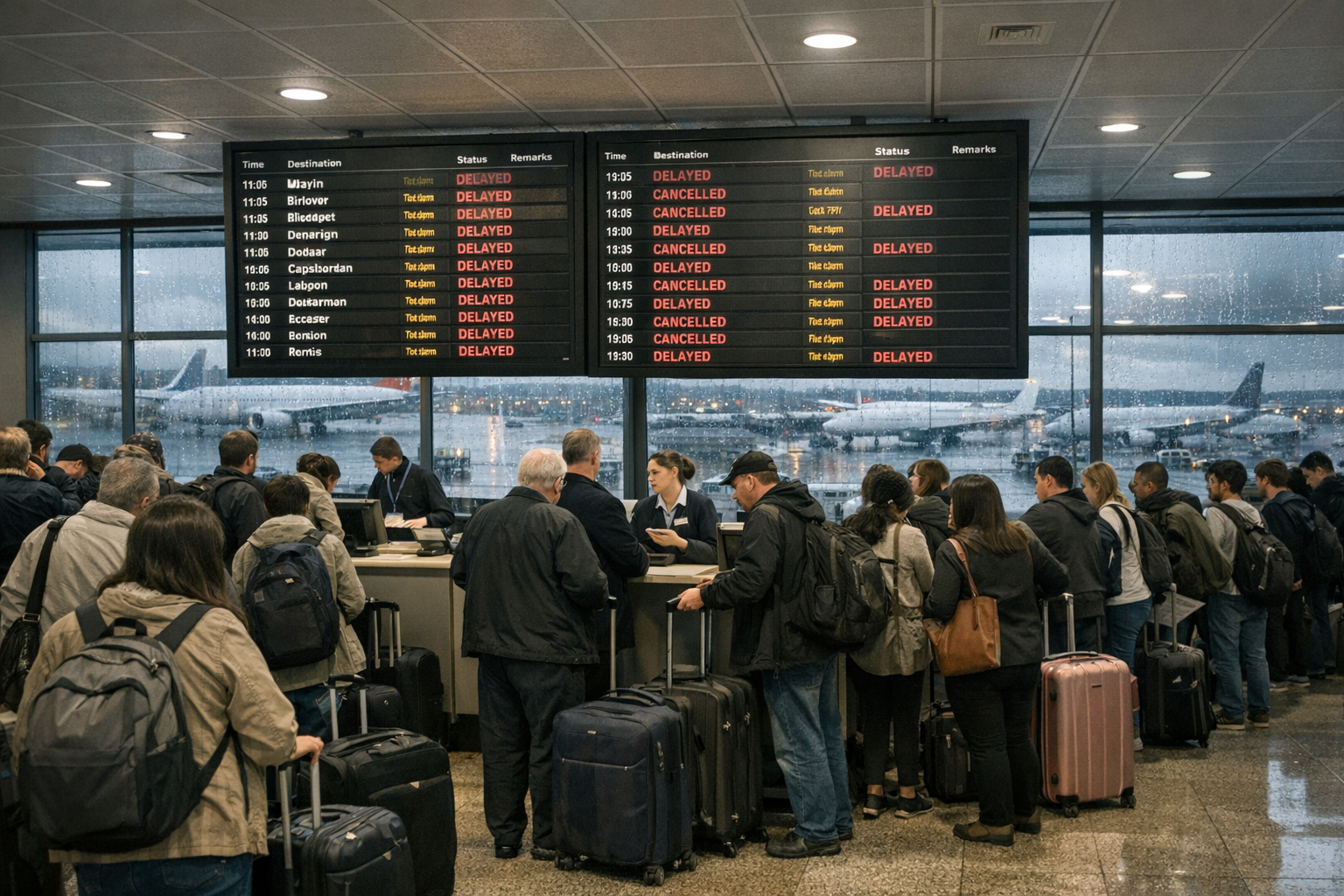
Britain’s air travel system lurched into a second day of disruption on Wednesday after a technical failure at the country’s air traffic control provider forced mass cancellations, stranded hundreds of thousands of passengers and drew the personal intervention of the transport secretary.
The breakdown, centered on NATS, the private company that manages most of Britain’s airspace, began on Tuesday afternoon and rippled across the country’s busiest airports, including Heathrow, Gatwick, Manchester and Birmingham. Although the immediate fault was resolved within hours, the disruption did not end there. Airlines spent Wednesday scrambling to reposition aircraft and crews, while travelers faced long lines, missed connections and uncertain departures.
By Wednesday, cancellations had passed 1,900, with Heathrow particularly badly affected. The airport said flights were operating again, but warned that delays and disruption would continue as carriers tried to restore their schedules.
The latest failure quickly became more than an operational headache. It has opened a fresh round of political scrutiny over the resilience of Britain’s air traffic infrastructure and sharpened questions about whether NATS’s leadership can withstand another high-profile collapse.
Political Pressure Mounts on NATS
Heidi Alexander, the transport secretary, summoned Martin Rolfe, NATS’s chief executive, for an explanation as criticism intensified from both ministers and airlines. Mr. Rolfe has been pressed to account for what carriers described as yet another unacceptable failure in a system on which millions of passengers depend.
Speaking on Wednesday, Mr. Rolfe said that NATS had, “at this point,” ruled out a cyberattack. But the company has not yet publicly provided a full technical explanation for what caused the outage, leaving open the question of whether the problem stemmed from software, hardware or a deeper weakness in the system’s safeguards.
That uncertainty has fueled anger in the airline industry. Budget carriers including Ryanair and Wizz Air have publicly called for accountability, with some demanding management changes and others arguing that the latest breakdown shows a need for broader structural reform.
Their frustration reflects a wider fear in aviation: that repeated failures are eroding confidence in a critical part of the country’s transport network, particularly at a time when airports and airlines are operating under intense schedule pressure and high passenger demand.
A Familiar Pattern of Failure
This week’s outage is being treated as at least the third major NATS-related disruption in just over three years, reviving concerns that were never fully settled after previous incidents.
In August 2023, a flight-planning system failure caused widespread disruption across British airspace, prompting investigations and intense criticism from airlines and travelers. Then, in July 2025, another radar-related disruption again raised alarms about the system’s resilience.
After the 2023 breakdown, the Civil Aviation Authority reviewed NATS’s handling of the crisis and said stronger contingency planning was needed. In the wake of this week’s latest failure, the regulator said it expects a full report and will consider whether further action is necessary to secure the reliability of the system.
That history matters because each new outage deepens doubts about whether lessons from previous failures have truly been absorbed. What might once have been seen as an isolated malfunction is now being judged against a pattern.
Passengers Face Delays, but Limited Compensation
For passengers, the practical consequences remain immediate. Under British and retained European air passenger rules, airlines must offer travelers a choice between rerouting and a refund when flights are canceled. Carriers also have a duty of care, meaning they must provide meals, accommodation where necessary, and transport to and from hotels during extended delays.
But compensation is a separate matter, and many passengers caught up in this week’s disruption may find they are not entitled to it. If the failure is ultimately classified as an “extraordinary circumstance” outside the airline’s control, carriers would generally not have to pay the standard fixed compensation that often applies in ordinary cancellations.
That distinction is likely to become a source of frustration. Travelers may still be reimbursed for hotel rooms, food or alternative transport if airlines fail to provide them, but they may not receive additional compensation for the disruption itself.
Why This Breakdown Matters Now
The scale of this week’s chaos has exposed how vulnerable modern air travel remains to a single systems failure. Even a problem lasting only a few hours can trigger a far longer cycle of missed aircraft rotations, displaced crews and overnight cancellations that spreads well beyond the original outage.
For the government, the episode lands at a politically difficult moment. Britain’s infrastructure resilience has become a broader public concern, and ministers now face pressure to show that essential national systems — even those operated by private or quasi-private entities — are robust enough to withstand technical failure.
For NATS, the stakes are even higher. The company must now explain not only what happened, but why repeated breakdowns continue to occur despite earlier warnings. Whether that leads to regulatory action, management changes or a broader overhaul of Britain’s air traffic control system may depend on what investigators uncover in the days ahead.
For now, the immediate task is recovery. But the larger question hanging over Britain’s airports is whether this was another unfortunate malfunction — or evidence of a system no longer capable of delivering the reliability that modern aviation demands.
Sources
Further reading and reporting used to add context:
- https://apnews.com/article/f0f69ef27a90c9d0455ebf54f0998df3
- https://www.caa.co.uk/newsroom/news/consumer-travel-advice-summer-2026
- https://www.theguardian.com/world/2026/sep/09/uk-flight-cancellations-nats-martin-rolfe-heidi-alexander
- https://www.caa.co.uk/air-passengers/travel-problems-and-rights/flight-delays-and-cancellations/cancellations/?hl=en-GB
- https://www.caa.co.uk/air-passengers/travel-problems-and-rights/flight-delays-and-cancellations/delays/
- https://www.lse.co.uk/news/uk-nats-ceo-rolfe-rules-out-cyber-attack-as-cause-of-air-traffic-control-issue-ejj71wwbrvpttn2.html
- https://www.caa.co.uk/air-passengers/travel-problems-and-rights/flight-delays-and-cancellations/
- https://www.caa.co.uk/air-passengers/travel-problems-and-rights/airline-and-travel-company-problems/airline-suspensions/
- https://skywise.caa.co.uk/alerts/?page_no=1
- https://www.caa.co.uk/data-and-publications/publications/documents/content/cap1126/
- https://www.caa.co.uk/commercial-industry/airlines/guidance-on-consumer-law-for-airlines-and-airports/
- https://au.marketscreener.com/news/uk-summons-air-traffic-boss-after-major-outage-as-flights-slowly-resume-ce785bd9da8cf527
- https://www.caa.co.uk/air-passengers/travel-problems-and-rights/travel-complaints/how-the-caa-can-help/
- https://www.caa.co.uk/media/etrlbfw1/guidance-to-industry-atc-incident_.pdf
- https://www.caa.co.uk/publication/download/15012
- https://www.caa.co.uk/media/tugfmyj4/joint-letter-disruption.pdf
- https://cadenaser.com/nacional/2026/09/08/solucionado-el-problema-de-trafico-aereo-que-ha-obligado-a-cancelar-mas-de-400-vuelos-y-ha-provocado-retrasos-en-reino-unido-cadena-ser/
- https://www.caa.co.uk/publication/download/21481
- https://www.caa.co.uk/media/akqfqyxo/aviation-trends-2025-q4.pdf
- https://elpais.com/internacional/2026-09-08/una-averia-en-el-sistema-de-control-aereo-provoca-la-cancelacion-de-400-vuelos-en-el-reino-unido.html
- https://apnews.com/article/a630becb86a2d1c0a2db6605baad0adc
- https://www.heathrow.com/arrivals/terminal-3/flight-details/BA789/08-09-2026
- https://prod.gk.heathrow.com/arrivals/first-time-in-britain
- https://www.heathrow.com/heathrow-blog?src=IN-WF19-HRW002
- https://www.nats.aero/wp-content/uploads/2024/06/AR-24.pdf
- https://www.heathrow.com/company/local-community/noise/data/operational-data/daily-operational-data/daily-operational-data-report
- https://www.nats.aero/wp-content/uploads/2024/06/2024-FinancialStatements.pdf
- https://prod.gk.heathrow.com/transport-and-directions/heathrow-parking/heathrow-park-and-ride
- https://nsf.nats.aero/commercial-aircraft/
- https://prod.gk.heathrow.com/transport-and-directions/heathrow-parking
- https://forms.nats.aero/
- https://nsf.nats.aero/drones-and-model-aircraft/
- https://www.heathrow.com/heathrow-blog?CMP=LP-IAPBBA023
- https://nsf.nats.aero/contact-us/
- https://www.nats.aero/wp-content/uploads/2025/06/NATS-En-Route-plc-2025-signed-EY.pdf
- https://nsf.nats.aero/
- https://www.nats.aero/wp-content/uploads/2024/06/AR-2024.pdf
- https://apnews.com/article/408a8997d9fb39508e922e09d2523884
- https://quews.news/uk-summons-air-traffic/
- https://www.thenationalnews.com/business/aviation/2026/09/09/second-day-of-chaos-at-uk-airports-after-air-traffic-control-glitch/
- https://www.lse.co.uk/news/uk-flights-resume-after-major-air-traffic-outage-but-airports-warn-of-more-disruption-c4rskibxptw7ge1.html
- https://live.euronext.com/en/financial-news/uk-flights-resume-airports-warn-ongoing-disruption-air-traffic-outage
- https://www.ksl.com/article/51621412/air-traffic-control-issue-disrupts-departing-flights-at-major-uk-airports
- https://www.investing.com/news/stock-market-news/air-traffic-control-issue-disrupts-departing-flights-at-major-uk-airports-4891986
- https://www.lse.co.uk/news/uk-flights-resume-but-airports-warn-of-ongoing-disruption-from-air-traffic-outage-1ukeiz50zx7taei.html
- https://www.gulf-times.com/article/732880/international/ukeurope/air-traffic-control-issue-disrupts-flights-at-major-uk-airports/amp
- https://www.marketscreener.com/news/uk-flights-resume-but-airports-warn-of-ongoing-disruption-from-air-traffic-outage-ce785bd9da89f521
- https://theprint.in/world/uk-flights-resume-but-airports-warn-of-ongoing-disruption-from-air-traffic-outage/3037770/
- https://www.reddit.com/r/aircanada/comments/1wapxxv/atc_issues_uk_flights_grounded/
- https://www.reddit.com/r/BritishAirways/comments/1wb1cvw/anyone_have_luck_getting_a_new_flight_booked/
- https://www.caa.co.uk/data-and-publications/publications/documents/content/cap2993c/
- https://www.caa.co.uk/publication/download/23340
- https://www.marketscreener.com/news/air-traffic-control-issue-disrupts-departing-flights-at-major-uk-airports-ce785bd8df81fe26
- https://www.caa.co.uk/data-and-publications/publications/documents/content/cap2993/
- https://www.2014.internazionale.it/ultime-notizie-reuters/2026/09/08/air-traffic-control-issue-disrupts-departing-flights-at-major-uk-airports
- https://bristolairportguide.org/news/ryanair-calls-for-nats-boss-to-quit-as-caa-reviews-bristol-a-811882
- https://www.caa.co.uk/media/r42hircd/nats-system-failure-12-12-14-independent-enquiry-final-report-2-0-1.pdf
- https://www.techtimes.com/articles/327036/20260908/nats-grounds-nearly-1000-flights-third-swanwick-failure-since-2023-reforms.htm
- https://www.caa.co.uk/data-and-publications/publications/documents/content/cap2582/
- https://www.caa.co.uk/commercial-industry/airspace/air-traffic-management-and-air-navigational-services/air-navigation-services/nats-august-2023-failure-review/
- https://www.caa.co.uk/our-work/publications/documents/content/acp1505c19/
- https://www.caa.co.uk/commercial-industry/airspace/air-traffic-management-and-air-navigational-services/air-navigation-services/nats-system-failure-enquiry-2014/
- https://www.caa.co.uk/data-and-publications/publications/documents/content/cap2993a/
- https://www.straitstimes.com/world/europe/wizz-air-ryanair-call-for-overhaul-of-uk-air-traffic-control-provider-after-flight-disruption
- UK flights resume after major air traffic outage but airports warn of more disruption | Financial News
- Airlines scramble to dig out from tech problems that canceled 1,750 flights in the UK
- UK summons air traffic boss after major outage as flights slowly resume | MarketScreener Australia
- UK NATS CEO Rolfe rules out cyber attack as cause of air traffic control issue | Financial News