
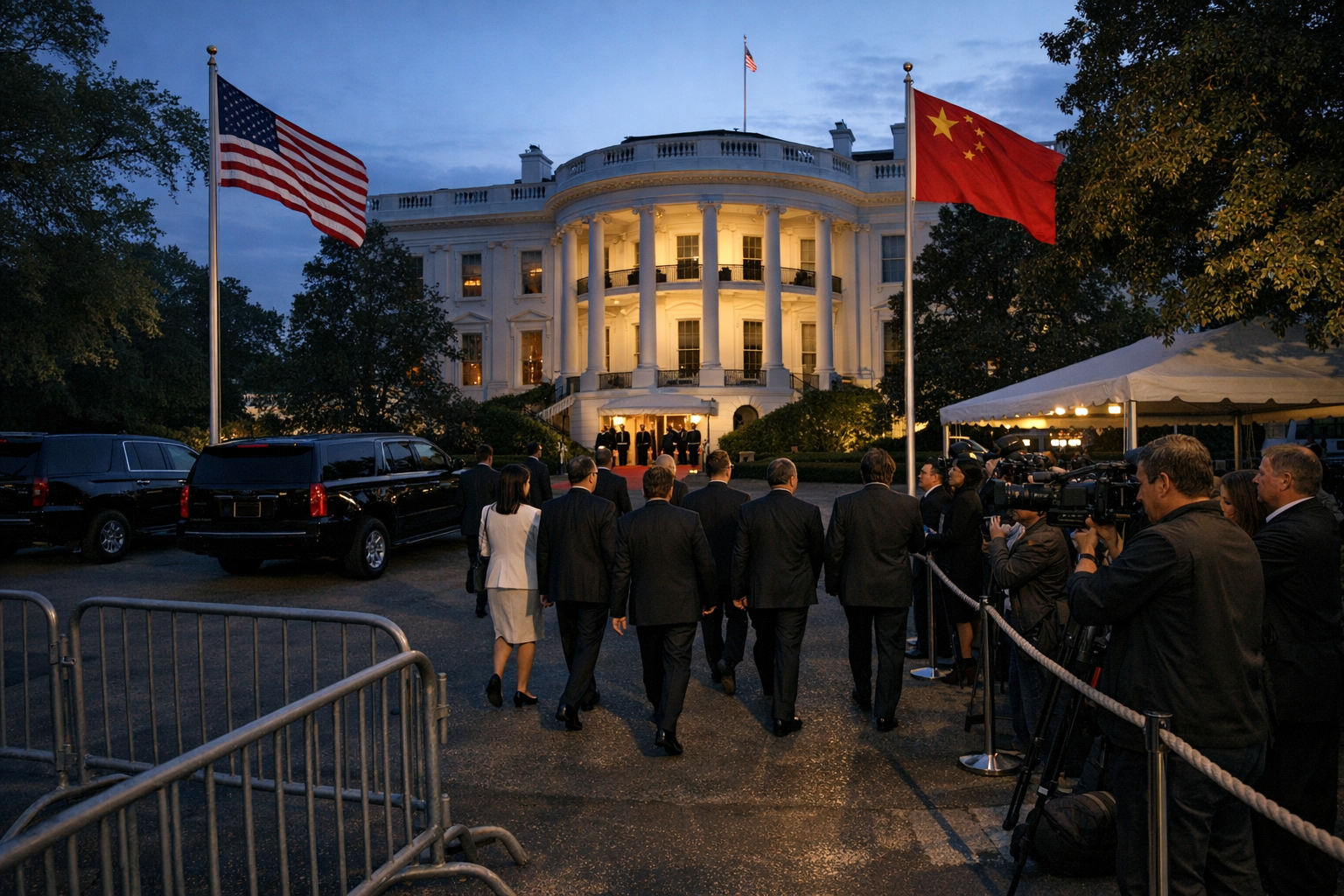
Senior American and Chinese officials are signaling cautious progress ahead of President Trump’s planned summit this week with China’s leader, Xi Jinping, while Wall Street and Silicon Valley executives prepare to gather at a White House state dinner that is shaping up as a display of the economic stakes in keeping at least part of the relationship intact.
Treasury Secretary Scott Bessent said that a weekend meeting in New York with Vice Premier He Lifeng, China’s top economic official, had been “very successful,” adding to a sense in financial markets that Washington may be trying to steady ties with Beijing even as competition over technology, industrial policy and national security remains intense.
The summit, scheduled for Thursday, comes at a delicate moment for the world’s two largest economies. After years of tariffs, export controls, investment scrutiny and increasingly blunt rhetoric from both capitals, officials now appear to be testing whether a narrower formula can hold: pressure and restrictions in the most sensitive sectors, paired with continued dialogue and selective room for business.
That approach was reflected not only in Bessent’s comments, but also in market reaction to reports that the United States may preserve most drug-licensing deals with Chinese firms. Chinese biopharmaceutical stocks climbed on Monday, a sign that investors saw the possibility of an important exception to broader efforts to reduce strategic dependence on China.
A message to markets and business
The attendance list for Xi’s state dinner is likely to amplify that message. Among those expected are Jamie Dimon of JPMorgan Chase, Jane Fraser of Citigroup, Sam Altman of OpenAI and Jensen Huang of Nvidia, according to people familiar with the plans. Their presence underscores how much corporate America still has at stake in the bilateral relationship, even after years of official calls in Washington to de-risk supply chains and limit exposure to China.
For big banks, China remains a market whose long-promised opening has often fallen short in practice but is still too large to ignore. For technology companies, the calculus is even more fraught. China is both a major market and a strategic rival, and companies operating in fields like advanced chips and artificial intelligence have become entangled in the widening contest over military advantage, data and industrial power.
The symbolism of having finance and technology chiefs in the room matters. It suggests that, despite the hardening tone in Washington, parts of the administration still want to reassure investors and business leaders that engagement with China is not being shut down across the board.
Biotech emerges as a test case
Biotechnology may now be one of the clearest examples of that selective approach.
In recent years, Chinese-origin assets have become a significant part of global pharmaceutical licensing, as multinational drugmakers increasingly look to Chinese laboratories and biotechs for compounds, partnerships and development pipelines. Any sweeping American move to block such deals would ripple well beyond the two countries, affecting research funding, access to promising therapies and the business models of drug companies on both sides of the Pacific.
That is why reports of a possible U.S. willingness to keep most licensing arrangements alive drew such a sharp response in the market. Investors interpreted the signal as evidence that Washington may be distinguishing between areas it views as directly tied to security concerns and those where commercial and public-health interests argue for leaving channels open.
The question now is how broad any carve-out would be. A permissive stance on many licensing agreements would not necessarily mean a broader thaw; it could simply mark an effort to avoid disrupting a part of the global health and drug-development system that has become deeply interconnected.
Beyond tariffs
Bessent said his talks with He covered trade, investment and artificial intelligence, according to the Treasury Department’s account of the meeting, and the two sides agreed to continue discussions. The inclusion of AI was especially notable.
American and Chinese officials have spent much of the past several years sparring over semiconductors, advanced computing and the technologies expected to shape the next phase of economic and military power. Even limited discussions about AI risk or communication mechanisms suggest that both governments see some value in guardrails, however modest, to reduce the chances of miscalculation.
That does not mean the rivalry is easing in any fundamental sense. The United States has continued to restrict Chinese access to certain advanced technologies, and China has doubled down on state-backed efforts to build domestic strength in chips, manufacturing and strategic industries. Both governments still describe the other as a challenge that demands vigilance.
But the latest signals indicate that neither side is eager for uncontrolled rupture. Instead, officials appear to be searching for a more managed form of competition — one in which tariffs, sanctions and controls remain available, but are balanced by talks and carefully chosen commercial exceptions.
What the summit may — and may not — deliver
Whether Thursday’s summit produces tangible outcomes remains uncertain. The most likely immediate result may be reassurance rather than a breakthrough: a commitment to keep talking, a few gestures toward business confidence, and perhaps limited sector-specific understandings.
The harder questions will come afterward. It is not clear whether any new access for foreign companies in China would be meaningful in practice or mostly symbolic. Nor is it clear whether a dialogue on AI can become durable enough to matter once strategic tensions rise again. In Washington and Beijing alike, hard-liners remain skeptical of selective engagement and could push back if they conclude the other side is benefiting too much.
Still, the buildup to the meeting has already revealed something important about the current phase of the relationship. After years of debate over decoupling, the emerging policy appears less absolute and more transactional: defend critical technologies, scrutinize sensitive investment and supply chains, but preserve business ties where the economic costs of severing them are too high or the strategic gains too uncertain.
For markets and multinational companies, that distinction matters. And for an administration trying to project toughness without triggering a broader economic shock, it may be the only workable middle ground left.
Sources
Further reading and reporting used to add context:
- https://apnews.com/article/2c7f54f07e755f506d9db9b91df282bd
- https://apnews.com/article/d08e58524de21511dcaba51f43faad95
- https://apnews.com/article/1f1a267bf4556c01513f506914eb6359
- https://www.axios.com/2026/09/16/us-open-ai-shared-risks-china-bessent
- https://apnews.com/article/04b29a32b6a47da55a642d4415415d7f
- https://apnews.com/article/2716ee31afa579e9ca18ae76cbe35ab9
- https://apnews.com/article/9e8603ba58eee87d8f305615d11871af
- https://www.marketscreener.com/news/us-weighs-allowing-most-pharma-licensing-deals-with-china-sources-say-ce785adadb8bf227
- https://www.investing.com/news/stock-market-news/us-treasurys-bessent-chinas-he-to-meet-on-sunday-at-jpmorgan-headquarters-4908112
- https://www.technology-times.com/posts/20260918-jpmorgan–citigroup-ceos-attending-trump-s-state-dinner-for-china-s-xi–sources/
- https://www.marketscreener.com/news/citigroup-ceo-fraser-expected-to-attend-trump-s-state-dinner-for-chinese-president-xi-jinping-sourc-ce785adadc88fe22
- https://metapress.net/politics/2026/09/19/jpmorgan-citigroup-ceos-attending-trumps-state-dinner-for-chinas-xi-sources/
- https://www.tipranks.com/news/the-fly/u-s-weighs-allowing-most-pharma-licensing-deals-with-china-reuters-says-thefly-news
- https://www.fxmare.com/news/chinese-biopharma-stocks-climb-after-u-s-openness-to-licensing
- https://www.investing.com/news/stock-market-news/nvidia-ceo-to-attend-trump-dinner-for-xi-source-says-4902711
- https://www.fiercepharma.com/pharma/china-deals-safe-coins-act-key-wclc-data-legend-new-ceo
- https://gvwire.com/2026/09/20/us-treasurys-bessent-chinas-he-to-meet-on-sunday-at-jpmorgan-headquarters/
- https://sa.marketscreener.com/news/us-treasury-s-bessent-china-s-he-to-meet-on-sunday-at-jpmorgan-headquarters-ce785adad18cf227
- https://www.scmp.com/business/china-business/article/3368249/expect-high-tide-chinese-biotech-deals-threat-us-curbs-fades-analysts
- https://qz.com/jamie-dimon-jane-fraser-trump-xi-state-dinner-091826
- https://www.marketscreener.com/news/bessent-says-the-us-and-china-had-very-successful-talks-on-trade-ai-ce785adbd98af021
- https://financenews.one/2026/09/18/jpmorgan-citigroup-ceos-dimon-fraser-at-trump-xi-state-dinner/
- https://www.livemint.com/news/us-news/trumpxi-state-dinner-jpmorgan-s-jamie-dimon-citi-s-jane-fraser-join-elite-guest-list-who-else-is-attending-11789823032871.html
- https://en.fnnews.com/news/202609190317410940
- https://news.bloomberglaw.com/artificial-intelligence/huang-altman-bezos-to-attend-xi-state-dinner-us-official-says
- https://finatcotech.com/article/jpmorgan-citigroup-ceos-to-attend-trump-xi-state-dinner
- https://www.tipranks.com/news/the-fly/jpmorgan-ceo-to-attend-state-dinner-for-chinas-xi-cnbc-says-thefly-news
- https://www.devdiscourse.com/article/international/3979658-bessent-says-us-china-had-successful-meeting-with-focus-on-trade-ai
- https://news.bloomberglaw.com/artificial-intelligence/bessent-hails-very-successful-china-talks-on-ai-threats-trade
- https://www.reddit.com/r/TradeVerseNetwork/comments/1wm134z/white_house_state_dinner_for_xi_jinping_sept_24/
- https://www.jpmorgan.com/content/dam/jpmorgan/documents/cb/insights/outlook/jpm-biopharma-deck-q1-2026.pdf
- https://www.reddit.com/r/WhatTrumpHasDone/comments/1wjthzo/us_weighs_allowing_most_pharma_licensing_deals/
- https://www.axios.com/2026/07/30/bessent-xi-china-visit-trade-greer
- https://assets.cfr.org/images/TFR83_EconomicSecurity_Full_2025-10-30_Final_350051e0ae7/TFR83_EconomicSecurity_Full_2025-10-30_Final_350051e0ae7.pdf
- Bessent says the US and China had 'very successful' talks on trade, AI | MarketScreener
- Bessent Hails ‘Very Successful’ China Talks on AI, Trade (1)
- Bessent: US proposes AI incident alert system in talks with China
- Bessent says US, China had successful meeting with focus on trade, AI | International