
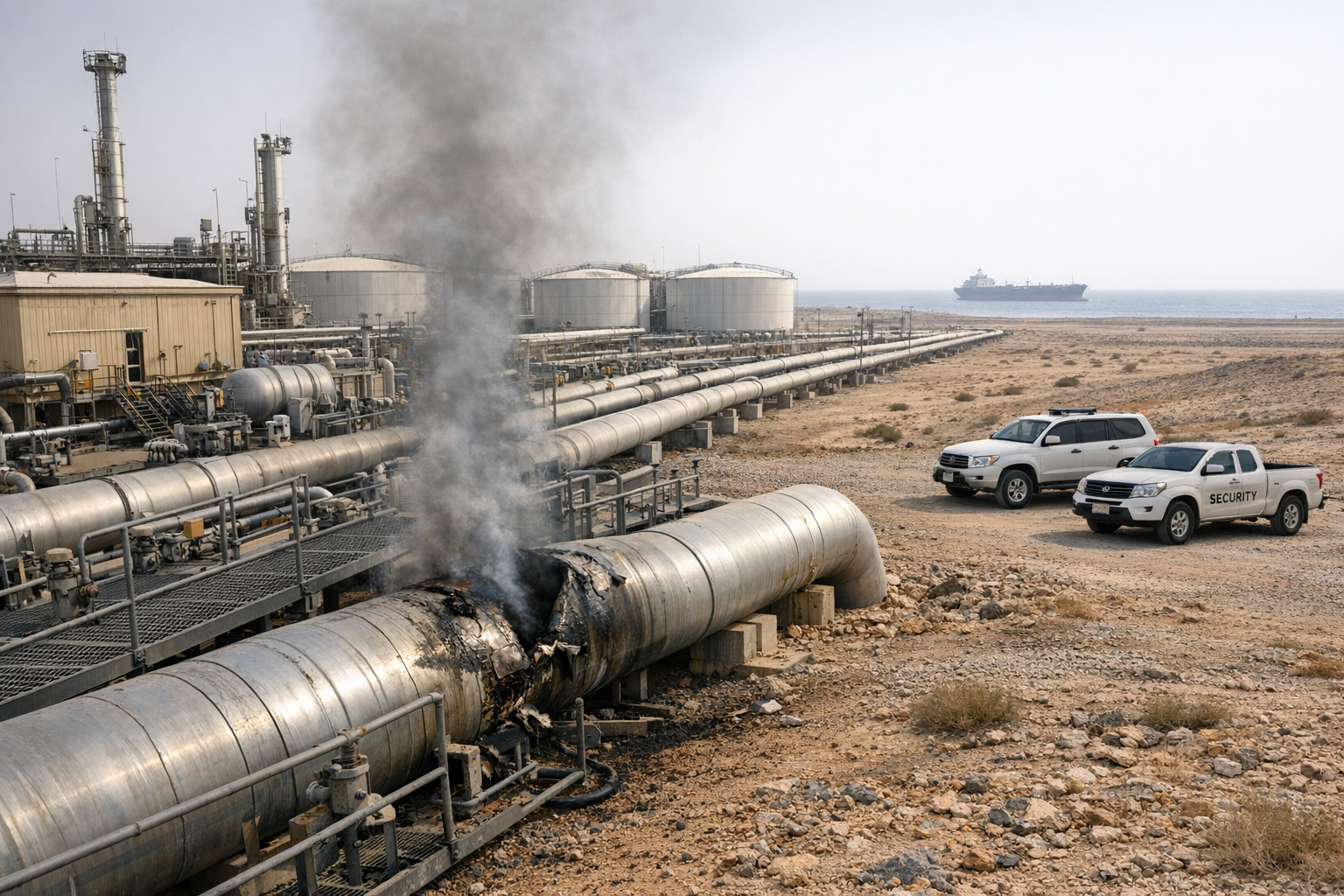
Oil Jumps as Saudi Pipeline Shutdown Deepens Fears of a Wider Energy Crisis
Oil prices climbed above $108 a barrel on Monday after Saudi Arabia shut down a major pipeline that allows it to move crude to the Red Sea without passing through the Strait of Hormuz, a disruption that has sharpened concerns that the widening Middle East conflict is beginning to threaten the world’s energy arteries on multiple fronts.
The closure of the East-West pipeline followed a drone attack that damaged facilities along the roughly 750-mile route, according to Saudi officials and satellite imagery published over the weekend showing visible destruction at a station in the Hejaz region. The line is one of the kingdom’s most important strategic assets, giving the world’s largest oil exporter a way to keep shipments flowing even if traffic through Hormuz becomes unsafe.
That workaround now looks far less secure.
Maritime security monitors also reported that a vessel was struck in or near the Strait of Hormuz, the latest in a series of incidents that have rattled shipping markets already on edge after Iran said it had destroyed an advanced American drone over the waterway. Taken together, the attacks have underscored how quickly the confrontation among the United States, Iran and Iranian-aligned armed groups is spilling beyond military targets and into the infrastructure that underpins global trade.
A Threat to Two Chokepoints
The Saudi pipeline shutdown matters not only because of the immediate damage but because it strikes at one of the few alternatives to Hormuz, through which roughly a fifth of the world’s oil consumption typically passes. The East-West line has recently carried about 4 to 5 million barrels a day, according to Reuters, transporting crude from the Gulf to terminals on the Red Sea coast.
If the outage lasts, it could constrain a significant share of Saudi export flexibility at the same moment that another chokepoint, Bab al-Mandab at the southern end of the Red Sea, is also coming under pressure.
In Yemen, the Iran-backed Houthi movement has intensified operations along the Red Sea coast and claimed new drone and missile strikes inside Saudi territory. The group’s recent gains near Bab al-Mandab, including the capture of strategic islands and port areas, have heightened fears that the conflict could jeopardize shipping through a second vital passage for oil, fuel and container traffic moving between Asia and Europe.
The effect has been immediate in energy markets. Brent crude, the international benchmark, rose sharply in early trading Monday, reflecting not only the loss of infrastructure but the growing possibility that insurers, tanker operators and refiners will have to account for sustained danger across both the Gulf and the Red Sea. Higher shipping and insurance costs can feed quickly into fuel prices, especially diesel, even before any large physical supply loss is fully felt.
Damage With Global Consequences
Saudi Arabia has not said how long the East-West pipeline will remain offline, and that uncertainty is one reason traders reacted so strongly. If repairs are completed quickly, the kingdom may be able to rely on inventories and reroute some flows. But if the damage proves extensive, a prolonged interruption could tighten supplies at a time when spare capacity elsewhere is limited and geopolitical risk premiums are already rising.
The vulnerability of the pipeline is especially significant because it was designed to reduce exactly this kind of exposure. For years, Saudi planners and international markets have treated the line as a crucial safety valve in any crisis involving the Strait of Hormuz. An attack severe enough to halt it, even temporarily, raises uncomfortable questions about whether there are any truly secure routes left when regional tensions escalate this far.
The strike on the pipeline also appears to reflect a broadening pattern in which infrastructure once considered insulated from front-line conflict is becoming a direct target. Facilities deep inside Saudi territory, commercial ships in international waterways and unmanned American systems near Hormuz have all been drawn into the same expanding confrontation.
Diplomacy Lags Behind the Escalation
The latest attacks come as diplomatic efforts have struggled to keep pace. Planned regional talks in Oman focused on shipping through the Strait of Hormuz were postponed, dimming hopes that Gulf states and Iran might soon agree on steps to reduce risks to commercial traffic.
Over the weekend, leaders at the BRICS summit called for peace and restraint, and China’s leader, Xi Jinping, urged member countries to work toward de-escalation. China, Iran’s biggest trading partner and a major buyer of its oil, has particular reason to press for stability. But so far, such appeals have done little to reassure energy markets, where traders are watching military developments more closely than summit statements.
Washington and Tehran continue to trade warnings with no clear sign of a diplomatic off-ramp. Each new incident has increased the danger of miscalculation, particularly in the crowded waters around Hormuz, where naval patrols, commercial tankers, drones and armed groups now operate under intense strain.
Why This Moment Matters
The shock to oil prices is not simply a reaction to one pipeline attack. It is a reflection of a growing belief that the conflict is entering a phase in which the systems built to protect global energy supply — alternate pipelines, diversified routes, naval escorts and emergency inventories — may no longer be enough to shield markets from sustained disruption.
For consumers, that could mean higher gasoline and diesel prices if the turmoil persists. For governments, it revives an old strategic fear: that a regional war centered on Iran and its allies could choke off not just one route, but several, with consequences far beyond the Middle East.
What remains uncertain is whether this week’s price spike will prove to be a temporary panic or the start of a deeper supply shock. Much depends on how quickly Saudi Arabia can restore the pipeline, whether attacks on merchant shipping intensify, and whether any meaningful diplomacy can be revived before the next strike pushes the crisis further out of control.
Sources
Further reading and reporting used to add context:
- https://apnews.com/article/025d052a14d9481258d51009a76d0bd6
- https://apnews.com/article/9c2b68921a16bb7bf9a90d31fb7473d9
- https://apnews.com/article/aa034da0d8226f5a3b4794b10afb8b3b
- https://apnews.com/article/27d276de911a983cdb1b81101ee56083
- https://apnews.com/article/5393274f87a16461b195d13f324e747a
- https://www.investing.com/news/commodities-news/saudis-shut-down-oil-pipeline-as-houthis-tighten-grip-on-red-sea-shipping-4898593
- https://www.investing.com/news/economy-news/saudi-arabia-shuts-key-oil-pipeline-after-houthis-drone-attack–reuters-4898625
- https://www.marketscreener.com/news/saudis-shut-down-oil-pipeline-as-houthis-tighten-grip-on-red-sea-shipping-ce785bdfd088f12c
- https://www.aljazeera.com/news/2026/9/12/saudi-arabia-shuts-critical-oil-pipeline-after-drone-attack-what-happened
- https://gvwire.com/2026/09/12/saudis-shut-down-oil-pipeline-as-houthis-tighten-grip-on-red-sea-shipping/
- https://mediaselangor.com/en/2026/09/395339
- https://currently.att.yahoo.com/att/several-merchant-vessels-hit-disabling-092322864.html
- https://theprint.in/world/chinas-xi-urges-brics-to-take-on-peacemaking-role-in-middle-east-war/3041158/
- https://www.investing.com/news/commodities-news/brics-agrees-on-joint-declaration-before-new-delhi-summit-sources-say-4898638
- https://theprint.in/world/brics-adopts-joint-declaration-urges-maximum-restraint-in-mideast/3041229/
- https://gvwire.com/2026/09/12/brics-adopts-joint-declaration-urges-maximum-restraint-in-mideast/
- https://reporterworldnews.com/news/world/2026/09/11/iran-says-it-hit-united-states-sea-drone-near-strait-of-hormuz
- https://www.reddit.com/r/oil/comments/1wfsxa1/satellite_images_show_extent_of_damage_to_major/
- https://www.tomshardware.com/tech-industry/drones/iran-could-potentially-reverse-engineer-captured-u-s-underwater-drone-several-iranian-embassies-mock-us-over-capture-as-u-s-military-downplays-the-situation
- https://www.ukmto.org/?adsBeforeAudio=true&adsBeforeVideo=true&core_dmena=pro&primarySection=&sdi=huff_home_cardlos40
- https://au.marketscreener.com/news/oil-prices-jump-more-than-3-after-new-strikes-on-saudi-strait-of-hormuz-ce785bdcd981f025
- https://au.investing.com/news/commodities-news/oil-prices-jump-more-than-3-after-new-strikes-on-saudi-strait-of-hormuz-4639616
- https://www.washingtonpost.com/world/2026/09/08/iran-says-it-captured-us-sea-drone-strait-hormuz/
- https://www.aa.com.tr/en/americas/iran-downs-us-mq-1-drone-over-strait-of-hormuz-report/4051017
- https://www.investing.com/news/world-news/iran-says-it-captured-us-submarine-drone-in-strait-of-hormuz-4892580
- https://ca.investing.com/news/commodities-news/new-report-of-attack-on-strait-of-hormuz-shipping-fans-fears-of-threats-to-oil-supplies-4837271
- https://www.defensenews.com/news/your-military/2026/09/09/iran-says-it-captured-us-submarine-drone-in-strait-of-hormuz/
- https://www.timesofisrael.com/liveblog_entry/crew-of-vessel-attacked-in-hormuz-strait-evacuated-ukmto-says/
- https://www.dawn.com/news/amp/2028401
- https://www.tbsnews.net/worldbiz/middle-east/new-report-attack-strait-hormuz-shipping-fans-fears-threats-oil-supplies
- https://www.reddit.com/r/MarketFluxHub/comments/1wfxi5v/brent_crude_surges_to_108_as_saudi_arabia_shuts/
- https://www.ukmto.org/-/media/ukmto/products/update-013—jmic-advisory-note-13_mar_2026_final.pdf?rev=c196fe402d6c4679a0c9097d6f147058
- https://www.reddit.com/r/Economics/comments/1wfrvfm/oil_prices_rise_after_saudi_arabia_shut_down/
- https://www.reddit.com/r/oil/comments/1wfrhbc/removed/
- https://www.reddit.com/r/oil/comments/1wf4npz/daily_oil_price_opinions_september_13_2026_all/
- https://www.reddit.com/r/EconomyCharts/comments/1wfx41t/brent_crude_oil_surges_at_open_after_saudi_arabia/
- https://apnews.com/article/8c18d82c109a8ea91347ce53c0096c53
- https://apnews.com/article/90dc86201ef51410ebcdd913837d741d
- https://www.reutersconnect.com/item/satellite-image-shows-damage-to-the-east-west-pipeline-facility-in-the-hejaz-region/dGFnOnJldXRlcnMuY29tLDIwMjY6bmV3c21sX1JDMkpITkFUUEdBSQ
- https://www.koreatimes.co.kr/world/20260914/oil-prices-jump-more-than-3-after-new-strikes-on-saudi-strait-of-hormuz
- https://998.gov.sa/en/Page/News/722/
- https://740thefan.com/2026/09/13/oil-prices-jump-more-than-3-after-new-strikes-on-saudi-strait-of-hormuz/
- https://www.reutersconnect.com/item/a-combination-of-satellite-images-shows-the-east-west-pipeline-facility-in-the-hejaz-region/dGFnOnJldXRlcnMuY29tLDIwMjY6bmV3c21sX1JDMktITkFITkpEUA
- https://saudigazette.com.sa/article/664519/saudi-arabia/houthi-projectile-injures-two-damages-mosque-and-buildings-in-jazan
- https://1-e8259.azureedge.net/video/newsfeed/2026/9/13/mosque-and-homes-damaged-in-saudi-arabia-after-alleged-houthi-strike
- https://www.reutersconnect.com/item/a-satellite-image-shows-black-smoke-rising-from-an-area-of-saudi-arabias-east-west-oil-pipeline-south-of-medina/dGFnOnJldXRlcnMuY29tLDIwMjY6bmV3c21sX1JDMlhHTkFPMU5GVw
- https://1-e8259.azureedge.net/news/2026/9/13/houthi-projectile-wounds-two-damages-mosque-in-jazan-region-saudi-says
- https://www.reutersconnect.com/item/satellite-image-shows-the-east-west-pipeline-facility-in-the-hejaz-region/dGFnOnJldXRlcnMuY29tLDIwMjY6bmV3c21sX1JDMkpITkFMQ001UA
- https://www.gulf-times.com/article/733136/region/saudi-shuts-down-east-west-pipeline
- https://www.reddit.com/r/PrepperIntel/comments/1wdsqfs/high_quality_satellite_image_of_one_of_the/
- https://www.reddit.com/r/suppressed_news/comments/1wfwycj/saudi_arabia_will_run_out_of_export_oil_reserves/
- https://www.reddit.com/r/saudiarabia/comments/1wf101o/the_houthi_bombed_a_masjid_in_saudi_arabia/
- https://www.reddit.com/r/oil/comments/1wdo4lt/satellite_imagery_shows_extensive_damage_at_two/
- Saudis shut down oil pipeline as Houthis tighten grip on Red Sea shipping By Reuters
- Iran says it captured US submarine drone in Strait of Hormuz By Reuters
- Licensable picture: A combination of satellite images shows the East-West pipeline facility in the Hejaz Region | Reuters Connect