
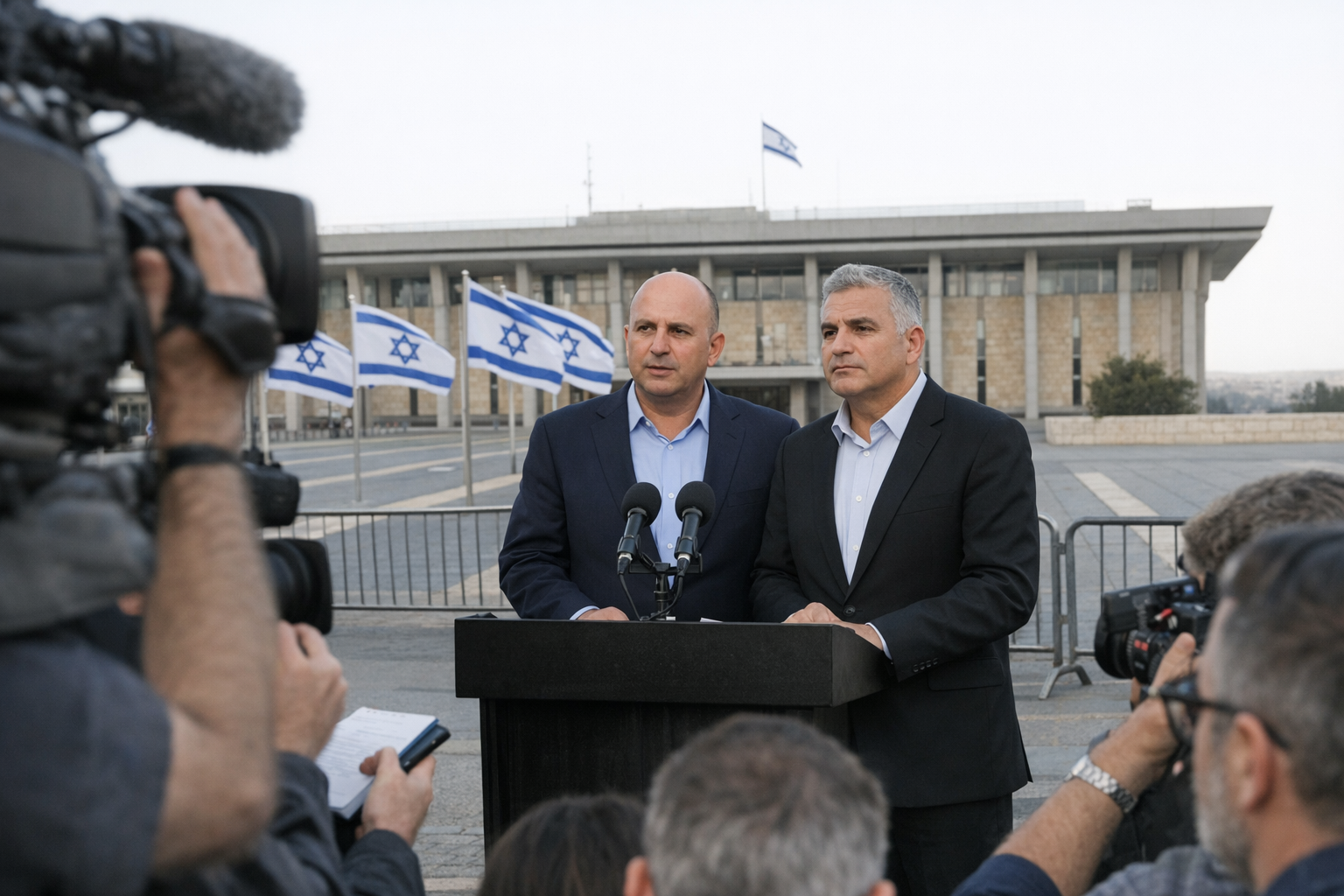
A New Challenge to Netanyahu Emerges as War Pressures Mount
Two of Benjamin Netanyahu’s most prominent rivals, Naftali Bennett and Yair Lapid, said on Sunday that they would run together in Israel’s next national election, reviving a political partnership that once helped drive the prime minister from office and signaling a sharpened challenge to his rule at a moment of deep strain for Israel on multiple fronts.
The announcement came as Israel faced mounting pressure beyond its domestic politics. In Gaza, humanitarian conditions were worsening, with aid agencies and local officials warning that attacks on water-sector workers and continuing restrictions on essential supplies were deepening a crisis in access to safe water. On Israel’s northern border, a fragile cease-fire with Hezbollah appeared increasingly precarious after Lebanese health officials said Israeli strikes killed 14 people in southern Lebanon, the deadliest day since the truce began earlier this month.
Together, the developments underscored how closely Israel’s electoral future is now bound up with the continuing consequences of the war that followed the Oct. 7 attacks: questions of security, accountability and leadership at home, alongside a widening toll on civilians in Gaza and persistent risks of regional escalation.
An Old Partnership, Revived
Bennett, a right-wing former prime minister, and Lapid, a centrist former prime minister and opposition leader, said they would contest the next vote under a new joint political alliance led by Bennett. The election is widely expected on Oct. 27.
Their decision revives the formula that briefly unseated Mr. Netanyahu in 2021, when an ideologically broad coalition stitched together by Bennett and Lapid ended his long run in power before collapsing the following year. This time, the pairing appears designed to consolidate anti-Netanyahu voters earlier and more decisively, in hopes of avoiding the fragmentation that has repeatedly benefited the prime minister and his allies.
The alliance is significant not only because it joins two nationally recognized figures, but because it attempts to bridge constituencies that Mr. Netanyahu’s opponents have often struggled to unite: conservative voters disillusioned with his leadership and centrists seeking a change in government. Bennett has retained appeal among parts of the Israeli right, while Lapid commands a sizable centrist base. Their wager is that together they can turn broad dissatisfaction into viable coalition arithmetic.
Whether they can do so remains uncertain. Israel’s parliamentary system rewards bloc-building, and a single alliance, however prominent, still needs to draw support from smaller parties to form a governing majority. Much may depend on whether other opposition figures decide to align themselves with the new ticket and whether voters see Bennett, Lapid or Mr. Netanyahu as the more credible steward of national security after the failures exposed by the Oct. 7 assault and the long war that followed.
Gaza’s Water Crisis Deepens
As the political battle took shape, conditions inside Gaza continued to deteriorate.
Recent killings of a water engineer and two drivers transporting water to displaced Palestinians have further strained an already devastated system, according to reporting from Gaza and warnings from humanitarian agencies. The deaths have removed personnel from one of the enclave’s most fragile lifelines at a time when many families rely on trucked water, damaged pipelines and only partially functioning desalination facilities.
The destruction and degradation of Gaza’s water infrastructure have been accumulating for months, the result of bombardment, fuel shortages, lack of spare parts and repeated disruption to municipal services. In some areas, output has fallen to less than a fifth of normal capacity, according to recent U.N.-linked reporting. For hundreds of thousands of displaced people living in overcrowded shelters and tent encampments, the consequences are immediate: less drinking water, less water for washing and greater exposure to disease.
Aid groups have also warned that limits on the entry of hygiene products such as soap and detergent are compounding the danger. Without enough clean water or basic sanitation supplies, preventable illnesses can spread quickly, especially among children. UNICEF and other organizations have repeatedly cautioned that Gaza’s public health emergency is not only about food and medicine, but also about the collapse of systems that keep disease at bay.
The worsening water shortage matters not just as a humanitarian indicator, but as a measure of whether any civilian stabilization in Gaza is possible while the war grinds on. Even where large-scale fighting ebbs, the absence of functioning water and sanitation networks can turn displacement sites into zones of chronic emergency.
A Cease-Fire Under Strain in Lebanon
At the same time, violence on Israel’s northern front cast fresh doubt on the durability of the cease-fire with Hezbollah that took effect on April 17 after weeks of war.
Lebanon’s health ministry said Israeli strikes in the south killed 14 people on Saturday, including women and children, and wounded dozens more. Israel said one of its soldiers was also killed and several others were wounded. The two sides have traded blame for violations of the truce, which was supposed to create space for de-escalation after months of cross-border conflict that had already displaced communities in both countries.
The latest fatalities were the highest reported in a single day since the cease-fire began, a sign that the arrangement may be holding only tenuously. Even limited exchanges carry the risk of spiraling, particularly when civilian casualties mount and domestic political pressures rise on both sides.
For Israel, the northern front remains inseparable from broader wartime politics. Any perception that the government has failed either to restore deterrence or to secure quiet along the border feeds directly into the arguments of Mr. Netanyahu’s opponents. For Lebanon and Hezbollah, meanwhile, each strike tests the limits of restraint under an agreement that has not yet proved it can survive repeated shocks.
Why This Moment Matters
The convergence of these developments has heightened the sense that Israel is entering a pivotal period.
At home, the Bennett-Lapid alliance gives shape to a more coherent opposition campaign against Mr. Netanyahu, one centered on the claim that Israel needs a political reset after the security and political crises of the past three years. In Gaza, the deepening water emergency highlights the growing cost of a war whose effects on civilians are becoming ever more entrenched. And in Lebanon, the deadliest day since the cease-fire began is a reminder that even partial diplomatic gains remain vulnerable.
The next several months are likely to test whether any of those trajectories can be altered: whether Israel’s opposition can turn unity into power, whether humanitarian conditions in Gaza can be stabilized before disease spreads further, and whether the northern cease-fire can be preserved long enough to prevent another round of wider war. For now, all three remain unsettled.
Sources
Further reading and reporting used to add context:
- https://apnews.com/article/daa0ac88d1750ddb95a65d65adff6444
- https://www.theguardian.com/p/x4qpnv
- https://www.aljazeera.com/news/2026/4/26/former-israeli-pms-bennett-lapid-unite-to-challenge-netanyahu-in-elections
- https://www.ajupress.com/view/20260427093170396
- https://www.theguardian.com/p/x4qdf3
- https://www.jpost.com/israel-news/politics-and-diplomacy/article-894238/
- https://en.wikipedia.org/wiki/Bennett_2026
- https://en.wikipedia.org/wiki/2026_Israel%E2%80%93Lebanon_ceasefire
- https://www.emro.who.int/images/stories/lebanon/Lebanon-Emergency-Sitrep-14-2026.pdf
- https://www.un.org/en/unicef-%E2%80%98outraged%E2%80%99-killing-gaza-water-truck-drivers-urges-investigation
- https://www.un.org/unispal/document/statement-by-unicef-17apr26/
- https://www.aljazeera.com/news/2026/4/24/israel-continues-attacks-on-lebanon-despite-extension-of-ceasefire
- https://www.lemonde.fr/en/international/article/2026/04/17/in-lebanon-a-fragile-cease-fire-between-israel-and-hezbollah-begins_6752528_4.html
- https://www.aljazeera.com/news/2026/4/8/world-reacts-to-brutal-israeli-attacks-on-lebanon-amid-us-iran-ceasefire
- https://apnews.com/article/9402965418687c634d4a157c966ec6ea
- https://www.aljazeera.com/news/2026/4/8/hundreds-of-casualties-across-lebanon-after-israel-says-it-hit-100-sites
- https://apnews.com/article/5fbec1f6c4aa0e283b3d56e5134e8097
- https://en.wikipedia.org/wiki/Together_%28Israel%29
- https://allisraelnews.com/fmr-pms-bennett-and-lapid-announce-party-merger-ahead-of-knesset-elections
- https://www.un.org/unispal/document/unicef-restores-water-access-for-tens-of-thousands-of-children-in-gaza/
- https://www.un.org/unispal/document/ocha-humanitarian-situation-report-10-april-2026/
- https://www.un.org/unispal/document/ocha-press-release-24feb26/
- https://www.who.int/publications/m/item/herams-opt-gaza-infographics-2026-03
- https://www.un.org/unispal/wp-content/uploads/2026/04/GazaScorecard2026FINAL.pdf
- https://www.afro.who.int/photo-story/strengthened-access-and-monitoring-clean-water-gaza-province-following-floods
- https://www.who.int/publications/m/item/occupied-palestinian-territory–who-health-emergency-appeal-2026
- https://www.who.int/philippines/news/detail-global/14-04-2026-after-three-years-of-conflict–sudan-faces-a-deeper-health-crisis
- https://www.un.org/sg/en/content/highlight/2026-04-16.html
- https://en.wikipedia.org/wiki/2026_in_Lebanon
- https://www.un.org/unispal/document/unicef-more-than-a-million-children-in-the-gaza-strip-deprived-of-lifesaving-aid-for-over-one-month/
- https://www.un.org/unispal/?p=315262
- https://en.wikipedia.org/wiki/April_2026_attack_on_French_UNIFIL_peacekeepers_in_Lebanon
- https://en.wikipedia.org/wiki/2026_Lebanon_war
- https://en.wikipedia.org/wiki/Timeline_of_the_2026_Lebanon_war
- https://www.un.org/unispal/wp-content/uploads/2026/02/State-of-Palestine-Humanitarian-Situation-Update-and-Humanitarian-Response-5-February-2026.pdf
- https://en.wikipedia.org/wiki/Amal_Khalil
- Two former Israeli prime ministers join forces against Netanyahu in upcoming elections