
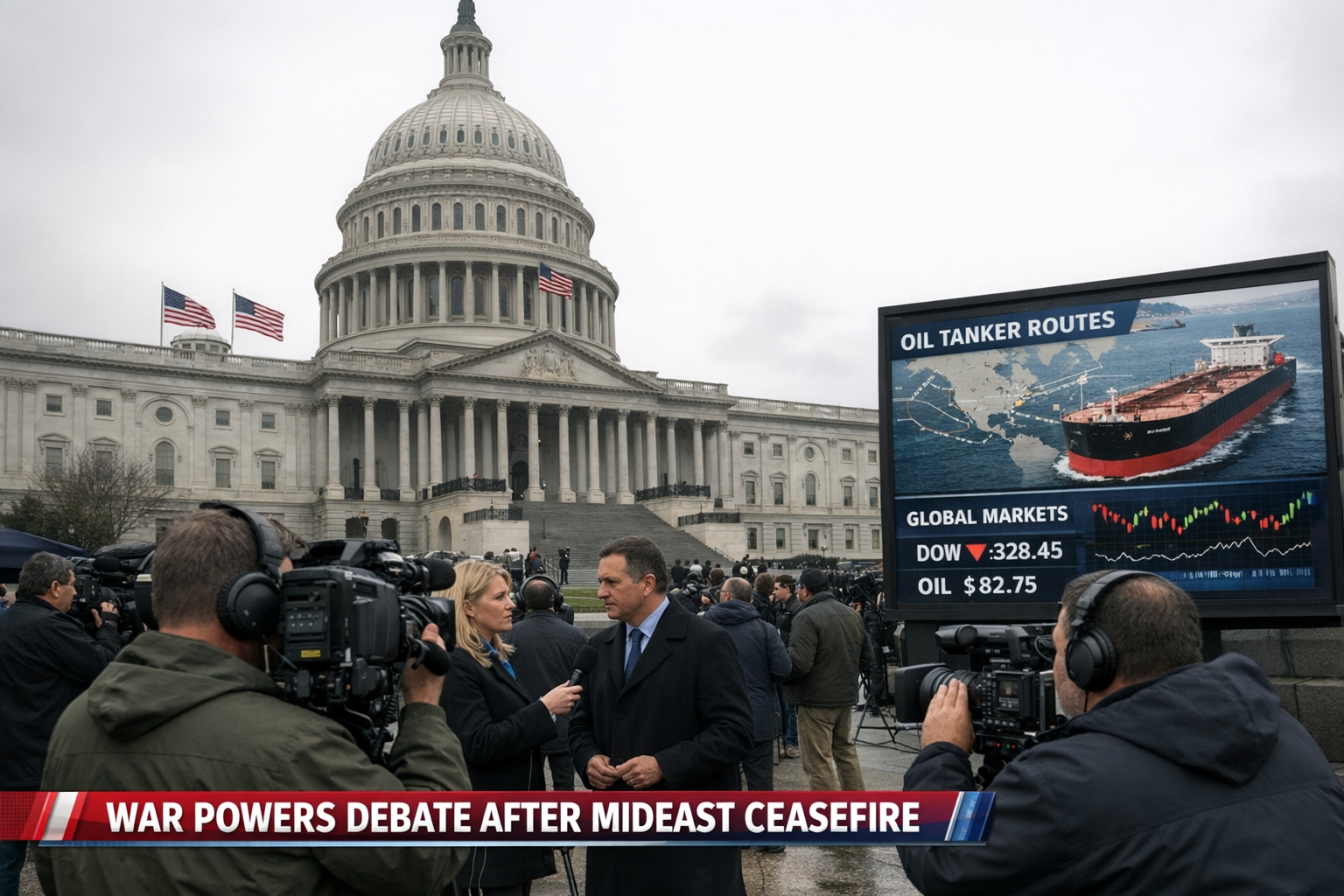
A fragile ceasefire between the United States and Iran is rippling far beyond the battlefield, stirring a new confrontation in Washington over presidential war powers, prompting warnings of lasting damage to the global economy and opening what some families of foreign detainees in Iran see as a narrow diplomatic opportunity.
On Thursday, House Democrats prepared to force a vote on a measure intended to curb President Trump’s ability to take further military action against Iran without congressional approval. The effort was expected to fail almost immediately under Republican opposition, but its symbolism was hard to miss: even with fighting paused under a two-week ceasefire announced this week, lawmakers are signaling that the political and constitutional questions raised by the conflict are far from settled.
The maneuver follows earlier failed attempts in Congress to restrain the administration. The Senate voted down a war-powers measure in March, and the House rejected a broader resolution the following day. Democrats’ latest push, using the chamber’s unanimous-consent procedure, appeared aimed less at securing passage than at underscoring a deeper unease over the scope of presidential authority in a conflict that intensified rapidly and still lacks a clear political end point.
The ceasefire itself, announced on April 7 and 8, was tied to efforts to reopen the Strait of Hormuz, the critical shipping corridor through which a significant share of the world’s oil and gas flows. That has helped calm markets from their most acute fears, but international officials say the damage has already begun.
Kristalina Georgieva, the managing director of the International Monetary Fund, warned this week that the war would leave “scarring effects” on the world economy even if peace holds. In her assessment, slower growth and weaker living standards are now likely this year even under the most optimistic scenario.
Her warning reflects a broader fear among policymakers that even a relatively short Middle East conflict can leave a long tail: higher energy prices feeding inflation, disrupted shipping through the Gulf, more cautious investment and weaker consumer confidence. The IMF had already cautioned in March that a prolonged war in the region would push prices higher and slow global growth. Georgieva’s latest remarks suggest that some of that downside is no longer hypothetical.
Why This Matters
The political and economic aftershocks of the ceasefire reveal a central reality of the crisis: a pause in hostilities is not the same as a return to stability.
In Washington, the renewed fight over war powers highlights a longstanding constitutional tension that flares whenever presidents undertake military action with limited congressional buy-in. The immediate issue is Iran, but the broader question is whether lawmakers are willing — or able — to reassert their authority once a president has already committed the country to a military confrontation. So far, under a Republican-controlled House, the answer appears to be no.
For the global economy, the concern is not simply oil prices in the coming days, but whether businesses and households begin to absorb the conflict as a new source of risk. Even if tankers resume moving normally through the Gulf, the episode has reminded governments, investors and consumers how quickly a regional war can threaten energy supply chains and raise costs worldwide.
And in Britain, the ceasefire has created a different kind of opening: a possible moment for diplomacy on behalf of foreign nationals imprisoned in Iran.
Joe Bennett, the son of Lindsay and Craig Foreman, a British couple detained in Tehran, urged Prime Minister Keir Starmer to use the lull in hostilities to press their case. The Foremans, from East Sussex, were arrested in January 2025 while traveling through Iran and have been held in Evin prison for 15 months. Convicted on espionage charges, they were sentenced in February to 10 years in prison, a punishment the British government denounced as “totally unjustifiable.”
Bennett said the ceasefire and Starmer’s engagement with Gulf leaders made this a particularly opportune moment to seek their release. His appeal speaks to a recurring pattern in relations with Tehran, where periods of de-escalation can create small, uncertain openings for negotiations over detainees, but rarely any guarantee of progress.
A Pause, Not a Settlement
That uncertainty hangs over every dimension of the current moment. The ceasefire was framed as a two-week arrangement, and reporting since its announcement has pointed to confusion over what comes next and what, precisely, each side has agreed to beyond a temporary halt in fighting. If the truce collapses, congressional pressure, economic alarm and diplomatic efforts could all intensify at once.
Even if it holds, the conflict has already reshaped the debate in capitals far from Tehran. American lawmakers are testing the limits of their influence over military decision-making. Global economic officials are recalculating expectations for growth and inflation. And families of detainees are trying to use a brief easing of tensions to draw attention to cases that might otherwise remain frozen.
For now, the ceasefire has bought time. What it has not yet delivered is clarity.
Sources
Further reading and reporting used to add context:
- https://apnews.com/article/54306933e129bf9a03ae620f87f5cde0
- https://apnews.com/article/421ee64fdc9a5c26460df8119c7d1b3f
- https://apnews.com/article/758eb5cd680d7d275c4e1c38b2e01e6d
- https://apnews.com/article/4b464b08aaf7220899526c0c6da4317d
- https://www.theguardian.com/world/2026/feb/19/jail-sentence-iran-british-couple-lindsay-craig-foreman-totally-unjustifiable-says-foreign-secretary
- https://www.theguardian.com/uk-news/2025/feb/15/iran-british-couple-held-craig-lindsay-foreman
- https://www.theguardian.com/uk-news/2025/feb/18/britons-craig-and-lindsay-foreman-detained-in-iran-charged-with-espionage
- https://news.sky.com/story/british-couple-detained-in-iran-feel-let-down-and-plead-with-starmer-to-help-us-13523391
- https://en.wikipedia.org/wiki/Detention_of_Craig_and_Lindsay_Foreman
- https://apnews.com/article/93c7cf147b039b95ccdd029b33e81e8b
- https://www.al-monitor.com/originals/2026/03/detained-briton-iran-urges-uk-pm-starmer-step-out-shadows
- https://www.theguardian.com/world/2025/oct/02/lindsay-craig-foreman-family-british-couple-detained-in-iran
- https://www.theguardian.com/us-news/2026/mar/05/us-house-war-powers-resolution-vote
- https://www.theguardian.com/world/2025/aug/04/british-couple-held-in-iran-moved-to-separate-prisons-heightening-welfare-concerns
- https://news.sky.com/story/british-couples-10-year-iran-prison-sentence-left-them-in-panic-says-son-13503275
- https://www.theguardian.com/politics/2025/jul/30/family-of-british-couple-held-in-iran-urge-uk-to-raise-case-in-talks-with-tehran
- https://www.thenationalnews.com/news/uk/2026/02/13/british-woman-detained-with-husband-in-iran-ignorantly-thought-we-would-be-ok/
- https://www.iranintl.com/en/202507304825
- https://harrigan.house.gov/media/press-releases/congressman-pat-harrigan-votes-no-war-powers-resolution-undercut-lawful
- https://levin.house.gov/media/press-releases/rep-mike-levin-votes-yes-on-war-powers-resolution-to-rein-in-trumps-unauthorized-war-on-iran
- https://elfreth.house.gov/media/press-releases/elfreth-votes-favor-iran-war-powers-resolution
- https://moulton.house.gov/news/press-releases/moulton-votes-yes-war-powers-resolution-demanding-constitutional-oversight
- https://democrats.house.gov/newsroom/press-releases/statement-from-chairman-aguilar-on-the-bipartisan-iran-war-powers-resolution
- https://wassermanschultz.house.gov/news/documentsingle.aspx%3FDocumentID%3D3469
- https://gottheimer.house.gov/posts/release-nine-members-introduce-war-powers-resolution-on-iran
- https://www.imf.org/en/news/articles/2026/03/09/sp030926-coping-and-thriving-in-a-fluid-world
- https://huffman.house.gov/media-center/press-releases/rep-huffman-statement-on-vote-to-rein-in-trumps-illegal-costly-war-in-iran
- https://casten.house.gov/media/press-releases/casten-votes-to-end-trumps-war-with-iran
- https://mcgarvey.house.gov/media/press-releases/congressman-morgan-mcgarvey-on-war-powers-resolution-vote
- https://newdemocratcoalition.house.gov/media-center/press-releases/new-dem-leadership-demands-war-powers-vote-after-us-attacks-on-iran
- https://www.congress.gov/crs_external_products/R/PDF/R47603/R47603.11.pdf
- https://www.imf.org/-/media/files/news/seminars/2025/26th-annual-research-conference/26th-annual-research-conference-speaker-bios.pdf
- https://algreen.house.gov/sites/evo-subsites/algreen.house.gov/files/evo-media-document/2.28.2026-war-powers-letter_0.pdf
- https://www.imf.org/-/media/Files/Publications/WEO/2025/April/English/text.ashx
- https://ross.house.gov/_cache/files/5/5/55d2c96e-2f3e-4f28-834d-4ed01824907d/180AF04254E2E6ECF1A7E609FF1C1FD32085EDFA8004547D05F37D887CA2E977.ansari-053-xml.pdf
- https://meetings.imf.org/-/media/Files/Publications/WEO/2025/April/English/text.ashx
- https://www.axios.com/2026/04/08/trump-25th-amendment-iran-democrats-jeffries
- https://apnews.com/article/66806b02a000235f1979e591279b6554
- https://time.com/7382790/house-rejects-war-powers-trump-iran-war/
- https://apnews.com/article/06f9465c16218f90192f7502baa736eb
- https://www.theguardian.com/us-news/2026/mar/09/democrats-iran-war-powers-resolutions
- https://www.axios.com/2026/03/26/iran-war-inflation-ai
- https://en.wikipedia.org/wiki/2026_Iran_war_fuel_crisis
- https://en.wikipedia.org/wiki/2026_Iran_war
- https://www.washingtonpost.com/world/2026/03/19/iran-war-global-economic-impact/
- https://en.wikipedia.org/wiki/Economic_impact_of_the_2026_Iran_war
- https://www.theguardian.com/p/x4g7cn
- https://www.deloitte.com/us/en/insights/topics/economy/iran-middle-east-conflict-impacts-global-economy.html
- https://gvwire.com/2026/04/06/war-in-middle-east-will-lead-to-slower-growth-higher-inflation-imf-chief-tells-reuters/
- https://time.com/7382846/democrats-who-voted-against-war-powers-resolution-iran-conflict-trump/
- https://en.wikipedia.org/wiki/2026_Kharg_Island_attack
- https://www.aljazeera.com/amp/news/2026/3/16/the-tell-tale-signs-how-bad-has-the-iran-war-hit-the-global-economy
- https://www.theguardian.com/uk-news/2026/apr/08/keir-starmer-visit-gulf-us-iran-ceasefire-trump
- https://en.wikipedia.org/wiki/2026_South_Pars_field_attack
- https://en.wikipedia.org/wiki/2026_Strait_of_Hormuz_crisis
- https://www.theguardian.com/us-news/live/2026/apr/07/government-shutdown-congress-house-of-representatives-donald-trump-republicans-democrats-ice-us-politics-latest-updates-news?page=with%3Ablock-69d586868f084837558bc42f
- https://www.washingtonpost.com/national/2026/03/05/iran-israel-us-latest-march-05-2026/02abe1d4-1854-11f1-aef0-0aac8e8e94db_story.html
- https://www.imf.org/en/news/articles/2026/04/07/cs-04072026-georgia-staff-cs-2026-aiv
- https://www.imf.org/en/publications/weo/issues/2026/04/14/world-economic-outlook-april-2026
- https://www.gov.uk/government/speeches/foreign-secretary-statement-on-iran-13-january-2026
- https://www.imf.org/en/news/articles/2026/01/21/tr-01212026-weo-press-conference-on-release-of-the-january-2026-world-economic-outlook-update
- https://mediacenter.imf.org/news/imf—managing-director-gpa-press-briefing/s/f1f3dc65-a091-4455-9d09-1f06cb73f32b
- https://www.imf.org/en/blogs/articles/2026/03/30/how-the-war-in-the-middle-east-is-affecting-energy-trade-and-finance
- https://www.imf.org/-/media/files/publications/pp/2025/english/ppea2025043.pdf
- https://www.imf.org/en/News/Articles/2025/10/16/tr-10-16-25-imf-md-gpa-press-briefing-transcript-annual-meetings-2025
- https://www.imf.org/en/News/Articles/2025/06/04/06042025-mcs-georgia-staff-concluding-statement-of-the-2025-article-iv-mission
- https://www.imf.org/en/News/Articles/2025/04/22/tr-04222025-weo-press-briefing
- https://www.imf.org/en/news/articles/2023/02/10/imf-managing-director-kristalina-georgieva-remarks-at-the-seventh-arab-fiscal-forum
- https://www.imf.org/en/news/articles/2025/01/17/tr011725-january-2025-world-economic-outlook-update
- https://www.imf.org/en/News/Articles/2024/04/11/sp041124-outlook-global-economy-policy-priorities-kristalina-georgieva
- https://www.imf.org/-/media/files/publications/reo/mcd-cca/2025/october/english/october-2025-reo-jihad-azour-dubai-press-remarks.pdf
- https://www.imf.org/-/media/files/publications/weo/2026/january/english/text.pdf
- https://assets.publishing.service.gov.uk/media/695e47dd7ad4bff6f7afdfc1/IRN_CPIN_Sexual_orientation_and_gender_identity_or_expression__1_.pdf
- https://apnews.com/article/6bf47beeb51b3e7753bf875a135f0ec8
- https://apnews.com/article/c7df5c093441adb0fcd5fd143f26980e
- https://en.wikipedia.org/wiki/List_of_foreign_nationals_detained_in_Iran
- https://www.thedailybeast.com/backpacking-couple-issues-desperate-plea-from-iranian-prison/
- https://www.thenationalnews.com/news/uk/2026/01/01/family-of-british-couple-detained-in-iran-speak-of-void-at-new-year-celebrations//
- https://www.yahoo.com/news/articles/government-press-iran-release-brits-181832078.html
- https://www.yahoo.com/news/articles/uk-condemns-10-sentence-british-094644311.html
- https://www.newarab.com/news/uk-couple-held-iran-caught-geopolitical-tensions-son
- https://en.wikipedia.org/wiki/Iran%E2%80%93United_Kingdom_relations
- https://www.aol.com/news/couple-jailed-iran-fear-rising-121745992.html
- https://www.unitedagainstnucleariran.com/sites/default/files/American%20and%20Other%20WesternHostages_2025-09-15.pdf
- https://www.cps.gov.uk/cps/news/gangster-brothers-involved-cocaine-theft-stash-house-ordered-pay-back-ps81000
- https://www.the-independent.com/news/uk/home-news/british-iran-tehran-east-sussex-kent-b2815938.html
- https://nz.news.yahoo.com/iran-detainees-son-urges-pm-050628126.html
- https://en.wikipedia.org/wiki/2026_Iran_war_ceasefire
- https://en.wikipedia.org/wiki/2026_in_the_United_Kingdom
- US and Iran agree to 2-week ceasefire as Trump pulls back on threats
- Top House Dems signal openness to 25th Amendment push
- The Latest: Iran says it has accepted a 2-week ceasefire in the war