
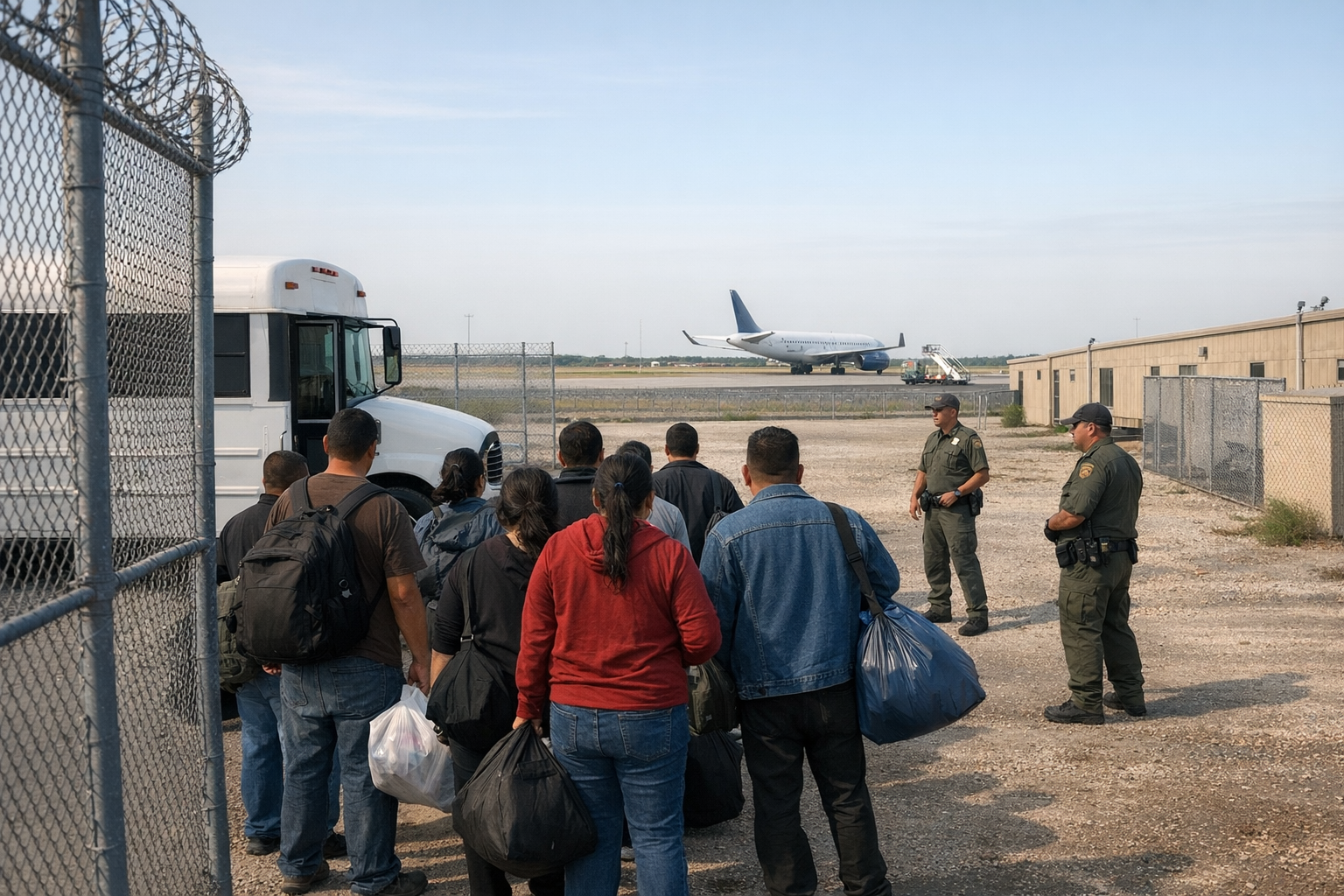
The Trump administration is pressing ahead with one of the most contested elements of its immigration agenda: deporting people not only to their home countries, but to nations with which they may have no connection at all.
In courtrooms, detention centers and airports spanning three continents, that policy is now colliding with a growing set of legal challenges and firsthand accounts that critics say reveal its human cost. Federal lawyers said this week that the Department of Homeland Security still intends to deport Kilmar Ábrego García to Liberia, even after reaching a new arrangement with Costa Rica to accept some migrants who cannot legally be returned to their countries of origin. In East Africa, Uganda has received its first flight of deportees under a similar agreement. And in southern Africa, men previously sent by the United States to Eswatini have described being jailed there despite having completed their sentences in America.
At the same time, new reporting from the Dilley Immigration Processing Center in South Texas has offered a stark window into the conditions facing asylum seekers held for months while the government pursues removals. For many migrants, advocates say, the expanding use of third-country deportations cannot be separated from the experience of prolonged detention that often precedes them.
Together, the developments amount to a widening test of how far the United States can go in outsourcing deportation — and whether courts will insist on fuller notice, meaningful consent and an opportunity to challenge transfers before people are sent to unfamiliar places overseas.
The case of Mr. Ábrego García has become a central measure of that fight. Born in El Salvador, he was mistakenly deported there in 2025, in a blunder that drew intense scrutiny. After being returned to the United States, he has been fighting renewed efforts to remove him again, this time to countries in Africa that are not his own. On April 7, government lawyers told a federal judge that Liberia remained the intended destination. The judge ordered further briefing and set a hearing for April 28.
The administration has portrayed such arrangements as a practical tool for removing people who cannot easily be repatriated, either because their home governments will not accept them or because legal barriers complicate return. But immigration lawyers and rights groups argue that the policy is eroding due process by sending people into legal and geographic limbo, sometimes with little warning and scant information about what awaits them on arrival.
That uncertainty has become especially vivid in accounts from Eswatini, where the United States sent several batches of deportees under an agreement reached as third-country removals expanded sharply in 2025 and 2026. One of them, Pheap Rom, a Cambodian man who had completed his U.S. sentence, said he would have accepted deportation to Cambodia but instead was sent to Eswatini, a country he knew so little about that he initially mistook its name for that of an American detention center. He was among deportees later held in a maximum-security prison there, according to accounts from lawyers and advocacy groups.
His experience has become shorthand for a broader critique: that people can be removed to countries where they have no family, language, legal status or realistic path forward, and then be detained again after they land. “We still deserve due process,” Mr. Rom said in an interview reported this week.
Now Uganda has entered the picture. A first group of deportees from the United States has arrived there under a new bilateral agreement, according to Ugandan officials, who described the stay as a transitional phase before possible transfer onward to other countries. That formulation has raised fresh concerns among advocates, who say the policy risks creating a chain of removals in which deportees are shuttled from one state to another with no durable protection and little ability to challenge what is happening to them.
The administration’s effort has unfolded as it revives and expands detention capacity inside the United States. Dilley, the sprawling family detention center in Texas, has once again become one of the most visible sites in that system. Human Rights First and RAICES have said that more than 5,600 people — including children, toddlers and newborns — were held there between April 2025 and February 2026.
A recent account from inside the facility, centered on a 19-year-old asylum seeker from the Democratic Republic of Congo identified as Olivia, described a regimen of monthslong confinement marked by weight loss, headaches and a deepening sense of despair. She told a reporter that each day felt like 48 hours. She had been detained for more than four months.
For critics of the administration’s approach, such accounts underscore that the debate over third-country deportation is not merely about foreign agreements or diplomatic logistics. It is also about the pressure created by detention itself: the attrition of long confinement, the vulnerability of asylum seekers and families, and the possibility that people may be pushed into accepting outcomes they do not understand for fear of remaining locked up.
The legal questions are still unsettled. Courts are being asked to decide what minimum protections must be provided before the government can deport someone to a third country: how much notice is required, whether the person must be allowed to raise fear-based claims, and whether judges can block removals to nations where deportees may face imprisonment or further expulsion. The answers could shape not only Mr. Ábrego García’s case, but the architecture of the policy itself.
Another uncertainty is how many countries will continue accepting U.S. deportees, and on what terms. Deals with smaller states in Africa have already drawn criticism from human-rights groups, which say impoverished or politically dependent countries may be asked to absorb migrants with little transparency about what support, legal status or safeguards they will receive. The administration, by contrast, has sought to show that a growing roster of partner nations is willing to cooperate.
Why it matters now is that the policy is no longer hypothetical or isolated. People are arriving in Uganda. Men sent to Eswatini are describing imprisonment there. A high-profile legal battle over Liberia is moving toward another hearing. And inside a detention center in Texas, asylum seekers are waiting, day after day, to learn whether they will be allowed to stay, returned home, or sent somewhere wholly unfamiliar.
What is emerging is a more expansive deportation system — one that stretches far beyond the American border, and whose consequences are becoming harder to keep out of view.
Sources
Further reading and reporting used to add context:
- https://apnews.com/article/e7f637d07f2135740c4d9a5d250661b9
- https://apnews.com/article/53425375eea5a5f93aa12106b77e0fd5
- https://apnews.com/article/2950610fea00caf717087ea0ac3bdf6d
- https://apnews.com/article/3b677c9a8a32db153151aae01af8b207
- https://www.theguardian.com/world/2026/apr/07/cambodian-man-pheap-rom-deported-us-eswatini
- https://www.theguardian.com/us-news/2026/apr/02/uganda-receives-first-us-deportation-flight-under-third-country-agreement
- https://www.theguardian.com/us-news/2026/apr/07/kilmar-abrego-garcia-liberia-deportation
- https://www.aljazeera.com/news/2026/4/8/trump-administration-reaffirms-plans-to-deport-abrego-garcia-to-liberia
- https://www.ugandaonline.net/news/2026-04-04–uganda-receives-first-us-deportees-under-safe-third-country-agreement–676c091e54d5/
- https://www.timeslive.co.za/news/africa/2026-04-03-uganda-says-it-received-eight-us-deportees/
- https://www.monitor.co.ug/uganda/news/national/uganda-confirms-receiving-us-deportees-whose-asylum-claims-were-rejected-5412424
- https://www.africa-press.net/uganda/all-news/govt-confirms-arrival-of-eight-deportees-from-us
- https://www.ugandaonline.net/news/2026-04-03–uganda-receives-20-us-rejected-asylum-seekers-amid-legal-backlash–972d0a0f002e/
- https://www.washingtonpost.com/immigration/2025/11/21/kilmar-trump-deport-costarica/
- https://www.washingtonpost.com/national-security/2025/12/11/trump-abrego-release-deportation/
- https://www.washingtonpost.com/national/2025/11/10/kilmar-abrego-garcia-deportation-liberia-el-salvador/7561362c-be7f-11f0-8eee-a78486b4c797_story.html?itid=agg_ticker
- https://time.com/7312651/kilmar-abrego-garcia-ice-asylum-uganda/
- https://elpais.com/us/migracion/2026-02-17/una-jueza-prohibe-al-ice-volver-a-detener-al-salvadoreno-kilmar-abrego-garcia.html
- https://en.wikipedia.org/wiki/Deportation_of_Kilmar_Abrego_Garcia
- https://en.wikipedia.org/wiki/Foreign_policy_of_the_second_Trump_administration
- https://en.wikipedia.org/wiki/Detention_of_Liam_Conejo_Ramos
- https://es.wikipedia.org/wiki/Detenci%C3%B3n_de_Liam_Conejo_Ramos
- https://humanrightsfirst.org/library/a-new-era-of-ice-family-detentions/
- https://www.theguardian.com/world/2025/nov/17/eswatini-5-m-dollars-us-deportees
- https://apnews.com/article/5388e0771714b074953cfcb1f110b67c
- https://humanrightsfirst.org/library/human-rights-first-and-raices-release-new-report-exposing-systemic-due-process-violations-and-cruelty-at-dilley-ice-family-prison/
- https://www.yahoo.com/news/articles/eswatini-high-court-dismisses-case-092423899.html
- https://www.washingtonpost.com/immigration/2025/11/21/kilmar-trump-deport-costarica//
- https://www.aljazeera.com/news/2025/10/27/us-judge-asks-for-assurance-abrego-garcia-wont-be-deported-to-liberia
- https://apnews.com/article/989facb5fff17289233b77c5f33279e2
- https://en.wikipedia.org/wiki/2026_in_Eswatini
- https://apnews.com/article/10ac9844e775ad2a4f16132124558fd0
- https://en.wikipedia.org/wiki/2026_Costa_Rican_general_election
- https://clubofmozambique.com/wp-content/uploads/2026/02/WR2026-web_2.pdf
- https://en.wikipedia.org/wiki/Eswatini
- https://mofa.go.ug/article/ministry-foreign-affairs-bids-farewell-distinguished-staff-ceremony-honor-and-reflection
- https://www.justice.gov/opa/pr/attorney-general-pamela-bondi-statement-supreme-court-stay-maryland-district-court-order
- https://www.justice.gov/usao-edla/pr/honduran-national-sentenced-illegal-reentry-united-states-1
- https://newyork.mofa.go.ug/leadership/mr-bagiire-vincent-waiswa
- https://www.justice.gov/opa/video/attorney-general-bondi-announces-charges-against-abrego-garcia
- https://www.justice.gov/atr/
- https://arusha.mofa.go.ug/article/uganda-diaspora-convention-2025
- https://www.mofa.go.ug/article/familiarization-trip-french-and-spanish-media-influencers-tourism-uganda
- https://www.ca4.uscourts.gov/opinions/daily-opinions/published-only
- https://mofa.go.ug/article/finance-pledges-support-ugandas-missions-during-ecd-mid-term-review-mombasa
- https://www.justice.gov/usao-edtx/pr/former-costa-rican-government-official-and-fellow-drug-trafficker-extradited-eastern
- https://www.mnb.uscourts.gov/sites/mnb/files/2026%20Confirmation%20hearing%20dates.pdf
- https://www.ca4.uscourts.gov/news-announcements/2026/03/26/fourth-circuit-2026-civics-contest-now-open-to-students-in-grades-9-12
- https://www.txnb.uscourts.gov/sites/txnb/files/postcal/4-April%202026.pdf
- https://www.nysd.uscourts.gov/sites/default/files/2025-04/Proceedings%204.28.2025.%20xlsb.pdf
- https://www.nmb.uscourts.gov/sites/default/files/opinions/11-1074.9.pdf
- https://archive.mofa.go.ug/sites/havana.dd/files/Statement%20on%20ICJ%20Ruling%20-%2026%20January%202024.pdf
- https://www.caeb.uscourts.gov/documents/Judges/PreHearingDispositions/0305_168F_2026.pdf
- US still wants to deport Kilmar Abrego Garcia to Liberia, despite new agreement with Costa Rica
- First group of 12 deportees from the US arrives in Uganda, lawyers say
- Congo to receive third-country deportees from the US under new deal