
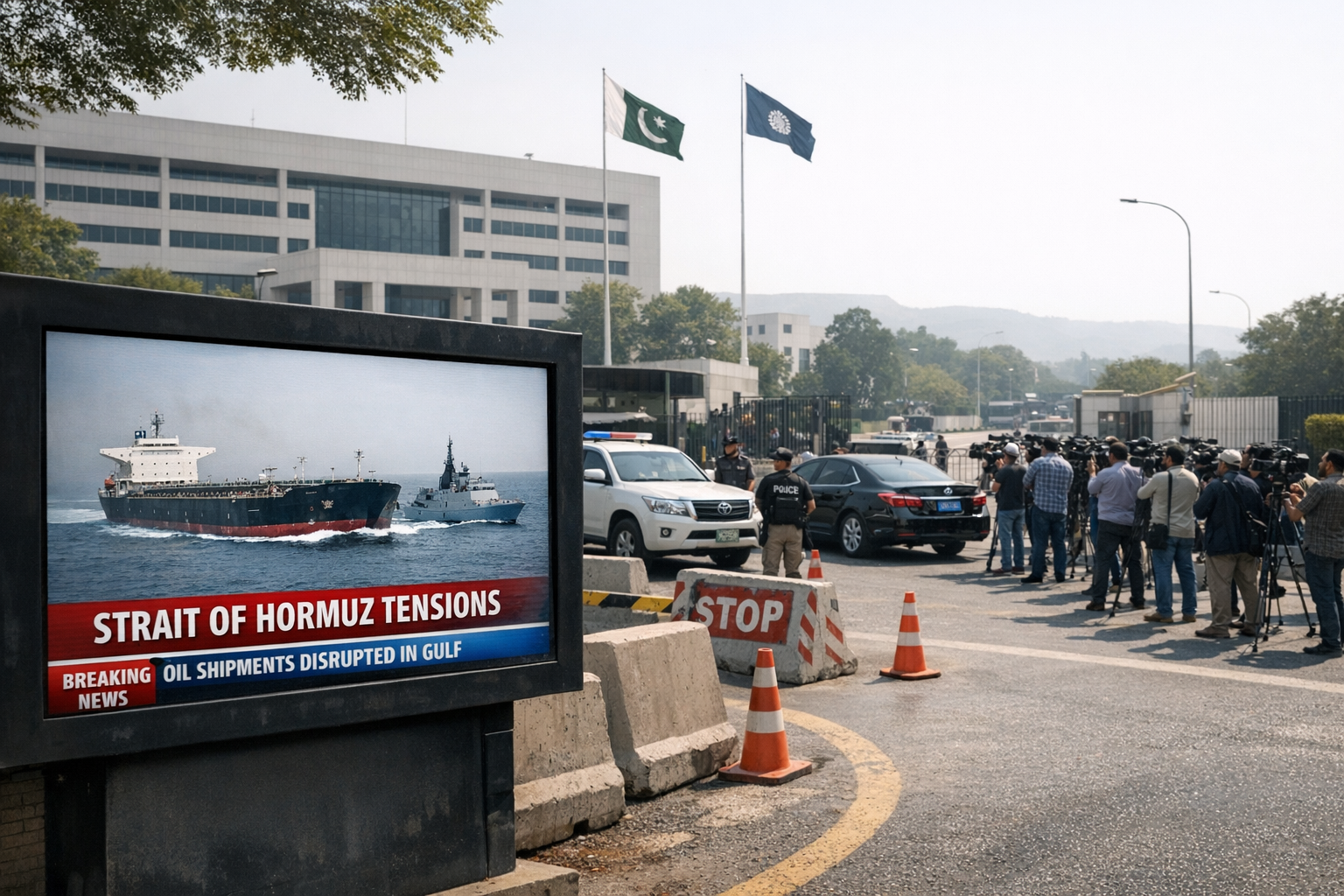
A Fragile Truce Faces Its First Test
The two-week ceasefire meant to halt the widening war around Iran was showing signs of fraying almost as soon as it began, with negotiators heading to Islamabad on Friday for what may be the most consequential talks of the crisis so far.
At the center of the dispute is the Strait of Hormuz, the narrow waterway through which a large share of the world’s oil and gas passes and which has become both the clearest measure of whether the ceasefire is real and Iran’s most potent source of leverage. President Trump accused Tehran of failing to honor commitments to restore oil transit through the strait, saying Iran was doing “a very poor job” of upholding the agreement. At the same time, Israeli strikes in Lebanon opened another fault line, with Iran arguing that any truce must cover Lebanese territory as well.
What had been announced on April 7 and 8 as a Pakistan-brokered pause in hostilities is now being tested by the very issues that made the conflict so dangerous: maritime chokepoints, regional spillover and the question of whether military pressure can be converted into political settlement.
Pakistan, which has spent weeks mediating between Washington and Tehran, is now the unlikely diplomatic center of gravity. The planned U.S.-Iran negotiations in Islamabad are intended not only to salvage the ceasefire but also to determine whether the temporary halt in fighting can be turned into something more durable.
Hormuz as Pressure Point
The immediate stakes are global as much as regional. Iran’s near-total blockade of Hormuz helped produce the most severe disruption to energy supplies in recent memory, rattling markets and underscoring how quickly a regional war can become a worldwide economic emergency.
That is why the strait has assumed an importance beyond military geography. Reopening it was built into the ceasefire framework; keeping it open is now the basic condition for proving the accord has substance. European governments and Britain have pushed urgently for maritime traffic to resume, while British officials have coordinated with Washington and Gulf allies in Saudi Arabia, the United Arab Emirates and Bahrain on securing passage.
Britain’s defense secretary, John Healey, said this week that the country’s role in the Gulf should be judged by its actions, not by Mr. Trump’s social media commentary, a reflection of the uneasy balancing act for U.S. allies trying to steady the crisis while managing an unpredictable White House.
Former American officials who negotiated the 2015 nuclear agreement with Iran say the war may have altered the diplomatic equation in ways Washington did not intend. By demonstrating it can inflict enormous economic pain through Hormuz, Iran has shown that it possesses a counterweight to America’s overwhelming military power. In their view, that lesson is likely to shape any future talks over Iran’s nuclear program, making Tehran less inclined to accept demands under duress.
Islamabad’s Moment
The choice of Islamabad as the venue for talks is itself a sign of how the crisis has reordered diplomacy. Pakistan has positioned itself as an intermediary acceptable to both sides, and its mediation produced the current ceasefire framework. Security in the capital was tightened ahead of the meetings, underscoring both the diplomatic stakes and the volatility surrounding them.
Whether the negotiations can move beyond crisis management remains uncertain. The open questions are stark: Will Iran fully restore shipping through Hormuz? Will Washington and Israel accept Tehran’s insistence that attacks in Lebanon violate the truce? And can a pause negotiated under pressure evolve into a broader political arrangement that addresses the conflict’s deeper causes, including Iran’s nuclear ambitions and the regional proxy confrontations surrounding them?
For now, even defining the boundaries of the ceasefire is contested.
China’s Quiet but Calculated Push
Hovering in the background is China, which has sought to present itself as an advocate for de-escalation while carefully tying its position to economic stability. Beijing says it made “active efforts” to secure peace, including calls by Foreign Minister Wang Yi, travel by regional envoys and a joint five-point initiative with Pakistan. Chinese officials have also emphasized that normal traffic through Hormuz is in the interest of the international community.
China’s motivations are not hard to discern. A prolonged war threatening oil flows and weakening global demand would strike at the export-led growth that remains central to its economy. Beijing has therefore approached the crisis less as an ideological contest than as a destabilizing threat to trade, energy and recovery.
That does not make its role insignificant. If the United States and Iran continue talking, China could remain a behind-the-scenes supporter of diplomacy. But if the ceasefire deteriorates further, it may try to shape the terms more directly, especially if it sees space to expand its influence as Washington’s handling of the war draws criticism.
Growing Political Blowback
That criticism is deepening in the United States and abroad. John Feeley, a former American ambassador and veteran diplomat, argued that Mr. Trump had misjudged Iran by treating intervention there as though it would resemble an easier regime-change scenario. The result, he said, has been devastation across the region and a sharp blow to the world economy.
On Capitol Hill, Representative Yassamin Ansari, an Iranian American Democrat from Arizona, has become one of the war’s fiercest critics, arguing that the intervention has only entrenched the Iranian government further rather than weakened it. Her condemnation reflects a broader debate now taking shape in Washington over whether the administration’s use of force strengthened the very regime it sought to coerce.
That question hangs over the Islamabad talks. If Iran emerges from the war convinced that its ability to threaten Hormuz gives it a stronger hand, then the conflict may have made future nuclear diplomacy harder, not easier. If the ceasefire collapses, the result could be another energy shock and a renewed cycle of strikes across the Middle East. If it holds, even tenuously, Islamabad could become the site where an emergency truce begins to turn into a more serious negotiation.
For now, the war’s pause remains just that: a pause, narrow and uncertain, with the world’s energy arteries and the credibility of several governments resting on whether it can survive the next few days.
Sources
Further reading and reporting used to add context:
- European leaders seek to stabilize US-Israel ceasefire with Iran | AP News
- https://www.thedailybeast.com/americas-closest-ally-breaks-with-donald-trump-as-his-iran-plan-goes-sideways/
- https://apnews.com/article/54306933e129bf9a03ae620f87f5cde0
- https://apnews.com/article/421ee64fdc9a5c26460df8119c7d1b3f
- https://www.thedailybeast.com/us-admiral-trolls-trump-for-aya-toll-booth-funding-iran/
- https://www.theguardian.com/politics/live/2026/apr/08/keir-starmer-iran-war-trump-ceasefire-gulf-strait-of-hormuz-labour-conservatives-liberal-democrats-reform-scotland-holyrood-uk-politics-latest-news-updates
- https://www.independent.co.uk/news/uk/home-news/keir-starmer-iran-strait-of-hormuz-donald-trump-rachel-reeves-b2950146.html
- https://www.aljazeera.com/news/2026/4/9/us-iran-talks-in-pakistan-whos-attending-whats-on-the-agenda
- https://www.theguardian.com/us-news/2026/apr/10/first-thing-islamabad-us-iran-talks-ceasefire
- https://www.aljazeera.com/news/2026/4/8/iran-says-talks-with-us-will-begin-in-pakistans-islamabad-on-friday
- https://www.iranintl.com/en/202604088216
- https://www.theguardian.com/politics/live/2026/mar/23/keir-starmer-donald-trump-strait-of-hormuz-shabana-mahood-john-healey-labour-conservatives-kemi-badenoch-cobra-uk-politics-latest-updates-news
- https://time.com/article/2026/03/16/strait-of-hormuz-international-responses-starmer-uk-trump-threatens-nato/
- https://www.newarab.com/news/trump-starmer-discuss-need-practical-plan-hormuz-uk
- https://www.cbsnews.com/live-updates/iran-war-us-israel-trump-ultimatum-strait-of-hormuz/
- https://www.al-monitor.com/newsletter/2026-03-26/china-hedges-us-iran-truce-stalls
- https://www.theguardian.com/world/2025/jul/31/former-iranian-foreign-minister-proposes-regional-nuclear-pact
- https://en.wikipedia.org/wiki/2026_Iran_war_ceasefire
- https://apnews.com/article/5032adf869db373558775db0e030f18c
- https://apnews.com/article/2a3feb0f7987079ad526a43fbae2278f
- Foreign Ministry Spokesperson Mao Ning’s Regular Press Conference on April 8, 2026_Ministry of Foreign Affairs of the People's Republic of China
- https://www.axios.com/2026/03/31/china-pakistan-iran-peace-deal-strait-ceasefire
- https://en.wikipedia.org/wiki/2026_Iran_war
- https://en.wikipedia.org/wiki/Twelve-Day_War_ceasefire
- https://en.wikipedia.org/wiki/2026_Strait_of_Hormuz_crisis
- https://finance.yahoo.com/economy/policy/articles/xi-helps-trump-iran-war-110000983.html
- https://www.theguardian.com/business/live/2026/apr/10/oil-rise-iran-war-ceasefire-china-factory-increase-business-latest-news-updates?filterKeyEvents=false&page=with%3Ablock-69d8a5ee8f08a86a0e56308b
- https://www-scmp-com.libproxy1.nus.edu.sg/news/china/diplomacy/article/3349416/trump-warns-50-cent-tariffs-arms-suppliers-iran
- https://www.newsweek.com/china-reacts-to-iran-ceasefire-trump-credits-beijing-11797141
- https://www.washingtonpost.com/business/2026/04/09/stock-markets-trump-iran-ceasefire-oil/c5d8f20a-33cf-11f1-b85b-2cd751275c1d_story.html
- https://en.wikipedia.org/wiki/Pakistan_in_the_2026_Iran_war
- https://en.wikipedia.org/wiki/Strait_of_Hormuz
- https://www.gov.uk/government/speeches/pm-remarks-16-march-2026
- https://www.reutersconnect.com/item/trump-says-he-doesnt-want-ceasefire-in-iran/dGFnOnJldXRlcnMuY29tLDIwMjY6bmV3c21sX01UMUFOQURMMDAwUUhDU0JM
- https://www.fxstreet.com/amp/news/asian-stock-markets-extend-recovery-on-trumps-ceasefire-proposal-202603250659
- https://www.fdd.org/overnight-brief/april-7-2026/
- https://www.gov.uk/government/news/pm-call-with-president-trump-of-the-united-states-22-march-2026
- https://countyvoice.denbighshire.gov.uk/english/march-2026-copy/print
- https://countyvoice.denbighshire.gov.uk/english/april-2026/print
- https://www.nimdta.gov.uk/gp-appraisal-revalidation-and-mentoring/gp-appraisal/
- https://www.lisburncastlereagh.gov.uk/w/lmp-programmes
- https://antrimandnewtownabbey.gov.uk/getmedia/d3025828-f336-4703-89e0-cfb67ceab7e6/03-Web-Agenda-Community-Development-Committee-9-March-2026_3.pdf.aspx
- https://www.breckland.gov.uk/article/25940/5-April-2026-Easter-Sunday-Duck-Race-with-Easter-Bonnet-Parade
- https://www.hart.gov.uk/about-council/councillors-and-committees/get-involved-council-decisions/consultations
- https://get-information-schools.service.gov.uk/Establishments/Establishment/Details/137241?searchQueryString=tok%3D8T8R5Bll%26startIndex%3D26400%26Count%3D30017
- https://assets.publishing.service.gov.uk/media/5a74e7aced915d502d6cbf09/Future_of_the_sea_-_implications_from_opening_arctic_sea_routes_final.pdf
- https://assets.publishing.service.gov.uk/media/6968c9343f43dfed1544b093/Iran_Toponymic_Factfile.pdf
- https://www.gamblingcommission.gov.uk/about-us/freedomofinformation/print/contacts-with-tobacco-industry
- https://assets.publishing.service.gov.uk/media/5d35b9d6ed915d0d05cb17fd/Letter_to_President_of_the_United_Nations_Security_Council.pdf
- https://isc.independent.gov.uk/wp-content/uploads/2025/07/Intelligence-and-Security-Committee-of-Parliament-Iran.pdf
- https://check-for-flooding.service.gov.uk/alerts-and-warnings?ext=-10.417383%2C49.926455%2C6.462596%2C55.844258&lyr=mv%2Cts%2Ctw%2Cta&v=map
- https://www.brent.gov.uk/children-young-people-and-families/send-local-offer/annual-reviews
- https://assets.publishing.service.gov.uk/government/uploads/system/uploads/attachment_data/file/1100525/national-strategy-for-maritime-security-web-version.pdf
- https://apnews.com/article/87b62d531d3290fde5255077179bd3b5
- https://www.axios.com/2026/04/06/iran-war-us-tehran-ceasefire-talks
- https://www.thedailybeast.com/trump-lashes-out-to-shift-blame-after-ceasefire-backlash/
- https://www.aljazeera.com/news/2026/3/24/pakistan-ready-to-host-us-iran-talks-can-latest-peace-push-work
- https://www.aljazeera.com/news/2026/4/2/can-starmers-40-nation-coalition-open-the-strait-of-hormuz
- https://www.aljazeera.com/features/2026/4/8/how-pakistan-managed-to-get-the-us-and-iran-to-a-ceasefire
- https://www.theguardian.com/world/live/2026/apr/10/iran-war-live-updates-trump-ceasefire-strait-hormuz-israel-lebanon-hezbollah?page=with%3Ablock-69d870a68f08dd483077368d
- https://www.mynbc5.com/article/iran-us-talks-islamabad-ceasefire-hormuz/70982552
- https://thediplomat.com/2026/04/pakistan-as-peacemaker-facilitates-the-us-iran-ceasefire/
- https://en.wikipedia.org/wiki/2026_Kharg_Island_attack
- https://www.washingtonpost.com/world/2026/04/02/us-iran-war-strait-hormuz-future/
- https://www.theguardian.com/politics/live/2026/apr/01/keir-starmer-rachel-reeves-iran-energy-bills-supermarket-cost-of-living-uk-politics-latest-news-updates?page=with%3Ablock-69cd17878f083e12572a7d26%23block-69cd17878f083e12572a7d26
- https://en.wikipedia.org/wiki/2026_Strait_of_Hormuz_campaign
- https://thesoufancenter.org/intelbrief-2026-april-9/
- https://www.theguardian.com/world/2026/apr/10/trump-iran-intervention-easy-as-venezuela-maduro-capture-john-feeley
- https://apnews.com/article/5e16a8e55def5966c1b073adfe1c6bf1
- https://apnews.com/article/c0079c38746a896e2967a9a9cc2799d5
- https://apnews.com/article/8628f2dbd4c911cb4cda5fb92c1aadef
- https://apnews.com/article/436162f886bdaed30c8dd0cdbe1b5aea
- https://www.lemonde.fr/en/international/article/2026/03/18/assassination-of-security-chief-larijani-strips-iran-of-key-power-broker_6751560_4.html
- https://www.aljazeera.com/news/2025/6/26/iran-moves-to-suspend-cooperation-with-un-nuclear-watchdog
- https://www.reddit.com/r/GUARDIANauto/comments/1shin4g/world_trump_reaping_bitter_fruit_of_thinking_iran/
- https://en.wikipedia.org/wiki/2026_South_Pars_field_attack
- https://en.wikipedia.org/wiki/Ali_Larijani
- https://en.wikipedia.org/wiki/Abbas_Araghchi
- https://en.wikipedia.org/wiki/Assassination_of_Ali_Larijani
- https://www.yahoo.com/news/iran-says-conducted-successful-space-061518687.html
- https://www.aljazeera.com/amp/news/2026/3/28/lawmakers-push-npt-exit-as-us-israel-hit-irans-nuclear-sites-steel-plants
- https://foreignpolicy.com/2025/04/10/us-iran-nuclear-talks-trump/comment-page-1/
- https://www.theguardian.com/commentisfree/2026/jan/15/the-guardian-view-on-trumps-world-from-venezuela-to-iran-to-greenland-the-madness-is-the-method
- https://united24media.com/world/irans-nuclear-enrichment-boom-hands-putin-global-strategic-leverage-9275
- https://en.wikipedia.org/wiki/2026_Iran_war_fuel_crisis
- https://www.locus.press/20260402
- https://time.com/article/2026/03/25/strait-of-hormuz-iran-war-weapon-option//
- https://en.wikipedia.org/wiki/2026_Iranian_strikes_on_Arab_countries
- https://www.theguardian.com/world/irans-nuclear-programme
- https://iranprimer.usip.org/blog/2025/mar/07/un-nuclear-watchdog-iran%E2%80%99s-stonewalling
- https://www.pbs.org/newshour/world/iran-meets-un-nuclear-watchdog-ahead-of-u-s-talks
- https://blackwire.world/articles/iran-nuclear-sites-struck-hormuz-pivot-march27-2026.html
- https://www.armscontrol.org/act/2025-11/features/there-way-rebuild-iaea-safeguards-iran
- https://www.yahoo.com/news/articles/iran-meets-un-nuclear-watchdog-100937712.html
- https://www.currentaffairz.com/news/view/an-atomic-tug-of-war-irans-nuclear-programme-and-the-fragile-balance-between-diplomacy-and-war/display_news
- https://www.globalguardian.com/newsroom/risk-barometer-april-2025
- https://claws.co.in/wp-content/uploads/2026/03/For-Upload_IB-492.pdf
- https://centralread.com/media/2026/02/18/The_Assam_Post_18_Feb_2026.pdf
- https://www.theguardian.com/world/2025/jun/02/iran-on-brink-of-rejecting-us-proposal-on-nuclear-programme
- https://www.theguardian.com/world/2025/jun/29/iran-nuclear-enrichment-un-ambassador
- https://www.theguardian.com/p/x4a3bx
- https://www.theguardian.com/world/2025/apr/19/irans-minister-says-nuclear-deal-possible-if-us-does-not-make-unrealistic-demands
- https://www.theguardian.com/world/2025/sep/07/iran-will-exchange-nuclear-monitoring-for-lifted-sanctions-says-its-foreign-minister
- https://www.theguardian.com/world/2025/sep/22/irans-foreign-minister-meets-with-un-nuclear-watchdog-in-bid-to-avert-sanctions
- https://www.theguardian.com/world/2025/nov/16/iran-could-rejoin-us-nuclear-talks
- https://www.theguardian.com/world/2025/may/23/iran-us-nuclear-talks-end-no-agreement-possibility-progress-
- https://www.theguardian.com/business/live/2026/apr/07/oil-price-rises-trump-deadline-iran-reopen-strait-of-hormuz-imf-business-live-news/
- https://www.theguardian.com/commentisfree/2026/apr/08/iran-crisis-ceasefire-friday-talks-islamabad-nuclear-programme
- https://www.theguardian.com/world/2025/apr/20/moscow-may-gain-key-role-in-iran-nuclear-deal-as-us-talks-progress
- https://ausadvertising.theguardian.com/assets/files/guardianadvertising_shift_happens_au_2025.pdf
- https://recruiters.theguardian.com/assets/files/inclusive_recruitment/The-Guardian-Jobs-guide-to-inclusive-recruitment.pdf
- https://advertising.theguardian.com/assets/files/the-guardian-advertising-awards-2025-t%26cs-%281%29.pdf
- https://recruiters.theguardian.com/assets/files/hr_tech/HRTechGuide_GuardianJobs.pdf
- https://apnews.com/article/ea13fc589d1dd75e552de883f2e86e71
- https://www.axios.com/2026/04/06/pete-hegseth-impeach-democrats-iran-war-trump
- https://www.thedailybeast.com/pentagon-pete-hegseth-hit-with-humiliating-impeachment-threat-as-war-chaos-spirals/
- https://www.axios.com/2026/04/07/trump-iran-impeachment-25th-amendment-war-crimes
- https://www.theguardian.com/world/2026/apr/10/yassamin-ansari-representative-congress-iran-trump
- https://apnews.com/article/5d7d93c7793802881d9cde042220d7bc
- https://apnews.com/article/e2e17a76d79617a68370f076c0291208
- https://www.theguardian.com/world/live/2026/apr/08/iran-war-ceasefire-live-updates-trump-deadline-middle-east-crisis-latest-news?page=with%3Ablock-69d6d0a28f0892bae50d7b95
- https://www.aljazeera.com/news/2026/3/25/iran-calls-us-proposal-to-end-war-maximalist-unreasonable
- https://www.theguardian.com/world/2026/apr/10/all
- https://www.theguardian.com/us-news/live/2026/apr/07/government-shutdown-congress-house-of-representatives-donald-trump-republicans-democrats-ice-us-politics-latest-updates-news?filterKeyEvents=false&page=with%3Ablock-69d5388d8f082af210bc5564
- https://ansari.house.gov/media/press-releases/rep-ansari-statement-on-temporary-us-iran-ceasefire
- https://www.theguardian.com/us-news/live/2026/apr/06/trump-iran-war-congress-us-politics-live
- https://www.vanguardngr.com/2026/04/us-lawmakers-divided-over-trump-ceasefire-announcement/
- https://www.wusf.org/2026-04-07/u-s-and-iran-agree-to-2-week-ceasefire-suspending-trumps-threat-to-annihilate-iran
- https://www.wbur.org/news/2026/04/07/markey-pressley-moulton-clark-trahan-warren-congress-trump-iran/
- https://www.theguardian.com/commentisfree/2026/apr/08/the-guardian-view-on-trump-iran-and-the-ceasefire-a-devastating-war-has-only-losers
- https://www.yahoo.com/news/articles/iranian-american-lawmaker-says-trump-204436404.html