
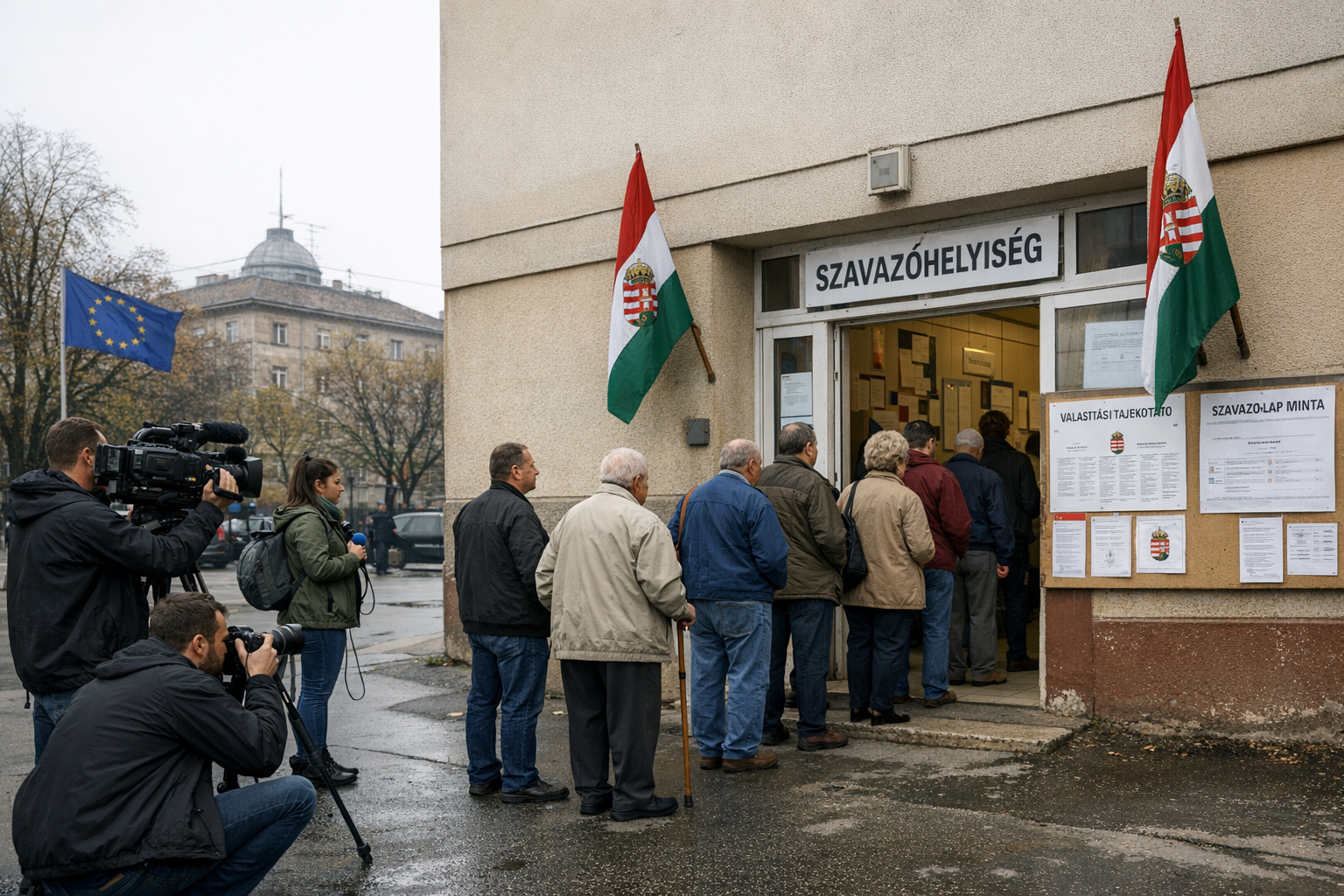
A Defining Vote for Hungary, and a Test for Europe
Hungary heads to the polls on Sunday in what is widely seen as the most serious threat yet to Prime Minister Viktor Orbán’s 16-year hold on power, as a fast-rising challenger, Péter Magyar, has turned a once-fragmented opposition into a genuine electoral force.
The contest has sharpened into more than a struggle over one government’s future. It has become a referendum on the direction of Hungary’s democracy, its place in Europe and, increasingly, the integrity of the election itself.
In recent days, members of the European Parliament have pressed the European Commission to examine allegations of possible Russian interference, intimidation of journalists and pressure on voters tied to the campaign environment. Those concerns have deepened the sense that Sunday’s vote will reverberate far beyond Budapest.
For Brussels, Hungary has long been both a political problem and a warning sign: an E.U. member state whose leader cultivated an “illiberal” model, clashed repeatedly with the bloc over rule-of-law standards and maintained unusually warm ties with Moscow even after Russia’s invasion of Ukraine. Now, with Orbán facing a competitive race at home, the election is being watched as a measure of whether that model can still command democratic consent.
The Rise of Péter Magyar
At the center of the upheaval is Mr. Magyar, 45, a former insider in Orbán’s Fidesz world who has recast himself as the vehicle for change. His Tisza party, once peripheral, has surged since the 2024 European election cycle and is now the main opposition challenger.
His biography is central to his appeal. Mr. Magyar is not an outsider in the classic sense, but a defector from the governing camp, someone who knows the mechanics, language and vulnerabilities of the system he now seeks to dismantle. That has allowed him to present himself to voters not simply as an opponent of Orbán, but as proof that disillusionment has spread into the heart of the ruling establishment itself.
His message has tapped into grievances that have accumulated over years: stubborn cost-of-living pressures, economic unease, allegations of corruption and frustration with public services. He has also tried to strike a careful ideological balance, offering a sharper break with Orbán’s confrontational relationship with Brussels while avoiding the appearance of abandoning Hungarian sovereignty or conservative instincts on issues like migration.
That positioning has helped Tisza gather support from voters weary of Fidesz but skeptical of the older opposition parties that repeatedly failed to unseat Mr. Orbán.
Orbán’s Toughest Contest in Years
Mr. Orbán remains one of Europe’s most durable political survivors, and his dominance has often seemed to rest on a combination of ideological clarity, message discipline and a state machinery shaped over more than a decade and a half in office. Since returning to power in 2010, he has redrawn Hungary’s political landscape, centralizing authority and building a system that critics say has weakened institutional checks, narrowed media pluralism and tilted the electoral field in favor of the ruling party.
That record has made him a hero to parts of the international nationalist right and a persistent antagonist for mainstream European leaders. But it has also produced fatigue at home.
Recent polling has pointed in conflicting directions, with some surveys suggesting Tisza is ahead and others indicating a much tighter race. What is clear is that the election is no longer a foregone conclusion. The key question is not only who wins the vote, but whether any opposition lead can be converted into a workable parliamentary majority under Hungary’s electoral system, which has in the past amplified Fidesz’s advantage.
That uncertainty has injected unusual suspense into a political system that, for years, appeared structured to deny it.
Alarm Over Possible Interference
As the campaign entered its final stretch, attention shifted sharply to the conditions under which the vote is being held.
A group of lawmakers in the European Parliament has called on Ursula von der Leyen, the president of the European Commission, and the bloc’s top rule-of-law officials to examine allegations that the election may be vulnerable to manipulation, including possible Russian disinformation efforts, coercion of voters and intimidation of journalists.
The claims come at a moment of particular sensitivity. Hungary’s relationship with Russia has long unsettled European partners, and scrutiny has intensified following investigative reporting and leaked material suggesting unusually close contacts between Hungarian and Russian actors. Those allegations are politically explosive and have not been fully adjudicated. But in the current atmosphere, they have added to long-running fears that Hungary’s democratic institutions are under strain and that external influence could exploit those weaknesses.
For the European Union, the concern is not merely whether there has been interference in a technical sense. It is whether one of the bloc’s member states can still guarantee a contest that is free, fair and insulated from both domestic intimidation and foreign manipulation.
Why the Outcome Matters Beyond Hungary
The stakes of Sunday’s vote extend well beyond national politics.
If Mr. Orbán prevails again, he is likely to claim renewed legitimacy for a model that has challenged the E.U. consensus on migration, judicial independence, media freedom and support for Ukraine. Such a result would reinforce his status as the bloc’s most disruptive nationalist leader and could embolden allies across Europe and the United States who see him as a template for conservative power.
If Mr. Magyar breaks through, the implications could be equally profound. He has framed the election as a choice between continued democratic erosion and a return to a more conventional place within the European mainstream. A Tisza victory would not erase Hungary’s accumulated institutional conflicts overnight, but it could reset the country’s relationship with Brussels and alter the balance of power inside the European Union.
That is one reason officials in Brussels are watching so closely. The election comes at a time when the E.U. is confronting Russian pressure, internal fragmentation and rising support for nationalist parties in several member states. Hungary, long treated as an exceptional case, now looks like a battlefield over whether that trajectory can be reversed.
The Unanswered Questions
Even at this late stage, much remains unsettled. Polling has been inconsistent. The extent of any opposition advantage is unclear. The impact of alleged interference or campaign irregularities, if any, may be impossible to measure quickly. And the European Commission is unlikely to resolve such questions before voters cast their ballots.
There is also the practical matter of governance. Even if Mr. Magyar wins the popular vote, the architecture of Hungary’s electoral system means the decisive question may be whether he can secure enough seats to govern effectively.
Still, the sense of consequence is unmistakable. In Hungary, elections have often been portrayed by the government as civilizational struggles. This time, many voters — and many European officials — appear to believe that description may be less hyperbole than usual.
Sunday’s result will help determine not only who governs Hungary, but whether a political order that has defined much of Europe’s democratic anxiety for more than a decade is entering a new phase, or proving once again how hard it is to dislodge.
Sources
Further reading and reporting used to add context:
- https://apnews.com/article/348539b3911d721bcf8f3e0d1f937ab3
- https://apnews.com/article/5ce359a2bf065484669454b722237ea1
- https://apnews.com/article/08e0929e9c8b3ae4302ae4e8c0393d5e
- https://apnews.com/article/69868c03330a50c679050bf585cdf92e
- https://www.euronews.com/my-europe/2026/04/01/hungarian-opposition-tisza-party-cements-lead-ahead-of-april-elections-polls-show
- https://www.euronews.com/2026/02/19/hungarian-polls-split-on-april-election-outcome-as-fidesz-and-tisza-trade-leads
- https://www.euronews.com/my-europe/2026/01/12/eu-freezes-hungarian-files-ahead-of-key-election-in-april-fearing-orban-campaign-backlash
- https://www.theguardian.com/world/2026/apr/09/meps-alarm-possible-russian-interference-hungary-elections
- https://www.euronews.com/my-europe/2025/08/18/debunking-moscows-allegations-the-eu-is-plotting-hungarian-regime-change
- https://www.intellinews.com/latest-hungarian-poll-puts-tisza-party-20-points-ahead-of-fidesz-428295/
- https://apnews.com/article/408ab04702c28390fef5ba785bf14a2d
- https://brusselssignal.eu/2026/03/ec-launches-dsa-crackdown-on-disinformation-ahead-of-hungary-elections/
- https://www.yahoo.com/news/articles/hungarys-opposition-leads-polls-far-082600409.html
- https://instituteofgeoeconomics.org/en/research/2026040901/
- https://polymarket.com/event/hungary-parliamentary-election-popular-vote-margin-of-victory/will-tisza-win-the-national-list-vote-in-the-2026-hungarian-parliamentary-election-by-3-6
- https://www.robert-schuman.eu/en/monitor/6758-viktor-orban-under-pressure-from-peter-magyar-s-tisza-party
- https://hungarytoday.hu/many-election-polls-many-conflicting-results/
- https://en.wikipedia.org/wiki/2026_Hungarian_parliamentary_election
- https://www.europarl.europa.eu/doceo/document/P-10-2026-001155_EN.html
- https://apnews.com/article/014af62a374215d3feceec5f9b2db7ad
- https://apnews.com/article/71b54205f00252ca7c466eb5407a2aa1
- https://www.yahoo.com/news/articles/russia-sending-election-operatives-hungary-081921735.html
- https://en.wikipedia.org/wiki/Opinion_polling_for_the_2026_Hungarian_parliamentary_election
- https://www.hungarianconservative.com/articles/politics/orban-hungary-election-2026-politico-brussels-interference-peter-magyar
- https://eutoday.net/tisza-extends-polling-lead-over-orban/
- https://www.intellinews.com/russian-intelligence-allegedly-deploys-team-to-budapest-embassy-to-sway-elections-vsquare-says-430185/?source=hungary
- https://www.eunews.it/en/2026/04/09/meps-sound-the-alarm-ahead-of-the-hungarian-election-the-freedom-and-fairness-of-the-election-are-at-risk/
- https://hungarytoday.hu/hungarians-reject-the-idea-of-early-elections/
- https://www.pravda.com.ua/eng/news/2026/04/09/8029462/
- https://www.euronews.com/my-europe/2026/03/26/budapests-moscow-eu-barroso
- https://www.euronews.com/my-europe/2026/04/08/new-leaks-reveal-szijjarto-briefing-russias-lavrov-on-key-eu-summit
- https://www.euronews.com/my-europe/2026/03/26/newsletter-cut-hungary-from-eu-talks-unless-it-explains-allegations-of-leaks-to-russia-bar
- https://www.euronews.com/2026/03/26/hungarian-minister-russia-leaks-highlight-eu-weaknesses-as-information-is-weaponised
- https://www.lemonde.fr/en/international/article/2026/03/26/regular-exchanges-between-hungarian-and-russian-foreign-ministers-spark-scandal-in-brussels_6751820_4.html
- https://www.yahoo.com/news/articles/politico-eu-excludes-hungary-sensitive-035800655.html
- https://www.lemonde.fr/en/international/article/2026/04/03/espionage-suspicions-and-tense-exchanges-brussels-on-edge-ahead-of-hungary-elections_6752086_4.html
- https://www.aljazeera.com/news/2026/3/23/eu-calls-for-clarification-after-hungary-accused-of-leaking-info-to-russia
- https://www.polskieradio.pl/395/9766/artykul/3668032%2C%E2%80%98im-always-at-your-disposal%E2%80%99-leaked-calls-suggest-hungary-helped-russia-fight-eu-sanctions
- https://telex.hu/english/2026/04/09/hungary-betrayed-eu-by-szijjarto-promising-assistance-to-lavrov-french-foreign-minister-says
- https://www.eunews.it/en/2026/03/24/the-hungarian-minister-confirms-i-make-phone-calls-to-russia-during-eu-meetings/
- https://interfax.com/newsroom/top-stories/111681/
- https://www.theguardian.com/world/2026/apr/01/ukraine-war-briefing-ukraine-calls-hungary-a-disgrace-after-leaked-calls-with-moscow-emerge
- https://en.wikipedia.org/wiki/Accession_of_Ukraine_to_the_European_Union
- Orbán's rural base is still behind the Hungarian leader ahead of Sunday's pivotal vote
- Exclusive: Orbán challenger Magyar says election is a 'referendum' on Hungary's place in the world
- Hungary sets April 12 election date as Orbán faces tough challenge
- Hungarian polls split on April election outcome as Fidesz and Tisza trade leads | Euronews