
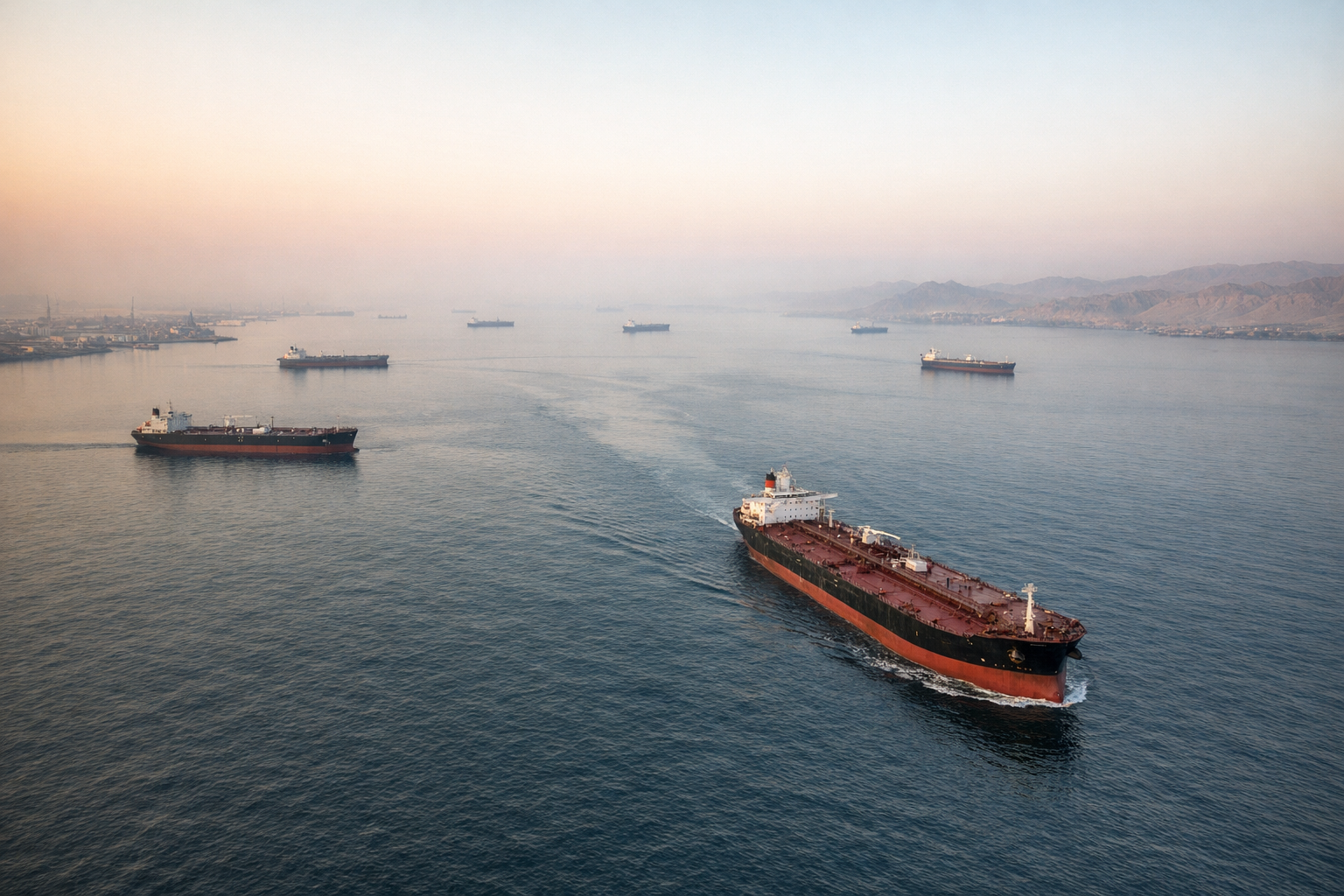
Oil markets remain on edge as Hormuz stays effectively shut
The fragile ceasefire between Washington and Tehran has done little to calm the world’s oil markets, as tanker traffic through the Strait of Hormuz remains far below normal and crude prices push back toward $100 a barrel.
By Thursday, the hoped-for reopening of the strategic waterway had not materialized. Sultan Al Jaber, the head of Abu Dhabi’s state oil company, said the strait was “not open,” describing access as subject to “permission, conditions and political leverage” by Iran. Ship-tracking data cited across market reports showed only a small number of vessels moving through the passage during the ceasefire, underscoring how limited the recovery has been.
That failure has become the clearest sign yet that the ceasefire, announced earlier this week, has not restored confidence in the physical oil trade. Brent crude, which initially dipped on news of the truce, reversed course as traders confronted the reality that one of the world’s most important energy chokepoints remains constrained.
The Strait of Hormuz carries roughly one-fifth of the world’s oil under normal conditions. When passage slows there, the effects ripple far beyond the Gulf: cargoes are delayed, tanker availability tightens, insurance costs rise and refiners begin to worry not simply about price, but about whether barrels will arrive at all.
A ceasefire in name, but not in shipping
The truce was meant to halt hostilities and restore safe passage. Instead, it has been weakened almost immediately by disputes over its scope, particularly after Israeli strikes in Lebanon prompted Iran to effectively reclose the channel, according to reporting from the region.
President Donald Trump has publicly pressed Tehran to allow unrestricted passage, warning that Iran “better stop now” if it is charging tankers to transit the strait. The White House has tied the durability of the ceasefire to the “complete, immediate, and safe opening” of Hormuz.
But for shipowners and traders, political statements have mattered less than the operational reality. Shipping specialists say traffic is unlikely to normalize quickly, even if diplomacy holds, because owners are still weighing war-risk premiums, legal liability and the possibility that rules of passage could change with little warning. In such an environment, even a nominal reopening does not amount to a functioning trade route.
That distinction is now shaping prices in the real market for oil, where analysts say the strain is visible not merely in futures trading but in the cost and availability of physical cargoes. The concern is no longer only that a wider war could interrupt supplies. It is that Iran may seek to control flows through inspections, permissions or transit charges, creating a more persistent form of disruption even short of open conflict.
Supply strains widen beyond the strait
The pressure on the market has been compounded by damage elsewhere in the region. Attacks on Saudi energy infrastructure have cut about 600,000 barrels a day of production capacity and reduced throughput on the kingdom’s East-West pipeline by roughly 700,000 barrels a day, according to figures reported in trade and wire coverage.
That matters because the East-West pipeline has long been viewed as one of the principal alternatives to Hormuz, allowing Saudi crude to reach the Red Sea without passing through the strait. Any reduction in that route leaves producers and buyers with fewer options at precisely the moment flexibility is most needed.
The result is a market that remains stressed despite the absence, for now, of a full-scale collapse in diplomacy. Crude benchmarks rose again in Asian trading, with both Brent and West Texas Intermediate posting gains as investors digested signs that the ceasefire had failed to bring tankers back in meaningful numbers.
The economic fallout is already spreading
The consequences are being felt most acutely in oil-importing economies across Asia, where higher fuel costs are pushing up transport, manufacturing and food prices.
In Australia, fuel shortages have already emerged at hundreds of service stations, prompting the government to release reserves, reduce fuel excise and roll out emergency fuel-security measures. In India and Sri Lanka, farmers have begun warning of fertilizer shortages tied to the energy disruption, raising fears that an oil shock could spill into agricultural production and food inflation.
Those pressures have stirred comparisons to the Asian financial crisis of the late 1990s, when surging costs and weakening currencies fed broader instability. Economists say the comparison is imperfect: many countries in the region now hold larger reserves, have more flexible exchange rates and are better positioned to absorb external shocks. Still, the current episode is a reminder of how quickly a shipping crisis in the Gulf can become an inflation problem half a world away.
In Britain, Prime Minister Keir Starmer has voiced frustration at the way geopolitical conflict is feeding directly into household energy costs, reflecting a broader political dilemma for governments already struggling with voters’ fatigue over inflation.
Why the next few days matter
The immediate question is whether the ceasefire can survive long enough to restore genuine freedom of navigation. Just as important is whether shipowners believe it. Tanker traffic does not return because diplomats declare calm; it returns when crews, insurers and charterers conclude that the route is safe, legally clear and commercially viable.
For now, they have not reached that conclusion.
That leaves the oil market confronting a dangerous middle ground: not an outright regional shutdown, but a partial, politicized restriction on a waterway central to the global economy. Such a scenario can be almost as destabilizing as open warfare, because it injects uncertainty into every link of the supply chain — from producers and shippers to refiners, truckers and consumers.
As long as Hormuz remains only partly accessible, and as long as passage depends on conditions set in Tehran rather than established norms of maritime transit, the ceasefire will offer only limited relief. The military confrontation may have paused. The energy shock has not.
Sources
Further reading and reporting used to add context:
- https://www.axios.com/2026/04/09/iran-us-strait-of-hormuz-khamenei
- European leaders seek to stabilize US-Israel ceasefire with Iran | AP News
- https://www.thedailybeast.com/us-admiral-trolls-trump-for-aya-toll-booth-funding-iran/
- https://www.thedailybeast.com/donald-trump-slams-evil-reporters-for-exposing-his-unraveling-peace-plan/
- https://www.thedailybeast.com/americas-closest-ally-breaks-with-donald-trump-as-his-iran-plan-goes-sideways/
- https://apnews.com/article/54306933e129bf9a03ae620f87f5cde0
- https://www.theguardian.com/business/2026/apr/09/oil-price-rises-as-markets-question-durability-of-middle-east-ceasefire-iran
- https://www.dailysabah.com/business/energy/strait-of-hormuz-still-shut-must-reopen-without-conditions-adnoc
- https://en.wikipedia.org/wiki/2026_Iran_war_ceasefire
- https://pgjonline.com/news/2026/april/attacks-cut-saudi-output-by-600-000-bpd-slash-east-west-pipeline-flows
- https://www.icis.com/explore/resources/news/2026/04/08/11196067/tanker-traffic-through-strait-of-hormuz-halted-amid-israel-strikes-on-lebanon-fars
- https://en.wikipedia.org/wiki/2026_Kharg_Island_attack
- https://en.wikipedia.org/wiki/2026_Aramco_refinery_attack
- https://www.al-monitor.com/originals/2026/04/iran-has-attacked-saudi-arabias-jubail-petrochemical-complex-irgc-says
- https://www.digitaljournal.com/business/strait-of-hormuz-traffic-remains-becalmed-despite-ceasefire/article
- https://www.cubaheadlines.com/articles/325263
- https://houseofsaud.com/iran-kuwait-desalination-strike-april-2026/
- https://thesoufancenter.org/intelbrief-2026-april-9/
- https://www.semafor.com/article/04/06/2026/limited-tanker-flow-returns-to-hormuz
- https://en.wikipedia.org/wiki/2026_South_Pars_field_attack
- https://en.wikipedia.org/wiki/2026_Strait_of_Hormuz_crisis
- https://fortune.com/2026/04/09/strait-of-hormuz-tankers-ships-oil-crude-brent-gas-wti-prices-markets-taco-trump//
- https://www.lines.com/prediction-markets/economy/strait-of-hormuz-traffic-returns-to-normal-by-april-30
- https://www.cnbc.com/2025/06/23/us-joins-iran-israel-war-stoking-worries-about-oil-volatility-.html
- https://www.cnbc.com/2025/04/25/asia-pacific-markets-live-tokyo-cpi-gold-us-china.html
- https://www.cnbc.com/2025/06/23/us-iran-crisis-shipping-groups-seen-avoiding-the-strait-of-hormuz.html
- https://www.cnbc.com/2025/02/13/asia-pacific-markets-set-for-higher-open-after-wall-street-declines-on-inflation-fears-.html
- https://www.cnbc.com/2025/05/02/asia-markets-live-stocks-set-to-trade-mixed.html
- https://www.cnbc.com/2025/04/14/asia-markets-live-updates.html
- https://www.cnbc.com/2025/06/24/virgin-australia-shares-soar-8point3percent-in-439-million-ipo-debut.html
- https://www.cnbc.com/2025/06/13/asia-pacific-markets-live-us-china-trade.html
- https://www.cnbc.com/2024/03/20/red-sea-crisis-may-lead-to-tanker-shortage-kuwait-petroleum-ceo-says-.html
- https://www.cnbc.com/2025/06/22/gulf-markets-end-higher-iran-strike.html
- https://www.cnbc.com/2025/06/25/asia-pacific-markets-live-australia-cpi-fed.html
- https://www.cnbc.com/2025/04/10/asia-markets-live-trump-tariff-pause-rally.html
- https://fm.cnbc.com/applications/cnbc.com/resources/editorialfiles/2025/04/21/fullsurveyliesmanhere.pdf
- https://fm.cnbc.com/applications/cnbc.com/resources/editorialfiles/2022/03/31/Joint_Statement_of_the_Russian_Federation_and_the_Peoples_Republic_of_China_on_the_International_Relations_Entering_a_New_Era_and_the_Global_Sustainable_Development__President_of_Russia.pdf
- https://apnews.com/article/004f246d084871c4e2460a9baf786506
- https://apnews.com/article/29e03d9dd5e31c5ea10d2bdc87d68257
- https://www.lemonde.fr/en/economy/article/2026/03/14/kharg-island-iran-s-key-oil-export-hub_6751437_19.html
- https://apnews.com/article/21e634acba4c35801d28dfdbcc53824a
- https://houseofsaud.com/opec-april-5-saudi-oil-weapon-iran-war/
- https://en.wikipedia.org/wiki/2026_Qeshm_Island_desalination_plant_attack
- https://www.icis.com/explore/resources/news/2026/04/06/11195438/attacks-on-mideast-energy-petrochemical-facilities-intensify
- https://www.thenationalnews.com/business/energy/2026/03/02/iran-attacks-saudi-oil-qatar-gas//
- https://fortune.com/2026/03/01/opec-oil-output-increase-saudi-arabia-russia-iran-conflict-crude-prices/
- https://es.wikipedia.org/wiki/Ataque_contra_la_refiner%C3%ADa_de_Ras_Tanura
- https://www.investing.com/news/commodities-news/oil-extends-gains-to-rise-56-after-iran-attacks-gulf-energy-facilities-4569709
- https://www.iranintl.com/en/202602257596
- https://www.insurancejournal.com/news/international/2026/04/07/864740.htm
- https://apnews.com/article/4b464b08aaf7220899526c0c6da4317d
- https://apnews.com/article/3ef5dcd907122922db714d318c35317e
- https://www.axios.com/2026/04/08/iran-ceasefire-oil-shipping-impact-prices
- https://apnews.com/article/640e644b57df5c762ed9c57ef87b0427
- https://apnews.com/article/38d75d5e4f1c7339a1456fc99415bb2a
- https://www.lloydslist.com/LL1156847/Shipowners-and-charterers-prepare-to-move-after-US-and-Iran-agree-ceasefire
- https://www.lloydslist.com/LL1156478/Iran-attacks-prompt-Red-Sea-rethink-as-box-shipping-exits-Strait-of-Hormuz
- https://www.theguardian.com/business/2026/mar/20/risk-london-shipping-industry-iran-war-lloyds-of-london-premiums
- https://www.wired.com/story/the-strait-of-hormuz-reopens-but-global-shipping-will-take-months-to-recover/
- https://www.lloydslist.com/LL1153384/US-Houthi-ceasefire-not-expected-to-spur-imminent-Red-Sea-return
- https://nz.news.yahoo.com/experts-see-no-sign-shipping-113418192.html
- https://shippingtelegraph.com/container-news/after-us-iran-war-ceasefire-shipowners-not-rushing-for-hormuz-return/
- https://en.wikipedia.org/wiki/2026_Strait_of_Hormuz_campaign
- https://www.lloydslist.com/LL1153988/Why-a-ceasefire-and-sanctions-deal-with-Iran-does-not-necessarily-reopen-the-Red-Sea