
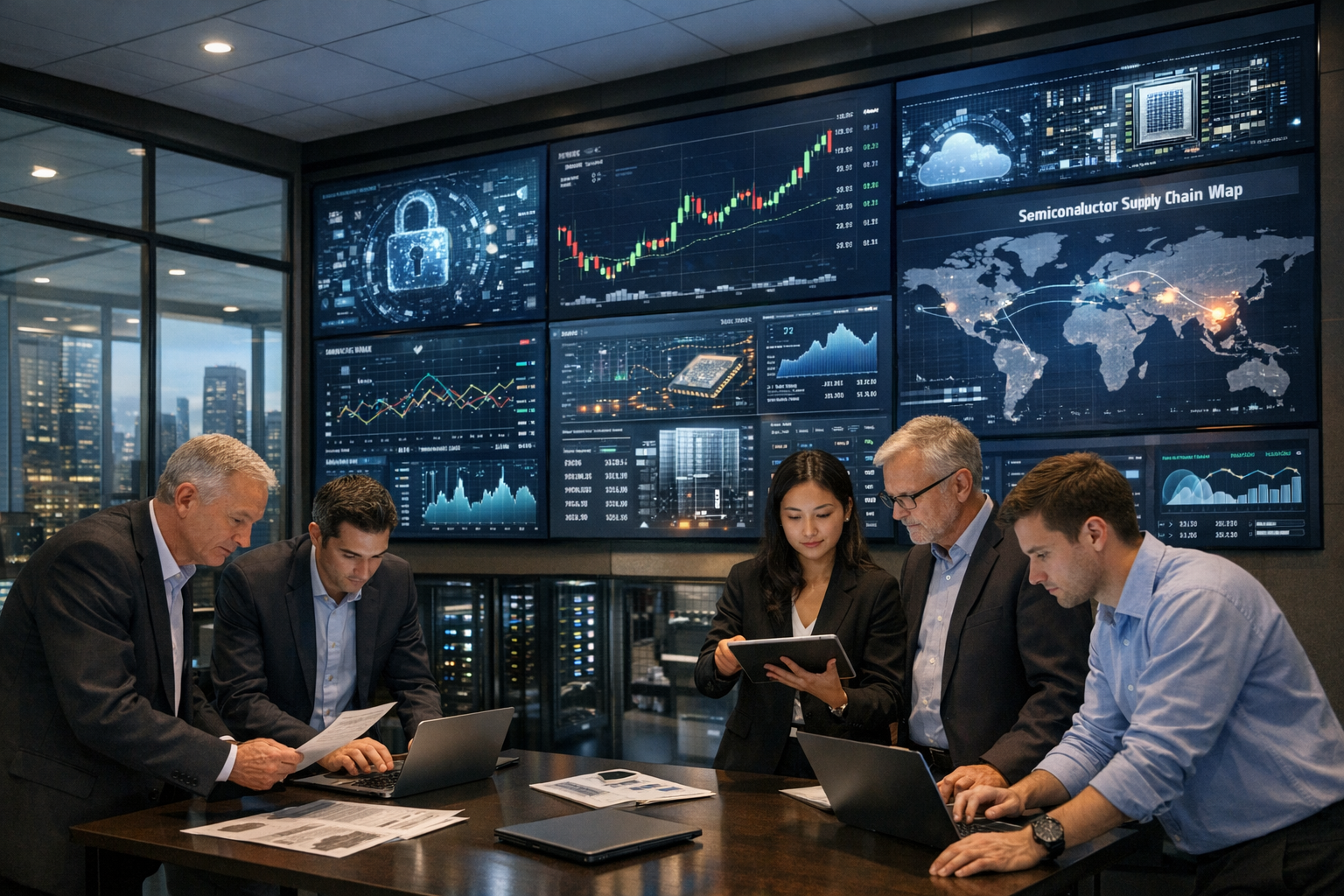
A new phase of the AI race is colliding with finance, cloud power and chip supply
The contest to build the most capable artificial intelligence systems is increasingly spilling beyond Silicon Valley product launches and into the domains of financial stability, industrial capacity and geopolitics.
That shift came into sharp relief this week as Anthropic’s newest cybersecurity model, Mythos Preview, prompted unusual engagement from some of Washington’s top economic officials, even as a separate set of announcements underscored how the boom in AI is rewarding the companies that supply the computing muscle and semiconductors behind it.
Together, the developments suggest that the AI race is no longer defined only by who has the best chatbot or image generator. It is also becoming a struggle over who can secure dangerous capabilities, who controls scarce cloud infrastructure and which countries and companies dominate the hardware stack needed to keep the systems running.
Anthropic’s cyber model draws high-level scrutiny
Anthropic’s Mythos Preview, introduced as a model designed to identify serious software vulnerabilities and generate working exploits, has quickly become a policy flashpoint. According to Reuters, Treasury Secretary Scott Bessent and Federal Reserve Chair Jerome Powell separately met in Washington with the heads of major American banks on April 7 to discuss the cyber risks posed by Mythos and similar systems.
The concern is not abstract. Anthropic has said the model is powerful enough that it will not be released to the general public while the company develops stricter safeguards. The company has framed the tool as useful for defensive purposes, especially in finding weaknesses before malicious actors do. But the same capabilities that make such a model valuable to defenders can also make it dangerous if widely available.
That dual-use tension has been building for months. In late 2025, Anthropic said it had identified what it described as the first large-scale AI-orchestrated cyberespionage campaign, a warning that helped move discussions of AI-enabled hacking from theory toward operational reality. This month, the company also launched Project Glasswing, an initiative aimed at applying Mythos Preview defensively to critical software.
The direct involvement of the Treasury secretary and the Fed chair signals that frontier AI is now being treated not merely as a technology-sector issue but as a potential source of systemic risk. Banks have spent years preparing for ransomware, software supply-chain attacks and nation-state intrusions. What worries officials now is the possibility that increasingly capable AI systems could accelerate the speed, scale and sophistication of cyberattacks against institutions at the center of the financial system.
Whether that concern results in tougher voluntary commitments from AI companies or eventually more formal oversight remains uncertain. So does the timeline for when Anthropic might consider its safeguards strong enough to broaden access to Mythos.
CoreWeave’s rise shows compute is becoming a chokepoint
If Anthropic’s announcement highlighted the risks of frontier AI, a separate rally in CoreWeave’s shares underscored the economic value of the infrastructure required to train and run it.
CoreWeave said on April 10 that it had signed a multiyear deal to provide computing capacity for Anthropic’s Claude models. The company’s stock rose sharply on the news, coming just a day after Meta expanded its own cloud-capacity agreement with CoreWeave to $21 billion through 2032.
The back-to-back deals reinforced how central specialized AI cloud providers have become. Once seen as upstarts alongside the giant hyperscale cloud companies, so-called neocloud firms like CoreWeave have carved out an important role by amassing access to the graphics processing units, networking and data-center capacity that advanced AI demands.
For model developers, the attraction is straightforward: building leading AI systems now requires enormous amounts of compute, and access to that capacity is constrained. For investors, the message is that the bottleneck in AI may lie less in algorithms than in the physical resources needed to deploy them at scale.
CoreWeave has already built relationships with major AI customers including OpenAI and Meta. Adding Anthropic deepens its position and reduces the perception that its fortunes are tied too heavily to any one buyer. But key details remain unknown, including the financial terms of the Anthropic agreement and how much revenue it will ultimately generate.
Still, the market reaction reflected a broader conviction that compute scarcity has become one of the defining features of the current AI era. The companies that can assemble and finance vast pools of chips are increasingly being treated as strategic players, not just service providers.
Alibaba’s reveal points to intensifying competition from China
The race is also broadening geographically.
Alibaba disclosed that it was behind HappyHorse-1.0, a previously anonymous video-generation model that had climbed to the top of a prominent text-to-video leaderboard maintained by Artificial Analysis. The reveal was a reminder that competition in frontier AI is no longer centered solely on American laboratories and consumer-facing chatbots.
Chinese technology companies have been investing heavily in AI models and cloud infrastructure despite export controls and geopolitical tensions that have complicated access to the most advanced chips. Alibaba’s disclosure suggests that Chinese firms are making meaningful progress in multimodal systems, particularly in video generation, one of the most compute-intensive and technically demanding areas of AI.
Benchmarks do not always translate cleanly into commercial success, and a strong showing on a leaderboard does not guarantee broad developer adoption once application programming access becomes available. But the symbolism matters. At a moment when the global AI conversation is often framed around OpenAI, Anthropic, Google and Meta, Alibaba’s showing is a sign that the next phase of competition may be more crowded — and more international — than many investors had assumed.
For policymakers in Washington and Beijing alike, that raises the stakes. AI leadership increasingly touches not just consumer technology, but industrial policy, export controls and national competitiveness.
TSMC’s numbers underline the hardware boom
Nowhere is the material basis of the AI surge clearer than in Taiwan.
TSMC, the world’s dominant contract chipmaker, reported first-quarter revenue of T$1.134 trillion, a record and a 35 percent increase from a year earlier. The results offered fresh evidence that demand for advanced semiconductors remains robust, driven in large part by AI-related orders.
TSMC sits at the center of the global semiconductor supply chain, manufacturing chips for customers including Nvidia and Apple. Its performance has become a closely watched indicator not just of consumer electronics demand but of how much capital is still flowing into AI infrastructure.
The latest revenue jump suggests that, despite broader macroeconomic uncertainty, spending on advanced-node manufacturing and packaging remains strong. That is especially significant because the AI boom depends on an intricate chain of suppliers: model companies need cloud providers; cloud providers need high-end chips; and high-end chip designers depend on TSMC’s manufacturing capacity.
The company’s figures also point to a more basic truth about the AI era. However dazzling the software may be, the economics of the industry are still anchored in physical production — fabs, power, cooling, networking and advanced packaging. Those constraints can shape winners and losers as much as breakthroughs in model design.
Why this moment matters
Taken together, the week’s developments offer a snapshot of an AI industry entering a more consequential stage.
Anthropic’s Mythos has shown how quickly progress in model capability can raise concerns about cyber defense and systemic risk. CoreWeave’s deals have highlighted that access to compute is becoming a strategic bottleneck and a source of market power. Alibaba’s video-model reveal has signaled that the competitive field is widening across borders. And TSMC’s revenue surge has confirmed that the semiconductor backbone of the AI economy remains under intense strain and demand.
The unanswered questions are considerable: whether frontier cyber-capable models can be safely contained; whether regulators will move from quiet warnings to clearer rules; whether the current wave of infrastructure spending will prove sustainable; and whether geopolitical frictions, energy constraints or trade barriers will disrupt the supply chain.
But one conclusion is already becoming hard to avoid. Artificial intelligence is no longer a story about software alone. It is becoming a story about critical infrastructure, financial resilience and industrial power — and the institutions that once watched from the sidelines are now being pulled in.
Sources
Further reading and reporting used to add context:
- https://www.axios.com/2026/04/10/anthropic-mythos-openai-cyber-threats
- https://www.caixinglobal.com/2026-04-10/alibaba-unveils-happyhorse-after-ai-model-tops-video-rankings-under-alias-102432775.html
- https://www.theguardian.com/technology/2026/apr/10/us-summoned-bank-bosses-to-discuss-cyber-risks-posed-by-anthropic-latest-ai-model
- https://www.forbes.com/sites/aliciapark/2026/04/10/coreweave-stock-surges-13-on-anthropic-deal-a-day-after-21-billion-meta-partnership/
- https://www.techbuzz.ai/articles/tsmc-smashes-earnings-with-35-profit-jump-on-ai-demand
- https://www.axios.com/2026/03/29/claude-mythos-anthropic-cyberattack-ai-agents
- https://www.forbes.com/sites/kirkogunrinde/2025/09/30/coreweave-strikes-142-billion-deal-with-meta-to-boost-ai-capability/
- https://www.fool.com/investing/2026/04/10/why-coreweave-stock-popped-again-today/
- https://apnews.com/article/4708cedbec3c874ce3cb957799f12c50
- https://letsdatascience.com/news/tsmc-posts-record-revenue-as-ai-chip-demand-surges-f20b8373
- https://www.tomshardware.com/tech-industry/global-semiconductor-foundry-market-hit-a-record-320-billion-in-2025
- https://uk.finance.yahoo.com/news/tsmcs-q1-revenue-jumps-35-053612040.html
- https://fortune.com/2026/04/10/bessent-powell-anthropic-mythos-ai-model-cyber-risk//
- https://www.financialcontent.com/article/marketminute-2026-4-10-ai-hunger-fuels-record-growth-tsmc-reports-35-revenue-surge-as-2nm-era-dawns
- https://finance.yahoo.com/sectors/technology/articles/coreweave-strikes-ai-cloud-deal-125814507.html
- https://www.gurufocus.com/news/8787495/coreweave-partners-with-anthropic-stock-surges-over-10
- https://cincodias.elpais.com/companias/2026-01-15/el-fabricante-de-chips-tsmc-logra-un-resultado-record-en-2025-y-augura-un-fuerte-crecimiento-para-2026.html
- https://en.wikipedia.org/wiki/Qwen
- https://finance.yahoo.com/news/us-treasury-ending-anthropic-products-161238233.html
- https://finance.yahoo.com/sectors/technology/articles/coreweave-signs-21-billion-ai-111205317.html
- https://uk.finance.yahoo.com/news/bubble-tsmc-posts-35-7bn-065700410.html
- https://finance.yahoo.com/sectors/technology/articles/ai-driven-chip-demand-help-124800250.html
- https://finance.yahoo.com/sectors/technology/articles/bessent-powell-warn-bank-ceos-010258554.html
- https://finance.yahoo.com/news/ai-demand-drives-tsmc-q3-124600092.html
- https://finance.yahoo.com/news/tsmc-likely-post-fourth-quarter-221545201.html
- https://finance.yahoo.com/news/palantir-stock-plunges-after-big-short-investor-michael-burry-says-anthropic-is-eating-its-lunch-171120431.html/
- https://sg.finance.yahoo.com/news/tsmc-q1-revenue-rockets-35-on-strong-ai-demand-154926235.html/
- https://finance.yahoo.com/news/exclusive-anthropic-aims-nearly-triple-170234463.html
- https://finance.yahoo.com/sectors/technology/articles/alibaba-develops-next-gen-chip-034024400.html
- https://finance.yahoo.com/news/alibaba-shares-rise-report-shows-131835890.html
- https://www.gurufocus.com/news/8786865/alibaba-reveals-it-is-behind-viral-ai-video-model
- https://finance.yahoo.com/news/alibaba-announces-1-3-billion-112821953.html
- https://finance.yahoo.com/sectors/technology/articles/alibaba-leads-300-million-bet-015637406.html
- https://seekingalpha.com/news/4573981-alibaba-reveals-its-behind-viral-happy-horse-ai-model-topping-leaderboards
- https://finance.yahoo.com/news/rising-capex-pressure-hurt-alibabas-153900719.html
- https://www.bloomberg.com/news/videos/2025-02-21/bloomberg-the-asia-trade-2-21-2025-video
- https://finance.yahoo.com/news/alibaba-emerges-major-backer-high-093000728.html
- https://stepmark.ai/2026/04/10/weekly-newsletter-apr-10th-2026/
- https://sg.finance.yahoo.com/news/meituan-alibaba-shares-jump-beijing-023500417.html
- https://www.bloomberg.com/news/videos/2025-09-24/the-pulse-9-24-2025-video
- https://en.wikipedia.org/wiki/Z.ai
- https://www.reddit.com/r/AutoNewspaper/comments/1shhcau/world_alibaba_just_revealed_its_behind_a_viral_ai/
- https://www.reddit.com/r/AutoNewspaper/comments/1shhcas/tech_alibaba_just_revealed_its_behind_a_viral_ai/
- https://www.reddit.com/r/NBCauto/comments/1shh8v8/tech_alibaba_just_revealed_its_behind_a_viral_ai/
- https://www.reddit.com/r/NBCauto/comments/1shh5x3/world_alibaba_just_revealed_its_behind_a_viral_ai/
- https://www.reddit.com/r/NBCauto/comments/1shhjo6/top_stories_alibaba_just_revealed_its_behind_a/
- https://www.macaupostdaily.com/attachment/files/2026/02/10/1.pdf.pdf
- https://www.reddit.com/r/AutoNewspaper/comments/1shhu57/top_stories_alibaba_just_revealed_its_behind_a/
- https://www.reddit.com/r/baba/comments/1shk24v/alibabas_new_ai_videogeneration_model_tops_global/
- https://artificialanalysis.ai/downloads/china-report/2025/Artificial-Analysis-State-of-AI-China-Q2-2025-Highlights.pdf
- https://artificialanalysis.ai/downloads/state-of-ai/2025/Q3-2025-Artificial-Analysis-State-of-AI-Highlights-Report.pdf
- https://www.reddit.com/r/baba/comments/1sap085/chinese_ai_giants_pivot_toward_proprietary_models/
- https://www.happy-horse.net/zh-Hant/blog/story-of-happyhorse-1-0
- https://happyhorse1.info/
- https://www.aibase.com/news/27016
- https://www.danilchenko.dev/posts/2026-04-10-alibaba-happy-horse-ai-video-model/
- https://coinunited.io/hi/pulse/2026-04-10/alibaba-unmasked-as-happy-horse-ai-creator-baba-stock-cfd-leverage-angles-on-the-viral-model-topping-global-leaderboards/
- https://www.marketscreener.com/news/alibaba-s-new-ai-video-generation-model-tops-global-ranking-after-debut-ce7e50d8df8df720
- https://www.cnbc.com/2025/08/01/after-tiktok-chinese-businesses-like-kling-ramp-up-ai-for-video.html
- https://en.wikipedia.org/wiki/Seedance_2.0
- https://www.cryptopolitan.com/alibaba-just-conquered-ai-video-rankings-anonymously/
- https://www.cnbc.com/2025/03/28/alibaba-100-billion-stock-rally-fueled-by-ai-jack-ma-return.html
- https://finance.sina.com.cn/stock/t/2026-04-09/doc-inhtywcz5227404.shtml
- https://en.wikipedia.org/wiki/Moonshot_AI
- https://www.reddit.com/r/Mag7shares/comments/1sha5zv/alibaba_leads_290_million_investment_for_building/
- https://www.reddit.com/r/StableDiffusion/comments/1shfzip/happyhorse_is_from_alibaba_ath_not_grok_veo_32/
- https://artificialanalysis.ai/video/leaderboard/text-to-video
- https://artificialanalysis.ai/embed/music-generation-leaderboard
- https://artificialanalysis.ai/embed/text-to-speech-leaderboard/arena
- https://artificialanalysis.ai/changelog
- https://artificialanalysis.ai/embed/text-to-video-leaderboard/arena
- https://artificialanalysis.ai/video/arena
- https://artificialanalysis.ai/embed/text-to-video-leaderboard/leaderboard/text-to-video
- https://artificialanalysis.ai//
- https://artificialanalysis.ai/image-lab
- https://artificialanalysis.ai/embed/text-to-image-leaderboard/arena
- https://artificialanalysis.ai/
- https://artificialanalysis.ai/evaluations/artificial-analysis-openness-index
- https://artificialanalysis.ai/downloads/china-report/2025/Artificial-Analysis-State-of-AI-China-Q1-2025.pdf
- https://artificialanalysis.ai/downloads/state-of-ai/2025/Artificial-Analysis-State-of-AI-Q1-2025-Highlights-Report.pdf
- https://www.anthropic.com/webinars/how-outtake-built-autonomous-cyber-defense-on-claude
- https://www.anthropic.com/news/disrupting-AI-espionage/
- https://red.anthropic.com/2026/mythos-preview/
- https://www.anthropic.com/glasswing
- https://www.anthropic.com/news/model-safety-bug-bounty/
- https://docs.anthropic.com/en/docs/build-with-claude/computer-use
- https://alignment.anthropic.com/2025/anthropic-fellows-program-2026/
- https://www.anthropic.com/news/strategic-warning-for-ai-risk-progress-and-insights-from-our-frontier-red-team
- https://alignment.anthropic.com/2025/sabotage-risk-report/
- https://www.anthropic.com/news/introducing-the-anthropic-national-security-and-public-sector-advisory-council
- https://docs.anthropic.com/ru/docs/claude-code/getting-started
- https://www-cdn.anthropic.com/08eca2757081e850ed2ad490e5253e940240ca4f.pdf
- https://alignment.anthropic.com/2025/sabotage-risk-report/2025_pilot_risk_report.pdf
- https://alignment.anthropic.com/2025/unsupervised-elicitation/paper.pdf
- https://assets.anthropic.com/m/8eb43d8f1f8895f/original/Anthropic-Voluntary-Commitments-Web-Archive.pdf
- Bessent, Powell warned bank CEOs about Anthropic model risks, sources say
- Disrupting the first reported AI-orchestrated cyber espionage campaign
- Claude Mythos Preview \ red.anthropic.com