
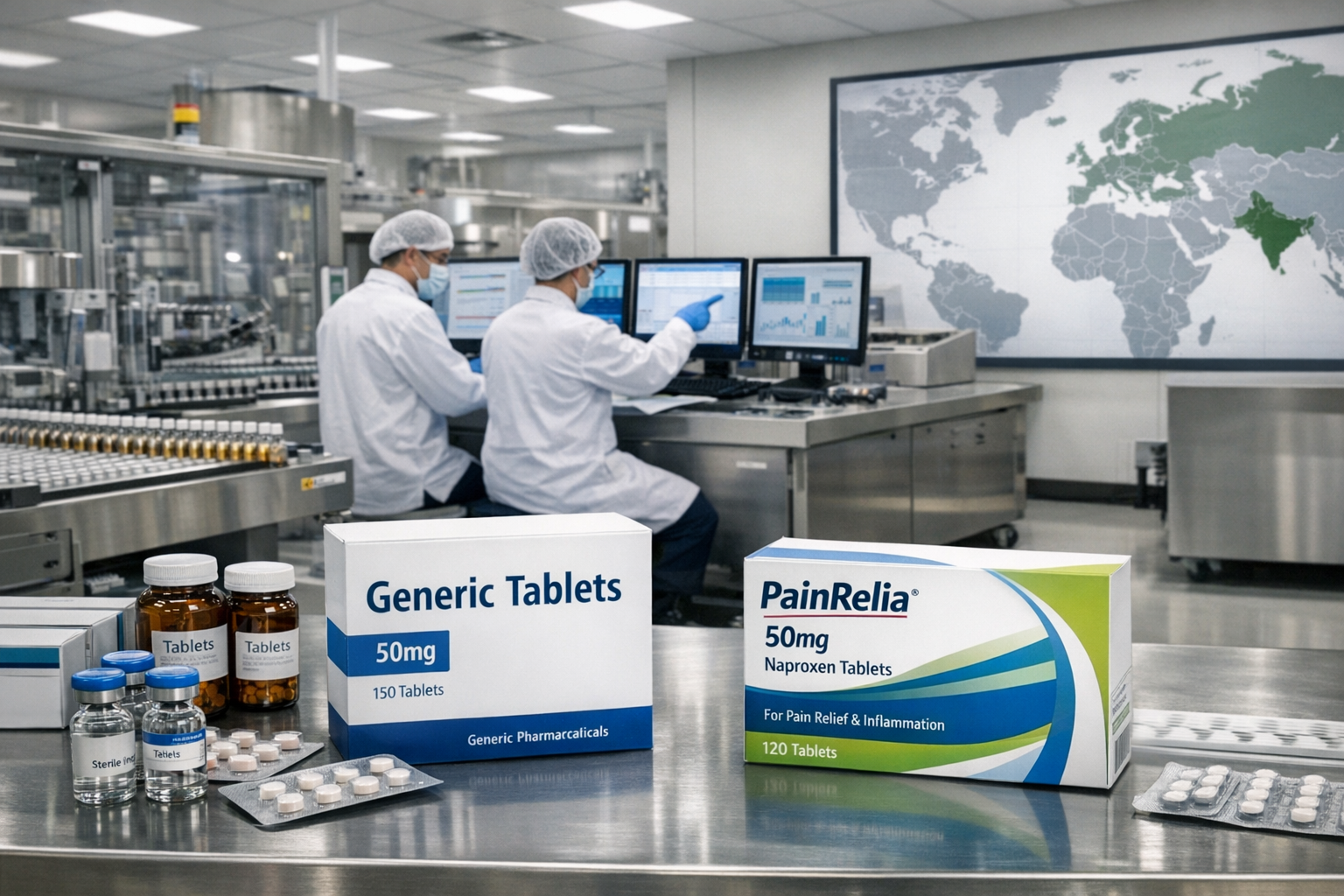
A New Map for the Drug Industry
The global pharmaceutical business is being redrawn by two forces that rarely arrive separately for long: government policy and the expiration of patents.
In Europe, drugmakers are warning that the region’s standing as one of the world’s premier centers for medicine research and production is under growing threat, squeezed by policy uncertainty in the United States, China’s fast-rising biotech sector and Europe’s own long-running structural weaknesses. In India, meanwhile, a very different but equally consequential shift is underway, as cheap generic versions of semaglutide — the ingredient behind blockbuster diabetes and weight-loss drugs — rapidly reshape a market that only recently belonged to a handful of multinational brands.
Taken together, the developments underscore how quickly investment, market share and pricing power can move when regulatory conditions change or exclusivity falls away.
Europe’s Competitive Squeeze
For years, large drugmakers have complained that Europe, despite its scientific base and longstanding pharmaceutical heritage, has become a harder place in which to launch and scale innovative medicines. Executives have pointed to fragmented capital markets, slower clinical trial processes, and reimbursement systems that vary sharply from country to country, making the European single market feel less unified than it appears on paper.
Now the industry says the pressure is intensifying.
The European Federation of Pharmaceutical Industries and Associations, the sector’s main trade group, has warned the European Commission that without a more forceful policy response, investment planned for the second half of the decade could migrate elsewhere. The group has said that as much as €50.6 billion in capital expenditure and €52.6 billion in research and development spending slated for 2025 through 2029 could be at risk.
That warning lands at a moment when Europe is confronting stronger external competition than it has in years. The United States remains the industry’s most lucrative market and continues to exert a powerful pull on investment, even as policy shifts there create new uncertainties around pricing and trade. At the same time, China has moved far beyond its earlier reputation as primarily a producer of generic drugs and pharmaceutical ingredients. Its biotech sector has become a growing source of innovative drug development and international dealmaking, forcing European policymakers and executives alike to rethink old assumptions about where future breakthroughs will emerge.
The result is a more urgent debate in Brussels and across European capitals over whether the region can still compete for the next wave of pharmaceutical investment.
Why Europe Is Worried Now
The concern is not simply that Europe is losing sales. It is that it could lose the ecosystem that supports them: laboratories, manufacturing plants, clinical research, and the networks of capital and talent that tend to cluster around industry growth.
European officials have tried to respond through an updated pharmaceutical package and a proposed European Biotech Act, both meant to strengthen the bloc’s attractiveness and resilience. But the industry’s message has been that legislation alone will not be enough if implementation is slow or if commercial incentives remain weaker than in rival markets.
That matters because pharmaceutical investment is unusually sensitive to long time horizons. Decisions on where to build a biologics plant, run a large trial or fund early-stage biotech research can shape a region’s industrial base for years. If companies conclude that pricing conditions are tougher, reimbursement slower and regulation less predictable in Europe than elsewhere, they may place their next bets in the United States or Asia — and future jobs, tax revenue and scientific leadership can follow.
India’s GLP-1 Market Turns Into a Price War
If Europe illustrates how policy can redirect long-term capital, India shows how quickly a market can be transformed once patent protection ends.
In March 2026, semaglutide lost patent exclusivity in India, opening the door to local manufacturers. The effect was swift. Lower-cost generic semaglutide captured about a third of India’s GLP-1 market in March, rapidly changing the economics of one of the industry’s hottest therapeutic categories.
The shift has hit Eli Lilly particularly hard. Lilly’s Mounjaro, a branded tirzepatide treatment introduced into India in 2025, has lost market share as cheaper semaglutide copies spread. Novo Nordisk, whose Ozempic and Wegovy are built on semaglutide, has so far held its ground more effectively — but only after aggressive price reductions of as much as 48 percent.
That response has turned India into a test case for what happens when one of the world’s most valuable drug classes moves from a branded market toward a price-led one. Until recently, obesity and diabetes treatments based on GLP-1 mechanisms were among the industry’s clearest examples of premium pricing power. In India, that assumption is now being tested in real time.
Access Expands, Margins Shrink
The rise of generics in India could broaden access to treatment in a country where high out-of-pocket health spending has often limited uptake of expensive branded medicines. For patients, that is potentially significant. Lower prices can expand the market beyond affluent urban consumers and private specialists, especially for chronic conditions like diabetes and obesity that require sustained treatment.
But for multinational drugmakers, wider access comes with a cost: much thinner margins and a more crowded competitive field.
Novo’s deep price cuts suggest that even the market leader believes defending volume is more important than preserving premium prices. Lilly, whose tirzepatide is not a semaglutide copy but competes in the same broad category, faces a separate strategic question: whether it can maintain a higher-price, differentiated position or whether India’s market dynamics will force a more flexible approach.
Those choices will be closely watched well beyond India. As legal protections weaken in other markets over time, the Indian experience may offer an early glimpse of how branded GLP-1 economics could compress elsewhere. The lesson is not that innovation loses value overnight, but that once lower-cost alternatives appear, the balance between access and profitability can shift with surprising speed.
Two Markets, One Structural Change
At first glance, Europe’s competitiveness debate and India’s GLP-1 price war may look unrelated. One concerns the future of research spending and industrial policy; the other, the immediate fallout from a patent cliff. But both reflect the same underlying reality: the pharmaceutical industry is becoming more exposed to shifts in public policy, market access rules and exclusivity periods.
In Europe, the question is whether policymakers can create conditions strong enough to retain the investment that underpins future drug discovery. In India, the question is how far prices will fall and whether branded companies can protect their positions as generic competition intensifies.
For governments, the tension is familiar. Lower prices and wider access are politically attractive and socially valuable. But if pricing systems become too unattractive for innovators, they may invest elsewhere. For drugmakers, the challenge is equally stark: they must navigate a world in which their most profitable products are increasingly vulnerable either to regulatory pressure or to swift commoditization once patents expire.
What is happening in Europe and India, then, is not a pair of isolated disruptions. It is a sign that the geography and economics of the pharmaceutical industry are entering a new phase — one in which capital, innovation and pricing power may prove more mobile, and more fragile, than many companies once assumed.
Sources
Further reading and reporting used to add context:
- https://www.emarketer.com/content/generic-semaglutide-climbs-33-share-india-eroding-branded-players-pricing-power/
- https://pharma.economictimes.indiatimes.com/news/pharma-industry/novo-nordisk-slashes-weight-loss-drug-semaglutide-prices-by-up-to-48-in-india/129924024
- https://www.aol.com/articles/novo-nordisk-shares-down-43-161059143.html
- https://www.business-standard.com/amp/industry/news/eli-lilly-s-mounjaro-sales-dip-as-semaglutide-generics-flood-indian-market-126040900527_1.html
- https://www.business-standard.com/industry/news/eli-lilly-novo-nordisk-compete-for-lead-in-india-s-obesity-drug-market-125122400095_1.html
- https://economictimes.indiatimes.com/industry/healthcare/biotech/pharmaceuticals/novo-nordisks-semaglutide-gains-weight-against-eli-lilly-in-battle-for-market-share/articleshow/129286391.cms?from=mdr
- https://www.business-standard.com/health/novo-nordisk-loses-weight-loss-drug-lead-to-eli-lilly-in-us-and-india-125052901014_1.html/
- https://www.businesstoday.in/amp/industry/pharma/story/novo-further-cuts-semaglutide-prices-as-generics-enter-india-523336-2026-03-31/
- https://www.bloomberg.com/news/articles/2025-03-26/europe-rapidly-falling-behind-china-in-pharma-astra-chief-warns
- https://qz.com/generic-semaglutide-eli-lilly-market-share-india-glp1-041026/
- https://www.ndtvprofit.com/business/patent-cliff-impact-eli-lilly-market-share-stumbles-as-generic-weight-loss-drugs-gain-ground-in-india-11338871?pfrom=home-business_topstories
- https://apnews.com/article/ac23734a63e8354b5d9f0c93718ef2ff
- https://www.lemonde.fr/en/economy/article/2025/12/18/astrazeneca-ceo-pascal-soriot-the-pharmaceutical-industry-in-europe-will-be-reduced-to-a-shadow-of-itself-within-15-years_6748620_19.html
- https://www.axios.com/2026/02/23/ozempic-novo-nordisk-eli-lilly-zepbound
- https://cincodias.elpais.com/companias/2026-03-23/la-india-comienza-a-vender-ozempic-hasta-un-80-mas-barato-tras-la-liberalizacion-de-la-patente-de-novo-nordisk.html
- https://itif.org/publications/2026/03/18/lessons-from-europes-loss-of-biopharma-leadership-and-attempts-to-recover/
- https://www.lemonde.fr/en/international/article/2025/12/29/europe-s-dramatic-decline-in-pharmaceutical-production-threatens-health-sovereignty_6748905_4.html
- https://chronicleclub.in/storage/uploads/1773030456-business-standard-09-march-2026.pdf
- https://www.fiercepharma.com/manufacturing/pharma-manufacturing-output-surged-25-countries-braced-us-tariffs-atradius
- https://en.wikipedia.org/wiki/Novartis
- https://www.forbes.com/sites/anjaleekhemlani/2026/03/10/is-china-pharmas-new-cash-cow-or-a-policy-risk/
- https://pharmprom.net/global-pharma-2026-usa-dictates-prices-europe-loses-leadership-asia-booms/
- https://en.wikipedia.org/wiki/BioNTech
- https://www.fiercepharma.com/pharma/trump-tariffs-drugs-industry-warns-eu-100b-plus-pharma-exodus-us
- https://www.cnbc.com/2025/02/13/china-biopharma-deals-rise-with-summit-merck.html
- https://www.pharmaceutical-technology.com/features/europes-pharma-trade-with-the-us-remains-critical-despite-tariff-turmoil/
- https://www.linkedin.com/pulse/silk-bulletin-n40-2-february-2026-riccardo-ghia-%25E9%25AB%2598%25E7%2591%259E%25E5%2585%258B-xc1tc
- https://pharma.lactalisingredients.com/2026/01/14/trumps-tariffs-and-the-future-of-pharma-a-geopolitical-turning-point-for-the-global-industry/
- https://www.axios.com/2026/01/30/trump-china-fda-nih-drugs
- https://www.chinastrategy.org/2025/07/22/big-pharma-is-increasingly-reliant-on-chinese-biotech-advances/
- https://www.efpia.eu/news-events/the-efpia-view/statements-press-releases/pharma-ceos-alert-president-von-der-leyen-to-risk-of-exodus-to-the-us
- https://www.lemonde.fr/en/economy/article/2025/05/12/pharmaceutical-companies-use-trump-to-put-pressure-on-europe_6741179_19.html
- https://fpanalytics.foreignpolicy.com/2026/03/15/europe-life-sciences-competitiveness/
- https://www.efpia.eu/news-events/the-efpia-view/statements-press-releases/efpia-responds-to-the-publication-of-the-us-eu-joint-framework-agreement/
- https://www.efpia.eu/news-events/the-efpia-view/statements-press-releases/european-pharmaceutical-industry-calls-for-competitiveness-industrial-strategy-and-dedicated-office-for-life-sciences/
- https://www.consilium.europa.eu/en/press/press-releases/2025/12/10/pharma-package-council-and-parliament-reach-a-deal-on-new-rules-for-a-fairer-and-more-competitive-eu-pharmaceutical-sector/
- https://www.soci.org/news/2026/3/the-global-biopharma-race-is-getting-serious
- https://deepnewz.com/europe/european-pharma-industry-warns-exodus-to-u-s-due-to-trump-s-tariffs-potentially-c13dfebd
- https://health.ec.europa.eu/biotechnology_en
- https://www.consilium.europa.eu/en/press/press-releases/2025/12/11/pharma-package-council-and-parliament-reach-a-deal-on-new-rules-for-a-fairer-and-more-competitive-eu-pharmaceutical-sector/pdf/
- https://dsv-europa.de/en/news/2025/12/biotech-act.html
- https://born2invest.com/articles/biopharma-crossroads-reforms-europe/
- https://pharmaphorum.com/news/az-backs-threat-manufacturing-shift-europe
- https://efpia.eu/media/cm2jbsjx/revision-of-the-general-pharmaceutical-legislation-impact-assessment-of-european-commission-and-efpia-proposals.pdf
- https://www.efpia.eu/media/zcwist01/revision-of-the-general-pharmaceutical-legislation-impact-assessment-of-european-commission-and-efpia-proposals.pdf
- Pharma CEOs alert President von der Leyen to risk of exodus to the US
- GLP-1 generics in India redraw competition for market dominance
- Novo Nordisk Cuts Semaglutide Prices Up to 48% in India Amid Competition, ETPharma
- European pharmaceutical industry calls for Competitiveness Strategy and dedicated Office for European Life Sciences
- Eli Lilly, Novo Nordisk compete for lead in India's obesity drug market | Industry News – Business Standard
- ‘Pharma package’: Council and Parliament reach a deal on new rules for a fairer and more competitive EU pharmaceutical sector – Consilium