
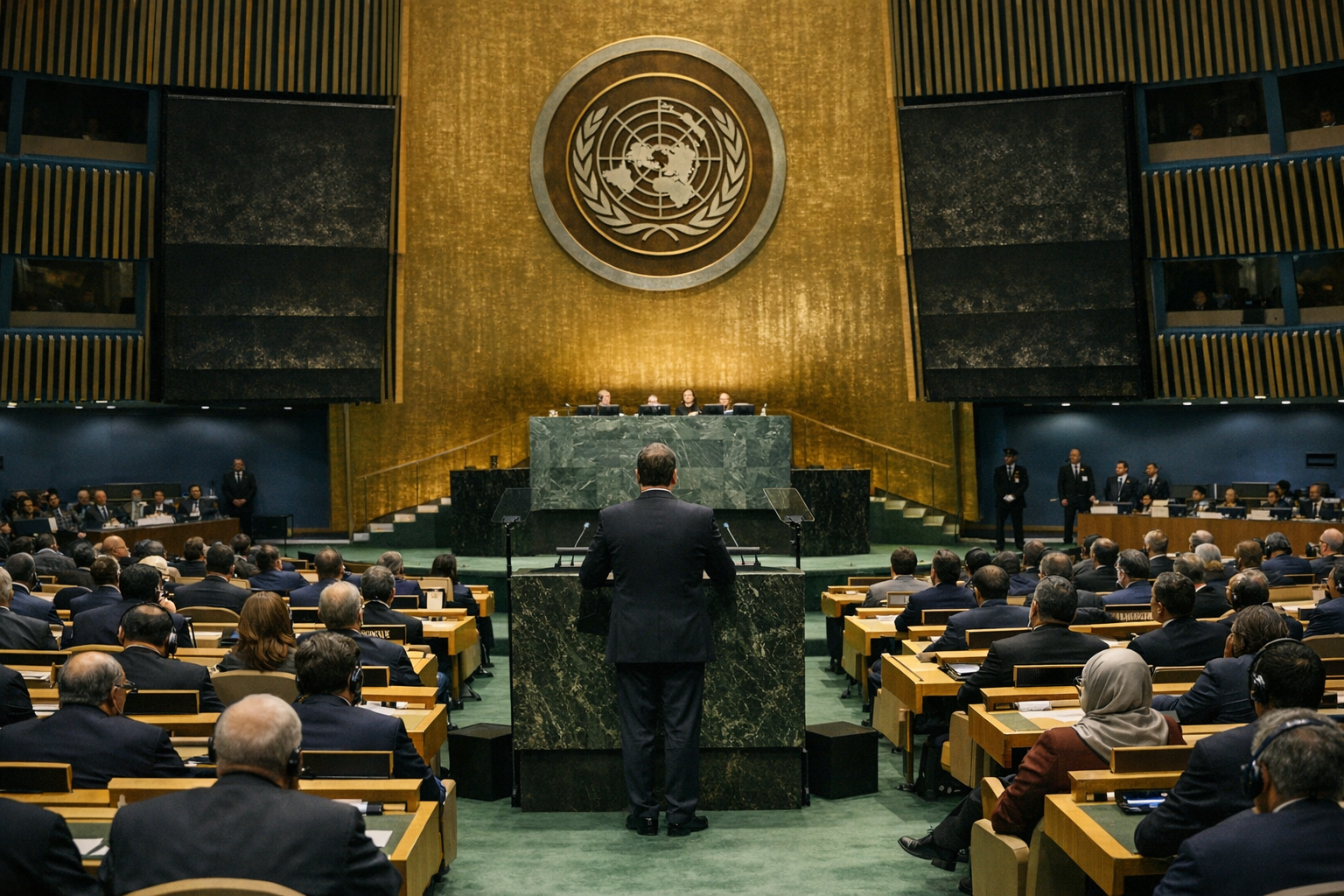
At the United Nations, Trump Turns a Global Forum Into a Test of Force
President Trump used the opening days of the United Nations General Assembly this week to transform one of diplomacy’s most ritualized gatherings into a muscular display of his foreign-policy doctrine, blending threats against Iran, denunciations of Cuba and a full-throated defense of rapid artificial intelligence expansion.
Before an audience of world leaders in New York, Mr. Trump framed the United States as a country unwilling to compromise with adversaries and unwilling, too, to cede technological advantage in what he cast as a defining global competition. The speech, delivered as wars and crises from the Middle East to Africa and Eastern Europe crowd the U.N. agenda, made clear that the annual assembly has become a prime stage for his effort to justify military confrontation, pressure rivals and recast Washington’s role in a more openly coercive register.
His sharpest language was reserved for Iran, the issue that hung over the gathering from the moment delegations arrived. Mr. Trump defended the U.S.-Israeli campaign against Tehran and reiterated that he would never allow Iran to obtain a nuclear weapon. He suggested he faced a consequential decision over the conflict, remarks that added to uncertainty over whether his rhetoric was meant as leverage or as a signal of possible further military action.
Even by the often-combative standards of Mr. Trump’s appearances at the United Nations, the speech stood out for its severity. He also lashed out at Cuba, portraying it as a failed communist state, and declared that the United States would not permit threats to gain a foothold in the Western Hemisphere.
A Diplomatic Gathering Overshadowed by War
This year’s high-level week, running from Sept. 18 to 28, has brought heads of state to New York at a moment of unusual global strain. The formal agenda spans wars in Gaza and Ukraine, the catastrophes in Sudan, Congo and Myanmar, and longer-term threats like climate change, inequality and the governance of emerging technologies.
But Iran quickly became the central drama around the American delegation. Mr. Trump arrived at the assembly facing international scrutiny over the conflict and growing questions from allies about the direction of U.S. policy. His remarks at the United Nations appeared designed not only for the delegates in the hall but also for domestic and foreign audiences watching whether he could project resolve without being drawn into a wider regional war.
At the same time, the administration has left open the possibility of diplomacy. Mr. Trump said he believed a U.S.-Iran deal could still emerge after the Nov. 3 midterm elections, and American officials indicated they were open to a possible meeting with Iran’s president during the New York gathering. That combination — threats of overwhelming force alongside hints of negotiation — has become a familiar pattern in Trump-era diplomacy, though it remains unclear which side of the equation foreign governments are meant to take more seriously.
A Collision With the U.N.’s Own Message
Mr. Trump’s address also highlighted a widening divide between Washington’s posture and the institutional message of the United Nations itself.
Opening the week, Secretary-General António Guterres urged countries to pursue cooperation rather than escalation, warning against deepening conflict, mounting inequality and an artificial intelligence “race to the bottom.” His appeal was for guardrails, collective management of risk and renewed faith in multilateral problem-solving.
Mr. Trump offered nearly the inverse argument. On technology, he dismissed calls to slow AI development for safety concerns and argued that the United States should accelerate. In one of the speech’s more striking flourishes, he said his administration would begin using the term “super intelligence” instead of artificial intelligence, underscoring his preference for framing the issue less as a source of danger than as a contest for supremacy.
That stance matters well beyond semantics. AI governance has become an increasingly urgent subject at the United Nations, where governments are struggling to devise rules for systems that could reshape warfare, labor markets, surveillance and political power. A more confrontational U.S. position — especially one skeptical of restraints — could affect multilateral negotiations at the very moment international institutions are trying to establish common standards.
Cuba and the Politics of the Hemisphere
Mr. Trump’s attack on Cuba fit into a broader message aimed at the Americas, where he has repeatedly sought to cast left-wing governments and anti-American movements as part of a wider strategic challenge close to U.S. borders. His language suggested continuity with a hard-line hemispheric approach that treats ideology, migration, organized crime and geopolitical rivalry as overlapping threats.
Whether that language results in a concrete policy shift remains uncertain. But by elevating Cuba in a speech dominated by war and strategic competition, Mr. Trump signaled that his administration still sees symbolic value in drawing ideological dividing lines in the region.
Why This Week Matters
The General Assembly has always been both diplomatic theater and substantive negotiation. For Mr. Trump, it has become something more specific: a global venue for asserting that American power should be measured not by consensus-building but by its willingness to confront enemies, break with international caution and dominate emerging technologies.
That message is landing at a precarious moment. The war involving Iran remains volatile. Ukraine is grinding on. Gaza continues to haunt deliberations. Crises in Sudan, Congo and Myanmar compete for attention in an overburdened international system. And alongside those immediate emergencies, governments are wrestling with how to regulate technologies that may alter the balance of economic and military power.
In that sense, Mr. Trump’s speech was not merely another provocative U.N. appearance. It crystallized a broader struggle over what global leadership should look like in an era of overlapping wars and technological upheaval: cooperative and rules-based, as the United Nations leadership is urging, or unapologetically nationalist and coercive, as Mr. Trump argued before the world.
Sources
Further reading and reporting used to add context:
- https://apnews.com/article/692e1e171a791be0c9b9c1f56718a0d0
- https://www.axios.com/2026/09/22/trump-cnn-white-house-un-speech
- https://apnews.com/article/767e63e2ffd5a2898c84f290de816ff7
- https://www.axios.com/2026/09/22/trump-speech-un-general-assembly-iran-annihilate
- https://apnews.com/article/5c7bb1ed77f24be8b22de4d7d297f396
- https://www.axios.com/2026/09/22/unga-iran-us-trump-war
- https://www.thedailybeast.com/trump-melts-down-at-kaitlan-collins-as-cnn-ban-backfires/
- https://www.theatlantic.com/podcasts/2026/09/ra-us-china/688731/?utm_source=openai
- https://apnews.com/article/f7cb0b3ebc492446c0be97ed3a6843aa
- https://apnews.com/article/6ae720a081ce4d5ede35837ca35b8460
- https://www.axios.com/2026/09/17/trump-axios-interview-iran-war
- https://apnews.com/article/40a2a3e36c47e5ddec61cba145292344
- https://www.whitehouse.gov/releases/2026/09/president-trump-at-the-united-nations-while-others-have-talked-i-have-acted/
- https://www.investing.com/news/world-news/trump-says-freedom-will-be-coming-to-cuba-in-un-speech-4911285
- https://www.marketscreener.com/news/trump-s-speech-at-the-un-from-threats-to-super-intelligence-ce785ad8d08dfe20
- https://www.investing.com/news/world-news/trump-says-he-thinks-us-will-make-deal-with-iran-after-election-4911198
- https://www.marketscreener.com/news/trump-at-un-threats-diplomacy-and-super-intelligence-ce785ad8d18bf124
- https://www.marketscreener.com/news/trump-says-freedom-will-come-to-cuba-in-un-speech-ce785ad9d88bf624
- https://rollcall.com/factbase/trump/transcript/donald-trump-remarks-multilateral-gulf-cooperation-council-united-nations-september-22-2026/
- https://www.whitehouse.gov/videos/president-trump-delivers-remarks-to-the-united-nations-general-assembly/
- https://www.internazionale.it/ultime-notizie-reuters/2026/09/22/trump-says-freedom-will-be-coming-to-cuba-in-un-speech
- https://www.internazionale.it/ultime-notizie-reuters/2026/09/22/trump-at-un-threats-diplomacy-and-super-intelligence
- https://www.thedailybeast.com/trump-humiliated-as-un-speech-bombs-with-bored-audience/
- https://apnews.com/article/c4727651b9030d6e7f81c0457a33440b
- https://www.axios.com/newsletters/axios-am-12828d89-342e-452b-a7e9-a70078c56670
- https://www.axios.com/2026/09/16/watch-day-1-axios-house-at-climate-week-unga
- https://www.un.org/en/high-level-week-2026
- https://www.ksl.com/article/51627090/un-chief-calls-for-ai-curbs-and-end-to-wars-in-his-last-assembly-address
- https://unsdg.un.org/latest/announcements/faultlines-our-world-are-widening-%E2%80%93-un-secretary-general-general-assembly
- https://www.un.org/en/node/248335
- https://www.investing.com/news/world-news/un-chief-calls-for-ai-curbs-and-end-to-wars-in-his-last-assembly-address-4911059
- https://www.un.org/sustainabledevelopment/blog/2026/09/press-release-un-convening-explores-the-future-of-ai-human-development-and-human-dignity/
- https://www.un.org/pga/81/documents/speeches/ai-governance-ambassadorial-lunch-10-september-2026/
- https://www.un.org/pga/81/documents/speeches/general-debate-opening-22-september-2026/
- https://www.un.org/es/node/248096
- https://www.idahostatejournal.com/news/world/with-war-climate-change-and-ai-its-a-troubled-world-as-leaders-convene-at-the/article_9b20b5a3-4904-57a4-83cf-d1c1b7c29c12.html
- President Trump at the United Nations: “While Others Have Talked, I Have Acted” – The White House
- Trump in address to world leaders at the UN defends his decision to start the war against Iran
- General Assembly High-level Week 2026 | United Nations
- Trump says he thinks US will make deal with Iran after election By Reuters