
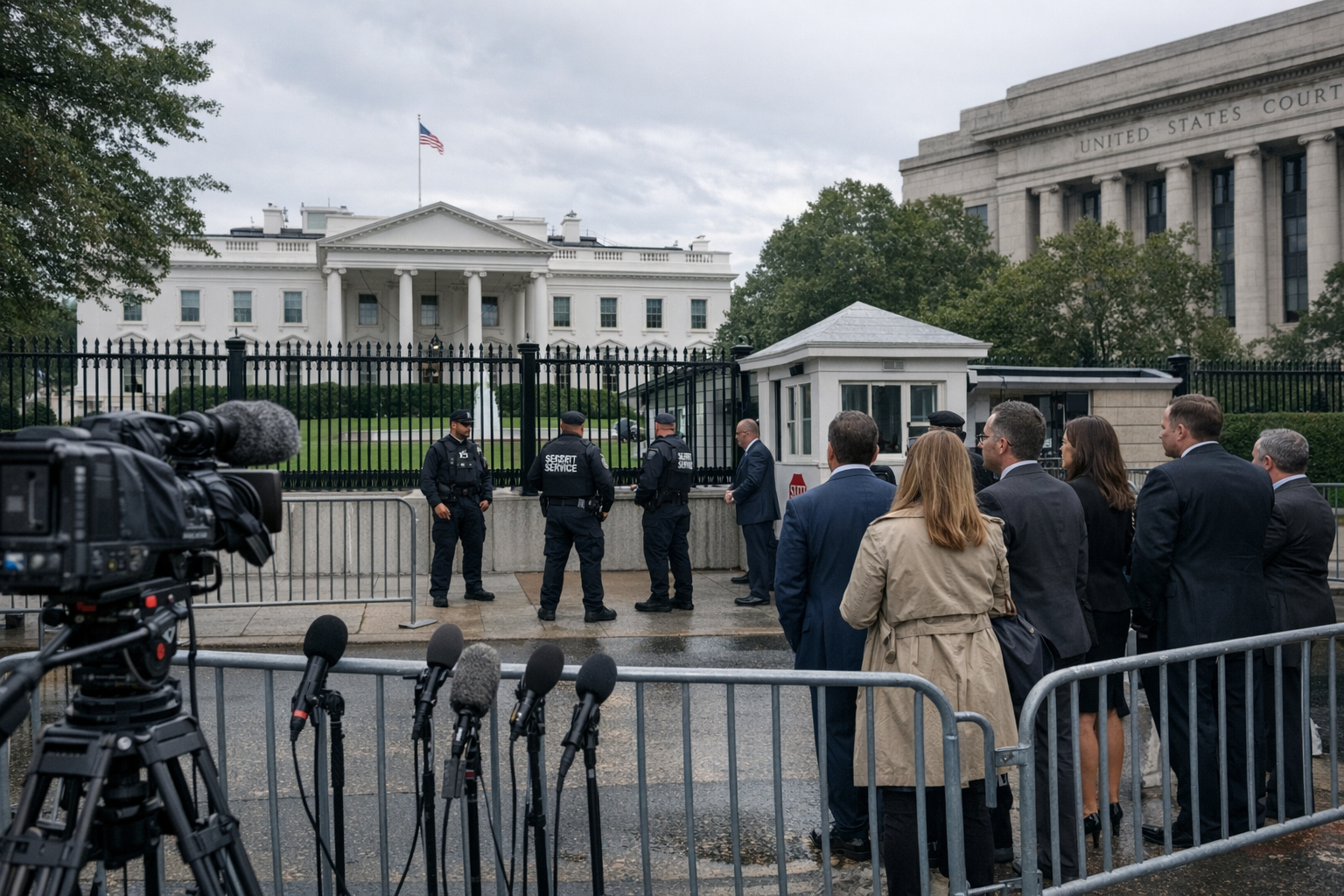
White House Press Fight Moves Into Court as Justice Department Defends Ban on Three Outlets
The confrontation between the Trump administration and several of the country’s largest news organizations escalated sharply on Tuesday, as the Justice Department formally defended the White House’s decision to bar CNN, MS NOW and Politico from the presidential complex, arguing that access to the White House is “a privilege — not a right.”
The filing pushes a volatile dispute over press freedom and presidential power into a consequential legal phase. What began last week as a public denunciation by President Trump of outlets he has long accused of hostile coverage has now become a direct constitutional test of how far a president may go in excluding journalists from spaces that are ordinarily open to credentialed members of the press corps.
The three organizations sued in federal court after their reporters were denied entry beginning Sept. 19 and had credentials taken, contending that the administration had retaliated against them for unfavorable reporting in violation of the First Amendment and denied them due process. In its response, the Justice Department argued that no news outlet is entitled to White House access and said the president’s actions were justified by national-security concerns.
That argument is likely to become the central fault line in the case: whether the administration can persuade a court that its restrictions stem from legitimate security judgments, or whether judges will view the move as viewpoint discrimination aimed at punishing critical coverage.
A Constitutional Test Over Press Access
The case arrives at a moment when the mechanics of covering the presidency have become unusually fraught. Access to the White House is not merely symbolic; it governs whether reporters can question officials in person, witness presidential movements and provide an independent record of events at the seat of executive power.
The practical effects have already spread beyond the three targeted outlets. Major television networks suspended pooled video coverage in protest, disrupting the standard system under which a rotating group of journalists provides shared audiovisual coverage for the wider press corps and the public. That pool system has long been one of the main ways Americans see and hear presidential appearances that are not otherwise broadly accessible.
For advocates of press freedom, the stakes extend well beyond the fortunes of any individual newsroom. If the administration prevails, legal scholars and media organizations say, the decision could give future presidents broader latitude to cut off specific news organizations from routine access on contested grounds.
The White House Correspondents’ Association has condemned the exclusions as an attack on the free press, framing the dispute as part of a larger battle over whether access decisions can be used to reward favorable coverage and punish scrutiny.
Echoes of Earlier Trump-Era Battles
The fight also revives a familiar tension from Mr. Trump’s earlier years in office, when his administration repeatedly clashed with journalists and major media organizations. The new case follows earlier litigation involving The Associated Press over access to certain restricted presidential spaces, a legal battle that helped define the current terrain.
In that appellate fight, judges suggested that the White House has greater discretion over tightly controlled areas but cannot exclude journalists from spaces “generally open to the press” based on viewpoint. That distinction may now prove critical. If the banned outlets can show they were singled out from ordinary press areas because of their reporting, the administration could face a steep challenge. If the government can persuade the court that the exclusions were tied to genuine security concerns or to categories of access subject to broader executive control, its defense may find more traction.
The Justice Department’s invocation of national security appears designed to place the ban in a traditionally deferential area for courts. But such claims are unlikely to be accepted automatically, particularly where the affected organizations argue that the government has offered little concrete explanation and where the president publicly announced the ban in terms that appeared closely tied to the outlets’ coverage.
What Comes Next
The immediate question is whether a judge will move quickly to restore access while the lawsuit proceeds. A prompt order in favor of the outlets would signal skepticism of the administration’s rationale and could preserve the traditional press arrangements at the White House. A ruling allowing the ban to stand, even temporarily, could embolden further attempts to redraw the rules of access.
Either way, the case is poised to become a significant marker in the continuing struggle over the relationship between the presidency and the press. At issue is not only who gets through the White House gates, but whether access to public-facing institutions can be conditioned on editorial posture.
For now, a conflict that once played out through denunciations, press-room skirmishes and social-media attacks is being translated into a more enduring form: a courtroom fight over the constitutional boundaries of presidential power and the practical meaning of a free press.
Sources
Further reading and reporting used to add context:
- https://www.axios.com/2026/09/22/trump-cnn-white-house-un-speech
- https://apnews.com/article/692e1e171a791be0c9b9c1f56718a0d0
- https://www.thedailybeast.com/trump-melts-down-at-kaitlan-collins-as-cnn-ban-backfires/
- https://www.thedailybeast.com/obsessed/kimmel-paints-obscene-picture-of-trump-and-natalie-harp/
- https://www.thedailybeast.com/fuming-trump-80-erupts-at-cowards-and-traitors-after-embarrassing-revelations/
- https://apnews.com/article/72f9acf68244ca70e9078d9d3661c722
- https://www.axios.com/2026/09/21/trump-national-security-executive-sledgehammer
- https://theweek.com/media/white-house-trump-bars-news-outlets-threat
- https://www.theatlantic.com/ideas/2026/09/trump-free-speech-media-banned/688713/?utm_source=openai
- https://www.thedailybeast.com/maga-turns-on-trump-over-wild-media-ban/
- https://www.cbsnews.com/news/cnn-ms-now-politico-lawsuit-white-house-access-trump/
- https://www.axios.com/2026/09/18/trump-ban-cnn-ms-now-politico-white-house
- https://www.investing.com/news/politics-news/white-house-turns-away-cnn-ms-now-politico-reporters-after-trumps-ban-4908229
- https://www.axios.com/2026/09/21/trump-cnn-msnow-politico-suit
- https://www.washingtonpost.com/business/2026/09/21/cnn-ms-now-politico-sue-over-white-house-bans/
- https://ktvz.com/politics/cnn-us-politics/2026/09/22/justice-department-says-president-can-shut-out-reporters-from-the-white-house-at-his-will-for-national-security/
- https://www.cbsnews.com/news/cnn-ms-now-politico-lawsuit-white-house-access-trump/?intcid=CNR-02-0623
- https://storage.courtlistener.com/recap/gov.uscourts.rid.62049/gov.uscourts.rid.62049.44.0.pdf
- https://storage.courtlistener.com/recap/gov.uscourts.cit.16285/gov.uscourts.cit.16285.38.0.pdf
- https://storage.courtlistener.com/recap/gov.uscourts.mad.285083/gov.uscourts.mad.285083.75.0.pdf
- https://courtlistener.com/docket/73563652/pushpeel-llc-v-schedule-a/
- https://storage.courtlistener.com/recap/gov.uscourts.dcd.200892/gov.uscourts.dcd.200892.1.0.pdf
- https://www.justice.gov/oip/available-documents-oip
- https://www.justice.gov/usao-edca/pr/rocklin-man-implicated-plot-attack-white-house-ufc-event-indicted-firearms-possession
- https://courtlistener.com/docket/18547535/national-coalition-on-black-civic-participation-v-wohl/?entry_gte=&entry_lte=&filed_after=&filed_before=&order_by=desc
- https://www.justice.gov/crt/appellate-section-voting
- https://www.justice.gov/oip/leopold-v-cia-no-16-1833-2026-wl-2104007-ddc-july-21-2026-cobb-j
- https://www.justice.gov/opa/pr/suspect-white-house-correspondents-dinner-shooting-charged-attempt-assassinate-president
- https://www.justice.gov/archives/usam/archives/usam-4-6000-federal-programs
- https://www.justice.gov/archive/oip/courtdecisions/exemption5.html
- https://courtlistener.com/docket/73519403/rare-breed-triggers-incorporated-v-firearm-systems-ll/
- https://courtlistener.com/docket/72070466/panovision-llc-v-maronda-homes-llc/
- https://www.knightcolumbia.org/content/trumps-ban-of-cnn-ms-now-and-politico-is-doubly-unconstitutional-knight-institute-says
- https://www.washingtonpost.com/business/2026/09/21/trump-ban-ms-now-media-cnn-politico/d8a820fe-b5a7-11f1-94cb-d3d8f22a8c8b_story.html
- https://www.axios.com/2026/09/21/trump-cnn-msnow-politico-suit?stream=top
- https://openclassactions.com/news/cnn-politico-ms-now-white-house-press-ban-lawsuit.php
- https://www.lawyer-monthly.com/2026/09/cnn-ms-now-and-politico-sue-over-white-house-press-ban/
- https://kesq.com/news/national-politics/cnn-us-politics/2026/09/22/justice-department-says-president-can-shut-out-reporters-from-the-white-house-at-his-will-for-national-security/
- https://askwhy.news/us/government-accountability/press-ban-lawsuit-first-amendment-complaint/
- https://www.reddit.com/r/cnn/comments/1wmi36l/cnn_ms_now_and_politico_to_sue_president_trump/
- https://www.reddit.com/r/newswall/comments/1wmk0dn/cnn_ms_now_and_politico_challenge_trumps_white/
- https://www.reddit.com/r/NewsThread/comments/1wkp81y/live_updates_cnn_and_ms_now_reporters_denied/
- https://www.reddit.com/r/AntiTrumpAlliance/comments/1wkq4qn/live_updates_cnn_politico_and_ms_now_reporters/
- https://mingooland.com/2026/09/trump-cites-national-security-midterms-coverage-to-defend-press-ban/
- https://www.aol.com/articles/defending-trump-media-ban-doj-090816000.html
- https://www.reddit.com/r/NewsSource/comments/1wmqd0a/news_outlets_trump_banned_from_white_house/
- https://www.reddit.com/r/PoliticusUSA/comments/1wkrfaj/networks_to_sue_trump_after_he_bans_reporters/
- https://apnews.com/article/eb57a4819c8a876a72c1301a112e21dc
- https://apnews.com/article/61667fb3faaa9a7e9cfc9ffb4f7dc90e
- https://apnews.com/article/dc1a144d37a5d2e90488eec110ca9835
- https://www.axios.com/2026/09/21/trump-un-tv-pool-cnn
- https://www.thedailybeast.com/cowardly-white-house-reporters-refuse-to-sanction-trump-over-bans/
- https://whca.press/2026/09/18/statement-on-white-house-position-on-cnn-msnow-and-politico/
- https://whca.press/category/whca-statement/
- https://transcripts.cnn.com/show/cnr/date/2026-09-19/segment/07
- https://prod.transcripts.cnn.com/show/ctmo/date/2026-09-21/segment/01
- https://www.washingtonpost.com/politics/2026/09/19/ms-now-says-journalists-blocked-white-house-after-trump-announces-ban/
- https://www.fidelity.com/news/article/company-news/202609212003RTRSNEWSCOMBINED_L1N45D0B5_1
- https://www.washingtonpost.com/business/2026/09/18/trump-says-hes-banning-cnn-ms-now-politico-white-house/
- https://www.cbsnews.com/news/white-house-media-ban-ms-now-politico-cnn-trump/
- https://apnews.com/article/e0a4aff8adefa8fd44f514fe4f7fdefa
- https://apnews.com/article/0481d2b8ac0fb5369513bf050dd5b5e2
- https://apnews.com/article/1c62d728230d55a5286c7f4e4ee8acb1
- https://www.axios.com/2026/09/21/trump-white-house-pool-tv-ban-audio
- https://www.thedailybeast.com/raging-trump-explodes-as-his-bonkers-media-ban-backfires/
- https://www.ap.org/media-center/ap-in-the-news/2025/ap-and-trump-administration-argue-access-case-before-federal-appeals-court-no-ruling-yet/
- https://www.ap.org/media-center/ap-in-the-news/2025/appeals-court-wont-reinstate-ap-access-to-presidential-events/
- https://www.13abc.com/2026/09/21/cnn-ms-now-politico-say-theyve-notified-trump-theyre-suing-over-denied-white-house-access/?outputType=amp
- Trump bans CNN, MS NOW and Politico from White House
- CNN, MS NOW and Politico sue to restore White House access – CBS News
- Statement on White House position on CNN, MSNOW and POLITICO | White House Correspondents' Association (WHCA)
- Defending reporter ban, Justice Department argues stories on Trump’s ballroom project, Iran war threaten national security – KESQ