
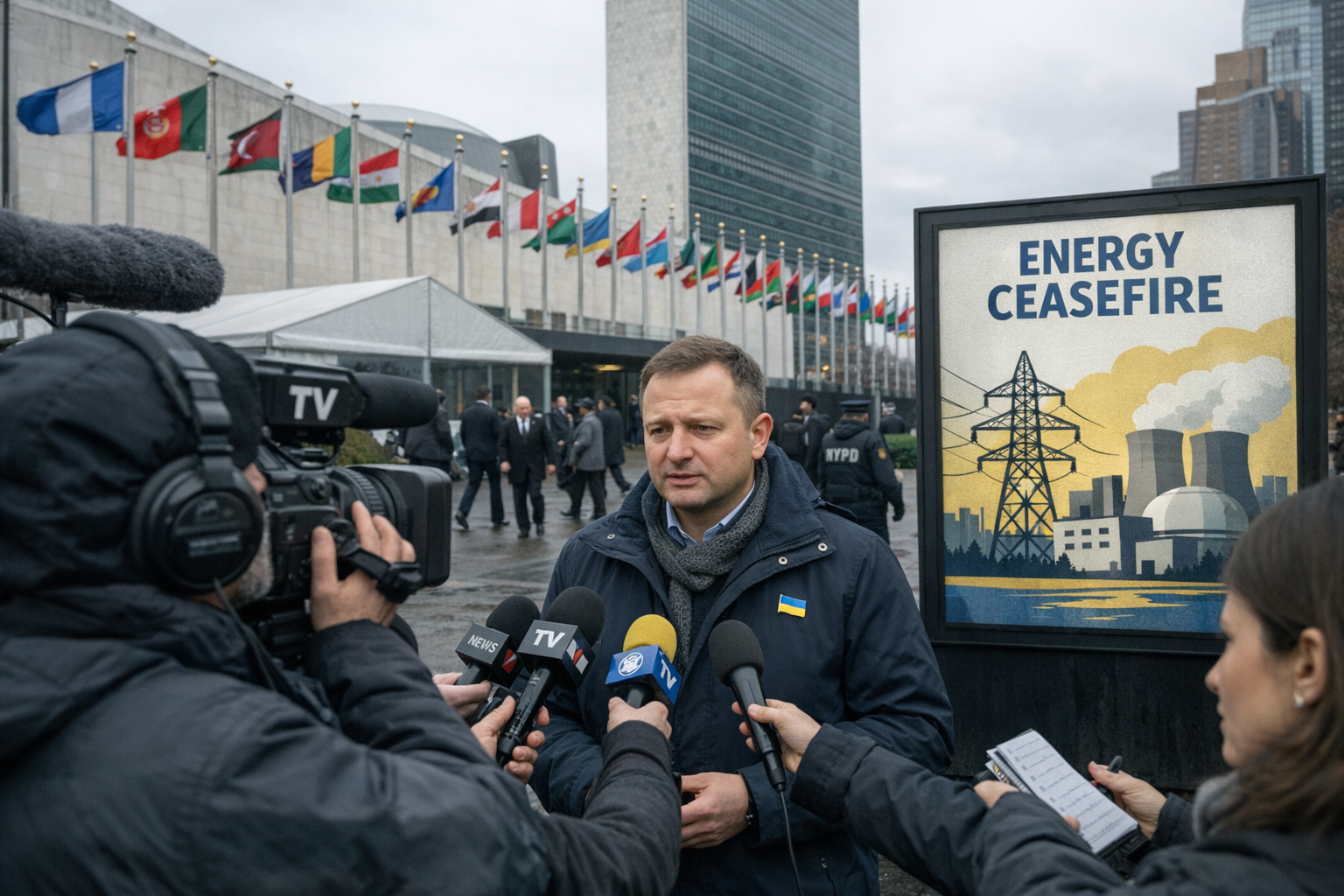
At the United Nations, Zelensky Tries a Narrow Diplomatic Opening
President Volodymyr Zelensky of Ukraine used the gathering of world leaders at the United Nations this week to press a limited but potentially consequential diplomatic proposal: a halt to attacks on energy infrastructure, even as the broader war with Russia grinds on.
Speaking in New York on Tuesday and Wednesday, Mr. Zelensky said Ukraine was ready for what he called an “energy ceasefire” with Russia, provided Moscow stopped striking Ukrainian power plants, transmission networks and other critical infrastructure. He also said he was prepared for a trilateral meeting with President Trump and President Vladimir V. Putin of Russia, casting such a session as a possible path back toward negotiations.
The proposal amounted to a carefully bounded opening rather than any suggestion of a comprehensive cease-fire. But it carried unusual weight as Ukraine heads toward another winter under the threat of Russian missile and drone barrages on its energy system, attacks that have repeatedly left civilians without heat, electricity or water.
Ukrainian officials said Mr. Zelensky’s meeting with Mr. Trump focused on de-escalatory steps, diplomacy, air defense needs for the winter months and support for Ukraine as colder weather approaches.
The timing was notable. Mr. Zelensky’s remarks came amid another round of heavy reciprocal strikes, a reminder of how fragile any diplomatic overture remains. Yet by centering the discussion on energy targets, Kyiv appeared to be offering a testable and narrower confidence-building step, one that could be easier to verify than a full stop to hostilities across the front.
A Limited Proposal With High Stakes
The focus on energy reflects both military reality and civilian urgency.
Since Russia’s full-scale invasion, Moscow has repeatedly targeted Ukraine’s power grid and fuel infrastructure, treating energy as both a military objective and a means of pressuring the population. Those attacks have become especially consequential before winter, when even temporary damage can cascade into prolonged hardship for millions of people.
At the same time, Ukraine has carried out strikes on Russian energy assets, particularly refineries, imposing costs on Russia’s fuel system and, at times, rattling broader energy markets. A reciprocal halt would therefore ask both sides to give up a tool they have used to gain leverage.
That is one reason the idea matters beyond symbolism. If implemented, even partially, an arrangement could reduce harm to civilians, ease pressure on electricity supplies and exports, and create a modest platform for broader negotiations later. It would not end the war. But it could establish whether either side is prepared to honor a limited, clearly defined restraint.
Zelensky’s Calculation
Mr. Zelensky’s comments in New York were also part of a broader diplomatic calculation. In recent weeks, Kyiv had already been signaling that it was open to limited de-escalatory pauses tied to negotiations. Ukrainian officials had discussed the possibility of an energy and Black Sea truce with American intermediaries, according to people familiar with those contacts.
Mr. Trump had previously suggested publicly that Russia and Ukraine had agreed not to hit energy facilities. But Mr. Zelensky drew a sharper line this week, saying that any such arrangement depended on Russia actually stopping its attacks first.
That distinction underscored Kyiv’s skepticism. Ukrainian officials have long argued that Russian declarations of restraint mean little without observable changes on the battlefield and in the skies.
By raising the prospect of a meeting with both Mr. Trump and Mr. Putin, Mr. Zelensky appeared to be testing whether Washington could help convert vague discussion into a more formal channel. Such a format, if it materialized, would mark an unusual diplomatic configuration, placing Mr. Trump in the middle of a highly constrained exploratory process rather than a sweeping peace initiative.
Moscow’s Response Remains the Biggest Unknown
Whether any of this goes further may depend less on Kyiv’s public readiness than on the Kremlin’s willingness to translate past signals into action.
Russian officials have, at times, welcomed the concept of an energy moratorium in principle. But implementation has remained elusive, and the fighting has continued. The latest exchanges of strikes, coming just as leaders assembled in New York, highlighted how distant any stable arrangement still appears.
There are also practical questions that would have to be answered quickly. What exactly counts as energy infrastructure? Would oil depots, pipelines, refineries and export terminals be covered, or only power-generation and transmission assets? Who would monitor compliance, and how would violations be judged in real time amid the fog of war?
Those are not technical details so much as the core of the proposal. Without common definitions and some credible way to verify attacks, an “energy ceasefire” could collapse into competing accusations within days.
Why the Push Comes Now
For Ukraine, the urgency is immediate. Another winter campaign against the grid could intensify pressure on civilians already exhausted by years of war. For its allies, especially the United States and European governments, any reduction in attacks on critical energy systems would be welcome at a moment when support for Ukraine is increasingly entangled with domestic political pressures and wider concerns about economic stability.
At the United Nations, where sweeping appeals for peace often collide with battlefield realities, Mr. Zelensky’s message was striking for its modesty. He was not offering the outline of a grand settlement. He was proposing a narrow halt in one of the war’s most punishing dimensions.
Whether that opening leads anywhere is uncertain. Moscow may reject it, redefine it or use it for tactical advantage. Mr. Trump may not be able to bring Mr. Putin into a trilateral format at all. And continued strikes on both sides could quickly overtake the effort.
Still, at a moment when diplomacy over the war has often seemed stalled between maximalist demands and military escalation, Ukraine’s call for an energy ceasefire offered something more concrete: a small, verifiable step that could matter greatly to civilians if it holds, and reveal just as much if it does not.
Sources
Further reading and reporting used to add context:
- https://www.axios.com/2026/09/22/unga-iran-us-trump-war
- https://apnews.com/article/692e1e171a791be0c9b9c1f56718a0d0
- https://apnews.com/article/445b619fc9b2d002df1edaac8b320d09
- Trump meets with Zelenskyy and implies a deal on Ukraine war | AP News
- https://apnews.com/article/608408f47bcc9cce30b93f764d18b96b
- https://apnews.com/article/29767a3fe6723ecffed343f0a4847e95
- https://www.axios.com/2026/09/20/trump-zelensky-meeting-russia-ukraine-war-talks
- https://www.aljazeera.com/news/2026/9/23/zelenskyy-says-ukraine-ready-for-energy-truce-with-russia-after-trump-talks
- https://www.gov.uk/government/news/pm-meeting-with-president-zelenskyy-of-ukraine-22-september-2026
- https://www.investing.com/news/commodities-news/zelenskiy-to-meet-trump-at-un-in-push-for-energy-truce-with-russia-4909869
- Ukraine's Zelenskiy says he discussed peace efforts, energy ceasefire with Trump | MarketScreener
- https://www.president.gov.ua/en/news/prezidenti-ukrayini-ta-ssha-obgovorili-kroki-sho-mozhut-vidk-106501
- https://qna.org.qa/en/news/news-details?date=23%2F09%2F2026&id=zelenskyy-trump-discuss-efforts-to-end-russia-ukraine-war
- https://kyivindependent.com/zelensky-meets-trump-at-un-amid-push-for-russia-ukraine-energy-truce/
- https://prox.dlmediahub.top/world/2026/sep/23/ukraine-war-briefing-zelenskyy-energy-ceasefire
- https://www.arabnews.pk/world/zelensky-says-ready-to-halt-energy-site-strikes-if-russia-reciprocates-3002040
- https://www.devdiscourse.com/article/international/3980837-ukraines-zelenskiy-says-he-discussed-peace-efforts-energy-ceasefire-with-trump
- https://www.theguardian.com/world/live/2026/sep/23/united-nations-general-assembly-unga-zelenksyy-trump-xi-china-ukraine-russia-europe-latest-news-updates
- https://uk.marketscreener.com/news/trump-says-he-and-zelenskiy-are-working-on-a-ukraine-war-solution-ce785ad8d180f627
- https://www.un.org/pga/wp-content/uploads/sites/110/2026/02/Annex_Letter-to-PGA_Eleventh-Emergency-Special-Session-of-the-General-Assembly.pdf
- https://president.gov.ua/en/
- https://www.president.gov.ua/en/news/prezidenti-ukrayini-ta-ssha-domovilis-pro-zustrich-u-nyu-jor-106477
- https://www.president.gov.ua/en/news/ukrayina-gotova-dotrimuvatisya-rezhimu-pripinennya-povitryan-106265
- https://president.gov.ua/en/news/all
- https://www.president.gov.ua/en/news/vidnovlennya-peregovornogo-procesu-ye-vazhlivim-i-ukrayina-v-106273
- https://www.president.gov.ua/en/news/all
- https://www.president.gov.ua/en/news/all?date-from=06-09-2025&date-to=06-09-2026&page=1
- https://www.president.gov.ua/en/news/all?date-from=23-09-2025&date-to=23-09-2026&page=1
- https://www.president.gov.ua/en/news/last?date-from=22-07-2025&date-to=22-07-2026&page=1
- https://www.president.gov.ua/en/news/all/
- https://www.president.gov.ua/en/news/last?date-from=03-09-2025&date-to=03-09-2026&page=9
- https://www.president.gov.ua/storage/j-files-storage/01/19/49/32af8d644e6cae41791548fc82ae2d8e_1691476006.pdf
- https://www.president.gov.ua/storage/j-files-storage/01/19/53/32af8d644e6cae41791548fc82ae2d8e_1691483767.pdf
- https://www.thedailybeast.com/world-leader-humiliates-trump-by-ignoring-his-desperate-plea/
- https://apnews.com/article/5f7889d027c0247ca2c2c64425b9ffa9
- https://www.thedailybeast.com/trumps-desperate-plea-to-world-leader-is-leaked-as-his-crisis-hits-new-record/
- https://meduza.io/en/news/2026/09/15/kremlin-calls-energy-truce-a-very-good-idea-but-says-it-won-t-solve-the-world-s-problems
- https://amp.dw.com/en/russia-trumps-ukraine-ceasefire-proposal-is-good-idea/a-79280087
- https://efe.com/portugues/mundo-2/2026-09-22/russia-rejeita-proposta-de-zelensky-de-cessar-fogo-sobre-infraestruturas-criticas/
- https://www.investing.com/news/commodities-news/kremlin-welcomes-trumps-idea-of-energy-truce-with-ukraine-calls-for-sanctions-removal-4901388
- https://www.aljazeera.com/amp/news/2026/9/23/zelenskyy-says-ukraine-ready-for-energy-truce-with-russia-after-trump-talks
- https://hk.marketscreener.com/news/ukraine-s-zelenskiy-says-he-discussed-peace-efforts-energy-ceasefire-with-trump-ce785ad8d08fff27
- https://www.reutersconnect.com/collection/kremlin-says-it-welcomes-trumps-idea-of-energy-truce-with-ukraine/dGFnOnJldXRlcnMuY29tLDIwMjY6bmV3c21sX1ZBMjg3NzE1MDkyMDI2UlAx
- https://www.investing.com/news/commodities-news/kremlin-welcomes-trumps-call-on-ukraine-to-halt-strikes-on-diesel-facilities-4899910
- https://www.newsquawk.com/headlines/russian-kremlin-spokesperson-says-there-are-currently-no-substantive-discussions-underway-regarding-the-possibility-of-an-energy-truce-with-ukraine
- https://www.aa.com.tr/en/asia-pacific/russia-backs-trumps-idea-of-energy-ceasefire-with-ukraine/4057956
- https://www.aa.com.tr/en/asia-pacific/russia-says-declarations-on-trumps-idea-of-energy-ceasefire-must-be-translated-into-action-/4058120
- https://www.aol.com/articles/ukraines-zelenskiy-says-discussed-peace-193252000.html
- https://www.reddit.com/r/zelensky/comments/1wntg8x/zelensky_asks_trump_for_winter_arms_package/
- https://www.reddit.com/r/UkraineRussiaReport/comments/1wnimur/ua_pov_zelensky_we_are_ready_for_an_energy_truce/
- https://www.reddit.com/r/ukraine/comments/1wmluq3/zelenskyy_responds_to_trump_ukraine_ready_for/
- https://www.reddit.com/r/europe/comments/1wnwx5f/macron_pushes_for_energy_truce_between_ukraine/
- Ukraine Is Ready to Observe a Ceasefire in Airstrikes against the Cities Involved in the Negotiation Process – Volodymyr Zelenskyy during a Call with Envoys of the U. S. President — Official website of the President of Ukraine
- Kremlin welcomes Trump’s idea of energy truce with Ukraine, calls for sanctions removal By Reuters