
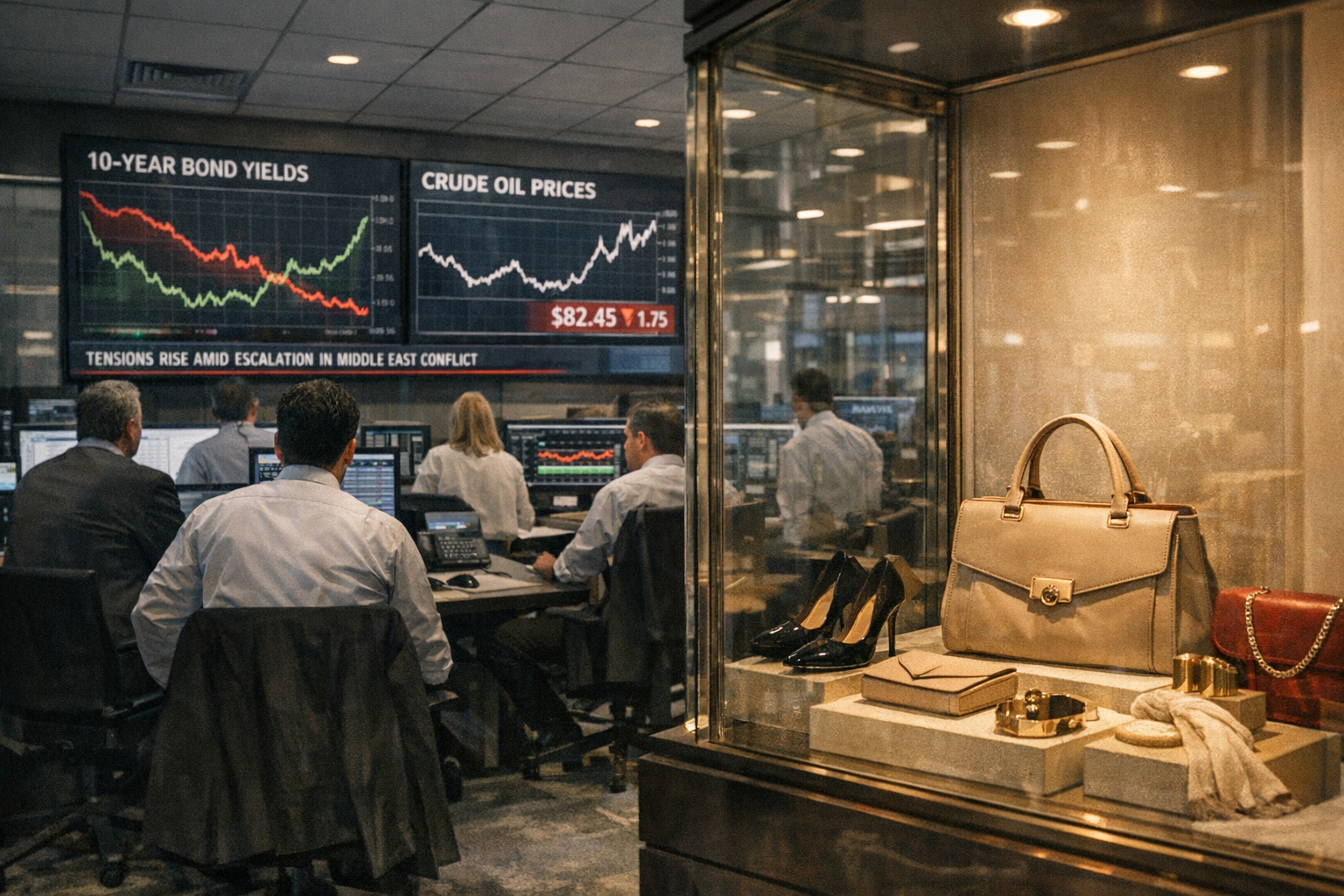
From Handbags to Treasury Bonds, the Iran War Is Rippling Across Markets
The war involving Iran is beginning to leave fingerprints far beyond the oil market, surfacing in places as varied as Parisian luxury houses, Wall Street trading desks and the market for U.S. government debt.
That widening reach came into sharper focus on Tuesday, when LVMH, the world’s largest luxury group, reported weaker-than-expected first-quarter sales and said demand had deteriorated in March as the Middle East conflict intensified. The company’s shares fell, and the broader luxury sector weakened with them, underscoring how a hoped-for recovery in high-end spending has been interrupted by a new layer of geopolitical uncertainty.
At nearly the same time, investors in Treasury markets were once again calibrating their response to developments in the region. Yields edged lower as traders weighed the conflict’s implications for growth, inflation and safe-haven demand. And at JPMorgan Chase, executives paired strong results in fixed income trading and investment banking with a cautionary note from Jamie Dimon, the bank’s chief executive, who warned of an “increasingly complex set of risks” confronting the global economy.
Taken together, the moves suggest that the fallout from the conflict is no longer being treated as a narrow commodity shock tied only to crude prices. Instead, businesses and investors are starting to reprice geopolitical risk across consumer demand, asset values and the broader outlook for growth and inflation.
Luxury’s Recovery Stumbles
Luxury companies entered 2026 hoping for relief after a prolonged slowdown, with the industry still grappling with soft demand from Chinese consumers and an uneven recovery across regions. But the latest results from LVMH showed how fragile that rebound had already been.
Management said demand worsened in March, and analysts pointed to the Iran war as a fresh headwind, particularly in a region that has been important for luxury spending. The setback landed just as investors had been looking for evidence that the sector was finally turning a corner.
The significance of the warning was not simply that one company had missed expectations. LVMH often serves as a barometer for global discretionary spending, especially at the high end of the consumer market. A deterioration there suggests that affluent shoppers, too, may be pulling back or delaying purchases when conflict darkens the economic outlook.
That matters because luxury groups had few easy buffers left. China’s recovery has remained disappointing, and demand in Europe and the United States has not been strong enough to fully compensate. The Middle East, long a reliable source of spending by local consumers and international travelers, was one of the places where companies had hoped to find resilience.
A Bond Market Caught Between Fear and Inflation
The Treasury market, meanwhile, has reflected a more complicated dynamic.
In moments of geopolitical stress, U.S. government bonds often benefit from safe-haven buying, pushing yields lower. That pattern reappeared as investors kept a close watch on developments in the Middle East. But this conflict has also carried the risk of disrupting energy flows, especially around the Strait of Hormuz, raising the prospect of higher oil prices and stickier inflation — forces that can push yields up instead.
That tension has left the bond market unusually sensitive to war headlines. After a two-week cease-fire between the United States and Iran was announced on April 7 and 8, the 10-year Treasury yield fell from roughly 4.30 percent to 4.24 percent intraday before later trading around 4.29 percent. The swing showed how quickly investors were adjusting to the possibility that a broader energy shock might be averted, or at least delayed.
The uncertainty is still unresolved. If the truce holds and talks progress, some of the pressure on oil prices and market volatility could continue to ease. If it collapses, traders may again have to price in a more severe inflation shock even as growth expectations weaken.
Wall Street Profits From Volatility, but Warns of It, Too
Banks are capturing another side of the same story. JPMorgan reported results that beat expectations, helped by strength in fixed income trading and investment banking as volatile markets generated business. On paper, that is the kind of environment large Wall Street firms are built to exploit.
But the bank’s message was not celebratory. Mr. Dimon described the economy as resilient while also warning about a more tangled backdrop of risks across global markets. His comments fit a pattern that has emerged among big financial institutions: volatility can buoy near-term revenues, even as the forces producing that volatility threaten to undermine confidence, investment and growth.
That duality is important. It suggests that strong bank earnings should not necessarily be read as evidence that the broader economy is shrugging off geopolitical turmoil. Rather, they may reflect how financial markets are adjusting to it in real time.
Mr. Dimon and other executives have increasingly pointed to conflict, elevated energy prices, trade tensions and high asset valuations as interconnected vulnerabilities. The concern is not only that any one shock becomes destabilizing, but that several begin reinforcing one another.
Why the Shift Matters Now
For months, investors had tended to interpret Middle East tensions largely through the lens of oil. What is changing now is the breadth of the impact.
Luxury companies are citing the conflict in discussions of demand. Bond investors are reacting not only to central bank policy and domestic economic data, but to cease-fire announcements and war risks. Large banks are posting gains from active markets while openly flagging geopolitical stress as a material threat.
That broader transmission matters because it can alter how risk is priced throughout the economy. A conflict that depresses spending in one region, stokes inflation concerns through energy, boosts market volatility and clouds corporate planning is no longer a contained external shock. It becomes part of the macroeconomic picture.
The next test is whether the cease-fire and diplomacy can hold long enough to reverse some of those effects. If they do, some of the recent repricing may unwind: oil could stabilize, Treasury yields could settle, and pressure on consumer sectors might ease. If not, the war’s consequences may deepen, forcing companies and investors alike to assume that geopolitical instability is not a brief interruption, but a more persistent feature of the global economy.
Sources
Further reading and reporting used to add context:
- https://apnews.com/article/2fc5ac7823bea71984b3578ec36aacee
- https://apnews.com/article/fafebd0711ab3b2a191ae23d4fe33350
- https://apnews.com/article/7ef6ebab1aaa731d2da6406b3cbde6dd
- https://www.financialcontent.com/article/marketminute-2026-4-7-treasury-yields-climb-to-436-amid-geopolitical-uncertainty
- https://apnews.com/article/3bc4432e146f23f33f039ef25cc00cf3
- https://www.lemonde.fr/en/economy/article/2025/07/25/lvmh-caught-in-turmoil-says-it-will-expand-its-production-in-the-us_6743710_19.html
- https://www.millionairematch.com/business/why-lvmh-shares-fell-after-results-2026
- https://news.bitcoin.com/us-10-year-treasury-yield-hits-8-month-high-above-4-4-pulls-back-on-middle-east-ceasefire-reports/
- https://tribune.com.pk/story/2599676/war-shakes-global-luxury-market
- https://www.tipranks.com/news/lvmh-stock-sell-off-rattles-luxury-brands-amid-trade-war-tensions
- https://www.cnbc.com/2025/06/16/us-treasury-yields-middle-east-conflict.html
- https://en.wikipedia.org/wiki/2026_Iran_war_ceasefire
- https://www.yahoo.com/lifestyle/lvmh-shares-slip-8-2-073019843.html
- https://www.nuveen.com/global/insights/investment-outlook/fixed-income-weekly-commentary
- https://www.nasdaq.com/articles/why-lvmh-stock-fell-today
- https://business.thepilotnews.com/thepilotnews/article/marketminute-2026-3-11-yields-anchor-at-415-as-markets-gird-for-critical-inflation-data-amid-middle-east-turmoil
- https://www.globalbankingandfinance.com/lvmh-shares-seen-lower-iran-war-weighs-first-quarter-sales/
- https://www.cnbc.com/2025/06/25/us-treasury-yields-investors-monitor-israel-iran-ceasefire-.html
- https://www.cnbc.com/2025/04/15/lvmh-sales-miss-as-tariff-uncertainty-threatens-to-hit-wealthy-shoppers.html
- https://www.cnbc.com/2025/06/23/us-treasury-yields-us-bombs-iran-.html
- https://www.cnbc.com/2025/06/18/dollar-muted-as-investors-watch-israel-iran-conflict-ahead-of-fed-decision.html
- https://www.cnbc.com/2025/04/29/us-treasury-yields-earnings-reports.html
- https://www.cnbc.com/2025/06/17/us-treasury-yields-trump-hints-israel-iran-conflict-escalation.html
- https://www.cnbc.com/2025/09/05/us-treasury-yields-investors-await-august-jobs-report-.html
- https://www.cnbc.com/2025/02/04/oil-falls-as-trump-agrees-to-pause-tariffs-on-mexico-canada.html
- https://www.cnbc.com/2025/02/26/dollar-lifts-from-11-week-low-amid-soft-economic-data-tariff-worries.html
- https://www.cnbc.com/2025/05/01/us-treasury-yields-investors-grapple-with-recession-fears.html
- https://www.cnbc.com/2025/06/24/global-markets-post-muted-gains-on-back-of-trump-policy-fatigue.html
- https://fm.cnbc.com/applications/cnbc.com/resources/editorialfiles/2023/02/25/2022ar.pdf
- https://fm.cnbc.com/applications/cnbc.com/resources/editorialfiles/2012/05/03/2226796_GPR_DELOITTE_Final%20%282%29.pdf
- https://fm.cnbc.com/applications/cnbc.com/resources/editorialfiles/2026/01/12/warrenletter.pdf
- https://fm.cnbc.com/applications/cnbc.com/resources/editorialfiles/2019/06/06/RickGatesEricBranstadEmailAboutTomBarrack.pdf
- https://apnews.com/article/be31f6305b847f5f555edb2f251e36c2
- https://www.forbes.com/sites/pamdanziger/2025/07/27/lvmhs-fashion-and-leather-goods-sales-plunge-12-signaling-a-broader-luxury-slowdown/
- https://www.rttnews.com/3528942/lvmh-shares-slide-as-sales-miss-sparks-luxury-sector-rout-herm-s-takes-top-spot.aspx
- https://www.luxurimag.com/news/luxury-rout-faces-middle-east-reckoning/
- https://www.investing.com/news/stock-market-news/lvmh-posts-3-drop-in-first-quarter-sales-3984031
- https://www.forbes.com/sites/marisato/2025/07/24/lvmh-sales-fall-but-luxury-conglomerate-outperforms-bleak-luxury-market-forecasts/
- https://www.cnbc.com/2025/01/29/shares-of-lvmh-drop-5percent-as-full-year-results-throw-doubt-on-broad-luxury-recovery.html
- https://www.bloomberg.com/news/articles/2025-01-28/lvmh-posts-subdued-sales-as-wealthy-shoppers-remain-cautious
- https://au.finance.yahoo.com/news/luxury-sector-1-hit-q1-060010063.html
- https://www.businessoffashion.com/articles/luxury/lvmh-fashion-sales-fall-5-percent//
- https://malaysia.news.yahoo.com/luxury-giant-lvmh-faces-headwinds-082811460.html
- https://en.wikipedia.org/wiki/2026_Strait_of_Hormuz_crisis
- https://www.reddit.com/r/REBubble/comments/1sftdqy/us_treasury_yields_fall_sharply_after_iran_war/
- https://www.jpmorganchase.com/ir/news/2026/jpmc-to-host-first-quarter-2026-earnings-call
- https://www.jpmorganchase.com/ir/news/2025/jpmc-announces-conference-calls-to-review-first-quarter-second-quarter-third-quarter-and-fourth-quarter-2026-earnings
- https://www.jpmorganchase.com/ir/annual-report/2025/ar-ceo-letters
- https://www.jpmorganchase.com/newsroom/press-releases/2025/center-for-geopolitics-launch
- https://www.jpmorganchase.com/newsroom/press-releases/2025/jpmorganchase-to-expand-paris-office-space
- https://www.jpmorganchase.com/content/dam/jpmc/jpmorgan-chase-and-co/investor-relations/documents/2026-company-updates/company-update-full-event-transcript.pdf
- https://www.jpmorganchase.com/ir/news/2025/jpmc-announces-new-responsibilities-for-senior-leaders
- https://www.jpmorganchase.com/newsroom/press-releases/2023/final-steel-beam-raised-at-new-jpmc-headquarters
- https://www.jpmorganchase.com/ir/news/2025/jpmorganchase-plans-dividend-increase
- https://www.jpmorganchase.com/newsroom/press-releases/2025/jpmorganchase-names-todd-combs-to-head-strategic-investment-group
- https://www.jpmorganchase.com/ir/annual-report/2024/ar-ceo-letters
- https://www.jpmorganchase.com/newsroom/press-releases/2019/2019-advancingcities-winners
- https://www.jpmorganchase.com/center-for-geopolitics
- https://www.jpmorganchase.com/content/dam/jpmc/jpmorgan-chase-and-co/investor-relations/documents/ceo-letter-to-shareholders-2018.pdf
- https://www.jpmorganchase.com/content/dam/jpmc/jpmorgan-chase-and-co/investor-relations/documents/2026-company-updates/company-update-firm-overview-transcript.pdf
- https://apnews.com/article/8118f58d75859b9fc74ab133fa9e8c3e
- https://apnews.com/article/f27e9560d1929732185da658e33d7fdb
- https://apnews.com/article/bcd3342cd0b4e60ebedc1e81db08f465
- https://www.mexc.co/en-NG/news/1001818
- https://en.wikipedia.org/wiki/8_April_2026_Lebanon_attacks
- https://markets.chroniclejournal.com/chroniclejournal/article/marketminute-2026-4-7-treasury-yields-climb-to-436-amid-geopolitical-uncertainty
- https://investor.wedbush.com/wedbush/article/marketminute-2026-4-3-the-yield-trap-housing-recovery-stalls-as-10-year-treasury-hits-437-and-mortgage-rates-surge
- https://dailyalpha.us/news/us-iran-ceasefire-news-sparks-market-moves-oil-plummets-gold-surges-and-bond-yields-fall-69d63c8ac55c4e12cc609a20
- https://en.wikipedia.org/wiki/2025%E2%80%932026_Iran%E2%80%93United_States_negotiations
- https://www.westernsouthern.com/-/media/files/fortwashington/fort-washington-monthly-market-pulse-april-2026.pdf
- https://en.wikipedia.org/wiki/2026_Iran_war_fuel_crisis
- https://economynext.com/sri-lanka-electricity-tariffs/
- https://m.economictimes.com/markets/commodities/news/gold-prices-climb-on-softer-dollar-lower-us-treasury-yields/amp_articleshow/129532494.cms
- https://en.wikipedia.org/wiki/2026_Iran_war
- https://cryptorank.io/news/feed/dcd52-gold-price-forecast-gld-pushes-toward-5000-on-falling-us-yields
- LVMH dethroned by Hermès as world's most valuable luxury stock after sales miss
- Luxury giant LVMH faces headwinds as sales growth slows in first quarter – Yahoo News
- Stocks drift lower and oil prices ease ahead of planned US-Iran talks