
Starmer Survives the Day, but Not the Crisis
Keir Starmer remained in Downing Street on Wednesday, digging in against calls to resign even as financial markets, Labour lawmakers and some of Britain’s largest investors weighed the cost of a prime minister who may have survived the immediate threat to his job only to emerge gravely weakened.
The day’s choreography captured the precariousness of his position. Ahead of the King’s Speech, Starmer held a brief meeting — less than 20 minutes — with Wes Streeting, the health secretary widely viewed as a potential successor. The encounter, short enough to invite its own interpretation, did little to quiet speculation about who might lead Labour if the party turns decisively against the man who brought it back to power less than two years ago.
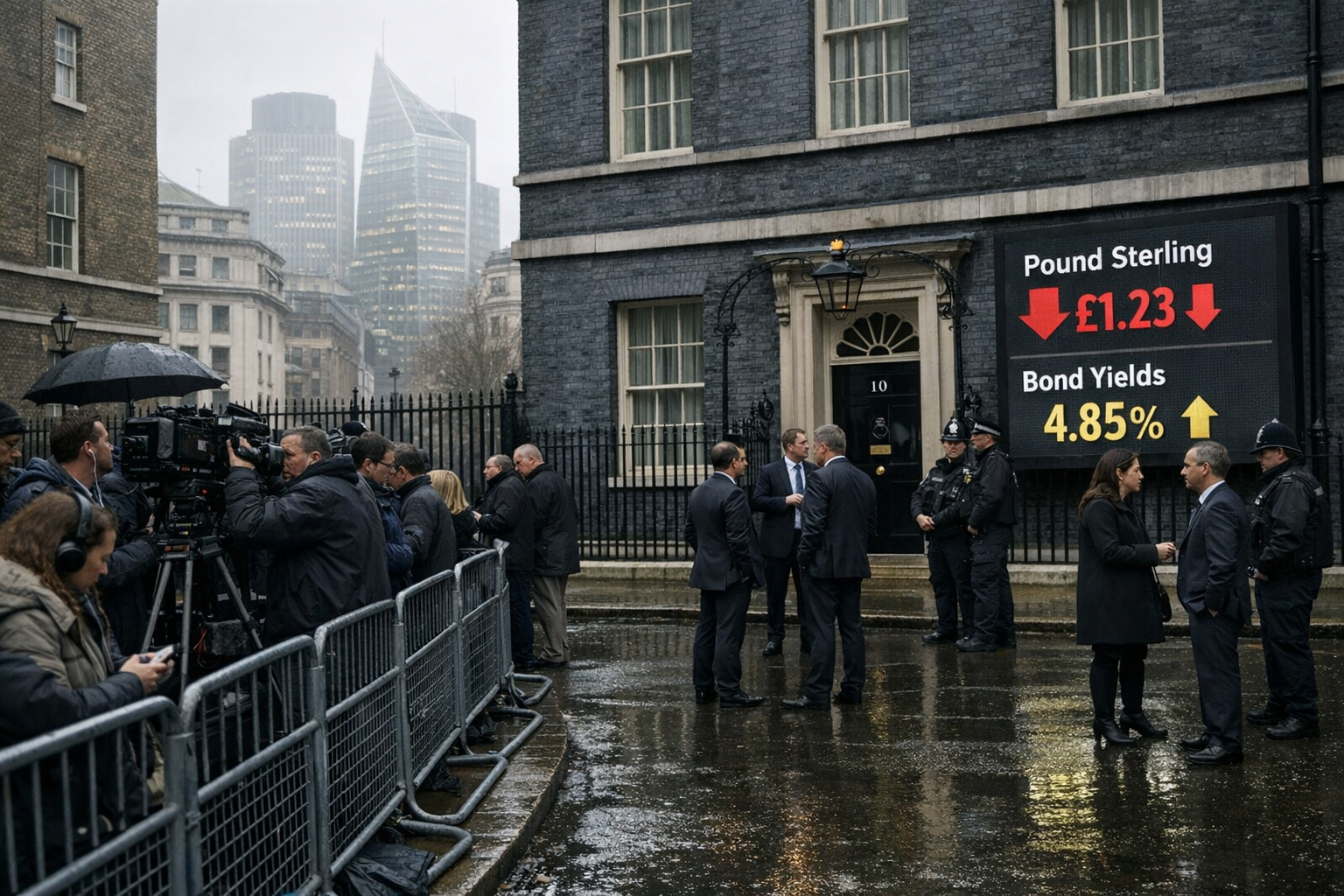
For now, no formal challenge has materialized. But the crisis has moved beyond Westminster intrigue. After a sharp sell-off in British assets on Tuesday, with gilt yields jumping and sterling sliding, investors have begun to treat Labour’s internal warfare as a question with implications for Britain’s economic credibility.
European markets steadied somewhat on Wednesday and British government bonds recovered some ground. But the rebound offered only limited relief. The market’s earlier reaction underscored how quickly political instability in London can feed into concerns over borrowing costs, fiscal discipline and the country’s wider investment climate.
Starmer himself has tried to make that case, warning that prolonged uncertainty carries an economic price. It was an argument aimed not only at restive MPs but at a country still sensitive to any sign that political upheaval could spill into the bond market.
From Electoral Setback to Leadership Emergency
The immediate trigger for Labour’s meltdown was its bruising performance in local elections on May 7, when losses and the advance of Reform UK sharpened long-simmering complaints that Starmer has failed to deliver the sense of national renewal he promised after taking office in July 2024.
What began as frustration over strategy and presentation has since become something more existential: a debate over whether Starmer can still serve as an electoral asset for a party already worrying about drift, disillusionment and a resurgent populist right.
In recent days, lawmakers have turned more openly against him, and analysts have increasingly questioned whether he can last the year. Even in the absence of a direct move by Streeting or another senior rival, the succession talk has become difficult to contain. Allies of the health secretary have openly renewed calls for Starmer to go, arguing that his authority has drained away.
That Streeting has not yet launched a challenge has given Starmer a narrow reprieve. But reprieve is not the same as recovery. A prime minister can survive a putsch and still lose the power to govern effectively, particularly when cabinet colleagues are being measured not by their loyalty but by their viability as replacements.
Markets Hear More Than Westminster Noise
What has made this episode more alarming for Labour is that the turmoil has not remained a purely political story.
Investors have been watching for signs that a leadership struggle could unsettle the government’s commitment to fiscal restraint, a pillar of Labour’s effort to reassure markets after years in which Britain’s economic credibility has at times appeared fragile. The rise in gilt yields on Tuesday — and the simultaneous weakness in the pound — suggested that some traders were beginning to price in the possibility that a wounded or replaced Starmer could complicate budget policy and the government’s relationship with business.
That anxiety was amplified by an unusual intervention from Jamie Dimon, the chief executive of JPMorgan Chase, who warned that the bank might reconsider plans for a new London headquarters if Starmer were ousted and succeeded by a leader less welcoming to the financial sector. Dimon described Starmer as “very smart,” a notable vote of confidence at a moment when Labour’s internal critics are portraying the prime minister as politically finished.
The warning was a reminder that, for all Labour’s troubles with parts of its base, Starmer has spent years trying to project caution and competence to boardrooms and international investors. If he falls, the question for markets will not simply be who comes next, but whether any successor preserves that balancing act.
Europe as a Lifeline — and a Limit
Facing pressure at home, Starmer has sought to reset the political conversation by leaning more heavily on Europe. Since returning to office, he has made repairing Britain’s post-Brexit relations with the European Union a central part of his governing project, culminating in a 2025 reset agreement covering defense, trade and broader cooperation.
The strategy offers a coherent policy story: Britain, under Labour, can be more pragmatic, less ideological and better able to unlock economic gains through closer ties with its neighbors. At a time of strained public finances and weak growth, that argument has obvious appeal.
But Europe may be a policy answer to a political problem it cannot fully solve.
Resetting relations with Brussels does not automatically repair a prime minister’s standing with voters who are angry about living standards, public services or a broader sense that little has changed. Nor does it necessarily soothe Labour MPs who fear they are losing ground to Reform UK in places where a Europe-first message may sound remote from local anxieties.
That is the harsh reality confronting Starmer. A diplomatic mission can provide direction, but not immunity. If his authority inside the party is too diminished, even a plausible long-term strategy may not be enough to hold the government together.
A Weakened Prime Minister, Even if He Stays
Wednesday’s question was whether Starmer would still be prime minister by the end of the day. The larger question is what kind of prime minister he would be afterward.
The answer, for now, appears to be one whose position remains intact formally but dangerously exposed politically. The King’s Speech may give him an opportunity to reassert control, outline priorities and remind colleagues of the consequences of toppling another British leader in the middle of economic uncertainty. Yet the brevity of his meeting with Streeting, and the persistence of public maneuvering around it, suggested that Labour’s power struggle is far from settled.
Much now depends on whether Starmer has merely bought time. If cabinet ministers, trade unions and wavering lawmakers decide that the moment for a coup has passed, he could stabilize and try to rebuild. If not, every policy announcement will be judged through the lens of succession.
That matters not just for Labour, but for Britain. A governing party consumed by doubts about its leader risks paralysis at a moment when the country faces sluggish growth, pressure on public services and a volatile international environment. The market tremors of the past 24 hours were modest by the standards of full-blown financial crises. But they served as a warning that in Britain, political weakness can quickly become an economic story.
For Starmer, survival has become the minimum requirement. Authority is the harder thing to recover.
Sources
Further reading and reporting used to add context:
- https://www.theguardian.com/politics/2026/may/12/starmer-cabinet-labour-leadership
- https://www.theguardian.com/politics/2026/may/13/labour-unions-keir-starmer-leader-election
- https://www.theguardian.com/politics/2026/may/10/starmer-faces-perilous-24-hours-streeting-readying-leadership-bid
- https://www.theguardian.com/politics/live/2026/may/12/keir-starmer-prime-minister-resignation-labour-leadership-cabinet-meeting-yvette-cooper-shabana-mahmood-andy-burnham-wes-streeting-uk-politics-latest-news-updates?page=with%3Ablock-6a0382d68f08830779870762
- https://www.theguardian.com/politics/2026/may/11/starmer-began-the-day-damaged-and-then-things-got-worse
- https://www.cnbc.com/2025/06/18/cnbcs-uk-exchange-newsletter-a-quantum-quandary-for-the-uk-government.html
- https://www.theguardian.com/politics/live/2026/may/12/keir-starmer-prime-minister-resignation-labour-leadership-cabinet-meeting-yvette-cooper-shabana-mahmood-andy-burnham-wes-streeting-uk-politics-latest-news-updates?filterKeyEvents=false&page=with%3Ablock-6a030e578f0883e855282cfb
- https://www.cnbc.com/2025/07/30/strong-ftse-strong-uk-not-necessarily-cnbcs-uk-exchange-newsletter.html
- https://www.cnbc.com/2025/05/28/cnbcs-uk-exchange-newsletter-an-all-too-familiar-dial-tone-from-vodafone.html
- https://www.cnbc.com/2025/05/22/us-tariffs-pose-a-real-challenge-to-europe-barclays-ceo-says.html
- https://www.cnbc.com/2025/07/07/the-euro-is-soaring-and-trumps-policies-could-push-it-even-higher.html
- https://www.cnbc.com/2025/05/19/uk-eu-summit-why-fish-and-youth-mobility-are-the-big-stumbling-blocks.html
- https://fm.cnbc.com/applications/cnbc.com/resources/editorialfiles/2026/04/23/Toplines_260142_CNBC_AAES_Q1_2026_Topline.pdf
- https://fm.cnbc.com/applications/cnbc.com/resources/editorialfiles/2025/10/08/2025-10-08Raskin_to_Dimon_JPMorgan_re_Epstein.pdf
- https://fm.cnbc.com/applications/cnbc.com/resources/editorialfiles/2012/05/03/2226515_Buffett%20Interview%20Transcript%202010-01-20.pdf
- https://fm.cnbc.com/applications/cnbc.com/resources/editorialfiles/2018/04/04/ceo-letter-to-shareholders-2017.pdf
- https://usadvertising.theguardian.com/assets/files/the-guardian-us–corporate-sustainability_-consumer-sentiments-research-x-script.pdf
- https://fm.cnbc.com/applications/cnbc.com/resources/editorialfiles/2019/01/18/Letter%20to%20Secretary%20Mnuchin%20on%20bank%20liquidity%20calls.pdf
- https://apnews.com/article/4bcdb20f449a8bf625dfdf57da6048ae
- https://apnews.com/article/28a702335a89400ea7c08254bf8817ab
- https://apnews.com/article/656fd7ba1ec1921ae05d1098bfac9d1e
- https://apnews.com/article/1454415a831ae3af31b10dff29d04d13
- https://apnews.com/article/68bfcf656ecd0acf6c52e1211f3b1bdc
- https://www.itv.com/news/2026-05-12/keir-starmer-to-meet-key-rival-wes-streeting-amid-open-revolt-in-labour-party
- https://www.theguardian.com/politics/live/2026/may/12/keir-starmer-prime-minister-resignation-labour-leadership-cabinet-meeting-yvette-cooper-shabana-mahmood-andy-burnham-wes-streeting-uk-politics-latest-news-updates?filterKeyEvents=false&page=with%3Ablock-6a0385fe8f082e881a333c71
- https://www.theguardian.com/politics/live/2026/may/12/keir-starmer-prime-minister-resignation-labour-leadership-cabinet-meeting-yvette-cooper-shabana-mahmood-andy-burnham-wes-streeting-uk-politics-latest-news-updates?filterKeyEvents=false&page=with%3Ablock-6a02fd098f0894ddcedce3e0
- https://www.thestar.com.my/news/world/2026/05/12/uk039s-starmer-defies-calls-to-quit-says-he-is-getting-on-with-governing
- https://www.internazionale.it/ultime-notizie-reuters/2026/05/10/uk-s-starmer-launches-political-fightback-putting-europe-ties-at-heart-of-reset
- https://www.itv.com/news/2026-05-11/starmer-leadership-in-peril-as-cabinet-ministers-tell-him-to-consider-position
- https://www.theguardian.com/business/2026/may/12/jamie-dimon-jp-morgan-could-scrap-new-3bn-hq-if-starmer-is-replaced-by-pm-hostile-to-banks
- https://www.itv.com/news/2026-05-12/keir-starmer-cabinet-meeting-calls-to-resign
- https://www.theguardian.com/politics/live/2026/may/12/keir-starmer-prime-minister-resignation-labour-leadership-cabinet-meeting-yvette-cooper-shabana-mahmood-andy-burnham-wes-streeting-uk-politics-latest-news-updates?page=with%3Ablock-6a0369368f082455fa0bcb77
- https://news.sky.com/story/starmer-latest-burnham-streeting-rayner-leadership-quit-cabinet-resign-kings-speech-local-elections-12593360?postid=11681014
- https://kfgo.com/2026/05/12/uks-starmer-defies-calls-to-quit-says-he-is-getting-on-with-governing/
- https://www.lemonde.fr/en/international/article/2026/05/13/starmer-rules-out-leaving-downing-street-despite-labour-rebellion_6753399_4.html
- https://en.wikipedia.org/wiki/2026_United_Kingdom_local_elections
- https://www.reddit.com/r/london/comments/1tbrb0f/dimon_says_jpmorgan_would_scrap_new_uk_hq_over/
- https://www.theguardian.com/business/live/2026/may/13/uk-bond-market-yields-political-turmoil-oil-inflation-housing-market-live-updates
- https://www.internazionale.it/ultime-notizie-reuters/2026/05/12/uk-s-starmer-defies-calls-to-quit-says-he-s-getting-on-with-governing
- https://www.globalbankingandfinance.com/sterling-drops-markets-watch-uk-politics-pm-starmers-future/
- https://www.internazionale.it/ultime-notizie-reuters/2026/05/12/uk-s-starmer-defies-calls-to-quit-says-he-is-getting-on-with-governing
- https://www.internazionale.it/ultime-notizie-reuters/2026/05/13/starmer-vows-to-carry-on-governing-prepares-for-grand-parliamentary-ceremony
- https://www.investing.com/news/world-news/uk-pm-starmer-urges-closer-collaboration-with-europe-on-defence-4506968
- https://wkzo.com/2026/05/12/uks-starmer-defies-calls-to-quit-says-he-is-getting-on-with-governing/
- https://www.lse.co.uk/news/sterling-slides-on-starmer-crisis-and-rate-cut-bets-1zgsi5rbxpvm6xk.html
- https://wkzo.com/2026/05/12/uk-borrowing-costs-march-higher-sterling-slumps-as-starmers-future-in-doubt/
- https://uk.marketscreener.com/news/starmer-vows-to-carry-on-governing-ahead-of-grand-parliamentary-ceremony-ce7f5bdfdb88f526
- https://uk.marketscreener.com/news/political-turmoil-and-inflation-threat-vie-to-push-up-uk-borrowing-costs-ce7f5bdedf8cf526
- https://www.globalbankingandfinance.com/sterling-limps-worst-week-two-months-bruising-days/
- https://en.wikipedia.org/wiki/2026_in_United_Kingdom_politics_and_government
- https://en.wikipedia.org/wiki/2026_in_the_United_Kingdom
- https://apnews.com/article/f17a122a0cfcc3595ef01f142517b0b6
- https://www.euronews.com/my-europe/2026/05/08/why-a-weakened-starmer-will-worry-the-eu
- https://www.consilium.europa.eu/en/press/press-releases/2025/05/19/remarks-by-president-antonio-costa-at-the-joint-press-conference-following-the-eu-uk-summit-in-london/pdf/
- https://fortune.com/europe/2025/05/19/uk-eu-reach-new-deal-brexit-keir-starmer-european-union-defence/
- https://feeds.bbci.co.uk/news/articles/ce9v28r7vlxo
- https://www.investing.com/news/economy-news/britain-poised-to-reset-trade-and-defence-ties-with-eu-4051939
- https://kelo.com/2026/05/10/uks-starmer-launches-political-fightback-putting-europe-ties-at-heart-of-reset/
- https://apnews.com/article/3181228316c3d0cd736ecbf93a1eff43
- https://reuters.screenocean.com/record/1998935
- https://elpais.com/internacional/2025-05-19/la-ue-y-el-reino-unido-alcanzan-un-acuerdo-historico-que-estrecha-lazos-en-defensa-pesca-y-juventud.html
- https://en.wikipedia.org/wiki/United_Kingdom%E2%80%93European_Union_relations
- https://www.lemonde.fr/en/international/article/2025/05/19/five-years-after-brexit-uk-and-eu-aim-for-a-fresh-start_6741415_4.html
- https://www.theguardian.com/politics/2026/mar/04/mps-say-starmers-uk-eu-reset-lacks-direction-definition-and-drive
- https://reuters.screenocean.com/record/1998357
- https://www.bloomberg.com/news/articles/2025-05-19/eu-and-uk-said-to-reach-a-technical-deal-to-strengthen-ties
- https://www.investing.com/news/economy-news/eu-and-uk-reach-tentative-agreement-ahead-of-summit-say-eu-officials-4052056
- Starmer vows to carry on governing, prepares for grand parliamentary ceremony – Internazionale
- Long-term UK borrowing costs rise to highest since 1998, sterling slumps as Starmer’s future in doubt
- Starmer says he won't quit after local elections deliver losses for Labour and wins for Reform UK
- Labour-supporting unions predict Starmer will not lead party into next election | Keir Starmer | The Guardian