
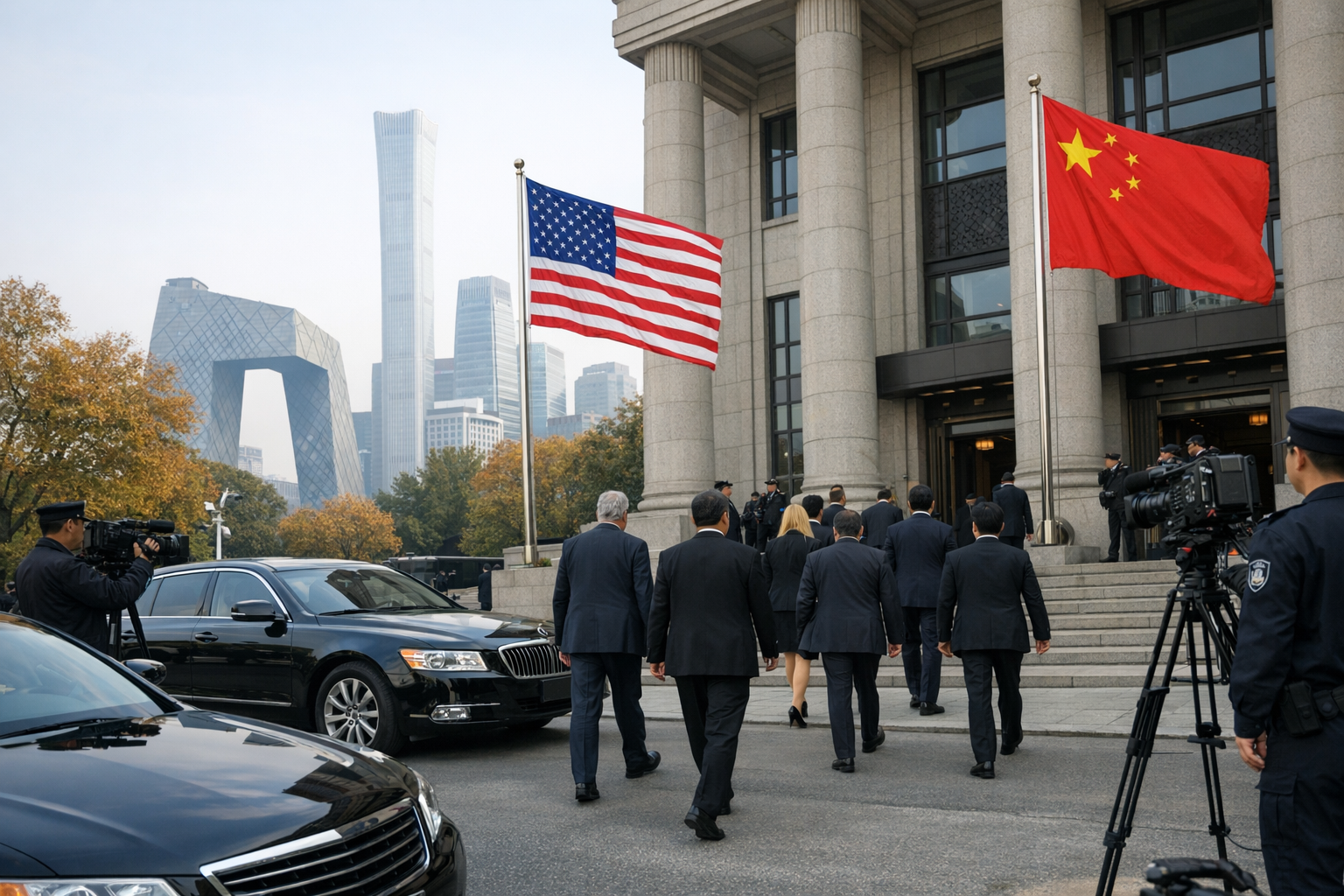
As President Trump heads to Beijing this week for two days of talks with President Xi Jinping, a meeting once framed chiefly around tariffs and trade has expanded into something broader and more volatile: a negotiation over technology, Taiwan, political prisoners and the fallout from war in the Middle East.
The shift was underscored by the late addition of Jensen Huang, Nvidia’s chief executive, to the American business delegation, a move that placed the world’s most influential artificial intelligence chipmaker at the center of a summit already freighted with strategic tension. Trump personally called Mr. Huang to join the trip, according to fresh reporting, and picked him up in Alaska on the way to Beijing.
His presence alongside other prominent business leaders, including the heads of Apple, Tesla and Goldman Sachs, is a reminder that even as Washington tightens export controls and investment restrictions, American executives still see China as too important a market to ignore. For Beijing, the appearance of Mr. Huang — whose company sits at the heart of the global race for AI computing power — offers a vivid measure of how deeply commercial ties remain entangled with national security rivalry.
A summit with a widening agenda
Trump and Xi are scheduled to meet Thursday and Friday in Beijing, at a moment when the relationship between the world’s two largest economies is being pulled in several directions at once.
Trump said this week that he intends to raise U.S. arms sales to Taiwan and the imprisonment of Jimmy Lai, the jailed Hong Kong media publisher, during his talks with Xi. Those choices inject two of the most politically sensitive issues in the relationship directly into a summit that had been expected to focus on preserving a fragile trade truce.
Taiwan remains the most dangerous military flashpoint between Washington and Beijing. China claims the self-governing island as its territory and has long denounced American weapons sales and political support as interference in its internal affairs. By saying in advance that he will press the issue, Trump appears to be signaling that he is not prepared to narrow the conversation to economics alone.
The mention of Mr. Lai, a prominent pro-democracy figure and publisher whose prosecution has drawn criticism in Washington and other Western capitals, similarly broadens the scope of the talks. Human rights issues have often receded in high-level U.S.-China diplomacy when security and trade concerns dominate. Trump’s decision to put Mr. Lai’s case on the agenda suggests a meeting likely to be as much about pressure points as problem-solving.
Tech takes center stage
Mr. Huang’s last-minute invitation has drawn outsized attention because it captures a central contradiction in U.S.-China relations: both governments recognize that advanced semiconductors are essential to economic and military power, yet they are moving in opposite directions on how those technologies should flow.
Nvidia has become one of the clearest symbols of that struggle. The company’s chips are critical to training and running advanced AI systems, making them highly sought after in China even as U.S. restrictions have increasingly limited what can be sold there. The Biden and Trump administrations alike treated high-end chip access as a strategic issue, and Beijing has responded with its own efforts to build up domestic semiconductor capacity and reduce dependence on American suppliers.
That makes Mr. Huang’s attendance significant whether or not it produces any immediate policy change. It suggests that chip policy, market access and the broader contest over AI standards and infrastructure are likely to hover over the meeting, even if they are not resolved in any formal way.
For American companies, the summit is also a chance to argue for more predictable operating conditions in China at a time when regulation, data rules and geopolitical distrust have made business planning far more difficult. For Chinese officials, high-profile executives offer evidence that foreign investors still want a stake in the Chinese market, despite years of decoupling rhetoric.
Iran and Hormuz recast the economic stakes
If technology and Taiwan are raising the temperature, events far from East Asia are reshaping the practical incentives for both sides to talk.
In the run-up to the summit, concern over Iran and the Strait of Hormuz has begun to rival — and for some Chinese exporters, even surpass — tariff worries. The reason is straightforward: any disruption in or around Hormuz threatens a crucial artery for global energy shipments and commercial transport, putting upward pressure on fuel costs, insurance rates and freight expenses across supply chains already rattled by war.
For China, the world’s largest importer of crude oil and a manufacturing power dependent on stable shipping routes, turmoil in the Gulf carries immediate economic consequences. For the United States, the region’s instability risks feeding inflation and further unsettling global markets. That has created an unusual overlap in interests at a time when common ground between Washington and Beijing is otherwise scarce.
The summit is therefore taking place under the shadow of a broader question: whether the two governments can cooperate at all to calm a crisis that neither side fully controls, even as they remain at odds on many of its causes and consequences.
That represents a notable change from earlier expectations for the meeting. What was once seen primarily as a venue to shore up a trade détente has been overtaken by the geopolitical aftershocks of the Iran war and the shipping tensions that followed. For Chinese manufacturers and investors, the cost of instability in the Gulf may now feel more immediate than the next round of tariff bargaining.
Symbolism and limits
The breadth of the agenda is also a sign of the limits facing both leaders.
Trump has suggested publicly that he may not need Xi’s help on Iran, even as the economic logic of coordination has grown stronger. Xi, for his part, is unlikely to welcome pressure on Taiwan or Mr. Lai, issues the Chinese government treats as matters of sovereignty and domestic authority. And while business leaders may hope for signals of moderation on trade or technology restrictions, neither side appears ready for a fundamental reset.
That leaves open a series of unresolved questions heading into Beijing: whether the two presidents can produce anything concrete on trade; whether AI or chip talks move beyond symbolism; whether raising Taiwan arms sales hardens China’s position rather than moderating it; and whether Mr. Lai’s case is discussed as a matter of principle or dismissed as political theater.
Mr. Huang’s presence may be the clearest expression of those ambiguities. It could point to a serious attempt to put technology access and commercial interests back into high-level diplomacy. Or it may simply serve as a powerful image: the chief executive of America’s most consequential chip company joining a presidential mission to China at a time when Washington is trying to contain Beijing’s access to exactly the technologies his company makes.
Why this meeting matters now
The Beijing summit matters not because it is likely to resolve the central disputes between the United States and China, but because it reveals how those disputes are merging.
Trade can no longer be separated cleanly from technology; technology cannot be separated from security; and security concerns in one region are now rapidly affecting economic calculations in another. Taiwan, export controls, AI supremacy, political freedoms in Hong Kong, oil flows through Hormuz and the cost of moving goods around the world are all arriving at the same table.
For years, U.S.-China summits often turned on a single organizing issue — trade deficits, tariffs, military signaling. This one looks different. It is shaping up as a test of whether the two powers can manage a relationship in which every major question has become interconnected, and in which even a business delegation can double as a strategic message.
In that sense, the addition of Mr. Huang was more than a scheduling wrinkle. It was an emblem of the summit itself: part commerce, part diplomacy, part contest for advantage in a world where economics and power are no longer easily disentangled.
Sources
Further reading and reporting used to add context:
- https://apnews.com/article/353c768987542843e2033aa684266879
- https://www.thedailybeast.com/marco-rubio-models-ultimate-bonkers-cosplay-in-air-force-one-pic/
- https://apnews.com/article/2eee658298ba8f064fe232e8832bd2ea
- https://apnews.com/article/9793fe4f345d05b4460d848eecbad6fa
- https://www.axios.com/2026/05/11/trump-china-summit-iran-ai-xi-jinping
- https://www.theguardian.com/technology/2026/may/13/nvidia-jensen-huang-joins-trump-as-tech-dominates-china-trip
- https://www.straitstimes.com/world/united-states/nvidia-ceo-jensen-huang-joins-trumps-china-visit/
- https://au.investing.com/news/stock-market-news/nvidias-jensen-huang-joins-trumps-china-visit-4429494
- https://www.internazionale.it/ultime-notizie-reuters/2026/05/13/nvidia-ceo-joins-trump-s-mission-to-open-up-china
- https://www.internazionale.it/ultime-notizie-reuters/2026/05/13/nvidia-ceo-joins-trump-s-thorny-trade-mission-to-china
- https://www.internazionale.it/ultime-notizie-reuters/2026/05/13/ahead-of-trump-xi-summit-china-warns-on-us-arms-sales-to-taiwan-2
- https://www.moneycontrol.com/world/nvidia-s-jensen-huang-to-join-trump-s-china-visit-report-article-13917291.html
- https://kelo.com/2026/05/12/nvidias-jensen-huang-to-join-trumps-china-visit-sources-say/
- https://letsdatascience.com/news/nvidia-ceo-joins-trumps-delegation-to-china-72e00321
- https://finance.yahoo.com/news/nvidia-ceo-joins-trumps-mission-041122393.html/
- https://www.tomshardware.com/tech-industry/artificial-intelligence/nvidia-ceo-jensen-huang-says-china-should-not-have-blackwell-or-rubin-ai-gpus-firmly-states-us-should-have-the-first-the-most-and-the-best-when-it-comes-to-ai-hardware
- https://finance.yahoo.com/news/nvidias-jensen-huang-join-trumps-013448593.html
- https://finance.yahoo.com/news/trump-personally-calls-nvidia-ceo-053546247.html
- https://en.wikipedia.org/wiki/Jensen_Huang
- https://www.reddit.com/r/MU_Stock/comments/1tbnhyy/reuters_nvidias_jensen_huang_joins_trumps_china/
- https://www.reddit.com/r/China/comments/1tbm2nm/nvidias_huang_joins_trumps_china_trip_as/
- https://apnews.com/article/f5b1d1229252179dd332181902d9a87b
- https://apnews.com/article/d0ebb5b2803acf8d4f550216552e0b29
- https://www.investing.com/news/economy-news/chinas-exports-set-to-lose-momentum-as-iran-war-undercuts-aidriven-boom-reuters-poll-4609203
- https://www.bworldonline.com/world/2026/05/12/749020/trump-to-discuss-taiwan-arms-sales-jailed-hk-tycoon-jimmy-lai-with-xi/
- https://www.investing.com/news/economy-news/chinas-march-exports-slow-as-iran-war-wipes-out-aidriven-gains-4611643
- https://ca.investing.com/news/commodities-news/oil-prices-slip-on-teetering-iran-ceasefire-as-trump-heads-to-china-4632798
- https://www.streetinsider.com/Reuters/Trump%2Bsays%2Bhe%2Bwill%2Bdiscuss%2Barms%2Bsales%2Bto%2BTaiwan%2Bwith%2BChinas%2BXi/26467608.html
- https://www.lemonde.fr/en/international/article/2026/05/13/xi-set-to-welcome-trump-from-a-position-of-strength_6753387_4.html
- https://au.investing.com/news/commodities-news/oil-prices-slip-on-teetering-iran-ceasefire-as-trump-heads-to-china-4429447
- https://www.investing.com/news/world-news/trumps-iran-tariff-threat-risks-reopening-china-rift-4443970
- https://ca.investing.com/news/world-news/trump-says-he-will-discuss-taiwan-arms-sales-case-of-jailed-tycoon-jimmy-lai-with-xi-4628199
- https://www.thejakartapost.com/world/2026/05/12/trump-says-he-will-discuss-taiwan-arms-sales-with-chinas-xi.html
- https://www.vindy.com/news/national-news/2026/05/trump-xi-summit-comes-with-high-stakes-for-taiwan/
- https://au.investing.com/news/world-news/trump-says-he-will-discuss-taiwan-arms-sales-case-of-jailed-tycoon-jimmy-lai-with-xi-4425129
- https://en.wikipedia.org/wiki/List_of_U.S._arms_sales_to_Taiwan
- https://apnews.com/article/48b0ca751712ce473ffcd207997928af
- https://apnews.com/article/1a0b28a9a7b9078d736ba94bf3b4d6e2
- https://au.investing.com/news/world-news/peace-deal-hopes-fade-after-trump-rejectsgarbage-iran-proposal-4425448
- https://www.investing.com/news/economy-news/china-urges-restraint-over-us-blockade-of-strait-of-hormuz-backs-talks-4609452
- https://www.investing.com/news/world-news/iran-offers-strait-deal-trump-dissatisfied-but-prefers-nonmilitary-path-4654784
- https://en.wikipedia.org/wiki/2026_Strait_of_Hormuz_crisis
- https://www.washingtonpost.com/politics/2026/05/05/trump-xi-iran-rubio-hormuz/0e470c3e-48d9-11f1-a119-857cd2bf4fd4_story.html
- https://www.investing.com/news/commodities-news/trump-warns-of-more-strikes-on-irans-kharg-island-pressures-allies-to-secure-oil-chokepoint-4561541
- https://www.straitstimes.com/asia/east-asia/china-urges-restraint-as-trump-threatens-to-blockade-strait-of-hormuz
- https://www.marketscreener.com/news/iran-conflict-disrupts-china-s-middle-east-steel-exports-ce7e5cdddc80ff20
- Nvidia’s Jensen Huang joins Trump’s China visit By Reuters
- Nvidia’s Jensen Huang joins Trump as tech dominates China trip | Nvidia | The Guardian
- Trump and Xi dialed down the trade war, but challenges lurk at their China summit
- Trump's legacy week