
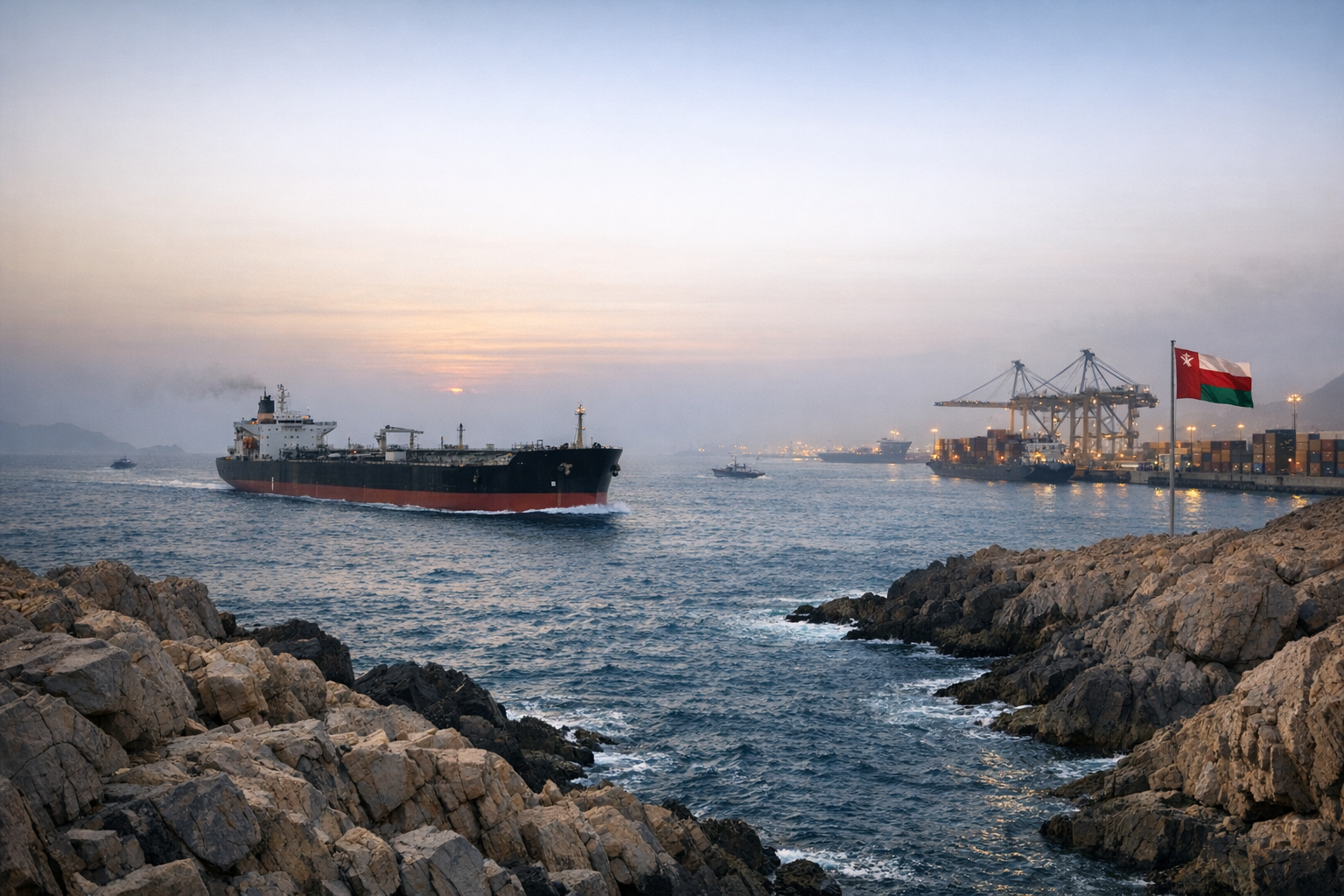
Oman, Long a Quiet Go-Between, Is Drawn Into Washington’s Escalating Iran Pressure
For decades, Oman has occupied a rare place in the Middle East: a trusted American security partner, a neighbor of Iran that keeps open lines to Tehran, and a discreet diplomatic channel when more formal talks have broken down.
Now that balancing act is under unusual strain.
President Trump’s latest warnings over the Strait of Hormuz have thrust the sultanate into the center of the Iran crisis, raising the prospect that Washington’s campaign of pressure could expand beyond Tehran itself and onto one of the region’s most careful intermediaries. The shift has startled diplomats and regional analysts because Oman has long been treated less as a target than as a bridge — a place where messages could be passed, tensions lowered and, at times, deals quietly explored.
The immediate dispute centers on reports that Iran and Oman might play a role in managing shipping through the Strait of Hormuz as part of a broader arrangement aimed at ending the current conflict. Mr. Trump publicly rejected the idea and warned that no one country would be allowed to control the strategic waterway, comments that appeared to include a threat against Oman as well as Iran.
The administration then moved to harden that message. On May 27, the Treasury Department imposed sanctions on Iran’s newly created Persian Gulf Strait Authority, which Washington says is tied to the Islamic Revolutionary Guard Corps and intended to extract transit payments from vessels moving through the narrow passage. A day later, Treasury officials, in discussions with Oman’s ambassador, underscored that any party cooperating with Iranian toll demands in the strait could face sanctions exposure — a warning widely read as a signal that Muscat itself was not beyond reach.
A Pressure Campaign Extends Beyond Iran
That marks a notable turn in American policy.
Washington has spent years trying to isolate Iran economically and militarily, but direct pressure on Oman would widen the battlefield of coercion to a country that has often helped the United States manage crises with Tehran. Oman hosts part of the Strait of Hormuz, the narrow maritime chokepoint through which a significant share of the world’s seaborne oil and gas passes. Any new uncertainty over who polices or administers traffic there can reverberate quickly through energy markets, shipping insurance rates and military planning across the Gulf.
The stakes are not only commercial. They are also diplomatic.
Oman has cultivated a reputation for neutrality that has allowed it to serve as a back channel in moments when Washington and Tehran were otherwise speaking mostly through threats. Muscat helped facilitate earlier rounds of U.S.-Iran contacts and, according to recent diplomatic reporting, hosted talks this year as cease-fire and nuclear discussions flickered in and out of view. Its value to both sides has rested on a delicate premise: that Oman can talk to everyone without being seen as belonging fully to any camp.
Threatening sanctions against Muscat risks weakening that role at the very moment when the region has few reliable intermediaries left.
The Strait’s Strategic and Symbolic Weight
The clash also highlights how central the Strait of Hormuz remains to the wider confrontation. The passage, bounded in part by Oman and facing Iran across the water, has long been one of the world’s most sensitive strategic arteries. Even limited disruptions — seizures, drone attacks, naval incidents or threats to commercial shipping — can send tremors through global markets.
Iran has often tried to use that geography as leverage in periods of heightened conflict. The new Persian Gulf Strait Authority appears, in Washington’s view, to be part of that strategy: an effort to turn military and territorial pressure into an institutional mechanism for collecting payments and asserting de facto control over transit. American officials have framed the body not as a legitimate regulator but as an extension of Iran’s coercive apparatus.
That helps explain the administration’s unusually sharp reaction. To Washington, allowing any arrangement that appeared to validate Iranian tolling or special authority in the strait would risk setting a precedent that could outlast the current war. For the Trump administration, the concern is not simply a single deal but the possibility that Tehran could emerge from the crisis with a more formalized grip over one of the world’s key maritime corridors.
Oman’s Delicate Position
For Oman, the problem is that geography and diplomacy now point in opposite directions.
Its location makes it indispensable to any serious conversation about the strait. But that same position leaves it vulnerable when larger powers harden their demands. Muscat has historically tried to avoid public confrontation, preferring quiet engagement over ideological alignment. It has maintained ties with Washington while preserving channels to Tehran, a posture that has earned it the nickname “the Switzerland of the Middle East.”
Yet neutrality becomes harder to sustain when one ally suggests that even facilitation could be punished.
It is still unclear whether the administration’s threats amount primarily to coercive signaling — a warning meant to block any Oman-backed maritime arrangement with Iran — or whether Washington is prepared to penalize Oman directly. That distinction matters enormously. A symbolic warning could still leave room for Muscat to continue mediating behind the scenes. Actual sanctions, or military pressure tied to the strait, would be far more destabilizing, potentially forcing Oman into choices it has spent decades trying to avoid.
Fragile Diplomacy, Persistent Risk
The timing is especially precarious. Fighting and drone threats around the strait have continued even as cease-fire efforts and proposed nuclear talks remain alive, if barely. In that environment, every intermediary matters, and every signal can shift the calculations of shipping companies, insurers, military commanders and negotiators.
The unresolved questions are piling up. It is not clear whether any Hormuz-related deal involving Iran is still viable. It is not clear whether Oman can preserve its role as mediator under mounting American pressure. And it is not clear whether fresh sanctions, or a military incident in or near the strait, could collapse the tentative diplomatic track altogether.
What is clearer is that a crisis once framed chiefly as a showdown with Iran is now testing a broader regional architecture — including the smaller states that have quietly helped keep lines of communication open. If Oman is no longer treated as an intermediary but as another point of pressure, the consequences could extend well beyond Muscat.
In a region where diplomacy often survives only in narrow, improvised channels, even a threat against the messenger can carry global weight.
Sources
Further reading and reporting used to add context:
- https://www.thedailybeast.com/ally-ignores-trump-warning-to-buddy-up-with-his-enemy/
- https://apnews.com/article/4958276f91ad629e1c5e284a216fd333
- https://www.thedailybeast.com/trump-79-threatens-to-blow-up-another-us-ally/
- https://www.gmanetwork.com/news/topstories/world/987065/us-iran-no-closer-to-ending-war-as-qatari-tanker-sails-toward-strait-of-hormuz/story/
- https://en.wikipedia.org/wiki/2026_Iranian_strikes_on_Oman
- https://www.investing.com/news/world-news/us-to-blockade-iran-after-talks-fail-to-yield-adeal-4609134
- https://www.investing.com/news/world-news/middle-east-truce-in-doubt-as-us-and-iran-fight-for-control-of-strait-of-hormuz-4657885
- https://www.internazionale.it/ultime-notizie-reuters/2026/05/28/trump-says-iran-and-oman-will-not-control-strait-of-hormuz-deal-remains-elusive
- https://openrss.org/www.reuters.com/world/middle-east/
- https://www.aljazeera.com/amp/news/2026/5/28/us-treasury-threatens-oman-with-sanctions-over-hormuz-strait
- https://www.streetinsider.com/Reuters/Iran%2Bcould%2Bopen%2BStrait%2Bof%2BHormuz%2Bwithin%2Ba%2Bmonth%2Bif%2Bterms%2Bagreed%2C%2Bstate%2BTV%2Bsays/26555479.html
- https://www.theguardian.com/world/live/2026/may/28/middle-east-crisis-trump-us-iran-war-lebanon-israel-strikes-latest-news-live?page=with%3Ablock-6a1886ce8f08714896b922e5
- https://www.theguardian.com/world/live/2026/may/28/middle-east-crisis-trump-us-iran-war-lebanon-israel-strikes-latest-news-live?filterKeyEvents=false&page=with%3Ablock-6a1840b48f08cf8299b16b46
- https://www.streetinsider.com/Reuters/US%2Band%2BIran%2Blaunch%2Bnew%2Battacks%2Bas%2Bthey%2Bwrestle%2Bfor%2Bcontrol%2Bof%2BGulf%2Bwaters/26419693.html
- https://www.internazionale.it/ultime-notizie-reuters/2026/05/05/us-and-iran-launch-new-attacks-as-they-wrestle-for-control-of-gulf-waters
- https://www.investing.com/news/world-news/iran-offers-strait-deal-trump-dissatisfied-but-prefers-nonmilitary-path-4654784
- https://www.axios.com/2026/02/06/iran-us-nuclear-talks-oman
- https://www.lemonde.fr/en/international/article/2026/05/02/gulf-monarchies-divided-amid-threats-of-new-us-strikes-on-iran_6753064_4.html
- https://apnews.com/article/28efe5f84b72fe6cb382b14fb9350c31
- https://apnews.com/article/13052dd9323747cbdd661d48759f27d6
- https://apnews.com/article/1c283f26d037102cc5e6f798546d0e59
- https://apnews.com/article/e603a7759d6cbd70ce5ed01f439a29dc
- https://apnews.com/article/af77d581873bfeec32d7342b56841244
- https://home.treasury.gov/news/press-releases/sb0507
- https://home.treasury.gov/news/press-releases/sb0510
- https://home.treasury.gov/news/press-releases/index
- https://home.treasury.gov/news/press-releases/sb0443
- https://home.treasury.gov/news/press-releases/sb0339
- https://home.treasury.gov/news/press-releases/sb0498
- https://home.treasury.gov/about/general-information
- https://home.treasury.gov/news/press-releases/sb0496
- https://home.treasury.gov/news/press-releases/sb0502
- https://home.treasury.gov/news/press-releases/sb0451
- https://home.treasury.gov/news/press-releases/sb0393
- https://home.treasury.gov/news/press-releases/sb0364
- https://home.treasury.gov/system/files/261/FSOC-20260325-Readout.pdf
- https://home.treasury.gov/system/files/136/May-29-2025-FLEC-Public-Meeting-Minutes.pdf
- https://home.treasury.gov/system/files/266/11.-FinCEN-FY-2026-CJ.pdf
- https://www.theguardian.com/us-news/2026/may/27/donald-trump-oman-threat-strait-hormuz
- https://www.scmp.com/news/world/middle-east/article/3355091/trump-appears-threaten-blow-oman-after-question-iran-and-hormuz
- https://www.aljazeera.com/news/2026/5/28/us-treasury-threatens-oman-with-sanctions-over-hormuz-strait
- https://www.gmanetwork.com/news//topstories/world/989266/trump-iran-war-strait-of-hormuz-middle-east-conflict/story/
- https://www.aljazeera.com/news/2026/5/27/trump-appears-to-threaten-oman-with-bombing-over-strait-of-hormuz-impasse
- https://www.theguardian.com/world/live/2026/may/28/middle-east-crisis-trump-us-iran-war-lebanon-israel-strikes-latest-news-live?filterKeyEvents=false&page=with%3Ablock-6a17f4008f0812dff661d14d
- https://www.theguardian.com/world/live/2026/may/28/middle-east-crisis-trump-us-iran-war-lebanon-israel-strikes-latest-news-live?page=with%3Ablock-6a184f718f08714896b91fb9
- https://www.straitstimes.com/world/united-states/trump-appears-to-threaten-to-blow-up-ally-oman
- https://www.aljazeera.com/amp/news/2026/5/28/why-has-trump-threatened-to-bomb-oman-amid-iran-war-escalation
- https://en.wikipedia.org/wiki/2026_United_States_military_buildup_in_the_Middle_East
- https://apnews.com/article/a4857f28d9b47e0170b65ced19451a25
- https://www.lemonde.fr/en/international/article/2026/04/20/trump-s-rejection-of-oman-s-mediation-reveals-his-drive-for-war-with-iran_6752600_4.html
- https://www.lemonde.fr/en/economy/article/2026/03/14/middle-east-war-gulf-economies-on-the-brink-of-suffocation_6751449_19.html
- https://en.wikipedia.org/wiki/2026_Strait_of_Hormuz_campaign
- https://en.wikipedia.org/wiki/2026_Strait_of_Hormuz_crisis
- Trump says Iran and Oman will not control Strait of Hormuz, deal remains elusive – Internazionale
- Trump threatens to ‘blow up’ US ally Oman amid talks over strait of Hormuz | US foreign policy | The Guardian
- Trump envoys met directly with Iran foreign minister in Oman