
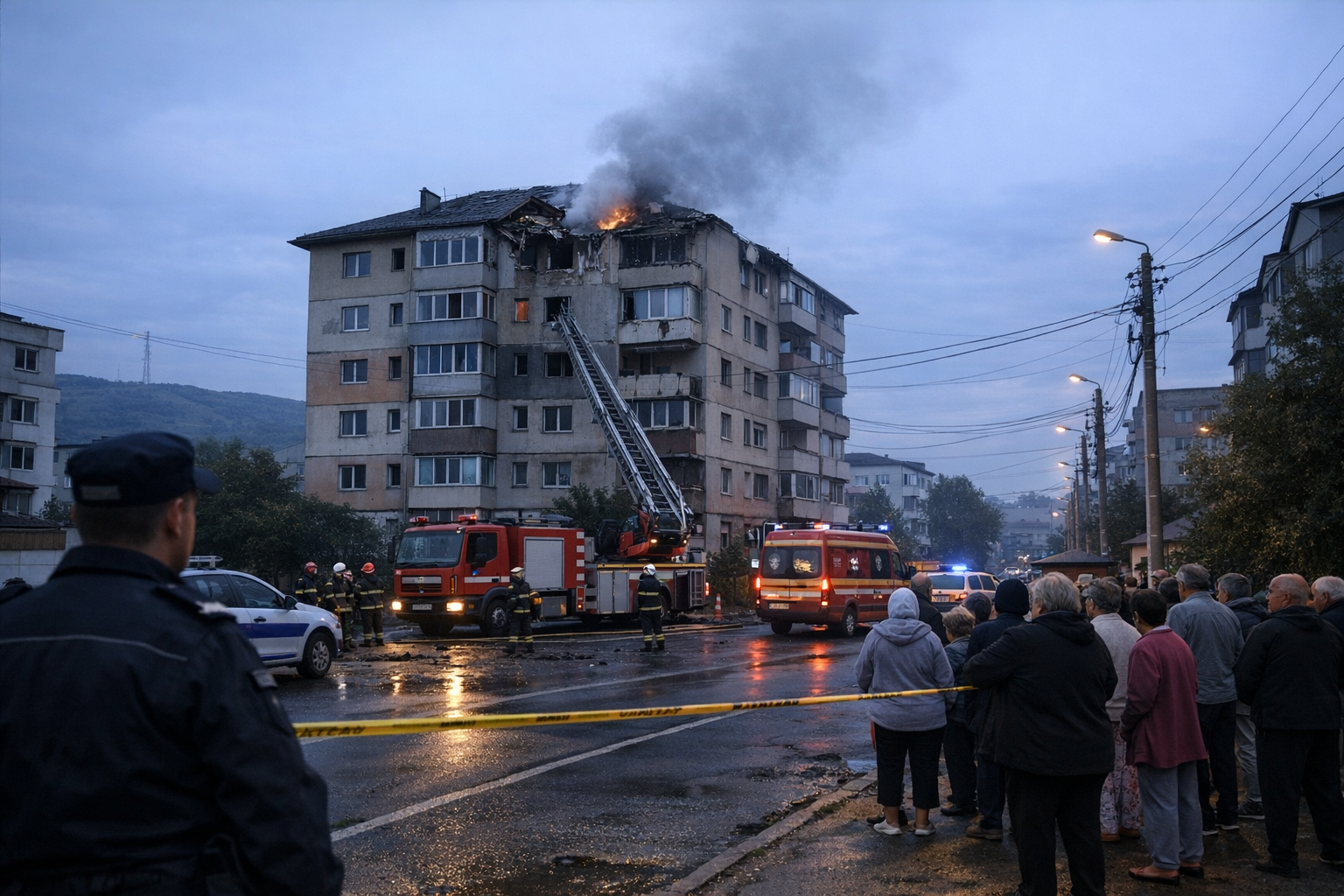
A Russian drone strike in Romania jolts NATO’s eastern flank
A Russian drone crashed into an apartment building in eastern Romania overnight, injuring two people and setting off what Romanian officials described as the gravest security incident on the country’s soil since Moscow’s full-scale invasion of Ukraine began.
The drone entered Romanian airspace during a wider Russian bombardment of neighboring Ukraine, according to Romanian authorities, and was tracked to Galați, a city near the Danube border. It struck the roof of a residential building, igniting a fire and forcing the evacuation of about 70 residents. Initial findings indicate the aircraft was a Russian-made Geran-2 drone, officials said, and that its payload detonated on impact.
The episode drew an unusually sharp response from Bucharest and NATO, underscoring how the war in Ukraine is pressing ever more dangerously against the borders of the Atlantic alliance.
Mark Rutte, NATO’s secretary general, said the alliance was “ready to defend every inch of Allied territory,” adding that Russia’s “reckless behavior is a danger to us all.” Romania’s president said the collision required a “firm, coordinated, and appropriate response.”
Romania’s Defense Ministry said it had scrambled two F-16 fighter jets and issued public alerts as the drone crossed into its airspace. By Thursday, the government was treating the strike not simply as another instance of wartime debris falling across a frontier, but as a direct warning about the vulnerability of NATO’s southeastern edge.
A new threshold crossed
Romania, which shares a long border with Ukraine along the Danube and sits on the Black Sea, has repeatedly found drone fragments and other evidence of the war spilling over since Russia invaded in 2022. But officials and international reporting have said this was the first time a drone had hit a densely populated area in Romania and caused injuries.
That distinction matters.
For months, Romanian officials have sought to avoid turning such incidents into an escalatory confrontation, generally portraying them as fallout from Russian attacks on Ukrainian port and grain infrastructure across the border. Even now, Romanian authorities have stressed that they do not assess the crash as a deliberate Russian attack on Romania itself.
But the fact that civilians were hurt inside a NATO member state changes the political and military calculus. A strike that might once have been treated as dangerous overflow from a nearby war is now prompting demands for visible deterrence, faster air defense upgrades and clearer alliance red lines.
Romania has already asked NATO to accelerate transfers of anti-drone capabilities, according to officials familiar with the discussions, and the incident is expected to intensify calls for stronger defenses along the alliance’s eastern flank.
Pressure grows for a tougher response
The strike comes at a moment of widening anxiety across Central and Eastern Europe that Russia is probing NATO’s resolve through repeated airspace violations, cyberpressure and other provocations around the alliance’s periphery.
In recent days, the Czech president, Petr Pavel, had urged NATO to “show its teeth” in responding to Russian tests on the eastern flank, arguing that weak responses risk inviting further escalation. That debate, once largely theoretical, now has an immediate and unsettling example in Galați.
Romanian leaders have not publicly detailed what measures may follow, but officials have been weighing what they call proportionate steps. Those could include diplomatic penalties beyond the summoning of Russia’s ambassador, requests for new deployments or equipment, and changes to air-defense posture near the border.
What remains unclear is whether the incursion was an accident caused by the chaos of Russia’s overnight assault on Ukraine, or something more intentional. That uncertainty is likely to shape how far Bucharest and its NATO allies are willing to go.
Why the incident matters now
The crash lands at a time when drones have become one of the defining weapons of the war, cheap enough to be used in large numbers and difficult enough to intercept that they are reshaping defense planning across Europe. Along NATO’s eastern frontier, counter-drone systems are no longer seen as niche tools but as essential parts of territorial defense.
The Romanian strike is likely to accelerate that shift.
For alliance officials, the incident is a reminder that the line between supporting Ukraine and defending NATO territory is becoming harder to police as Russian attacks intensify near allied borders. For Romania, it is a test of whether years of warnings about spillover from the war will now produce faster military reinforcement and more robust protective systems.
And for NATO as a whole, the danger lies not only in a single drone impact, but in the possibility that repeated “accidental” incursions could normalize attacks on the alliance’s edge without ever triggering a decisive response.
That is why leaders in Bucharest and Brussels moved quickly to frame the strike as more than an isolated mishap. Even if Romania stops short of calling it a direct attack, the message from the alliance was unmistakable: the war’s perimeter has reached NATO territory again, and the room for complacency is narrowing.
Sources
Further reading and reporting used to add context:
- https://apnews.com/article/aa90986c237b8fa1d9116685c8c32f95
- https://www.aljazeera.com/news/2026/5/29/nato-states-slam-russia-after-drone-crashes-in-romania
- https://www.itv.com/news/2026-05-29/drone-hits-romanian-apartment-block-as-nato-condemns-russias-recklessness
- https://www.aljazeera.net/news/2026/5/29/%D9%85%D8%B3%D9%8A%D8%B1%D8%A9-%D8%B1%D9%88%D8%B3%D9%8A%D8%A9-%D8%AA%D8%B5%D9%8A%D8%A8-%D9%85%D8%A8%D9%86%D9%89-%D9%81%D9%8A-%D8%B1%D9%88%D9%85%D8%A7%D9%86%D9%8A%D8%A7
- https://www.euronews.com/my-europe/2026/05/29/eu-leaders-denounce-russias-reckless-escalation-after-drone-hits-romania
- NATO member Romania says Russian drone hit block of flats, injuring two – Internazionale
- https://www.eurointegration.com.ua/news/2026/05/29/7238572/
- https://www.euronews.com/my-europe/2026/05/29/explosive-laden-russian-drone-hits-residential-building-in-romania-authorities-say
- https://www.theguardian.com/world/live/2026/may/29/romania-ukraine-russia-galati-drone-strike-europe-live-breaking-news?filterKeyEvents=false&page=with%3Ablock-6a1942008f0897699fdba6ee
- https://www.theguardian.com/world/2026/may/29/russian-drone-romanian-apartments-wounding-two-people-and-starting-fire
- https://www.digi24.ro/amphtml/stiri/mapn-explica-de-ce-nu-a-doborat-drona-care-a-lovit-un-bloc-de-10-etaje-din-galati-armata-are-limitari-foarte-stricte-3790775
- https://www.marketscreener.com/news/romania-says-russian-drone-hit-block-of-flats-in-galati-area-ce7f5ddad08ef025
- https://tvrinfo.ro/mapn-nu-au-existat-oportunitati-reale-de-angajare-a-dronei-in-conditii-de-siguranta-nu-ne-confruntam-cu-un-atac-asupra-romaniei/
- https://elpais.com/internacional/2026-05-29/dos-heridos-al-impactar-un-dron-ruso-contra-un-edificio-en-rumania.html
- https://cadenaser.com/nacional/2026/05/29/un-dron-impacta-contra-un-edificio-residencial-en-una-ciudad-del-este-de-rumania-cadena-ser/
- https://www.huffingtonpost.es/global/un-dron-ruso-estrella-apartamento-rumania-hiriendo-dos-personas-causando-incendio-f202605.html
- https://www.reddit.com/r/war/comments/1tqmo4d/video_of_russian_drone_impact_with_apartment/
- https://www.reddit.com/r/worldnews/comments/1tqwkwy/nato_ready_to_defend_every_inch_of_territory_as/
- https://www.reddit.com/r/TheColorIsBlue/comments/1tqsfh7/russian_drone_crashes_into_romanian_apartments/
- https://www.nato.int/en/news-and-events/articles/news/2026/03/19/nato-secretary-general-welcomes-romanian-president-to-headquarters
- https://www.nato.int/en/news-and-events/articles/news/2026/05/28/nato-secretary-general-meets-with-prime-minister-radev-of-bulgaria
- https://www.nato.int/en/news-and-events/articles/news/2026/02/12/nato-secretary-general-hails-shift-in-mindset-in-allied-deterrence-and-defence
- https://www.nato.int/en/news-and-events/articles/news/2025/12/03/nato-foreign-ministers-reaffirm-commitment-to-defence-investment-and-ukraine-support
- https://www.nato.int/en/news-and-events/events/transcripts/2026/04/09/speech-by-nato-secretary-general-mark-rutte-at-the-reagan-institutes-center-for-peace-through-strength
- https://www.nato.int/en/news-and-events/events/transcripts/2026/02/12/doorstep-by-nato-secretary-general-mark-rutte-ahead-of-the-meeting-of-nato-ministers-of-defence-in-brussels
- Press Release
- https://www.nato.int/fr/news-and-events/articles/news/2026/03/19/nato-secretary-general-welcomes-romanian-president-to-headquarters
- https://www.nato.int/en/news-and-events/events/transcripts/2026/05/13/joint-press-statements-by-nato-secretary-general-mark-rutte-president-of-romania-nicusor-dan-and-president-of-poland-karol-nawrocki-at-the-b9-summit
- https://www.nato.int/en/news-and-events/events/transcripts/2026/05/12/joint-press-conference-by-nato-secretary-general-mark-rutte-with-the-prime-minister-of-montenegro-milojko-spajic
- https://www.nato.int/en/news-and-events/articles/news/2026/04/10/secretary-general-visits-washington-to-discuss-transatlantic-security
- https://www.nato.int/en/news-and-events/events/transcripts/2026/03/03/joint-press-conference-by-nato-secretary-general-with-the-president-of-north-macedonia
- https://www.nato.int/content/dam/nato/webready/documents/publications-and-reports/annual-reports/sgar25-en.pdf
- https://www.nato.int/content/dam/nato/webready/documents/sto/sto-highlights.pdf
- https://www.jallc.nato.int/application/files/4417/6858/3720/OPS-TAC-Lessons-JFTC-Factsheet-15012025-ii.pdf
- https://www.jwc.nato.int/wp-content/uploads/2025/12/issue41.pdf
- https://www.jwc.nato.int/wp-content/uploads/2024/08/issue39.pdf
- https://eviza.mae.ro/media/3323/6-ordinul-546-2024.pdf
- https://agerpres.ro/romania-in-lume/2026/05/29/drona-cazuta-in-galati-rutte-nato-in-solidaritate-totala-cu-romania-si-pregatita-sa-apere-teritoriul–1561207
- https://www.news.ro/externe/secretarul-general-nato-mark-rutte-transmite-solidaritatea-absoluta-nato-romania-dupa-caderea-dronei-ruse-bloc-galati-anunta-discutat-nicusor-dan-comportamentul-nechibzuit-rusiei-pericol-toti-1922401329002026051122461510
- https://www.romania-insider.com/president-serious-incident-drone-crash-galati-may-2026
- https://www.act.nato.int/article/lci-x-builds-approach-fast-moving-threat/
- Drone crash in Galati/Supreme Council for National Defence convenes at Cotroceni Palace – AGERPRES
- https://www.irozhlas.cz/zpravy-svet/online-rusky-dron-v-rumunskem-galati-u-hranic-s-ukrajinou-zasahl-dum-a-zranil_2605290654_raf
- https://www.theguardian.com/world/live/2026/may/29/romania-ukraine-russia-galati-drone-strike-europe-live-breaking-news?page=with%3Ablock-6a19438e8f08714896b927bc
- https://www.reddit.com/r/UkraineWarVideoReport/comments/1tqkwfl/a_russian_shahed_drone_hit_a_apartment_building/
- https://www.reddit.com/r/europe/comments/1tqkwyf/drone_hits_romanian_apartment_building_in_galati/