
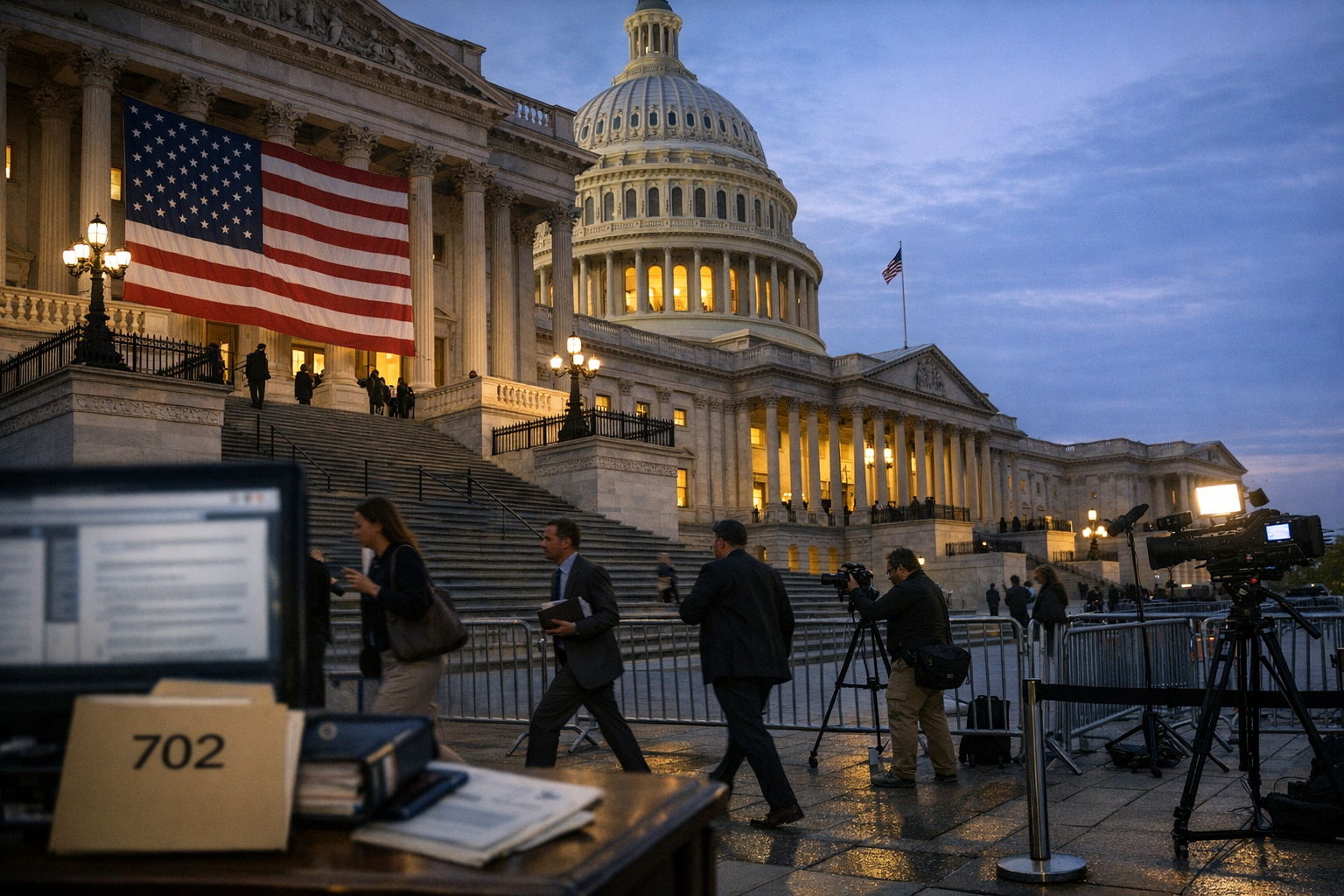
President Trump’s decision to tap Jay Clayton, the former Securities and Exchange Commission chairman and current U.S. attorney in Manhattan, to serve as director of national intelligence landed in Washington at a moment when the government’s surveillance powers and the leadership of the intelligence community had become entangled in a single high-stakes fight.
The nomination, announced Wednesday, followed a revolt over Mr. Trump’s earlier plan to install Bill Pulte as acting director of national intelligence. It also came just hours after the House voted 218 to 198 against a short-term extension of Section 702 of the Foreign Intelligence Surveillance Act, pushing one of the government’s most consequential spying authorities toward expiration at midnight Friday unless Congress intervenes.
What might otherwise have been a personnel reshuffle has instead become a broader test of trust: whether lawmakers are willing to preserve a powerful surveillance tool while questioning who would oversee it, and whether the White House can stabilize national-security leadership quickly enough to keep the debate from hardening into a full impasse.
A nomination shaped by a surveillance deadline
Mr. Clayton’s selection appeared to be an effort by the White House to calm a confrontation that had grown rapidly more volatile. Democrats had objected sharply to the prospect of Mr. Pulte serving, even temporarily, as the nation’s top intelligence official, arguing that they would not support extending a sweeping surveillance authority while someone they regarded as politically problematic or unqualified could be in charge of the broader apparatus.
That standoff helped sink a stopgap measure in the House and turned the succession question at the Office of the Director of National Intelligence into a condition for progress on surveillance policy.
In that sense, Mr. Clayton’s nomination was not simply about filling a vacancy. It was a signal that the administration recognized the political cost of pressing ahead with Mr. Pulte, at least for now. But the move did not resolve the central dispute. Democrats have demanded clear assurances that Mr. Pulte will not serve in an acting capacity, and it remains uncertain whether the White House will formally abandon that option.
Why Section 702 matters
The fight centers on Section 702, a post-9/11 authority that allows the government to collect foreign-intelligence communications by targeting non-U.S. persons located abroad, subject to procedures approved by the Foreign Intelligence Surveillance Court. Intelligence officials from both parties have long called it one of the government’s most important tools for tracking terrorism, cyberthreats, espionage and hostile foreign actors.
The authority has also been one of the most controversial. Although Americans cannot be directly targeted under Section 702, their communications can be incidentally swept up when they interact with foreign targets. That reality has fueled years of criticism from privacy advocates and civil-liberties groups, who argue that the system is prone to overreach and that reforms have not gone far enough.
Congress last reauthorized Section 702 in April 2024, setting a sunset date of April 20, 2026. Lawmakers later approved a 10-day extension, creating the current June 12 deadline. The latest House vote suggests that even a short bridge extension is no longer politically easy.
Yet the practical effects of a lapse may be less immediate than the deadline implies. Existing court-approved surveillance directives can remain in place until they expire, meaning operations already authorized would not necessarily shut off at once. The greater impact, at least initially, may be political and symbolic: a rare failure by Congress to renew a central intelligence power on time, and a warning about how fragile bipartisan consensus on national security has become.
Clayton’s credentials — and limits
Mr. Clayton brings a long résumé in law and regulation, including his tenure leading the S.E.C. during Mr. Trump’s first term and his current role as U.S. attorney for the Southern District of New York. Supporters are likely to portray him as a disciplined manager with experience navigating complex legal institutions.
But he does not come to the job with the kind of deep intelligence background traditionally associated with the director of national intelligence, a post created after the Sept. 11 attacks to coordinate the work of the nation’s sprawling spy agencies and serve as the president’s principal intelligence adviser.
That relative lack of direct intelligence experience may not be disqualifying on its own. Several senior national-security posts have gone to officials with backgrounds in law, diplomacy or politics rather than espionage. Still, at a moment when Section 702 itself is under renewed scrutiny, the Senate is likely to press Mr. Clayton on surveillance oversight, compliance failures and the balance between secrecy and civil liberties.
And even if his nomination eases some concerns, confirmation could take time — a calendar problem that does nothing to solve the immediate question of who is in charge if the administration still tries to elevate Mr. Pulte on an acting basis.
A deeper struggle over power and oversight
The episode reflects a broader shift in Washington’s national-security politics. For years, surveillance reauthorizations often passed after ritual disputes, with lawmakers reluctant to be seen weakening tools used to monitor foreign threats. That consensus has eroded under pressure from across the political spectrum.
On the left, privacy advocates and some Democrats have pushed for tighter limits on government queries involving Americans’ communications. On the right, a strain of Trump-aligned skepticism toward the intelligence agencies — sharpened by years of grievance over Russia investigations and the so-called deep state — has made surveillance authorities more politically vulnerable than they once were.
Now those currents have converged in a uniquely unstable moment: a president seeking to install loyalists, Democrats insisting on guardrails before renewing surveillance powers, and a Congress running down the clock on an authority that intelligence officials still describe as indispensable.
Whether Mr. Clayton’s nomination is enough to reopen negotiations remains unclear. If Democrats conclude that the White House is merely changing faces without abandoning the prospect of an acting appointment they oppose, the stalemate could persist. If, however, the administration makes a clean break and lawmakers decide that a lapse is too risky, Congress could still move at the last minute toward either another short-term extension or a broader compromise.
For now, the United States is confronting an unusual collision of personnel politics and intelligence law. At issue is not only who will lead the intelligence community, but also how much confidence Congress still has in the institutions and authorities that have defined American surveillance for two decades.
Sources
Further reading and reporting used to add context:
- https://www.axios.com/2026/06/11/trump-jay-clayton-director-national-intelligence
- https://apnews.com/article/b9a89bd3f1cb9c70fcca79de4c42cc99
- https://www.axios.com/2026/06/11/fisa-section-702-expiration-pulte-trump-johnson
- https://apnews.com/article/48bf108403bcb47d96b4e25b53e37d47
- https://www.thedailybeast.com/trump-makes-humiliating-u-turn-after-nepo-baby-sychophant-backlash/
- https://www.washingtonpost.com/national-security/2026/06/11/trump-picks-jay-clayton-manhattan-us-attorney-be-director-national-intelligence//
- https://www.washingtonpost.com/national-security/2026/06/11/trump-picks-jay-clayton-manhattan-us-attorney-be-director-national-intelligence/
- https://www.cbsnews.com/news/fisa-section-702-deadline-bill-pulte/
- https://democrats-judiciary.house.gov/media-center/press-releases/ranking-member-raskin-statement-on-fisa-section-702-reauthorization
- https://www.kaxe.org/news/2026-06-11/trump-names-jay-clayton-to-serve-as-director-of-national-intelligence
- https://www.theguardian.com/us-news/live/2026/jun/11/democrats-republicans-midterms-tech-laws-scotus-latest-news-updates?page=with%3Ablock-6a2b05a48f0881a067713b12
- https://www.fox5dc.com/news/trump-nominates-jay-clayton-serve-director-national-intellegence
- https://www.knkx.org/2026-06-11/trump-names-jay-clayton-to-serve-as-director-of-national-intelligence
- https://www.aa.com.tr/en/americas/trump-nominates-jay-clayton-for-director-of-national-intelligence/3964552
- https://www.post-gazette.com/news/politics-nation/2026/06/11/fisa-spy-powers-congress-trump-pulte-payton/stories/202606110059
- https://www.wunc.org/2026-06-12/trump-nominates-jay-clayton-to-serve-as-director-of-national-intelligence
- https://www.ksl.com/article/51509962/us-house-rejects-short-term-fisa-extension-as-expiration-looms
- https://en.wikipedia.org/wiki/Director_of_National_Intelligence
- https://www.reddit.com/r/politics/comments/1u3abm9/trump_picks_former_sec_chairman_jay_clayton_as/
- https://www.reddit.com/r/espionage/comments/1u37ajd/trump_picks_former_sec_chairman_jay_clayton_as/
- https://www.reddit.com/r/Politicalnewsandviews/comments/1u3h26e/the_house_rejected_a_bill_to_extend_fisa_section/
- https://www.reddit.com/r/NPR/comments/1u3hh9d/president_trump_names_jay_clayton_to_serve_as/
- https://www.fbi.gov/investigate/how-we-investigate/intelligence/foreign-intelligence-surveillance-act-fisa-and-section-702
- https://www.fbi.gov/news/speeches-and-testimony/oversight-of-section-702-of-the-foreign-intelligence-surveillance-act-and-related-surveillance-authorities
- https://www.brennancenter.org/our-work/research-reports/section-702-foreign-intelligence-surveillance-act-fisa-2026-resource-page
- https://www.dni.gov/index.php/newsroom/press-releases/press-releases-2026/4150-pr-05-26
- https://www.streetinsider.com/Reuters/US%2BHouse%2Brejects%2Bshort-term%2BFISA%2Bextension%2Bas%2Bexpiration%2Blooms/26634017.html
- National Security Division | Section 702 | United States Department of Justice
- https://www.washingtonpost.com/national-security/2026/06/11/house-vote-fails-extend-controversial-wiretapping-law//
- https://www.nextgov.com/policy/2026/04/former-national-security-officials-urge-congress-renew-section-702-expiration/412703/
- https://www.theguardian.com/us-news/live/2026/jun/11/democrats-republicans-midterms-tech-laws-scotus-latest-news-updates?page=with%3Ablock-6a2ad2d88f0880a90003498f
- https://news.antiwar.com/2026/06/11/house-rejects-bill-to-renew-warrantless-spy-powers/
- https://www.intelligence.gov/ic-on-the-record-database/results/fact-sheet
- https://www.congress.gov/crs_external_products/LSB/PDF/LSB11148/LSB11148.2.pdf
- https://legalclarity.org/is-section-702-still-in-effect-status-and-expiration/
- https://legalclarity.org/is-section-702-still-in-effect-status-and-sunset-date/
- https://www.theguardian.com/us-news/2026/jun/11/us-house-fisa-surveillance-law
- https://www.internazionale.it/ultime-notizie-reuters/2026/06/09/explainer-what-is-fisa-section-702-the-u-s-surveillance-law-set-to-expire-june-12
- https://legalclarity.org/patriot-act-renewal-what-expired-and-what-remains/
- https://www.congress.gov/crs-product/LSB11148
- https://www.marketscreener.com/news/what-is-fisa-section-702-the-u-s-surveillance-law-set-to-expire-june-12-ce7f5cdada8ef527
- https://www.congress.gov/crs_external_products/R/HTML/R48592.html
- https://www.kucoin.com/news/flash/us-senate-blocks-reauthorization-of-controversial-surveillance-law
- https://www.everycrsreport.com/reports/LSB11148.html
- https://www.congress.gov/crs_external_products/R/PDF/R48592/R48592.2.pdf
- https://s3.amazonaws.com/demandprogress/documents/702_Expiration_Myth-Fact.pdf
- https://www.fws.gov/sites/default/files/policy/files/blanket-amendment_removal-of-expiration-terms-from-current-dos_03312026_1.pdf
- Trump nominates US Attorney Jay Clayton to be director of national intelligence
- US House rejects short-term FISA extension as expiration looms