
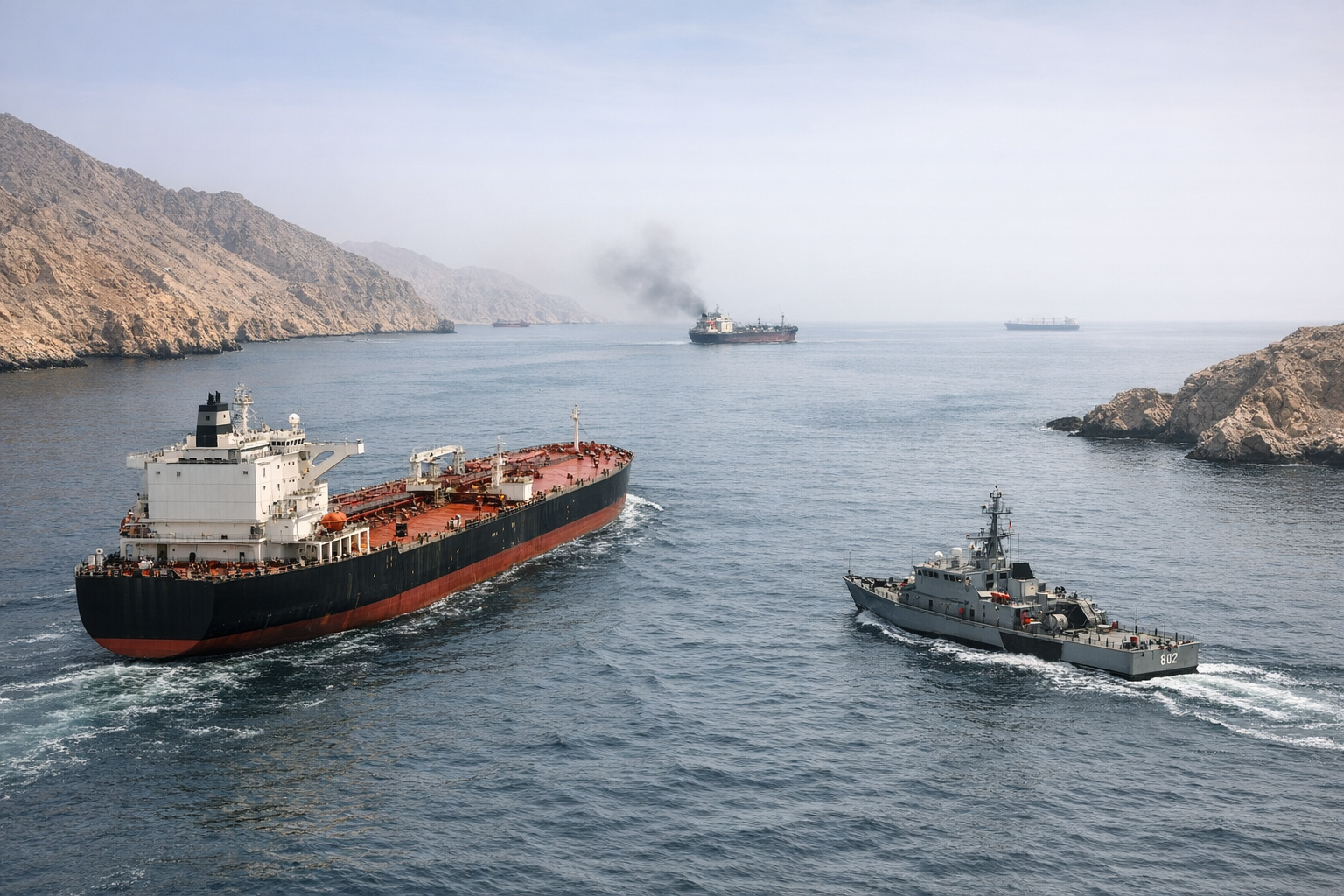
Traffic through the Strait of Hormuz, the narrow waterway that carries a substantial share of the world’s oil and gas, had begun to stir back toward normal this week after the interim U.S.-Iran accord announced on June 22. But a new strike on a vessel near Oman has exposed how tentative that recovery remains, interrupting a United Nations-backed effort to move stranded ships and crews and renewing fears that the region’s most important maritime corridor is still vulnerable to coercion and attack.
The latest setback came after a vessel was struck on June 25 in the Gulf of Oman, according to maritime reporting and Western officials, in the first such incident since Washington and Tehran agreed to a 60-day pause meant to create space for broader negotiations. A U.S. official said Iran was responsible and described the strike as involving a drone, though an independent public attribution has not yet emerged.
In response, the International Maritime Organization paused a large-scale evacuation plan that had been intended to help ships and crews trapped by the recent fighting and uncertainty around the strait. The agency said it needed to reconfirm safety guarantees before further movements could proceed.
A Recovery That Was Never Secure
The disruption comes at a delicate moment. Shipping through Hormuz had rebounded noticeably in the days after the agreement, offering a modest sign that commercial operators believed the risk of a broader confrontation had eased. But the improvement was only partial.
Last week, 125 vessels crossed the strait, compared with just 33 the week before, according to figures reported by The Associated Press. On June 24, 78 ships transited the channel, the highest daily number since the war began. Even so, that remained well below the prewar norm of more than 130 daily crossings.
That gap matters far beyond the Gulf. The Strait of Hormuz is one of the world’s most consequential energy chokepoints, linking producers in the Persian Gulf to markets in Asia, Europe and beyond. Any interruption — whether from direct attack, political dispute or sharply higher insurance premiums — can affect oil prices, liquefied natural gas shipments, freight schedules and the calculations of shipowners already wary of sending vessels through contested waters.
U.N. Plan Meets Iranian Resistance
The maritime agency had moved quickly after the interim accord to capitalize on the opening. On June 23, it announced an evacuation effort for more than 11,000 seafarers stranded in the region, saying it had obtained protection assurances from Iran, Oman, other coastal states, the United States and shipping industry partners.
But that arrangement rapidly ran into political resistance from Tehran.
Iran rejected the Oman- and U.N.-backed transit lanes and warned mariners that passage through the strait without Iranian approval was “unacceptable and dangerous,” asserting that only routes declared by Iran were valid. The warning underscored a central fault line that the June 22 agreement did not resolve: not simply whether ships can pass, but who gets to regulate that passage and on what terms.
The dispute goes to the heart of the current truce. The U.S.-Iran understanding temporarily deferred arguments over transit management and possible tolls, setting a 60-day negotiating period rather than settling the issue outright. That left open a profound question for commercial shipping: whether the strait will remain an international passage governed by long-established navigational freedoms, or evolve into a corridor where movement depends on Iranian authorization and potentially new fees or routing controls.
Fragile Confidence, High Stakes
For now, the result is a form of uneasy recovery. Some ships are returning, but confidence remains thin, and each new security incident threatens to reverse the gains. The pause in the evacuation plan is especially significant because it affects not only trade but also the welfare of thousands of seafarers caught in the standoff.
The episode also complicates the broader diplomatic picture. The interim deal was supposed to lower the immediate temperature and create momentum toward a more durable arrangement. Instead, the vessel strike and Iran’s insistence on tighter control of transit have shown how easily maritime security can become the test case for whether the agreement has substance.
Several critical questions remain unanswered: whether the June 25 attack will be conclusively attributed; when, or if, the U.N.-backed evacuation effort will resume; and whether shipping companies will trust routes that are not explicitly endorsed by Tehran. Beyond that lies the larger issue that the truce merely postponed: who will administer movement through the strait once the 60-day period ends.
Until that is resolved, the rebound in Hormuz traffic may prove less a return to normal than a brief experiment in confidence — one now under strain from the very dangers the agreement was meant to contain.
Sources
Further reading and reporting used to add context:
- https://www.axios.com/2026/06/25/iran-ship-attacked-strait-hormuz-un-sailors-evacuation-paused
- UN agency pauses evacuation of ships through the Strait of Hormuz | AP News
- https://www.axios.com/2026/06/23/iran-war-un-hormuz-strait-stranded-ships-evacuate
- https://www.axios.com/2026/06/20/iran-strait-hormuz-closed-israel-lebanon
- https://www.imo.org/en/mediacentre/pressbriefings/pages/statement-on-the-attack-in-strait-of-hormuz-evacuation-plan-pause.aspx
- https://www.imo.org/en/mediacentre/pressbriefings/pages/imo-statement-on-settebello-attack.aspx
- https://www.investing.com/news/stock-market-news/iran-warns-ships-against-unauthorized-hormuz-crossing-93CH-4759790
- https://www.aa.com.tr/en/middle-east/imo-pauses-hormuz-evacuation-plan-after-vessel-attack-off-oman/3978212
- https://www.imo.org/ru/mediacentre/pressbriefings/pages/statement-on-the-attack-in-strait-of-hormuz-evacuation-plan-pause.aspx
- https://www.imo.org/fr/mediacentre/pressbriefings/pages/statement-on-the-attack-in-strait-of-hormuz-evacuation-plan-pause.aspx
- https://www.wusf.org/2026-06-26/un-agency-pauses-evacuation-of-ships-through-the-strait-of-hormuz-after-attack-on-vessel
- https://www.imo.org/zh/mediacentre/pressbriefings/pages/statement-on-the-attack-in-strait-of-hormuz-evacuation-plan-pause.aspx
- https://1-e8259.azureedge.net/news/2026/6/25/un-agency-pauses-hormuz-ship-evacuation-initiative-after-vessel-attacked
- https://unn.ua/en/amp/un-suspends-evacuation-of-vessels-through-the-strait-of-hormuz-after-attack-on-civilian-ship
- https://www.jpost.com/international/article-900561
- https://report.az/en/amp/other-countries/un-suspends-hormuz-evacuation-operations-after-attack-on-cargo-vessel
- https://www.pcgamer.com/gaming-industry/crypto-scammers-are-offering-cargo-ships-in-the-strait-of-hormuz-safety-for-bitcoin-and-irans-already-fired-on-at-least-one/
- https://www.ukmto.org/-/media/ukmto/products/20260311-ukmto_warning_019-26_update-001.pdf?rev=1a83068d17134cf191ac2432ab3f8267
- https://www.allianz.com/content/dam/onemarketing/azcom/Allianz_com/economic-research/publications/specials/en/2026/june/2026_06_16-US-Iran-deal-markets-price-peace.pdf
- https://straits.live/
- https://www.aa.com.tr/en/middle-east/hormuz-traffic-rebounds-with-71-crossings-in-3-days-but-risks-persist-marinetraffic/3974347
- https://hormuz-traffic.com/
- https://hormuzstrait.us/
- https://www.washingtonpost.com/business/2026/06/18/strait-of-hormuz-iran-us-shipping-war/c2d00f1e-6b2c-11f1-830e-133d20cadd28_story.html
- https://hormuzstraitmonitor.com/
- https://straitofhormuz.report/
- https://insights.windward.ai/
- https://global.spctr.space/
- https://www.reddit.com/r/u_MarineTraffic/comments/1udjzp7/strait_of_hormuz_crossings_nearly_triple/
- https://www.aa.com.tr/en/us-israel-iran-war/strait-of-hormuz-reopening-gradually-as-12-tankers-transit-after-us-iran-framework-deal/3970873
- https://www.reddit.com/r/maritime/comments/1udjzo1/strait_of_hormuz_crossings_nearly_triple/
- https://www.aa.com.tr/en/europe/hormuz-traffic-rebounds-as-25-commercial-ships-cross-key-oil-chokepoint-in-one-day/3972026
- https://www.reddit.com/r/SeaEmploy/comments/1udk8xt/traffic_through_the_strait_of_hormuz_nearly/
- https://en.wikipedia.org/wiki/Strait_of_Hormuz
- https://en.wikipedia.org/wiki/2026_Strait_of_Hormuz_campaign
- https://en.wikipedia.org/wiki/2026_Strait_of_Hormuz_crisis
- https://www.reddit.com/r/u_MarineTraffic/comments/1ucg3z7/strait_of_hormuz_crossings_rebound_but_recovery/
- https://msrisk.com/wp-content/uploads/2026/06/Global-Maritime-Security-Report-24-June-2026.pdf
- https://apnews.com/article/e6039e5f3962ba001ed6b7abb74219b0
- https://www.theguardian.com/world/2026/jun/25/un-backed-plan-ships-trapped-strait-of-hormuz-rejected-iran
- https://www.imo.org/en/mediacentre/secretarygeneral/pages/no-safe-passage-strait-of-hormuz-remains-highly-volatile.aspx
- https://www.theguardian.com/world/strait-of-hormuz/2026/jun/25/all
- https://www.theguardian.com/world/2026/jun/25/un-pauses-ship-evacuations-through-strait-of-hormuz-after-vessel-attack
- https://www.imo.org/es/mediacentre/pressbriefings/pages/statement-no-safe-passage-strait-of-hormuz.aspx
- https://www.imo.org/es/mediacentre/pressbriefings/pages/statement-on-the-attack-in-strait-of-hormuz-evacuation-plan-pause.aspx
La OMI anuncia un plan de evacuación en el estrecho de Ormuz
- https://www.imo.org/en/mediacentre/secretarygeneral/pages/statement-on-the-strait-of-hormuz.aspx
- https://www.imo.org/fr/mediacentre/pressbriefings/pages/statement-no-safe-passage-strait-of-hormuz.aspx
- https://www.theguardian.com/world/2026/mar/26/strait-of-hormuz-visual-guide-trickle-of-ships-iran
- https://apnews.com/article/01c1335e69e40f2ee921e25e59a18a71
- https://apnews.com/article/21480b8ab2dae75935a5efc4d25e8e36
- https://apnews.com/article/03af894eaddb8ede53928babc76f80e2
- https://apnews.com/article/a8a0d22918fc3fb30bc3abf1cd5c5a13
- https://wwwcdn.imo.org/localresources/en/MediaCentre/PressBriefings/PublishingImages/Pages/IMO-calls-for-safe-passage-framework-in-Strait-of-Hormuz/C-ES.36-D%20-%20Summary%20Of%20Decisions%20%28Secretariat%29.pdf
- https://wwwcdn.imo.org/localresources/en/MediaCentre/Documents/C-ES.36-INF.2%20-%20Update%20on%20actions%20initiated%20by%20the%20IMO%20Secretariat%20%28Secretariat%29.pdf
- https://wwwcdn.imo.org/localresources/en/KnowledgeCentre/Documents/CAB%20342%20June%202025.pdf
- https://wwwcdn.imo.org/localresources/en/KnowledgeCentre/Documents/CAB%20271%20June%202019.pdf
- https://wwwcdn.imo.org/localresources/en/MediaCentre/PressBriefings/Documents/C%20ES-36-Decisions.pdf
- https://www.aa.com.tr/en/middle-east/cargo-vessel-hit-by-projectile-off-oman-uk-maritime-authority-says/3978062
- https://www.arabtimesonline.com/news/cargo-ship-hit-by-unknown-projectile-near-oman-after-irgc-warns-vessels-over-strait-of-hormuz-routes/
- https://halifax.citynews.ca/2026/06/25/british-military-says-cargo-ship-hit-by-projectile-off-oman-near-un-approved-route-for-strait-of-hormuz/
- https://www.investing.com/news/economy-news/cargo-ship-hit-by-projectile-in-strait-of-hormuz-4761093
- https://wanaen.com/ukmto-reports-tanker-hit-by-unknown-projectile-off-oman-coast/
- https://m.economictimes.com/news/international/global-trends/vessel-hit-by-unknown-projectile-in-hormuz-strait-maritime-agency/amp_articleshow/131999430.cms
- https://www.voiceofemirates.com/en/news/2026/06/13/a-tanker-was-hit-by-an-unidentified-projectile-off-the-coast-of-oman/
- https://www.euronews.com/2026/06/25/cargo-ship-hit-by-projectile-in-hormuz-as-iran-issues-renewed-passage-warning
- https://www.arabnews.com/node/2647040/middle-east
- https://www.arabtimesonline.com/news/ukmto-says-one-more-tanker-hit-by-unknown-projectile-off-oman/
- https://www.theepochtimes.com/world/cargo-ship-struck-near-strait-of-hormuz-by-unknown-projectile-maritime-group-says-6053364
- https://gulfnews.com/world/mena/us-iran-conflict-tanker-struck-by-unknown-projectile-off-oman-coast-ukmto-reports-1.500573273
- https://www.ukmto.org/-/media/ukmto/products/update-028—jmic-advisory-note-5-april_final.pdf?rev=6c1709007c774333b09a6fefd44e1d73
- https://www.ukmto.org/-/media/ukmto/products/update-057-jmic-advisory-note-11-june.pdf?rev=b6fabef8798843ba8777676a5cb9cb23
- https://www.ukmto.org/-/media/ukmto/products/20260302-ukmto_warning_005-26–update_001.pdf?rev=6d3aba94f5824ada883fdb67067a9bab
- https://mscio.eu/media/documents/20260418-WARNING_038_26_ATTACK.pdf
- https://www.ukmto.org/-/media/ukmto/products/update-045-jmic-advisory-note-14-may.pdf?rev=fbc591c60b56419e8901ca4afd47a416
- https://www.reddit.com/r/oil/comments/1ufdngx/according_to_ukmto_a_vessel_has_been_hit_off_of/
- https://en.wikipedia.org/wiki/2026_in_Oman
- https://www.reddit.com/r/Economics/comments/1ufehpp/ukmto_reports_vessel_hit_strait_of_hormuz/