
A Rare Admission From the Kremlin
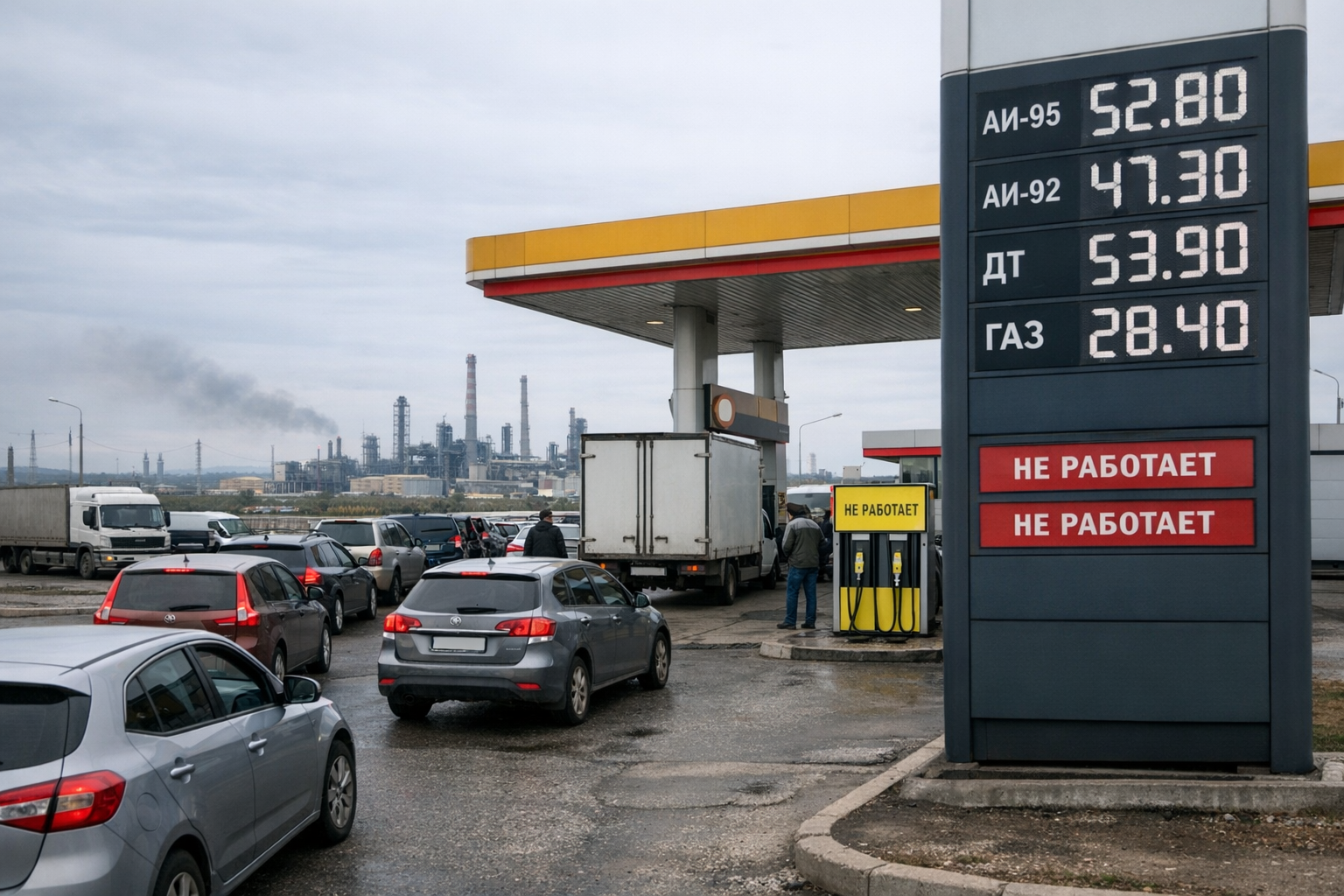
President Vladimir V. Putin acknowledged on Sunday that Ukrainian strikes on Russian energy infrastructure were contributing to fuel shortages inside Russia, a striking public concession that Kyiv’s long-range attacks are exacting visible costs far beyond the battlefield.
“Of course, they create problems, that’s obvious,” Mr. Putin said on Russian state television, adding that Russia was experiencing “a certain shortage” of fuel, though he insisted it was “not critical.”
The remarks were notable not only for their candor but for what they revealed about the widening reach of the war. For months, Ukrainian drones and missiles have targeted Russian refineries, export terminals and related energy facilities in an effort to squeeze the economic foundations of Moscow’s war effort. Until now, the effects had largely been tracked through satellite imagery, market data, regional rationing measures and industry reports. Mr. Putin’s comments amounted to a rare confirmation from the top of the Russian state that the campaign is biting.
According to the Kremlin’s account of the situation, the government has established a round-the-clock task force to manage supplies, is drawing on reserves and is weighing tighter restrictions on fuel exports, including a possible full ban on diesel exports.
Strikes Hit at a Strategic Nerve Center
The admission came after another wave of Ukrainian attacks, including a fire at the Slavyansk refinery in Russia’s Krasnodar region. It followed earlier strikes on some of Russia’s most important refining assets, including Moscow’s largest refinery and the TANECO plant operated by Tatneft.
Ukraine has steadily expanded its deep-strike campaign through 2026, focusing on oil infrastructure not simply as symbolic targets but as choke points in Russia’s wartime economy. Refineries are especially vulnerable pressure points: when they are damaged, the effects ripple outward into domestic fuel markets, export earnings, transport networks and potentially military logistics.
Market reporting earlier this year pointed to the scale of the disruption. In March and April, industry accounts indicated that attacks had at times knocked out a significant share of Russia’s oil export capacity and disrupted major Baltic terminals. By mid-June, reports said refinery attacks had roughly doubled since the start of the year, cutting into the production of gasoline, diesel and jet fuel.
Those losses are now colliding with seasonal demand inside Russia, where fuel consumption typically rises during the summer and agricultural needs place additional strain on supply networks.
Queues, Rationing and a Wartime Balancing Act
The pressure has already spilled into daily life in some Russian regions, where rationing measures and long lines at filling stations have underscored how a war often presented by the Kremlin as distant and manageable is increasingly being felt at home.
For Moscow, the problem is not only repairing damaged plants. It is also one of triage. Officials must decide how to balance domestic consumption, export commitments, reserve drawdowns and the demands of the farming season, all while preserving the energy revenues that remain central to financing the war and stabilizing the broader economy.
That balancing act helps explain why the possibility of broader export curbs matters. Russia has used export restrictions before to cool domestic price spikes, but stronger limits — especially on diesel — would signal deeper concern about internal supply strains. Any such move could also reverberate beyond Russia, affecting regional fuel markets already sensitive to disruptions in one of the world’s largest energy exporters.
Why the Shift in Tone Matters
Mr. Putin’s acknowledgment marks a shift in tone as much as a statement of fact. The Kremlin has generally sought to minimize the domestic consequences of the war, portraying Western sanctions as manageable and Ukrainian attacks as ineffective or isolated. Publicly conceding shortages suggests the problem has become difficult to dismiss, even as Mr. Putin moved to reassure Russians that the situation remained under control.
The larger significance is strategic. Ukraine’s long-range strikes have aimed to make the war more expensive for Russia by eroding the infrastructure that supports both state revenues and internal stability. If the attacks continue to disrupt refining and distribution, they could force Moscow into more painful trade-offs: exporting less, spending more on repairs and subsidies, or tolerating greater shortages at home.
Still, important questions remain unresolved. It is unclear how long the shortages will last, how quickly damaged facilities can return to service and whether the strains will significantly affect military supply chains or remain concentrated among civilian consumers. It is also uncertain whether Ukraine can sustain the pace and precision of its attacks as Russia strengthens air defenses around critical energy sites.
For now, though, the political significance is unmistakable. What had previously been visible in refinery fires, shipping disruptions and gas station queues has now been stated by Russia’s president himself: Ukraine’s campaign against Russian energy assets is no longer a peripheral nuisance. It is becoming a real test of the resilience of Russia’s war economy.
Sources
Further reading and reporting used to add context:
- https://www.thedailybeast.com/vladimir-putin-suffers-fresh-humiliation-after-being-forced-to-admit-crisis/
- https://apnews.com/article/88370faa1a49504438388f2854d7afd3
- https://www.axios.com/2026/06/27/ukraine-drone-strikes-russia-refineries
- https://www.thedailybeast.com/paranoid-vladimir-putin-73-makes-major-frontline-moves-after-humiliating-attacks-on-moscow-by-ukraine/
- https://www.themoscowtimes.com/2026/06/29/putin-admits-ukrainian-strikes-driving-fuel-shortages-a93116
- https://www.theguardian.com/world/2026/jun/28/putin-admits-ukrainian-strikes-driving-russian-fuel-shortages
- https://www.euronews.com/my-europe/2026/06/29/putin-admits-oil-deficit-and-adjusted-fuel-plans-amid-ukrainian-strikes-on-refineries
- https://fortune.com/2026/06/28/putin-russia-war-difficult-period-ukrainian-drone-attacks-fuel-supply-shortages/
- https://www.theguardian.com/world/ukraine%2Brussia
- https://www.aljazeera.com/news/2026/6/19/petrol-shortages-and-oil-rain-bring-russia-ukraine-war-home-to-moscow
- https://www.russiamatters.org/news/russia-review/russia-review-june-18-26-2026
- https://www.streetinsider.com/Reuters/Ukrainian%2Bdrone%2Bhits%2BMoscow%2Bregion%27s%2Blargest%2Brefinery/26649419.html
- https://www.moneycontrol.com/world/putin-admits-fuel-shortages-as-ukraine-strikes-disrupt-russia-s-oil-infrastructure-article-13960862.html
- https://english.nv.ua/nation/putin-acknowledges-fuel-problems-after-ukrainian-drone-strikes-50619985.html
- Putin acknowledges fuel shortages, task force set up to ensure – World – Business Recorder
- https://www.japantimes.co.jp/news/2026/06/24/world/russia-gasoline-crunch/
- https://www.themoscowtimes.com/2026/03/30/russia-faces-fuel-production-crunch-after-ukraine-hits-baltic-export-hubs-reuters-a92378/pdf
- https://www.themoscowtimes.com/2026/06/18/russias-fuel-shortages-are-manageable-but-the-kremlins-options-are-shrinking-a93046/pdf
- https://www.en.kremlin.ru/catalog/keywords/78/events/copy/55146
- https://en.kremlin.ru/events/president/transcripts/copy/79088
- https://kremlin.ru/press/announcements
- https://special.kremlin.ru/events/president/news/78216
- https://en.kremlin.ru/events/state-council/by-date/02.04.2026
- https://en.special.kremlin.ru/catalog/keywords/128/events
- https://en.kremlin.ru/catalog/keywords/98/events/by-date/06.02.2026
- https://en.kremlin.ru/acts/news/75845
- https://www.en.kremlin.ru/events/president/transcripts/copy/60630
- https://en.special.kremlin.ru/events/president/transcripts/79024
- https://kremlin.ru/
- https://en.special.kremlin.ru/catalog/keywords/28/events
- https://static.kremlin.ru/media/events/files/en/VlMXXg4uCU1WOilGCMNzd8sPyIujZg3y.pdf
- https://static.kremlin.ru/media/events/files/en/RosOySvLzGaJtmx2wYFv0lN4NSPZploG.pdf
- https://www.themoscowtimes.com/2026/03/30/russia-faces-fuel-production-crunch-after-ukraine-hits-baltic-export-hubs-reuters-a92378
- https://www.themoscowtimes.com/2026/03/25/ukrainian-drone-strikes-halt-at-least-40-of-russias-oil-export-capacity-reuters-a92339
- https://www.themoscowtimes.com/2026/03/25/ukrainian-drone-strikes-halt-at-least-40-of-russias-oil-export-capacity-reuters-a92339/pdf
- https://www.kitco.com/news/off-the-wire/2026-06-08/russia-reduce-june-oil-exports-amid-higher-refinery-runs-and-lower
- https://www.marketscreener.com/news/russian-oil-terminals-under-attack-unable-to-accept-shipments-for-second-week-sources-say-ce7e51d2d889f02d
- https://wsau.com/2026/04/03/russian-oil-terminals-under-attack-unable-to-accept-shipments-for-second-week-sources-say/
- https://www.marketscreener.com/news/russia-s-baltic-ports-halt-oil-loadings-after-massive-ukrainian-drone-attack-sources-say-ce7e5ed2d18cf32c
- https://www.pravda.com.ua/eng/news/2026/03/26/8027303/index.amp
- https://finance.yahoo.com/sectors/energy/articles/ukrainian-strikes-forcing-russia-cut-173200058.html
- https://finance.yahoo.com/sectors/energy/articles/russia-divert-export-oil-refineries-160000510.html
- https://www.pravda.com.ua/eng/news/2026/04/02/8028472/index.amp
- https://pgjonline.com/news/2026/march/attacks-halt-40-of-russia-s-oil-export-capacity-hit-pipelines-and-ports
- https://www.streetinsider.com/Reuters/Russian%2Boil%2Bterminals%2Bunder%2Battack%2Bunable%2Bto%2Baccept%2Bshipments%2Bfor%2Bsecond%2Bweek%2C%2Bsources%2Bsay/26271605.html
- https://www.lemonde.fr/en/international/article/2026/06/25/ukrainian-strikes-on-russian-refineries-are-triggering-shortages-and-rising-discontent_6754849_4.html
- https://www.lemonde.fr/en/international/article/2026/03/31/ukraine-strikes-russia-s-lifeblood-by-targeting-oil-ports_6751982_4.html
- Ukrainian Drone Strikes Halt at Least 40% of Russia’s Oil Export Capacity – Reuters – The Moscow Times