
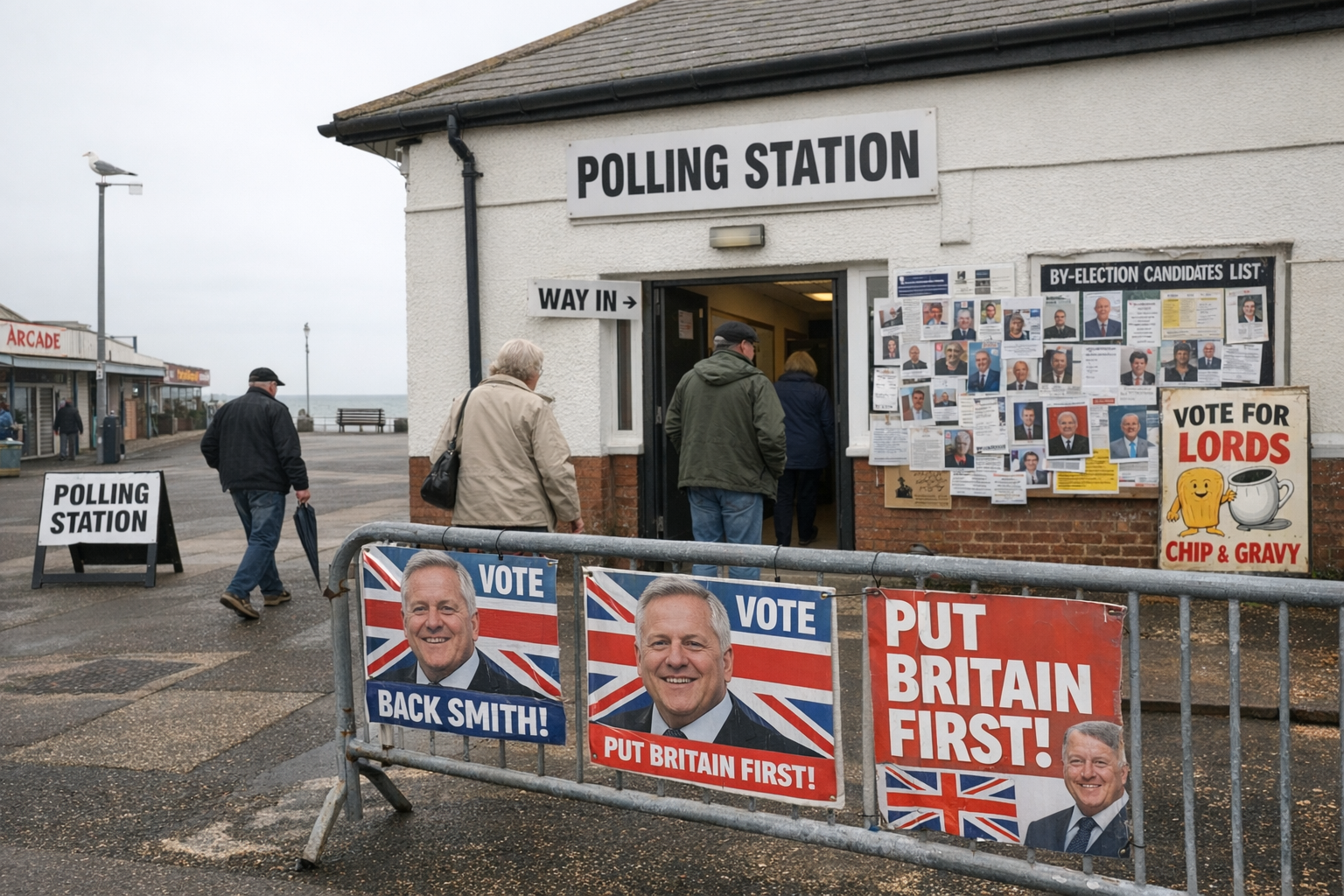
Farage Returns to Westminster After Unusual Clacton Vote
Nigel Farage returned to Parliament on Friday after winning the by-election in Clacton, the seat he had vacated only weeks earlier in a high-risk attempt to turn mounting questions over his finances into a public show of support.
Farage, the leader of Reform UK and one of Britain’s most durable anti-establishment political figures, won 63 percent of the vote in the Essex constituency, according to reported results, in a contest marked as much by who did not take part as by who did. With Labour, the Conservatives, the Liberal Democrats and the Greens largely boycotting the race, the ballot became an eccentric and fragmented affair, with 34 candidates and Count Binface, the satirical campaigner, emerging as Farage’s nearest challenger on about 27 percent.
Turnout was 44 percent.
The result restores Farage to the House of Commons and gives him a fresh mandate to argue that voters in Clacton were willing to look past the controversy that prompted his resignation in July. But it does not resolve the matter that led him to trigger the vote in the first place: scrutiny over whether he properly declared a £5 million gift from Christopher Harborne, the cryptocurrency billionaire and Reform donor.
That inquiry, suspended when Farage resigned his seat, is now expected to resume.
A Political Gamble
Farage had cast the by-election as a straightforward contest between himself and what he called “the establishment,” betting that a victory would allow him to present the investigation into his finances as a politically motivated campaign rather than a potentially serious standards case.
It was a characteristically confrontational move from a politician who has repeatedly used insurgent campaigns to force his way back into the center of British politics, from his years leading the UK Independence Party through the Brexit referendum and, more recently, his revival of Reform UK as a potent force on the right.
Clacton has long been fertile territory for him. The seaside constituency delivered him his first seat in Parliament in 2014, when he won a by-election after defecting from the Conservatives to UKIP, and it has remained one of the places where his brand of anti-immigration, anti-elite politics has found its most loyal audience.
This time, however, the circumstances were more unusual. Mainstream parties chose not to engage seriously in the race, dismissing it as a stunt or declining to lend legitimacy to a contest forced by Farage himself. Their absence left a field crowded with fringe, independent and novelty candidates, lending the campaign an air of political theater even as its implications were significant.
Questions Far From Over
Farage did not attend the official declaration of the result, saying there had been a threat of disruption. Essex Police publicly disputed any suggestion that they had advised candidates not to attend, creating a new, if smaller, point of contention around a race already defined by argument over legitimacy and accountability.
The bigger issue now returns to Westminster.
Under Parliament’s standards system, the key question is whether Farage correctly handled the declaration of the £5 million gift from Mr. Harborne. A finding against him would not automatically end his renewed tenure. But if the process ultimately led to a suspension of sufficient length, it could open the way to a recall petition in Clacton, potentially forcing yet another electoral test.
For Farage, then, Friday’s victory was both emphatic and incomplete: a political vindication of sorts, but not an institutional exoneration.
What the Result Does — and Does Not — Show
Farage will almost certainly claim the outcome as proof of enduring support, and on its face the margin was commanding. Yet the peculiar shape of the contest makes broader conclusions difficult.
Without credible candidates from the major parties, the by-election offered voters an unusual choice: rally behind Farage, stay home, or cast a protest vote in a field dominated by outsiders and novelty entrants. Count Binface’s second-place finish captured some of the absurdity of the moment, but also underscored how little conventional partisan competition remained.
That makes it hard to know whether the result reveals deepening support for Farage and Reform UK, or simply the distortions of a low-turnout, low-salience by-election conducted in the absence of normal opposition.
What is clearer is that Farage has once again managed to turn a political crisis into a platform. He is back in Parliament, back at the center of Britain’s political conversation, and back under scrutiny. The voters of Clacton have given him another opening. Westminster’s standards machinery may yet determine how long it lasts.
Sources
Further reading and reporting used to add context:
- Nigel Farage beats Count Binface to win back seat in Parliament | AP News
- Reform UK's Nigel Farage faces unique challenge in Clacton election | AP News
- https://www.theguardian.com/politics/2026/jul/07/nigel-farage-quits-as-mp-amid-scrunity-over-finances-clacton-reform
- Poll date of 13 August confirmed for Clacton by-election after Farage MP resignation | ITV News Anglia
- https://www.theguardian.com/politics/2026/jul/08/clacton-byelection-date-nigel-farage-resignation-reform
- https://www.pollcheck.co.uk/by-elections/clacton
- https://www.itv.com/news/2026-07-17/nigel-farage-to-compete-with-record-33-candidates-in-clacton-by-election
- https://www.irishtimes.com/world/uk/2026/07/07/nigel-farage-resigns-from-parliament-but-will-stand-in-byelection/
- https://www.rte.ie/news/uk/2026/0707/1582196-nigel-farage-uk/
- https://news.sky.com/story/politics-latest-mps-being-recalled-to-parliament-tomorrow-to-discuss-british-steel-12593360
- https://www.theguardian.com/politics/live/2026/jul/08/nigel-farage-reform-uk-clacton-5m-gift-crime-agency-labour-keir-starmer-pmqs-uk-politics-latest-news-updates?page=with%3Ablock-6a4e33498f08fa9e96d5d113
- https://app.standard.co.uk/news/politics/clacton-byelection-candidates-nigel-farage-count-binface-laurence-fox-b1289596.html
- https://www.theguardian.com/politics/live/2026/jul/07/nigel-farage-reform-uk-donations-investigations-parliament-electoral-commission-defence-nato-keir-starmer-latest-news-updates?page=with%3Ablock-6a4d265e8f08a87b126279ec
- https://ukelections.co.uk/by-elections/clacton/
- https://www.reddit.com/r/Clacton/comments/1vj74oo/do_you_think_voter_turnout_will_increase_on_13/
- https://www.reddit.com/r/neoliberal/comments/1vnz6l1/nigel_farage_wins_clacton_byelection_in_contest/
- https://www.reddit.com/r/UKGreens/comments/1uq9hmz/green_from_clacton_here_were_not_standing_a/
- https://www.reddit.com/r/TheNewsAgents/comments/1upvsc3/farages_resignation_a_hail_mary_an_act_of/
- https://www.reddit.com/r/fivethirtyeight/comments/1vnyk9i/nigel_farage_wins_clacton_byelection_that_major/
- https://www.reddit.com/r/AMA/comments/1vh0r09/i_live_near_the_clacton_constituency_and_know/
- https://www.reddit.com/r/unitedkingdom/comments/1vny1u0/nigel_farage_returns_as_mp_winning_clacton/
- https://www.tendringdc.gov.uk/essex-county-council-election-results-2026
- https://www.tendringdc.gov.uk/content/county-results
- https://www.tendringdc.gov.uk/content/parliamentary-results
- https://www.tendringdc.gov.uk/news/date-set-for-clacton-constituency-by-election
- https://www.tendringdc.gov.uk/news/clacton-voters-to-choose-next-mp-as-by-election-candidates-confirmed
- https://www.tendringdc.gov.uk/departments/results-of-elections
- https://tdcdemocracy.tendringdc.gov.uk/mgDecisionDetails.aspx?IId=38796&Opt=1
- https://www.tendringdc.gov.uk/content/district-and-parish-results
- https://legacy.tendringdc.gov.uk/sites/default/files/documents/council/elections%20%26%20voting/Election%20of%20Parish%20Council%20Brightlingsea%20Town%20Council%20Declaration%20of%20Result.pdf
- https://www.tendringdc.gov.uk/content/results-for-clacton-west
- https://www.tendringdc.gov.uk/news/tendring-voters-elect-eight-councillors-in-essex-county-council-elections
- https://legacy.tendringdc.gov.uk/sites/default/files/documents/council/elections%20%26%20voting/parliamentaryJune2017/UKPGE%20Declaration%20of%20result%20of%20Poll.pdf
- https://greenparty.org.uk/2026/07/07/green-party-of-england-and-wales-announce-they-will-not-stand-in-clacton-by-election/
- https://secureapps.essex.gov.uk/Freedom_of_information/ResultDetails.aspx?ID=46368
- https://legacy.tendringdc.gov.uk/sites/default/files/documents/council/elections%20%26%20voting/2025/Tendring%20District%20Council%20Frinton%20Ward%20Result.pdf
- https://legacy.tendringdc.gov.uk/sites/default/files/documents/council/elections%20%26%20voting/declaration%20of%20result%20for%20filing.pdf
- https://legacy.tendringdc.gov.uk/sites/default/files/documents/council/elections%20%26%20voting/election%20information/SOP%20ECC%202026_Part3.pdf
- https://legacy.tendringdc.gov.uk/sites/default/files/documents/council/elections%20%26%20voting/Bluehouse%20Declaration%20of%20Result%2011%20January%202024.pdf
- https://en.wikipedia.org/wiki/2026_Essex_County_Council_election
- https://en.wikipedia.org/wiki/Tendring_District_Council_elections
- https://www.reddit.com/r/GreenParty/comments/1uqad26/green_party_of_england_and_wales_announce_they/
- https://en.wikipedia.org/wiki/2023_Tendring_District_Council_election
- https://www.reddit.com/r/FuckNigelFarage/comments/1uqjh5e/theyre_calling_it_a_fake_byelection_tell_that_to/
- https://www.reddit.com/r/Clacton/comments/1vnbkk0/byelection_result_declaration_time/
- https://en.wikipedia.org/wiki/Clacton_in_the_2024_United_Kingdom_general_election
- https://apnews.com/article/2e5ea570961a48feeb777bb7ed862fcc
- https://www.reddit.com/r/Essex/comments/1vnuxoa/nigel_farage_says_he_wont_attend_clacton/
- https://www.reddit.com/r/ukpolitics/comments/1vnw8j4/nigel_farage_says_he_wont_attend_count_in_clacton/
- https://www.reddit.com/r/Clacton/comments/1vny1yh/why_clacton_we_have_a_chance_to_deal_with_farage/
- https://www.reddit.com/r/ukpolitics/comments/1vo0gvd/nigel_farage_wins_clacton_byelection_but_does_not/
- https://www.reddit.com/r/VoteBinface/comments/1vnufef/farage_will_not_attend_clacton_byelection_count/
- https://www.reddit.com/r/Essex/comments/1vnnfnr/clacton_byelection_live_results_and_reaction/
- https://www.reddit.com/r/ireland/comments/1vo0lg6/removed/
- https://www.reddit.com/r/uknews/comments/1vny7y0/nigel_farage_returns_as_mp_winning_clacton/
- https://www.reddit.com/r/uknews/comments/1vo0gyc/nigel_farage_wins_clacton_byelection_but_does_not/
- https://www.reddit.com/r/Essex/comments/1vnr7kc/nigel_farage_declares_victory_in_clacton/
- https://www.reddit.com/r/unitedkingdom/comments/1vnwa31/nigel_farage_says_he_wont_attend_count_in_clacton/
- https://feeds.bbci.co.uk/news/articles/cvgx9nyep7vo
- https://www.aol.com/news/farages-resignation-honourable-psychological-game-055229224.html
- https://nz.news.yahoo.com/farage-says-resignation-not-publicity-140318115.html
- https://nz.news.yahoo.com/why-farage-going-full-conspiracy-115340194.html