
Twin Crises Test Japan at Home and Abroad
Japan confronted two sharply different but politically resonant shocks this week: deadly flooding near Tokyo that stranded thousands of travelers and forced mass evacuations, and a fresh diplomatic clash with Russia after President Vladimir Putin visited islands long disputed by Tokyo and Moscow.
The dual developments, unfolding almost simultaneously, underscored the breadth of pressures facing the Japanese government — from protecting densely populated regions against increasingly extreme weather to managing a long-frozen territorial dispute that has outlasted generations of leaders.
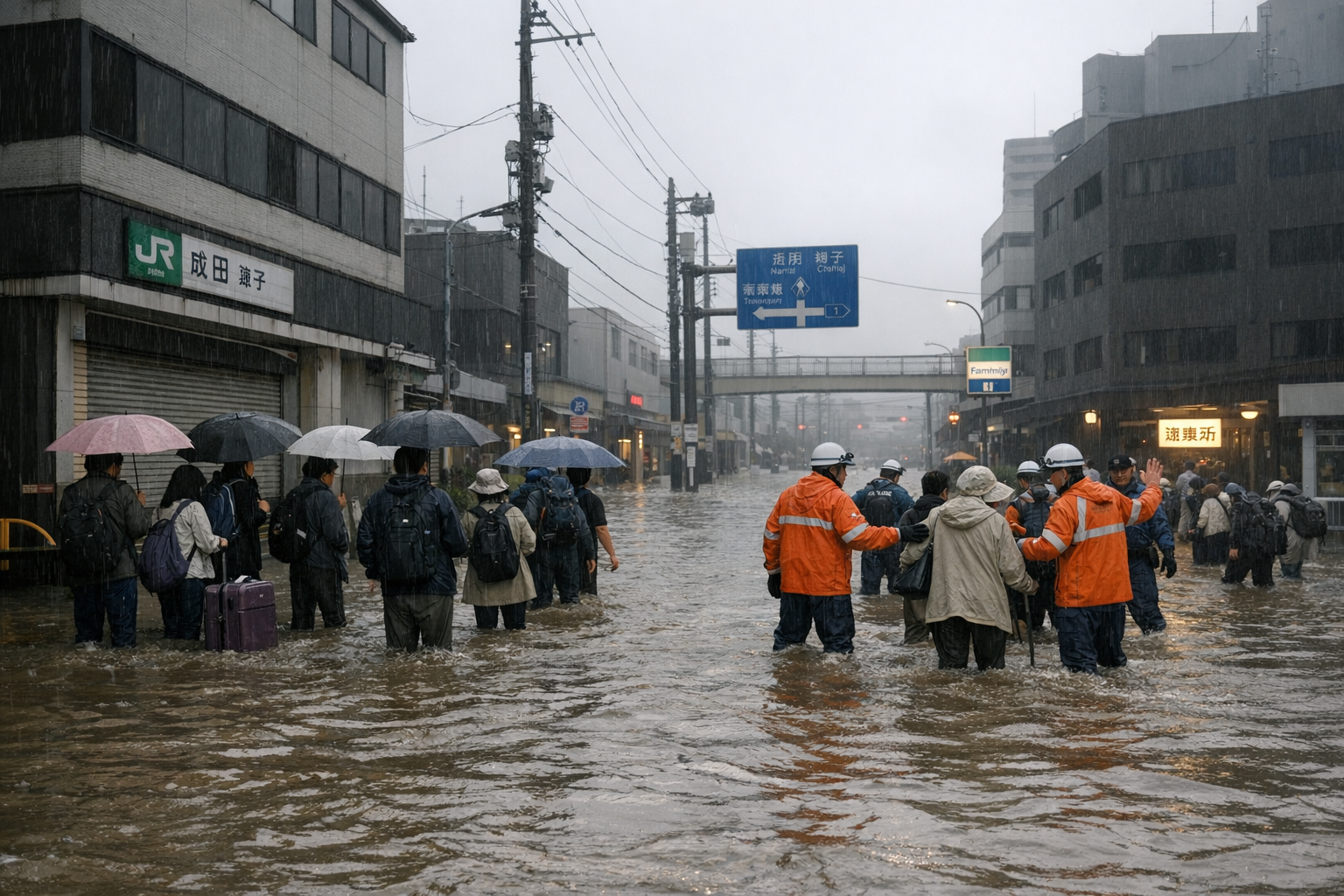
In eastern Japan, torrential rain lashed Chiba Prefecture, east of Tokyo, late Thursday into Friday, inundating roads, cutting power and snarling transport at the height of a busy summer travel period. At least four people were reported dead and one person was missing, as authorities warned of landslides and further flooding even after the most intense downpours began to ease.
At nearly the same time, Tokyo issued a formal protest to Moscow after Mr. Putin made his first visit to the southern Kuril Islands, known in Japan as the Northern Territories, a chain seized by Soviet forces at the end of World War II and still claimed by both countries.
Record Rain Over Chiba
Japan’s meteorological agency issued its highest-level heavy-rain warning for several municipalities in Chiba after exceptionally intense rainfall, including hourly totals of about 115 millimeters — roughly what the area would normally receive over much of August.
The deluge left a broad swath of disruption across the region. Evacuation orders were issued for roughly 400,000 people in Chiba and nearby areas, and about 45,000 households lost power. Thousands sought refuge in public buildings as floodwaters rose.
Among the most visible scenes of disruption was at Narita International Airport, one of the country’s main gateways, where nearly 7,000 people were stranded overnight. Train services were also heavily affected, leaving passengers stuck at major stations as operators suspended or delayed routes because of submerged tracks and safety concerns.
By Friday, some transportation links had begun to resume and the top-tier rain warning was downgraded. But officials cautioned that the danger had not fully passed, with additional rainfall still forecast and the risk of landslides remaining elevated in saturated ground.
The flooding is an immediate test of Japan’s disaster preparedness in the greater Tokyo orbit, where even localized weather emergencies can ripple quickly through rail lines, highways, airports and power systems. The country is among the world’s most disaster-conscious, with elaborate warning systems and evacuation protocols, yet recent years have repeatedly shown how short bursts of extreme rain can overwhelm infrastructure and leave large numbers of people abruptly stranded.
A Sovereignty Dispute Reignited
If the floods posed a domestic emergency, Mr. Putin’s visit opened a separate geopolitical fault line.
Japan reacted angrily after the Russian president traveled to the disputed island chain, with Foreign Minister Toshimitsu Motegi summoning Russia’s ambassador, Nikolay Nozdrev, to lodge a protest. Prime Minister Sanae Takaichi called the visit “absolutely unacceptable,” saying the islands are Japanese territory under international law.
The dispute centers on four islands off Hokkaido that Japan calls the Northern Territories and Russia includes in the Kuril chain. Soviet troops seized them in the closing days of World War II, and the unresolved sovereignty question has prevented Tokyo and Moscow from ever signing a formal peace treaty ending the war.
Official Russian visits to the islands have repeatedly infuriated Japan, but Mr. Putin’s presence there carried particular symbolic weight. It came at a time when relations between the two countries were already deeply strained and diplomatic engagement had dwindled to a minimum.
For Tokyo, the visit was a reminder that one of East Asia’s longest-running territorial disputes remains not merely historical but active — and capable of flaring with little warning. For Moscow, such visits have often served as assertions of control over territory it regards as unquestionably Russian.
Why the Week Matters
The two crises are unrelated in cause, but together they have sharpened questions about Japan’s resilience and room for maneuver.
The rain emergency has focused attention on whether further downpours could drive the death toll higher, trigger new landslides or prolong disruptions around the capital region. It has also highlighted the vulnerability of major transport hubs during peak travel periods, when interruptions can affect tens of thousands of people within hours.
The Kuril dispute, meanwhile, raises a different set of uncertainties: whether Japan’s protest remains largely symbolic, whether Russia follows with additional activity on the islands, and whether already sparse bilateral contacts deteriorate further.
For now, Japan is left managing a week in which nature and geopolitics collided — one crisis measured in flooded roads, darkened homes and crowded shelters, the other in summoning ambassadors and reviving a dispute that has shaped relations with Russia since 1945.
Sources
Further reading and reporting used to add context:
- https://apnews.com/article/d37730f09557f9cce4948754fcef673c
- https://apnews.com/article/00b3ce16f648f9c3885bf547edad1696
- https://apnews.com/article/fdf0cb3090d46c7ef94145f75afecab9
- https://apnews.com/article/bc9cf6a0aa3fdbed5264d32297d740b4
- https://www.narita-airport.jp/files/73b75536620910fb1f4eaee4ef70286da9180cd2aba1b7a20582e1cc4c2b935b
- https://www.bousai.pref.chiba.lg.jp/portal/X_PUB_VF_AirInformation
- https://www.narita-airport.jp/en/company/
- https://www.narita-airport.jp/en/news/
- https://www.narita-airport.jp/en/company/media-center/news/
- https://www.pref.chiba.lg.jp/kuushin/narita/kinoukyoukar80710.html
- https://www.reddit.com/r/anime_titties/comments/1vn52bq/japan_pm_takaichi_says_putins_visit_to_disputed/
- https://www.reddit.com/r/japan/comments/1vnbnsv/japan_pm_takaichi_says_putins_visit_to_disputed/
- https://x.com/Narita_OPC_info/with_replies
- https://www.reddit.com/r/japannews/comments/1vnraud/putin_visits_disputed_etorofu_island_off_east/
- https://www.data.jma.go.jp/multi/warn/kanto_chiba.html?lang=en&warning=all
- https://www.reddit.com/r/japannews/comments/1vnefl3/japan_pm_takaichi_says_putins_visit_to_disputed/
- https://www.reddit.com/r/TrendoraX/comments/1vn5va9/russian_leader_vladimir_putin_made_his_first/
- https://www.reddit.com/r/worldnews/comments/1vngifg/japan_pm_says_putins_visit_to_disputed_islands/
- https://www.reddit.com/r/worldnews/comments/1vn4wky/russias_putin_angers_japan_with_1st_visit_to/
- https://www.nippon.com/en/news/reu20210726KBN2EW089/
- https://www.narita-airport.jp/en/company/media-center/
- https://www.reddit.com/r/videos/comments/1vncmqg/japan_protests_putins_first_visit_to_disputed/
- https://www.bousai.pref.chiba.lg.jp/
- https://www.pref.chiba.lg.jp/kuushin/narita/hikoukosu.html
- https://www.reddit.com/r/geopolitics/comments/1vn4v2u/russias_putin_angers_japan_with_1st_visit_to/
- https://www.reddit.com/r/japannews/comments/1vnrajf/prime_minister_takaichi_strongly_protests_putins/
- https://www.mofa.go.jp/press/kaiken/kaiken24e_000069.html
- https://www.mofa.go.jp/press/kaiken/kaiken24e_000070.html
- https://www.mofa.go.jp/press/kaiken/kaiken18e_000002.html
- https://www.mofa.go.jp/press/kaiken/kaiken23e_000016.html
- https://www.mofa.go.jp/press/kaiken/kaiken4e_000668.html
- https://www.mofa.go.jp/mofaj/press/kaiken/gaisho/g_2408.html
- https://www.mofa.go.jp/press/kaiken/kaiken6e_000040.html
- https://www.mofa.go.jp/press/kaiken/kaiken4e_000879.html
- https://www.mofa.go.jp/press/kaiken/kaikenwe_000001_00090.html
- https://www.mofa.go.jp/press/kaiken/kaiken4e_000577.html
- https://www.mofa.go.jp/region/europe/russia/territory/index.html
- https://www.pref.chiba.lg.jp/seihou/kenpou/documents/r080630-14156-betu1.pdf
- https://www.mofa.go.jp/region/europe/russia/territory/pamphlet.pdf
- https://www.mofa.go.jp/policy/other/bluebook/2025/pdf/pdfs/2025_all.pdf
- https://www.mofa.go.jp/files/000290287.pdf
- https://www.pref.chiba.lg.jp/kokusai/english/information/residents/hello/documents/00-1-all-en.pdf
- https://www.reddit.com/r/neoliberal/comments/1vn6s46/japan_pm_takaichi_says_putins_visit_to_disputed/
- https://www.reddit.com/r/veritynews/comments/1vnkst2/japans_takaichi_protests_putins_kuril_islands/
- https://www.reddit.com/r/japanweather/comments/1vnxjg0/you_know_things_are_bad_when_chiba_makes/
- https://www.reddit.com/r/newswall/comments/1vnchet/putins_island_visit_draws_sharp_japanese_protest/
- https://www.reutersconnect.com/item/japans-takaichi-condemns-irans-ship-attacks-in-hormuz-warns-of-global-economic-fallout/dGFnOnJldXRlcnMuY29tLDIwMjY6bmV3c21sX1ZBNTY4NzE5MDMyMDI2UlAx
- https://sg.news.yahoo.com/japan-protests-russian-pms-visit-disputed-island-051301550.html
- https://tass.com/world/814227
- https://www.reddit.com/r/japanlife/comments/1vnc4we/anyone_else_with_familyfriends_stuck_at_narita/
- https://www.reddit.com/r/NoSpinMedia/comments/1vnnl9m/putin_makes_first_visit_to_disputed_kuril_island/
- https://www.reddit.com/r/japannews/comments/1vn6mn0/flooding_in_chibaprefecture_severeweather/
- https://hnonline.sk/svet/1985026-rusko-podniklo-cvicne-strelby-v-oblasti-spornych-ostrovov-japonsko-protestuje
- https://www.yahoo.com/news/articles/russia-says-no-peace-dialogue-095755101.html
- https://reuters.screenocean.com/record/1368824
- Heavy rain causes flooding near Tokyo that kills 4 and strands travelers
- Torrential rain near Tokyo causes flooding and paralyzes traffic, killing 1