
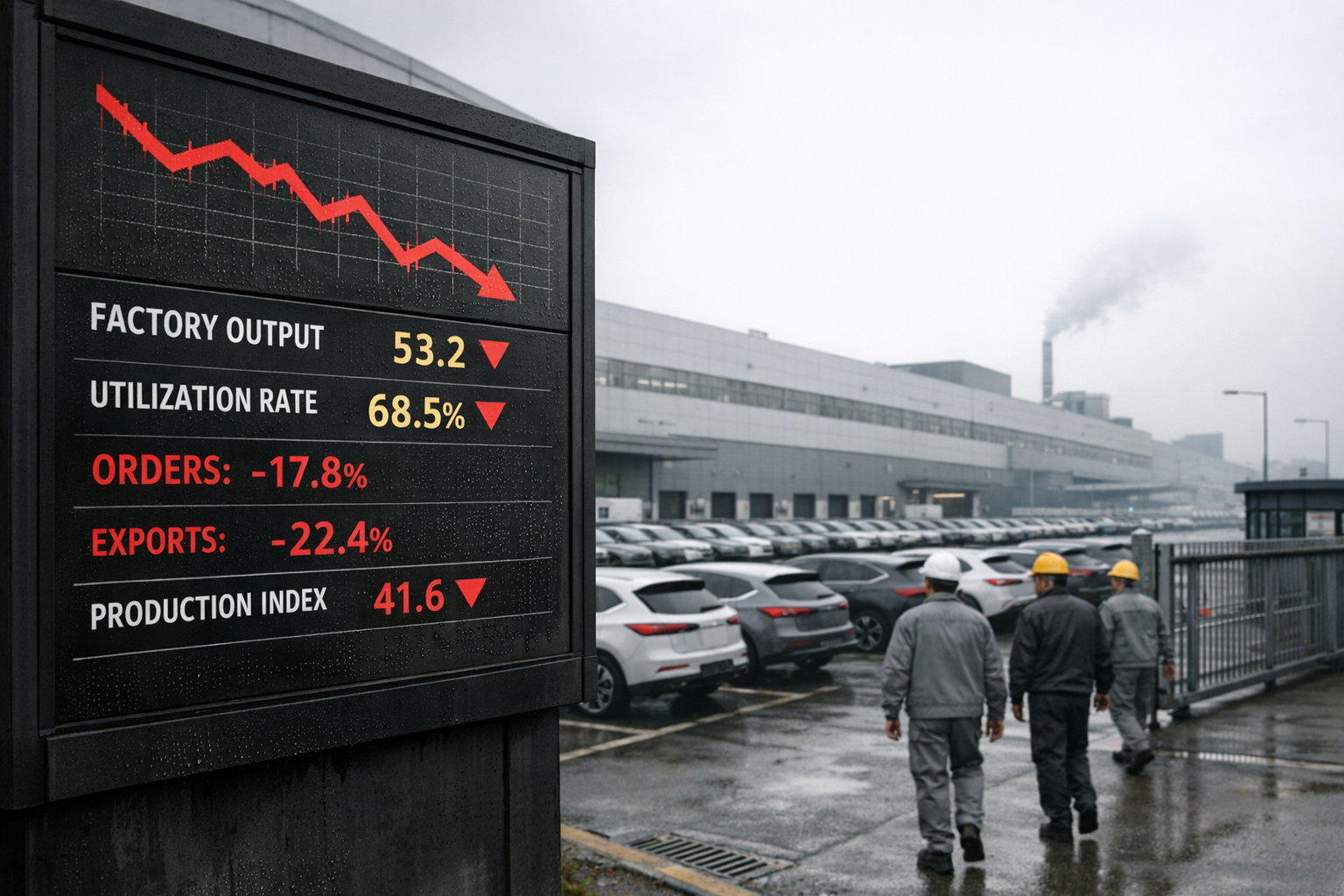
China’s economy showed fresh signs of strain in August, as factory activity contracted for a second straight month and BYD, one of the country’s most prominent industrial champions, reported a sharp drop in first-half profit after an bruising price war in the domestic electric-vehicle market.
Taken together, the data and the automaker’s results underscored a central challenge for Beijing: even as exports and overseas expansion provide pockets of resilience, weak demand at home is still weighing on growth, jobs and corporate earnings.
Factory activity remains under pressure
China’s official manufacturing purchasing managers’ index rose to 49.8 in August from 49.2 in July, an improvement but still below the 50-point threshold that separates expansion from contraction. It was the second consecutive month of shrinking factory activity, suggesting that the world’s second-largest economy has yet to regain steady momentum.
The details of the survey offered a mixed picture. Production returned to expansion territory at 50.4, and new orders improved to 50.6. New export orders also strengthened, indicating that external demand may be offering some support to manufacturers.
But employment remained weak, with the subindex at 48.1, a sign that factories are still hesitant to hire as they confront uncertain demand and narrow margins.
That matters because manufacturing remains a pillar of China’s economy, influencing not only output and trade but also business confidence and labor-market conditions. The August reading suggested that while activity may be stabilizing somewhat, the recovery remains fragile and uneven.
BYD’s earnings reflect the toll of the EV price war
The pressure on domestic demand was also evident in BYD’s latest results. The company said first-half net profit fell 20.5 percent from a year earlier to 12.325 billion yuan, while revenue slipped 7.1 percent to 344.8 billion yuan.
Its Hong Kong-listed shares fell sharply after the earnings release, as investors focused on the impact of intense competition in China’s electric-vehicle market.
BYD said domestic rivalry had intensified and demand remained under pressure, even as its overseas business expanded and its premium brands gained ground. The company’s exports reached 792,000 vehicles in the first half, up 67.8 percent from a year earlier, highlighting how much its international push has become a buffer against weakness at home.
Still, the figures showed the limits of that strategy. BYD remains one of the strongest players in the global EV industry, but even it has not been spared the effects of prolonged discounting in China, where automakers have slashed prices in a battle for market share.
Quarterly profit improved from earlier levels, helped in part by overseas shipments, but the broader message from the first half was that scale alone is not enough to shield companies from a market where competition is fierce and consumers remain cautious.
A broader signal for China’s economy
The combination of a sub-50 manufacturing reading and weaker earnings at BYD is especially notable because both speak to the same underlying problem: soft domestic demand.
For much of 2026, China’s manufacturing PMI has hovered around the 50 line, swinging between weak expansion and contraction. August’s result means the sector has now shrunk in both July and August, raising questions about whether the modest improvement this month signals the start of stabilization or merely a temporary rebound.
BYD’s results send a parallel signal from one of the country’s most strategically important industries. Autos, and especially electric vehicles, have been central to China’s industrial ambitions, export growth and technological positioning. If leading companies are seeing profits squeezed despite booming exports, that suggests the strain in the home market is deeper than headline shipment figures alone might imply.
The implications extend beyond a single company or a single month’s factory survey. Persistent weakness in domestic orders and hiring would increase pressure on policymakers to deliver more support for the economy. And for Chinese companies, the message is increasingly clear: growth abroad may help, but it may not fully compensate for prolonged softness at home.
What investors and policymakers will watch next
The next few months are likely to be critical in determining whether China’s economy is settling into a period of slower but stable growth or sliding into a more entrenched slowdown.
Economists and investors will be watching whether factory orders continue to improve, whether employment stops deteriorating, and whether consumer and business confidence revive. In the auto sector, attention will center on whether the EV price war begins to ease or keeps eroding profitability.
For BYD, the key test is whether export growth and its move into higher-end segments can continue offsetting weaker pricing in China. For Beijing, the broader challenge is more fundamental: how to shore up domestic demand strongly enough that the country’s industrial strength no longer depends so heavily on finding customers overseas.
Sources
Further reading and reporting used to add context:
- https://apnews.com/article/6d33b11dfd3c1ee834b169274f58f825
- 2026年8月中国采购经理指数运行情况 – 国家统计局
- https://cnevpost.com/2026/08/28/byd-h1-2026-earnings/
- https://www.investing.com/news/economic-indicators/china-factory-activity-contracts-for-second-straight-month-in-aug-4882104
- https://www.reutersconnect.com/item/china-manufacturing-activity-contracts-for-second-straight-month/dGFnOnJldXRlcnMuY29tLDIwMjY6bmV3c21sX09XRUZWQzcwMDE2MDg3ODgwMDE
- https://english.www.gov.cn/archive/statistics/202608/31/content_WS6a952339c6d00ca5f9a0ce12.html
- https://www1.hkexnews.hk/search/predefineddoc.xhtml%3Bjsessionid%3DVo76MxOma7yQRnWptKdva7gKlwdPqWbZhjZ4PW_9.s106
- https://www.marketscreener.com/news/china-s-factory-activity-seen-contracting-again-in-august-ce7858dfdb80f025
- China's factory activity improves but stays in contraction in August | MarketScreener UK
- https://ng.investing.com/news/stock-market-news/why-is-byd-stock-sliding-today-93CH-2679644
- BYD reports 20.5% drop in first-half profit | MarketScreener UK
- 比亚迪(002594):H股公告(二零二六年中期业绩公告)- CFi.CN 中财网
- https://www.dianmaauto.com/news/byds-h1-2026-profit-fell-20-but-margins-hit-a-one-year-high-as-exports-jumped-68-2
- https://www.hkexnews.hk/listedco/listconews/sehk/2025/1212/2025121200949.pdf
- https://pdf.dfcfw.com/pdf/H3_AP202604291821724116_1.pdf?1777452812000.pdf=
- https://www.hkexnews.hk/listedco/listconews/sehk/2025/0425/2025042500521.pdf
- https://www.hkexnews.hk/listedco/listconews/sehk/2025/0826/2025082601756.pdf
- https://iis.aastocks.com/20250828/11815862-0.PDF
- https://en.wikipedia.org/wiki/BYD_Company
- https://www1.hkexnews.hk/search/titlesearch.xhtml?category=0&lang=EN&market=SEHK&stockId=2696
- https://www1.hkexnews.hk/search/titlesearch.xhtml?category=0&lang=EN&market=SEHK&stockId=20247
- https://www3.hkexnews.hk/reports/bmn/ebmn.htm
- https://www1.hkexnews.hk/search/titlesearch.xhtml?category=0&market=SEHK&stockId=2696
- https://www1.hkexnews.hk/search/titlesearch.xhtml?category=0&lang=EN&market=SEHK&stockId=189809
- https://www1.hkexnews.hk/listedco/listconews/sehk/2026/0428/2026042803001.pdf?outputType=chromeless
- https://www1.hkexnews.hk/search/titlesearch.xhtml?category=0&lang=EN&market=SEHK&stockId=1000045675
- https://www1.hkexnews.hk/listedco/listconews/sehk/2025/0829/2025082902216.pdf
- https://www1.hkexnews.hk/listedco/listconews/sehk/2025/0829/2025082902253_c.pdf
- https://www1.hkexnews.hk/listedco/listconews/sehk/2025/0829/2025082902252.pdf
- https://www1.hkexnews.hk/listedco/listconews/sehk/2024/0828/2024082800854.pdf
- https://www1.hkexnews.hk/search/titlesearch.xhtml?category=0&lang=EN&market=SEHK&stockId=1108
- https://www.hkexnews.hk/listedco/listconews/sehk/2026/0601/2026060103055.pdf
- https://www1.hkexnews.hk/search/titlesearch.xhtml?category=0&lang=EN&market=SEHK&stockId=116122
- https://www1.hkexnews.hk/search/titlesearch.xhtml?category=0&lang=EN&market=SEHK&stockId=1000057952
- https://www1.hkexnews.hk/search/titlesearch.xhtml?category=0&lang=EN&market=SEHK&stockId=861
- https://www1.hkexnews.hk/search/titlesearch.xhtml?category=0&lang=EN&market=SEHK&stockId=49784
- https://www.marketscreener.com/news/byd-reports-20-5-drop-in-first-half-profit-ce7858dfdc88ff25
- https://www.marketscreener.com/news/byd-posts-first-quarterly-profit-rise-in-over-a-year-but-misses-estimates-ce7858dfdc8af220
- https://ca.marketscreener.com/news/byd-reports-20-5-drop-in-first-half-profit-ce7858dfdc88ff25
- https://in.marketscreener.com/news/byd-reports-20-5-drop-in-first-half-profit-ce7858dfdc88ff25
- https://hk.marketscreener.com/news/byd-reports-20-5-drop-in-first-half-profit-ce7858dfdc88ff25
- https://ae.marketscreener.com/news/byd-reports-20-5-drop-in-first-half-profit-ce7858dfdc88ff25
- https://uk.marketscreener.com/news/byd-s-shares-fall-despite-surge-in-earnings-ce7858dcdd8ff224
- https://www.marketscreener.com/news/byd-hong-kong-shares-set-to-drop-8-after-quarterly-profit-falls-ce7c50d2db8ef424
- https://www.marketscreener.com/news/chinese-ev-maker-byd-s-quarterly-profit-falls-for-first-time-in-3-1-2-years-ce7c50ddd889ff2d
- https://es.marketscreener.com/noticias/byd-registra-una-ca-da-del-20-5-en-su-beneficio-del-primer-semestre-ce7858dfdc88ff25
- https://in.marketscreener.com/news/byd-s-shares-fall-despite-surge-in-earnings-ce7858dcdd8ff224
- https://www.reddit.com/r/NBCauto/comments/1w32whu/world_byd_shares_slide_as_fierce_china/
- https://www.reddit.com/r/stocks/comments/1n80s4d
- https://cdn.growbeansprout.com/strapi-uploads/BYD_SDR_July_2025_c080680277.pdf
- https://publish.u-capital.net/report/download/13382/en
- https://www.reddit.com/r/electricvehicles/comments/1w0w97q/byd_h1_profit_falls_205_as_overseas_growth_fails/
- https://www.reddit.com/r/stocks/comments/1n39kns