
The United States and Iran traded direct military strikes for the first time in more than a month, jolting oil markets, unsettling Gulf capitals and reviving fears that a conflict that had appeared to be shifting into economic warfare could once again spill into a broader regional confrontation.
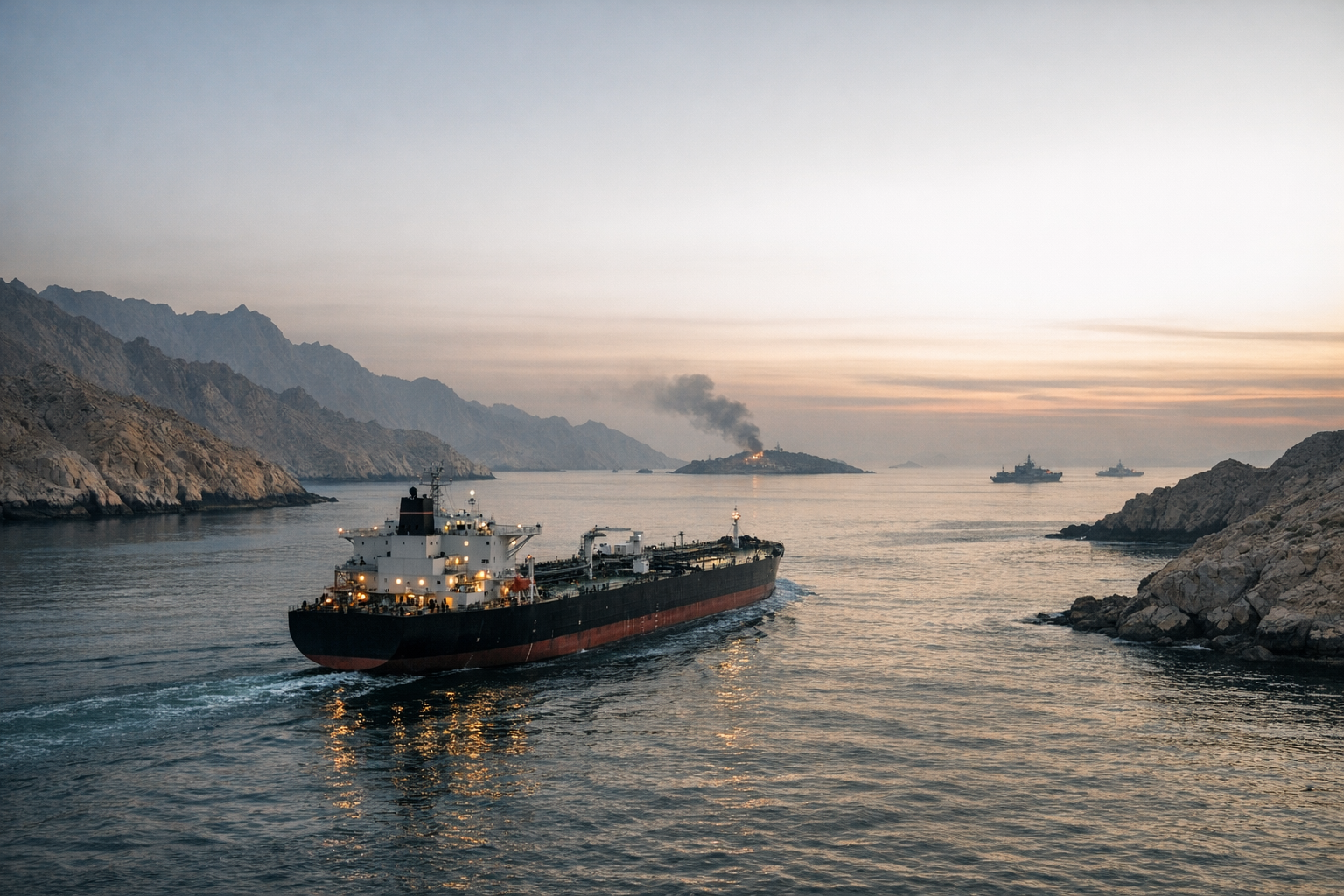
American forces struck two Iranian rocket launchers on Larak Island in the Strait of Hormuz on Sunday, saying the Islamic Revolutionary Guard Corps was preparing to deploy sea mines in the narrow waterway through which roughly a fifth of the world’s seaborne oil passes. Iran responded by firing missiles at American positions in Jordan, according to regional officials and Western reports, with the incoming fire intercepted before causing reported damage.
By Monday, the tension had spread across the Gulf. The United Arab Emirates said it had intercepted an Iranian drone over its territorial waters, and traders pushed Brent crude more than 3 percent higher, sending it back above $90 a barrel as concerns mounted over the security of one of the world’s most sensitive energy corridors.
A return to direct confrontation
The exchange ended a lull that had held since late July and marked a significant turn in a crisis that, in recent days, had seemed to be moving away from immediate battlefield escalation and toward financial pressure.
Just last week, Washington unveiled a sweeping sanctions drive, branded “Operation Economic Outcast,” aimed at further isolating Iran by tightening primary and secondary sanctions and squeezing what American officials describe as Tehran’s remaining economic lifelines. The campaign was presented as an effort to force Iran toward restraint without widening the military conflict.
Instead, the weekend’s strikes underscored how fragile that strategy remains when tensions center on the Strait of Hormuz, where even limited military action can rattle global markets. So far, there has been no confirmed large-scale damage to oil infrastructure, and no evidence of a major interruption to tanker traffic. But the speed of the oil-price jump reflected a familiar calculation by traders: in the Gulf, the threat of disruption can matter almost as much as disruption itself.
Hormuz and the global economy
The Strait of Hormuz has long been one of the world’s most dangerous economic chokepoints, a narrow passage between Iran and the Arabian Peninsula that links Gulf oil producers to global markets. Any sign that mines, missiles or drones could threaten shipping there tends to reverberate far beyond the region, raising costs for importers and fueling inflation concerns at a delicate moment for the global economy.
That is why the latest flare-up carries significance beyond the immediate military exchange. Markets are now weighing not only the risk of further attacks on shipping, but also the possibility that strategic energy sites could be drawn more directly into the conflict. President Trump has intensified his rhetoric around Iranian oil infrastructure, though there has been no verified attack on Kharg Island, Iran’s main oil export terminal, and Iranian oil officials have said conditions there remain calm.
For now, the move above $90 appears to be driven by renewed supply fears rather than by actual physical losses.
Diplomacy still flickers
Even as the military confrontation resumed, both sides left open the possibility that the latest violence might remain contained.
Iran’s president, Masoud Pezeshkian, said on Monday that Tehran still wanted a diplomatic end to the war, though he accused the United States of failing to honor its commitments. His remarks suggested that Iran’s leadership is trying to preserve room for negotiation even while signaling that direct American strikes will be answered.
European governments, meanwhile, have backed a tougher economic line while calling for stability in the Gulf. On Monday, the European Union said it supported added pressure on Iran and emphasized the need to protect freedom of navigation in Hormuz, aligning itself more closely with Washington’s sanctions push even as the risk of open conflict rises.
What comes next
The central question now is whether the latest exchange proves to be another limited round of tit-for-tat strikes or the start of a more sustained campaign involving Gulf bases, commercial shipping or oil facilities.
That uncertainty is what has made the market reaction so sharp. A contained confrontation could leave prices elevated but stable; a wider conflict touching tankers or export infrastructure could send energy costs much higher and draw more countries into the crisis.
For Washington, the renewed strikes also expose a deeper frustration: sanctions alone have not produced a quick strategic shift in Tehran, yet military action carries the constant risk of escalation. For Iran, already under severe economic strain from inflation, currency weakness and tightening sanctions, the challenge is to respond forcefully enough to deter further attacks without inviting a much broader war.
For now, the immediate damage appears limited. But with missiles, drones and mines again at the center of the standoff, and with the world’s most critical oil chokepoint back in focus, the conflict has entered a more dangerous phase.
Sources
Further reading and reporting used to add context:
- https://apnews.com/article/6b098da673ac3161a266ee459d5eff44
- https://www.axios.com/2026/08/30/us-iran-strike-hormuz-mines
- https://apnews.com/article/52b62137e842b9a25612a857368207b6
- https://apnews.com/article/9f34873bad9a928574c36ee984c3f96b
- https://apnews.com/article/00f872327d65e5330598054a234dc25a
- https://apnews.com/article/645e30123c3a0633a306466af71c3fa1
- https://www.thedailybeast.com/trump-turns-to-bombing-fantasy-after-humiliating-reality-leaks/
- https://www.thedailybeast.com/raging-trump-80-explodes-in-foulmouthed-morning-meltdown/
- https://www.washingtonpost.com/national-security/2026/08/30/us-strikes-iran-missile-sites-larak-island/
- https://www.aljazeera.com/news/2026/8/30/us-strikes-irans-lark-island-in-first-attack-in-weeks
- https://www.netzender.com/cnbc-daily-open-war-by-other-means-turns-to-armed-conflict-again
- https://www.cbsnews.com/live-updates/iran-war-us-trump-strait-of-hormuz-6-months-no-end-in-sight/
- https://cryptobriefing.com/war-by-other-means-escalates-armed-conflict/
- https://www.aljazeera.com/news/2026/8/31/iran-attacks-jordan-uae-after-us-bombs-larak-island-whats-the-latest
- https://www.thenationalnews.com/news/us/2026/08/30/us-strikes-iran-near-strait-of-hormuz-in-first-military-action-in-a-month/
- https://www.rferl.org/a/larak-island-iran-launchers-strike/33843587.html
- https://www.cbsnews.com/live-updates/iran-war-us-strikes-strait-of-hormuz/?ftag=CNM-00-10aab4i
- https://www.aljazeera.com/amp/news/liveblog/2026/8/31/iran-war-live-irgc-attacks-us-bases-in-jordan-after-us-bombs-larak-island
- https://www.aol.com/articles/oil-jumps-more-2-us-221149000.html
- https://themonexus.com/articles/2026-08-31-iran-missile-jordan-intercepts-august-2026
- https://www.mofa.gov.ae/en/MediaHub/News/2026/8/31/UAE-iran
- https://www.wam.ae/en/article/c20f0m3-uae-air-force-responds-uav-over-territorial-waters
- https://gulfnews.com/uae/uae-forces-deal-with-drone-from-iran-over-territorial-waters-1.500657759
- https://www.jaf.mil.jo/NewsViewEn.aspx?NewsId=62216
- https://www.jaf.mil.jo/NewsViewEn.aspx?NewsId=62204
- https://www.jordannews.jo/Section-109/News/Jordan-Intercepts-Five-Iranian-Missiles-53612
- https://www.centcom.mil/MEDIA/PUBLIC-RELEASES/Article/4457220/us-forces-start-mine-clearance-mission-in-strait-of-hormuz/
- https://live.euronext.com/en/financial-news/oil-jumps-more-2-after-us-attack-irans-larak-island
- https://www.euronews.com/2026/08/30/us-forces-strike-iranian-rocket-launchers-in-strait-of-hormuz-as-irgc-warns-of-retaliatory
- https://www.businesstimes.com.sg/international/global/us-strikes-iranian-rocket-launchers-larak-island-iran-hits-jordan-uae-retaliation
- https://www.reddit.com/r/UAE/comments/1w35gps/mod_confirms_drones_were_detected_towards_the/
- https://www.youtube.com/watch?v=jdWgAW0J7yY
- https://cincodias.elpais.com/mercados-financieros/2026-08-31/la-bolsa-y-el-ibex-35.html
- https://elpais.com/internacional/2026-08-31/el-primer-ataque-de-ee-uu-a-iran-desde-julio-provoca-varios-muertos-y-heridos.html
- https://www.reddit.com/r/war/comments/1w2uyg1/two_iranian_ballistic_missiles_seen_being/
- https://apnews.com/article/cf543dfad0a20097ed4c2b415a26e8b4
- https://apnews.com/article/68d1bb0817c9f83eaa34e9ec643690fa
- https://apnews.com/article/6011cce3d5b5a6f898bb3a66dc9fa612
- https://apnews.com/article/fa718f6f57b0be019a27c88b01df526d
- https://apnews.com/article/c457cd178b05f6c39c8c2e33f0a565ba
- https://www.axios.com/2026/08/24/bessent-dday-iran-secondary-sanctions
- https://www.axios.com/2026/08/25/trump-iran-dday-secondary-sanctions-china
- https://www.aljazeera.com/news/2026/8/31/uae-intercepts-drone-after-us-and-iran-exchange-attacks
- https://www.theguardian.com/world/live/2026/aug/31/us-iran-israel-hormuz-oil-donald-trump-larak-kharg-island-uae-jordan-latest-news-updates?page=with%3Ablock-6a9533888f08fce2a63fffd0
- https://ebs.publicnow.com/view/D13CEECC0DB97AE9962D2EFA4D86319E1332082A
- https://home.treasury.gov/news/press-releases/sb0613
- https://2eu.brussels/en/news-articles/eu-backs-stronger-economic-pressure-on-iran-and-demands-full-freedom-of-navigation-through-strait-of-hormuz
- https://www.gov.uk/government/news/chancellor-statement-on-iran-sanctions
- https://www.internazionale.it/ultime-notizie-reuters/2026/08/31/uae-says-forces-dealt-with-drone-coming-from-iran-condemns-attack-as-dangerous-escalation
- https://www.wam.ae/en/article/c20f10h-jordan-condemns-iranian-drone-attack-uae
- https://apnews.com/article/db2f55ab0c3bd5d091dd4338d8bd28c8
- https://apnews.com/article/c229bc39b6e1a3d5dd16f7f9e67fef3f
- https://www.investing.com/news/stock-market-news/trump-posts-ai-video-of-irans-kharg-in-smithereens-no-evidence-of-attack-4882150
- https://www.marketscreener.com/news/trump-posts-ai-video-of-iran-s-kharg-in-smithereens-no-evidence-of-attack-ce7858dcdd80f32d
- https://www.forbes.com/sites/siladityaray/2026/08/31/trump-posts-bizarre-ai-video-claiming-attack-on-kharg-island-after-us-resumes-iran-strikes/
- https://www.channelnewsasia.com/world/us-iran-kharg-island-exchanging-fire-6350801
- https://au.investing.com/news/stock-market-news/trump-posts-ai-video-of-irans-kharg-in-smithereens-no-evidence-of-attack-4622255
- https://www.internazionale.it/ultime-notizie-reuters/2026/08/31/trump-posts-ai-video-of-iran-s-kharg-in-smithereens-no-evidence-of-attack
- https://www.marketscreener.com/news/oil-jumps-more-than-2-after-us-attack-on-iran-s-larak-island-ce7858dcda81f42c
- https://www.khaleejtimes.com/world/mena/iran-president-seek-negotiated-end-to-war-after-latest-clash-with-us?amp=1
- https://live.euronext.com/en/financial-news/oil-jumps-more-1-after-us-attack-irans-larak-island
- https://www.khaleejtimes.com/world/mena/iran-dismisses-trump-claim-us-attack-kharg-island?amp=1
- https://uk.marketscreener.com/news/trump-says-iran-s-kharg-is-being-blown-to-smithereens-but-gives-no-details-ce7858dcdd8bf223
- https://www.omanobserver.om/article/1195356/world/region/trump-posts-ai-video-of-irans-kharg-in-smithereens-no-evidence-of-attack
- https://www.govinfo.gov/content/pkg/DCPD-202600169/pdf/DCPD-202600169.pdf
- https://apnews.com/article/f2e45b2c77f5994ed9d9534ae988403b
- https://apnews.com/article/49cf07bcd4f9166f93f51136892d76a6
- https://www.timesofisrael.com/liveblog_entry/irans-pezeshkian-says-tehran-still-interested-in-negotiated-solution-to-war-with-us/
- https://www.jpost.com/middle-east/iran-news/article-907132
- https://www.dawn.com/news/2026399/irans-pezeshkian-says-tehran-still-seeks-negotiated-solution-to-conflict-with-us
- https://quews.news/iran-still-wants-negotiated/
- https://www.dawn.com/news/2026399
- https://thecitizen.co.tz/tanzania/news/international/iran-still-wants-negotiated-end-to-war-president-says-after-exchanges-of-fire-5577432
- https://en.sedaily.com/international/2026/08/31/irans-president-urges-us-to-honor-truce-memorandum
- https://noticias.uol.com.br/ultimas-noticias/reuters/2026/08/31/presidente-iraniano-afirma-que-teera-ainda-busca-solucao-negociada-para-conflito-com-eua.htm
- https://www.reutersconnect.com/item/iran-president-says-country-must-move-beyond-neither-war-nor-peace-state/dGFnOnJldXRlcnMuY29tLDIwMjY6bmV3c21sX1ZBNDEzMjA4MDgyMDI2UlAx
- https://www.arabnews.com/node/2656423/middle-east
- https://www.reddit.com/r/geopolitics/comments/1w30dyv/removed/
- https://www.reddit.com/r/oil/comments/1vw2mlb/removed/
- https://www.reddit.com/r/moderatepolitics/comments/1vvbu5d/irans_president_calls_to_end_war_with_us_from/
- US strikes Iranian rocket launchers on the Strait of Hormuz in first military action in weeks
- U.S. strikes Iran to prevent Hormuz mine threat
- Treasury Launches Unprecedented Campaign Against Iranian Regime on Economic D-Day | U.S. Department of the Treasury
- US Conducts Fresh Strikes On Iran, Seen As 'Signal' To Tehran On Hormuz