
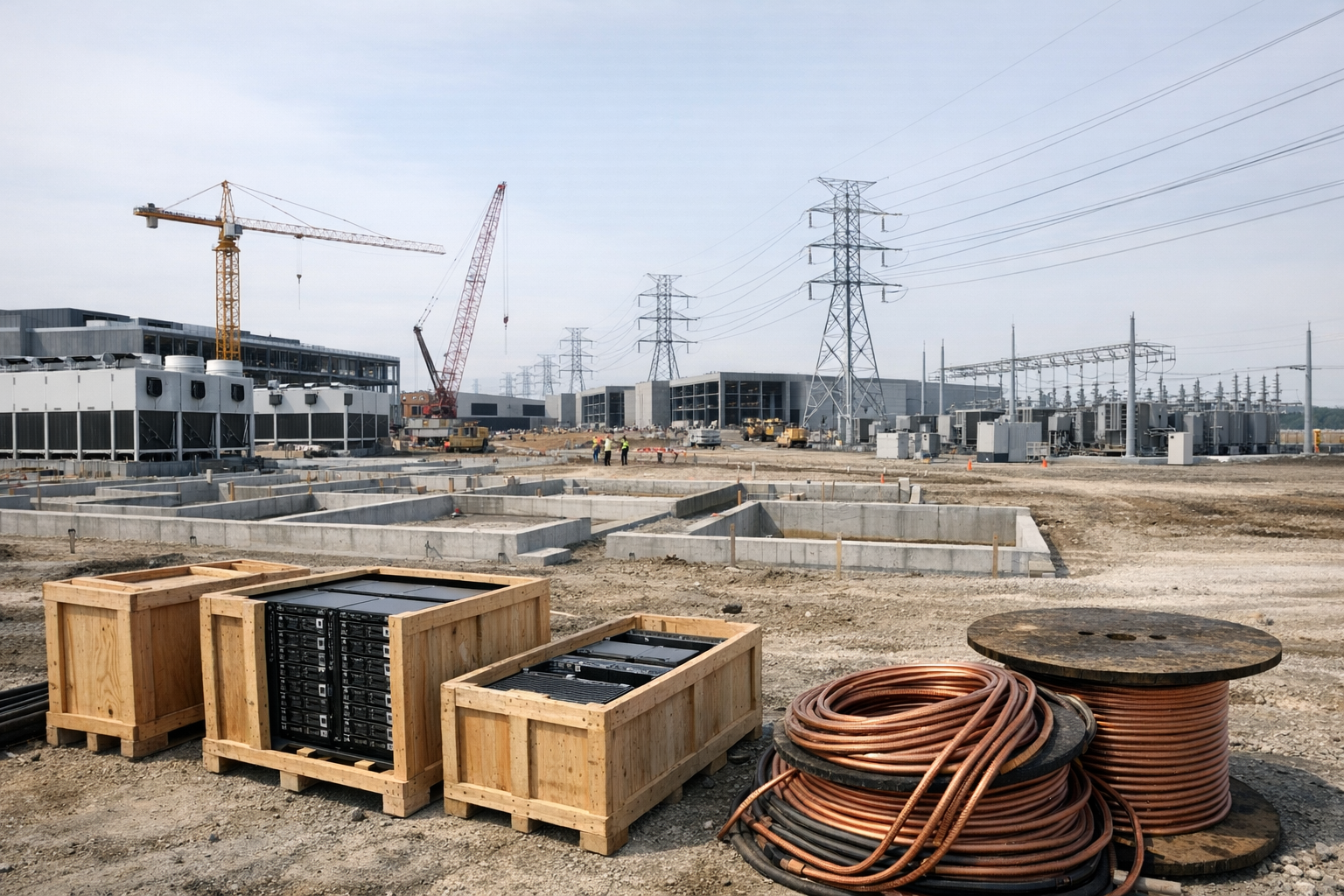
The race for artificial intelligence is becoming a contest of concrete, copper and power
The global competition over artificial intelligence is widening beyond chatbots and software models into something more tangible: who can secure the land, electricity, data centers, cloud systems and chips needed to run them.
That shift was on display this week as France and India intensified leader-level campaigns to draw in AI infrastructure spending, even as a reported delay to Nvidia’s next-generation rack system raised fresh questions about how fast the industry can build the hardware backbone of the AI boom.
In Europe, President Emmanuel Macron has been positioning France as a home for large-scale AI computing projects, arguing that the country’s low-carbon electricity system and industrial policy make it a natural site for energy-hungry data centers. The Élysée said SoftBank had announced a €45 billion investment that could eventually rise to €75 billion, tied to plans for 3 to 5 gigawatts of AI-dedicated data-center capacity.
In India, Prime Minister Narendra Modi has been making a parallel pitch, presenting the country as an emerging hub for AI and cloud infrastructure. Modi’s government said the India AI Impact Summit in February 2026 helped catalyze more than $200 billion in AI-related investment commitments. His office also said Amazon planned to invest $48 billion in India from 2026 through 2030, including major spending on AI and cloud operations.
Taken together, the announcements illustrate how national governments are now competing not only to regulate AI or foster startups, but to host the industrial systems that make advanced AI possible.
A strategic shift from models to machinery
For much of the past two years, AI competition was framed around which company could build the most capable model. But as demand for computing has surged, the industry’s center of gravity has moved toward infrastructure.
The prize is substantial. Countries that can attract data centers, power generation, semiconductor supply chains and cloud capacity stand to capture jobs, tax revenue, technical expertise and strategic leverage. The outcome may also shape who gets access to the most advanced computing resources at a time when those resources remain scarce.
France has sought to make the case that it offers rare advantages in Europe: relatively abundant low-carbon power, a state capable of coordinating industrial projects, and ambitions that link AI expansion to broader semiconductor and high-performance computing goals.
India, for its part, has paired investment diplomacy with policy support. The government says its IndiaAI Mission includes a shared compute facility with more than 45,000 GPUs, while officials are also pushing semiconductor manufacturing and broader data-center development. For New Delhi, the effort is part of a larger attempt to move up the technology value chain and establish India not only as a market for AI services, but as a base for the infrastructure itself.
Still, the gap between announcement and execution remains wide. Large AI data centers require vast amounts of power, fast permitting, land acquisition, cooling systems and specialized construction. Financing, grid connections and supply-chain availability can all slow projects long after ribbon-cutting promises are made.
Nvidia’s reported delay underscores the supply bottleneck
The strain on the hardware side of the AI boom became clearer with a report on Sunday from CNBC, citing the research firm SemiAnalysis, that Nvidia’s next-generation Kyber NVL144 rack system had been pushed back to 2028 because of manufacturing problems involving a key printed circuit board midplane. Nvidia did not respond to CNBC’s request for comment.
If the report is borne out, it would represent more than a scheduling hiccup for the world’s most important AI chip supplier. Nvidia has tried to maintain a breakneck annual release cadence for its AI platforms, persuading cloud providers and corporate customers to plan around ever more powerful systems. A delay to one of its highest-end rack-scale products would suggest that the limiting factor in AI may be shifting from chip design to the less glamorous, but equally essential, mechanics of assembly: packaging, boards, power delivery and interconnects.
That matters because modern AI systems are no longer just collections of chips. They are tightly integrated racks in which GPUs, networking, memory and power systems must all work in concert. Even if processors themselves improve on schedule, deployment can be slowed by bottlenecks in the components that bind those systems together.
Why governments are stepping in now
The juxtaposition of aggressive courtship by governments and a potential Nvidia manufacturing setback points to the same conclusion: physical infrastructure has become the choke point of the AI economy.
That is helping explain why heads of state are increasingly taking direct roles in investment pitches once left to trade ministers or local development agencies. In the AI era, winning a data-center project can mean securing a foothold in a strategic industry, while losing one can leave a country dependent on computing capacity built elsewhere.
It also helps explain why national strategies are increasingly sprawling. They now encompass electricity generation, fiber networks, semiconductor incentives, cloud regulation, export controls and training programs for workers who can build and operate these facilities.
Whether France and India can convert headline-grabbing commitments into operating capacity remains uncertain. So does the exact timeline for Nvidia’s Kyber platform. But the direction of travel is clear: the AI race is no longer only about who writes the smartest code. It is also about who can pour the foundations, secure the megawatts and assemble the machines.
Sources
Further reading and reporting used to add context:
- https://v3techmedia.online/prime/nvidias-next-gen-ai-rack-system-delayed-to-2028-on-manufacturing-snags-semianalysis-says/
- https://aiweekly.co/alerts/nvidias-kyber-nvl144-ai-rack-slips-to-2028-on-pcb-snag
- https://www.techtimes.com/articles/319410/20260701/nvidia-rubin-ultra-four-die-gpu-cancelled-packaging-limits-cut-2027-performance-half.htm
- https://www.newsbytesapp.com/news/science/nvidia-s-next-gen-ai-racks-hit-production-snag/story
- https://seekingalpha.com/news/4611538-nvidia-next-gen-kyber-ai-rack-delayed-to-2028-on-manufacturing-snags-report
- https://www.kucoin.com/news/flash/nvidia-delays-multiple-ai-rack-level-architectures-rubin-ultra-expansion-path-constrained
- https://cryptobriefing.com/nvidia-kyber-nvl144-delayed-2028/
- https://www.macrostream.ai/articles/6a4af3b43c80f748cb632c76
- https://www.techmeme.com/260706/p3
- https://www.livemint.com/news/world/india-france-turn-to-leader-level-diplomacy-to-win-ai-infrastructure-bets/amp-11783168344728.html
- https://www.tomshardware.com/tech-industry/artificial-intelligence/nvidia-reportedly-cancels-quad-die-rubin-ultra-gpu-in-favor-of-dual-gpu-design-report-claims-complex-design-purportedly-scrapped-over-manufacturing-execution-concerns
- https://www.reddit.com/r/BetterOffline/comments/1uos9d1/nvidias_nextgen_ai_rack_system_delayed_to_2028_on/
- https://phemex.com/news/article/nvidias-nextgen-ai-rack-system-delayed-to-2028-91922
- https://www.tomshardware.com/tech-industry/artificial-intelligence/amd-denies-report-of-mi455x-delays-as-nvidia-vr200-systems-are-rumored-to-arrive-early-company-says-helios-systems-on-target-for-2h-2026
- https://www.reddit.com/r/AMD_Stock/comments/1uon052/nvidias_nextgen_ai_rack_system_delayed_to_2028_on/
- https://www.reddit.com/r/economy/comments/1uoqdpo/nvidias_nextgen_ai_rack_system_delayed_to_2028_on/
- https://www.techradar.com/pro/softbank-offers-eur75-billion-to-help-build-europes-biggest-data-centre-project
- https://www.lemonde.fr/en/opinion/article/2026/06/02/beyond-ai-billions-energy-emerges-as-the-crucial-battleground-at-choose-france-summit_6754062_23.html
- https://apnews.com/article/67c2b5a37f98e0a6ebb81136e0287969
- https://www.elysee.fr/en/emmanuel-macron/2026/06/01/meeting-with-masayoshi-son-ceo-of-softbank
- https://www.elysee.fr/G7evian/2026/06/16/le-g7-sengage-pour-un-numerique-responsable-quatre-priorites-adoptees-sous-presidence-francaise
- https://www.elysee.fr/emmanuel-macron/2026/06/18/deplacement-au-salon-vivatechnology-1
- https://www.elysee.fr/en/emmanuel-macron/2026/06/11/global-convergence-for-growth-summit
- https://www.elysee.fr/emmanuel-macron/2026/04/01/declaration-conjointe-franco-japonaise-sur-la-cooperation-dans-le-domaine-de-lintelligence-artificielle
- https://www.pib.gov.in/PressReleasePage.aspx?PRID=2278453&lang=2®=48
- https://static.pib.gov.in/WriteReadData/specificdocs/documents/2026/jun/doc2026622899501.pdf
- https://www.elysee.fr/en/emmanuel-macron/2026/06/07/joint-statement-of-the-leaders-of-france-the-united-kingdom-germany-and-ukraine
- https://www.elysee.fr/emmanuel-macron/2026/06/22/la-france-et-lallemagne-ont-conclu-un-accord-sur-la-strategie-et-la-gouvernance-de-knds
- https://www.elysee.fr/emmanuel-macron/2026/06/01/entretien-de-travail-avec-masayoshi-son-directeur-general-de-softbank
- https://www.elysee.fr/emmanuel-macron/2026/02/19/deplacement-en-inde-sommet-sur-lintelligence-artificielle-a-new-delhi
- https://docs.aws.amazon.com/whitepapers/latest/aws-overview/introduction.html?linkId=212566867&sc_channel=sm&sc_outcome=AWS+Support&sc_publisher=REDDIT
- https://www.elysee.fr/emmanuel-macron/2026/05/22/forum-europeen-sur-la-puissance-de-calcul-les-sciences-et-technologies-quantiques-et-les-semi-conducteurs
- https://static.pib.gov.in/WriteReadData/specificdocs/documents/2026/feb/doc2026214790001.pdf
- https://static.pib.gov.in/WriteReadData/specificdocs/documents/2026/feb/doc2026217795001.pdf
- https://newindiasamachar.pib.gov.in/WriteReadData/Magazine/2026/Jun/M202606161.pdf
- https://static.pib.gov.in/WriteReadData/specificdocs/documents/2026/feb/doc2026212786901.pdf
- https://www.gate.com/zh-tw/news/detail/nvidia-kyber-ai-rack-system-delayed-to-2028-on-pcb-manufacturing-issues-22371514
- https://www.kucoin.com/news/flash/nvidia-delays-multiple-ai-rack-level-architectures-rubin-ultra-expansion-path-restricted
- https://blockchain.news/ainews/nvidia-kyber-rack-delay-reshapes-2028-ai-buildouts
- https://money.udn.com/money/story/5599/9610120?from=edn_newest_index
- https://www.coinlive.com/news/nvidia-kyber-delayed-to-2028-winners-and-losers-in
- https://www.tomshardware.com/pc-components/cpus/nvidias-new-consumer-desktop-pc-chip-reportedly-delayed-well-into-2026
- https://www.tomsguide.com/computing/cpus/nvidia-n1x-cpu-delayed-once-again-and-microsofts-next-gen-os-seems-to-be-at-fault
- https://www.pib.gov.in/PressReleasePage.aspx?PRID=2277727&lang=1®=48
- https://techcrunch.com/2026/06/25/amazon-ups-india-bet-with-fresh-13b-ai-infrastructure-investment/
- https://www.financialexpress.com/business/news/amazon-to-invest-another-13-billion-in-india-ai-cloud-infrastructure/4276534/
- https://economyglobal.com/news/amazon-expands-india-ai-cloud-investment-to-48-billion-with-additional-13-billion-through-2030/
- https://www.theregister.com/paas-and-iaas/2026/06/25/amazon-pours-another-13b-into-indias-ai-and-cloud-infrastructure/5262067
- https://www.hindustantimes.com/india-news/usd-48-billion-investment-ai-and-cloud-expansion-by-2030-amazon-ceo-andy-jassy-plans-for-india-101782377955809.html/
- https://www.aa.com.tr/en/asia-pacific/amazon-announces-13b-more-in-india-investments-for-ai-cloud-infrastructure/3977756
- https://www.pib.gov.in/PressReleasePage.aspx?PRID=2276447&lang=1®=48
- https://www.ndtv.com/india-news/amazon-48-billion-google-15-billion-global-ceos-india-investment-push-11687717?pfrom=home-ndtv_mainnavigation
- https://www.ad-hoc-news.de/boerse/news/ueberblick/amazon-com-cautious-india-ai-expansion-shares-reflect-growing-cloud/69625504
- https://m.economictimes.com/industry/services/retail/amazon-will-look-at-acquisitions-continue-to-work-with-govt-on-expanding-ai-capabilities-andy-jassy-ceo/articleshow/132005368.cms
- https://www.ndtv.com/india-news/amazon-ceo-meets-pm-modi-announces-48-billion-investment-in-india-by-2030-11685360/amp/1
- https://dailypioneer.com/uploads/2026/epaper/june/ranchi-english-edition-2026-06-26.pdf
- https://chronicleclub.in/storage/uploads/1782448618-business-standard.pdf
- https://www.yugmarg.com/edition/2026/06/26/pages.pdf
- https://kgi.georgetown.edu/wp-content/uploads/2026/01/How-to-Regulate-the-Cloud_Ramzanali_24.pdf
- https://www.reddit.com/r/YesIntelligent/comments/1uf8dfn/amazon_ups_india_bet_with_fresh_13b_ai/
- https://www.reddit.com/r/IndiaTech/comments/1uf691i/amazon_to_invest_48_billion/
- https://chronicleclub.in/storage/uploads/1783140449-business-standard.pdf
- https://www.reddit.com/r/NewsA/comments/1ijr2u5
- Meeting with Masayoshi Son, CEO of SoftBank. | Élysée