
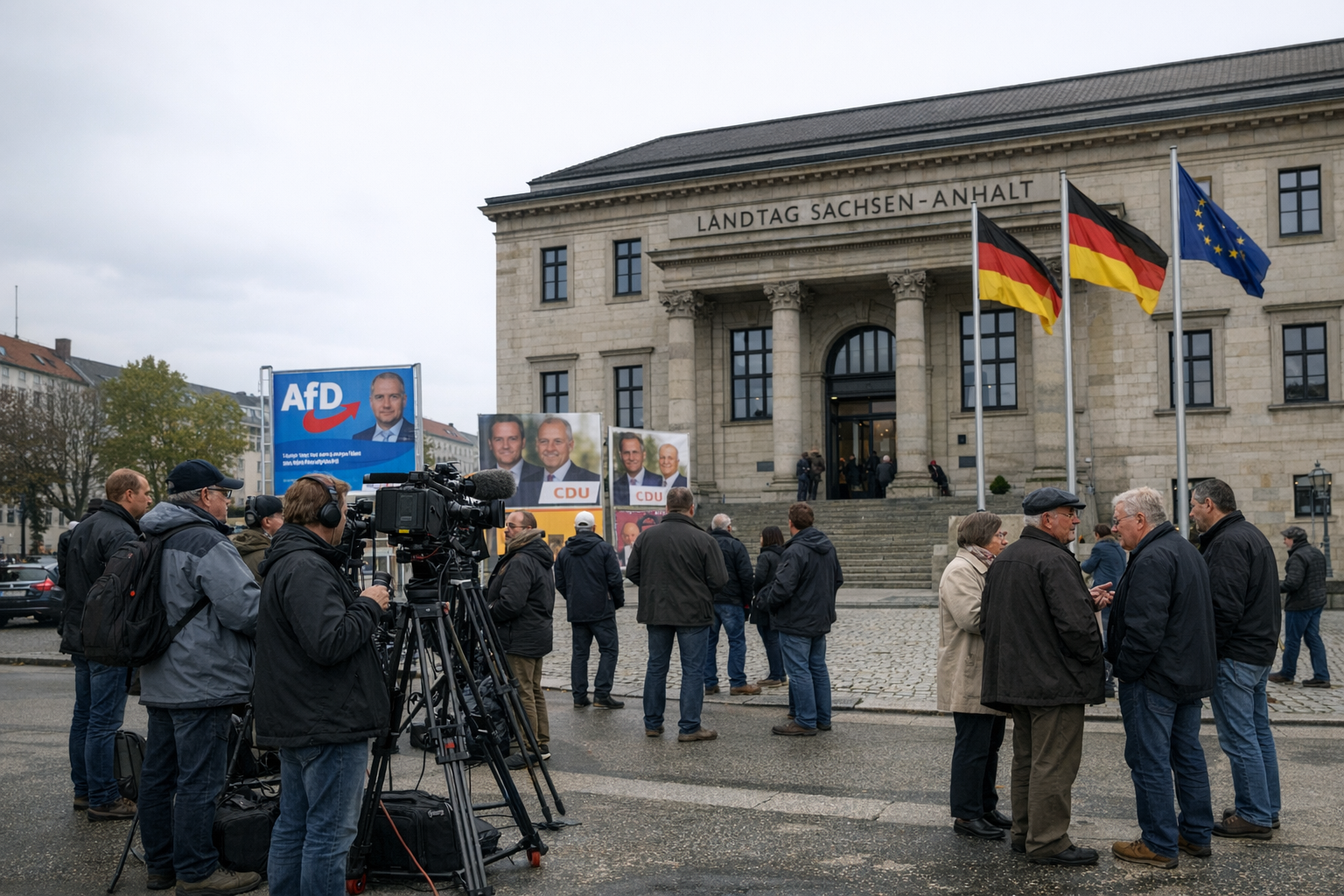
The far-right Alternative für Deutschland scored a historic victory in the eastern German state of Saxony-Anhalt on Sunday, winning 43.8 percent of the vote and finishing far ahead of Chancellor Friedrich Merz’s Christian Democrats, in a result that has shaken Berlin and revived urgent questions about whether Germany’s political establishment can still contain the party’s rise.
Preliminary official results gave the AfD 39 seats in the 83-member state parliament in Magdeburg, leaving it just three short of an outright majority. For a party long kept from power by a cross-party refusal to cooperate with it — the so-called firewall — the outcome amounted to its most important electoral breakthrough yet.
Merz called the result a shock that could not simply be ignored. He has reason for alarm. The Christian Democratic Union, which had governed Saxony-Anhalt for years, fell to 17.2 percent, roughly halving its support and underscoring the extent to which the vote was read as a rebuke not only to local leaders but to the federal government.
A breakthrough with national consequences
In postwar Germany, no far-right party has led a state government. That Saxony-Anhalt came close to delivering exactly that has intensified pressure on Merz at a particularly sensitive moment, as his government faces discontent over the economy, living costs, migration and support for Ukraine.
AfD leaders wasted little time in presenting the result as a mandate for political change. Ulrich Siegmund, the party’s lead figure in Saxony-Anhalt, said on Monday that the AfD would seek to govern only with a “stable majority,” ruling out a minority administration. The statement was both a claim to legitimacy and an acknowledgment of the problem before him: victory alone may still not be enough to translate support into power.
That dilemma goes to the heart of what makes the election so consequential. The AfD has now demonstrated that in parts of eastern Germany it can do more than register protest; it can dominate. The question is whether the established parties can still organize themselves to keep it from office without deepening the resentment on which it thrives.
The firewall is under strain
The mainstream parties’ refusal to govern with the AfD has been one of the defining guardrails of German politics, rooted in the country’s postwar determination to isolate extremist forces. In Saxony-Anhalt, that barrier is now under its heaviest strain yet.
The outgoing coalition of the CDU, Social Democrats and Free Democrats lost its majority. That has left a narrow and awkward set of options. The Bündnis Sahra Wagenknecht, or BSW, cleared the threshold to enter parliament and could become pivotal in coalition arithmetic. One possible path discussed in German political circles would give the AfD and BSW a slim majority. But BSW has signaled discomfort with handing the far right direct power and has floated the idea of backing a nonpartisan premier instead.
Whether such an arrangement could hold is uncertain. So is whether the CDU can maintain party discipline if pressure builds to find a practical governing formula. For now, Merz and other mainstream leaders have insisted the firewall remains intact. But each election in which the AfD grows stronger raises the cost of that position.
Why Saxony-Anhalt matters
Saxony-Anhalt is not just another state contest. It sits in eastern Germany, where the AfD has built some of its deepest support by combining hard-line anti-immigration rhetoric with anger at political elites and a sense of economic and cultural neglect that has endured long after reunification.
The party campaigned on anti-establishment themes and tapped dissatisfaction over stagnating living standards, industrial anxiety and federal policy. It has also attacked Berlin’s support for Ukraine, arguing that German money should be spent at home instead. That message has resonated with some voters in the east, where skepticism toward sanctions on Russia and military aid to Kyiv tends to run stronger than in much of western Germany.
The sensitivity is sharpened by the fact that the AfD branch in Saxony-Anhalt has been classified by the state intelligence service as right-wing extremist. That designation has made the prospect of the party entering government especially fraught in a country where the memory of authoritarian collapse remains central to political culture.
A warning for Europe
The result was immediately treated beyond Germany as more than a regional upset. Mainstream politicians elsewhere in Europe described it as a grave moment, while nationalist figures celebrated it as evidence that the political tide is shifting across the continent.
That reaction reflects a wider pattern. Far-right and populist parties have advanced in elections from France to Italy to the Netherlands, often fueled by migration fears, distrust of governing elites and frustration with economic pressures. Germany, because of its size and postwar history, has long been regarded as a crucial test of whether the center can hold. An AfD landslide in one of its states inevitably reverberates far beyond Magdeburg.
The response from international right-wing figures highlighted that dynamic. AfD leaders welcomed praise from prominent allies abroad, underscoring how closely connected Europe’s nationalist movements have become and how quickly a regional contest can be recast as a continental symbol.
What Merz does next
For Merz, the result presents both a strategic and an existential challenge. He must now decide whether to answer the AfD’s advance primarily with tougher policy shifts — especially on migration and economic grievances — or by doubling down on moral and political isolation of the far right. Doing both may prove difficult: moving closer to the AfD’s terrain risks legitimizing it, while relying solely on the firewall risks making the mainstream look defensive and out of touch.
The election also raises a broader question about whether this was an exceptional result in one eastern state or the opening of a deeper realignment in German politics. If the AfD can reproduce anything close to this performance in future regional contests, the burden on traditional coalition-building may become nearly impossible to sustain.
For now, the immediate struggle is over government formation in Saxony-Anhalt. But the larger story is already clear. The AfD did not merely win a state election; it exposed how fragile Germany’s old political certainties have become.
Sources
Further reading and reporting used to add context:
- German chancellor under pressure after AfD win in state polls | AP News
- https://apnews.com/article/7f43ae2c42345ed879510bf63e23f3a9
- https://www.axios.com/2026/09/06/afd-saxony-anhalt-germany-far-right-firewall
- https://apnews.com/article/ef8c9e271f20870c106b601f9daca662
- https://apnews.com/article/8a0054face48cc56f6cb6bcf9a8f4b51
- https://apnews.com/article/fa3deebe59f81baadc821c743fb26814
- https://apnews.com/article/ef9c21908f232651d056d7462330e2b7
- https://wahlergebnisse.sachsen-anhalt.de/
- https://statistik.sachsen-anhalt.de/themen/gebiet-und-wahlen/wahlen/landtagswahl-2026
- https://wahlen.sachsen-anhalt.de/zu-den-wahlen/landtagswahl/faq-zur-landtagswahl-2026
- https://wahlen.sachsen-anhalt.de/
- https://wahlergebnisse.sachsen-anhalt.de/wahlen/lt26/erg_land.html?v=1788714447717
- https://www.bundeswahlleiterin.de/service/landtagswahlen/land-15.html
- https://wahlen.sachsen-anhalt.de/zu-den-wahlen/landtagswahl?cHash=3e649f49c6323f5147a2ee9bbdd0c961&tx_news_pi1%5BcurrentPage%5D=0
- https://www.wahlrecht.de/ergebnisse/sachsen-anhalt.htm
- https://www.kpbs.org/news/international/2026/09/06/germanys-far-right-achieves-an-electoral-breakthrough-in-key-state-election
- AfD triumphiert in Sachsen-Anhalt – aber wohl keine Alleinregierung • onvista
- https://www.landtag.sachsen-anhalt.de/wahlergebnis
- https://statistik.sachsen-anhalt.de/themen/gebiet-und-wahlen/wahlen/landtagswahl-2026-2/uebersicht-wahlkreiseinteilung
- https://wahlen.sachsen-anhalt.de/fileadmin/Bibliothek/Politik_und_Verwaltung/MI/wahlen/PDF/2025_07_21_Feststellung_der_Landeswahlleiterin.pdf
- https://en.wikipedia.org/wiki/Results_of_the_2025_German_federal_election
- https://en.wikipedia.org/wiki/2026_Saxony-Anhalt_state_election
- https://de.wikipedia.org/wiki/Liste_der_Mitglieder_des_Landtages_von_Sachsen-Anhalt_%288._Wahlperiode%29
- https://de.wikipedia.org/wiki/Landtagswahl_in_Sachsen-Anhalt_2026
- https://www.youtube.com/watch?v=tFRPQrCBP2c
- https://apnews.com/article/277d377d7639423958b9975714f4cf03
- https://www.lemonde.fr/en/international/article/2026/09/07/far-right-achieves-historic-result-in-germany-s-saxony-anhalt-regional-elections_6757237_4.html
- https://www.tagesschau.de/newsticker/liveblog-landtagswahl-sachsen-anhalt-montag-100.html
- https://www.tagesschau.de/thema/landtagswahl_sachsen
- https://www.tagesschau.de/inland/merz-sachsen-anhalt-100.html
- https://www.tagesschau.de/inland/innenpolitik/landtagswahlen-osten-merz-100.html
- https://meta.tagesschau.de/tag/sachsen-anhalt
- https://shuffleschau.de/inland/sachsen-anhalt-wahl-pressestimmen-100.html
- https://www.tagesschau.de/thema/sachsen/?pageIndex=2
- https://meta.tagesschau.de/id/176092/landtagswahl-in-sachsen-anhalt-sorgen-um-wirtschaft-und-steigende-preise
- https://www.tagesschau.de/thema/sachsen?pageIndex=1
- https://www.tagesschau.de/thema/friedrich_merz
- https://shuffleschau.de/inland/innenpolitik/landtagswahl-sachsen-anhalt-erkenntnisse-100.html
- https://www.tagesschau.de/thema/merz/?pageIndex=1
- https://www.reddit.com/r/autismpolitics/comments/1w941yx/germanys_farright_afd_landslide_winner_in_key/
- https://www.reddit.com/r/UnderReportedNews/comments/1w91oe6/a_party_classified_as_rightwing_extremist_just/
- https://www.reddit.com/r/europe/comments/1w9kn5f/removed/
- https://www.reddit.com/r/collapse/comments/1w9nkt5/germanys_farright_afd_thanks_elon_musk_after/
- https://www.lemonde.fr/en/opinion/article/2026/09/07/germany-s-political-model-is-threatened-by-the-far-right_6757245_23.html
- https://www.lemonde.fr/en/international/article/2026/09/07/afd-supporters-celebrate-saxony-anhalt-win-siegmund-has-given-us-back-a-sense-of-unity-that-had-been-missing-in-germany_6757235_4.html
- https://www.reddit.com/r/justincaseyoumissedit/comments/1w92a8r/a_party_classified_as_rightwing_extremist_just/
- https://www.reddit.com/r/MapPorn/comments/1w9qa6z/support_for_afd_2026/
- https://www.reddit.com/r/europeanunion/comments/1w9ekld/after_farright_election_breakthrough_germanys/
- https://apnews.com/article/e98d278a30dbed6fb9848e824e1b37e7
- https://www.euronews.com/my-europe/2026/09/06/german-far-right-afd-wins-by-a-landslide-in-saxony-anhalt-exit-polls
- https://www.onvista.de/news/2026/09-07-vorlaeufiges-ergebnis-afd-gewinnt-in-sachsen-anhalt-deutlich-absolute-mehrheit-verfehlt-0-20-26550602
- https://www.reutersconnect.com/item/afd-leaders-speak-at-berlin-press-conference-after-saxony-anhalt-election-win/dGFnOnJldXRlcnMuY29tLDIwMjY6bmV3c21sX09XQU5BQ0FBVklERU8yMDI2MDkwNzQyNDA1MzUy
- https://www.cbsnews.com/news/afd-german-election-saxony-anhalt/
- https://www.aljazeera.com/news/2026/9/6/far-right-afd-wins-vote-in-germanys-saxony-anhalt-state-exit-polls
- https://www.sueddeutsche.de/panorama/vorlaeufiges-ergebnis-afd-gewinnt-in-sachsen-anhalt-deutlich-li.3543396
- https://wahlergebnisse.sachsen-anhalt.de/wahlen/lt26/erg_land.html?v=1788725331239
- https://www.abc.net.au/news/2026-09-07/german-state-saxony-anhalt-elects-far-right-afd/107121828
- https://wahlergebnisse.sachsen-anhalt.de/wahlen/lt26/erg_land.html?v=1788730944004
- https://www.aa.com.tr/en/politics/germany-s-right-wing-afd-wins-saxony-anhalt-election-with-record-438-vote/4049204
- https://wahlergebnisse.sachsen-anhalt.de/wahlen/lt26/erg_land.html?v=1788719094984
- https://www.reddit.com/r/YAPms/comments/1w8zypu/polls_have_now_closed_in_saxonyanhalt/
- https://www.reddit.com/r/RedAutumnSPD/comments/1w98i4s/final_result_in_saxonyanhalt/
- https://www.landtag.sachsen-anhalt.de/fileadmin/Downloads/Faltblaetter/2025-01-28_FB_Parlament_Final.pdf
- https://statistik.sachsen-anhalt.de/fileadmin/Bibliothek/Landesaemter/StaLa/startseite/Themen/Wahlen/Berichte/6B706_2021-A.pdf
- https://fr.wikipedia.org/wiki/%C3%89lections_r%C3%A9gionales_de_2026_en_Saxe-Anhalt
- Germany’s right-wing AfD wins Saxony-Anhalt election with record 43.8% vote