
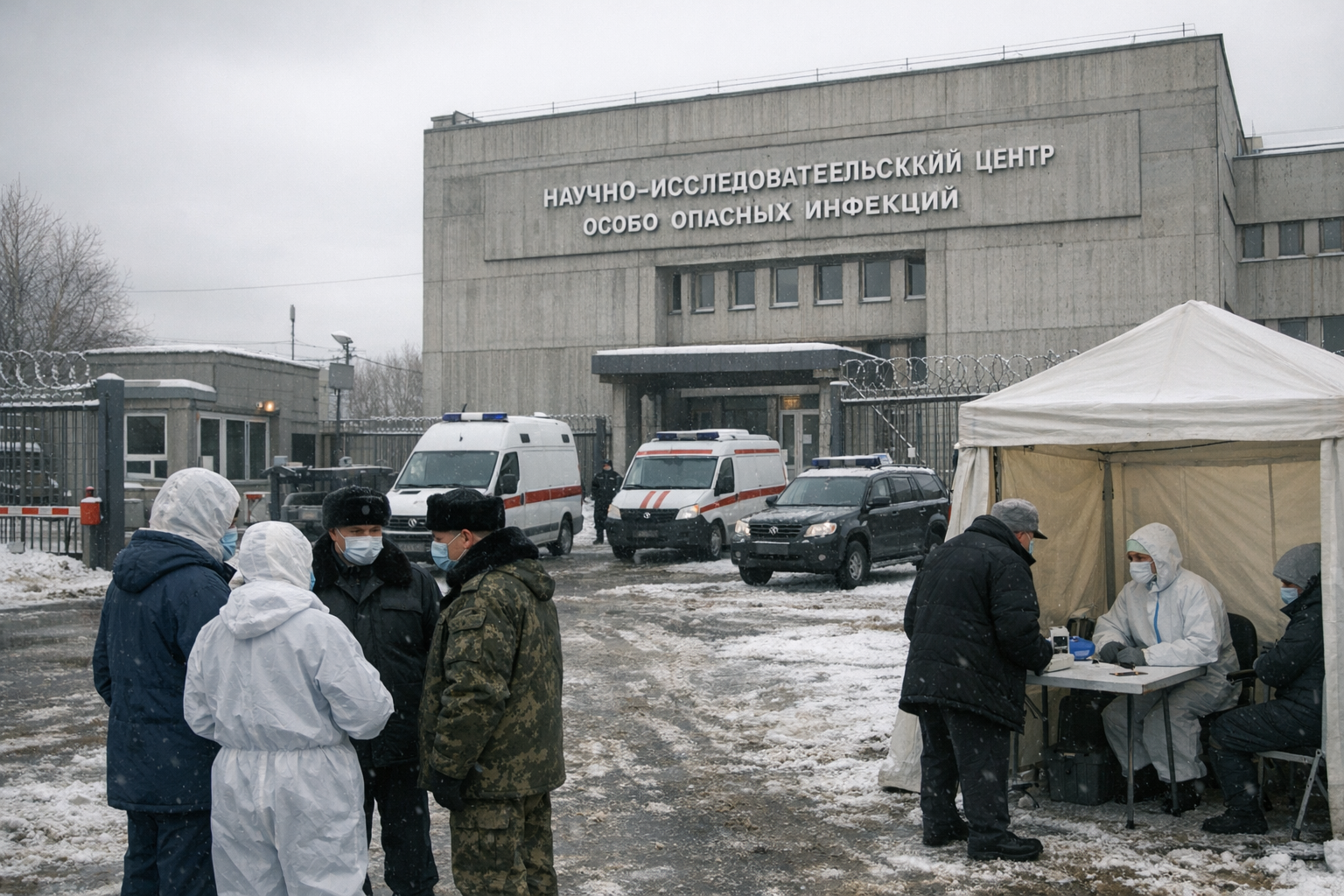
A lab death in Siberia becomes an international concern
The death of a young employee at a Russian anti-plague institute in Siberia has evolved from a murky local health investigation into a matter drawing scrutiny from global health officials and political leaders, after former President Donald Trump said he planned to speak with President Vladimir Putin “very soon” about the case.
At the center of the episode is the death of a 28-year-old worker at the Irkutsk Anti-Plague Research Institute, who fell ill and died on Oct. 2 after developing what Russian officials have described as pneumonia of unknown origin. The case quickly attracted attention because of where she worked: a facility associated with the study of dangerous infectious diseases, including plague.
Russian authorities have sought to calm concern, saying the situation is stable and that testing of contacts has not identified plague cases. But the combination of quarantine measures, limited public detail and the institute’s role has left epidemiologists and outside observers with unanswered questions.
Monitoring hundreds, but no confirmed plague
Local reports said 189 people in Irkutsk, in eastern Siberia, were placed under medical observation after the woman’s death. Broader reporting has put the number of contacts being quarantined or monitored at around 200.
That response was notable in itself. Even without a confirmed diagnosis, public health officials do not typically monitor such a large group unless there is concern about possible exposure to a serious infectious threat. The specter of pneumonic plague — the rare but highly dangerous lung infection caused by Yersinia pestis — has hung over the case, though Russian authorities have not publicly confirmed that the woman had plague.
Officials have said samples did not detect microorganisms connected to the worker’s professional activities. They have continued to characterize her death as resulting from pneumonia of unknown etiology, a formulation that has done little to settle speculation about what precisely killed her.
The World Health Organization added another layer to the shifting account. It initially said Russia had not officially answered a request for information. Later, the organization said Moscow had informed it that no plague cases had been recorded in Irkutsk.
That statement appeared to lower the immediate alarm. Yet it did not fully answer the central question: if there was no plague case, why was such an extensive contact-tracing and observation effort launched?
Why the case has resonated
Even isolated unexplained illnesses can command international attention when they occur inside high-security or specialized research settings. In this case, the worker was employed at a plague institute, a type of facility whose very name evokes both legitimate scientific work and longstanding public anxiety over containment failures.
There is no public evidence that a lab accident occurred, and Russian authorities have not said one did. But the setting has inevitably revived memories of other episodes in which illnesses with unclear origins prompted suspicions of laboratory involvement long before facts were firmly established.
The absence of confirmed secondary cases is significant. If health monitoring continues to show no onward transmission, that would suggest the incident, however serious for those directly involved, did not become a broader public health emergency. Still, experts say that incomplete information in the early days of such investigations can fuel mistrust, especially when the pathogen in question could, in a worst-case scenario, spread rapidly and prove fatal without prompt treatment.
Trump introduces a diplomatic twist
The story took on a geopolitical dimension this week when Trump said he would speak with Putin “very soon” about the Siberian death, as American health authorities monitor the situation.
That statement suggested the case had risen beyond a regional Russian investigation to become a matter of interest in Washington. It also underscored how disease outbreaks — or even suspected outbreaks — can quickly become entangled with diplomacy when they involve opaque governments, dangerous pathogens or sensitive research facilities.
But whether such a conversation will happen imminently remains uncertain. On Oct. 7, the Kremlin said that no call had yet been scheduled, casting doubt on the timeline implied by Trump.
The discrepancy added to the broader uncertainty surrounding the episode: not only is the medical cause of death unresolved in public accounts, but even the prospect of high-level discussions about it remains unsettled.
A case with more questions than answers
For now, the known facts remain narrow. A young researcher died after developing severe pneumonia. Dozens, and possibly about 200, people were placed under observation. Russian officials say there are no confirmed plague cases and no signs of spread among contacts. The W.H.O. says Russia has reported no plague cases in Irkutsk.
What remains unknown is what caused the woman’s death, what exactly prompted the scale of the monitoring response and whether fuller disclosure will emerge from Russian authorities.
Those unanswered questions help explain why the case has drawn such outsized attention. In an era when unexplained illnesses can carry consequences far beyond a single city, even a contained event at a specialized disease institute can become a test of transparency, public trust and international coordination.
Sources
Further reading and reporting used to add context:
- https://apnews.com/article/f78d6612128f649ac179aee7da40e5be
- https://www.theatlantic.com/health/2026/10/russia-plague-pneumonia-panic/688897/?utm_source=openai
- https://www.thedailybeast.com/putins-plague-mystery-takes-grim-twist/
- https://apnews.com/article/9ddc8e3e064637853407bfd24d8937f5
- https://www.investing.com/news/world-news/russia-says-no-plague-cases-detected-among-contacts-of-deceased-lab-worker-4934632
- https://www.internazionale.it/ultime-notizie-reuters/2026/10/06/explainer-what-do-we-know-about-plague-institute-lab-worker-s-death-in-russia
- https://www.axios.com/2026/10/06/cdc-russia-pneumonic-plague-outbreak-threat-us-risk
- https://www.internazionale.it/ultime-notizie-reuters/2026/10/06/russia-says-no-plague-cases-detected-among-contacts-of-deceased-lab-worker
- https://www.gmanetwork.com/news/topstories/world/1005006/explainer-what-do-we-know-about-plague-institute-lab-worker-s-death-in-russia/story/
- https://currently.att.yahoo.com/att/russia-says-no-plague-cases-103151967.html
- https://www.marketscreener.com/news/russia-tells-who-there-are-no-plague-cases-in-siberian-city-ce785dd9d988f42c
- https://www.marketscreener.com/news/russia-says-no-plague-cases-have-been-detected-among-contacts-of-deceased-lab-worker-ce785dd8d08cf323
- https://www.aljazeera.com/news/2026/10/6/russia-denies-imposing-anti-plague-measures-after-lab-worker-death
- https://www.internazionale.it/ultime-notizie-reuters/2026/10/07/russia-says-it-properly-informed-who-of-plague-institute-worker-s-death-blasts-media-coverage
- https://www.reutersconnect.com/item/trump-says-us-looking-very-strongly-at-reported-plague-case-in-russia/dGFnOnJldXRlcnMuY29tLDIwMjY6bmV3c21sX09XQU5BQ0FBVklERU8yMDI2MTAwNjQyNjYxMzQz
- https://www.marketscreener.com/news/russia-says-it-properly-informed-who-of-plague-institute-worker-s-death-blasts-media-coverage-ce785dded988f52c
- https://www.reddit.com/r/u_4running/comments/1wx3gmm/irkutsk_plague_incident_report_031026_1832/
- Explainer-What do we know about plague institute lab worker’s death in Russia? – Internazionale
- Russia reports a worker at a Siberian plague institute got pneumonia from an unknown cause and died