
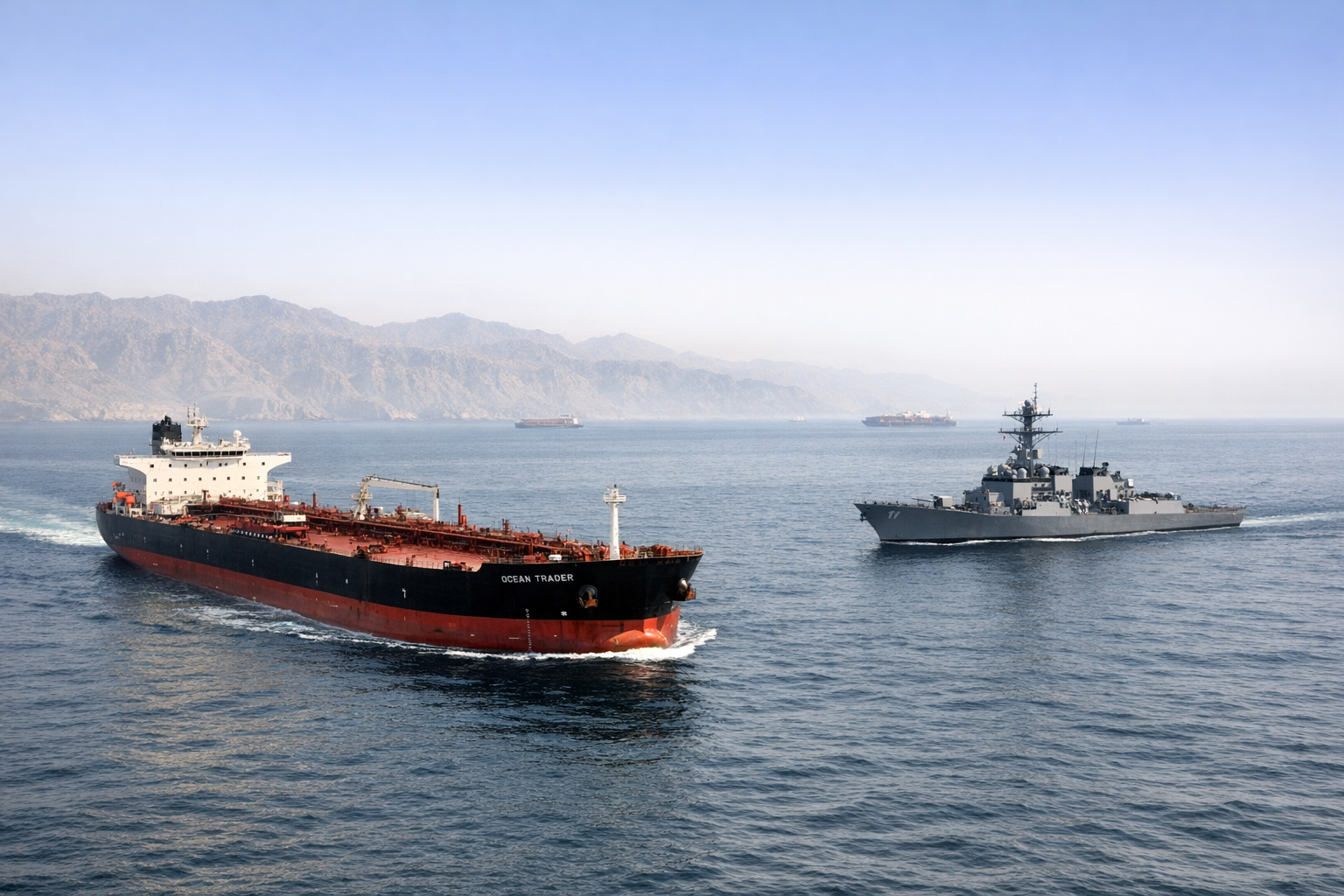
A U.S. blockade in the Gulf becomes a wider diplomatic struggle
The American naval blockade of shipping to and from Iranian ports has quickly grown beyond a military pressure campaign in the Strait of Hormuz, setting off a broader contest over who will shape the response to one of the world’s most dangerous chokepoints.
On Tuesday, China denounced the blockade as “dangerous and irresponsible,” sharpening the sense that the confrontation is no longer only about Washington and Tehran, but about whether other major powers will support, blunt or challenge the American strategy. At the same time, Iran moved to exploit unease among U.S. allies, with Foreign Minister Abbas Araghchi briefing European capitals after inconclusive talks in Islamabad over the weekend. France and Britain are now preparing to chair fresh talks on Friday, an effort that underscores Europe’s emerging role as mediator rather than participant in the blockade.
The result is a fast-widening diplomatic battlefield around Hormuz, where the immediate risk is not just a naval incident, but a deeper fracture between the United States and countries that fear its approach could ignite a broader economic and geopolitical crisis.
China raises the stakes
Beijing’s criticism carried unusual weight because China is both a major buyer of Middle Eastern energy and a power with growing strategic interests in the region. The Chinese Foreign Ministry said that only a “comprehensive ceasefire” and renewed negotiations could ease the crisis, casting Washington’s blockade as a destabilizing move rather than a lawful or prudent form of coercion.
That response matters in part because the blockade, while narrower than a full closure of the strait, threatens to further disrupt already diminished tanker traffic through a waterway critical to global oil and gas supplies. Analysts have warned that any prolonged interference in Hormuz could deepen an already severe energy shock, with repercussions far beyond the Gulf.
The International Energy Agency’s baseline outlook assumes that flows begin recovering only in May, a sign of how fragile market expectations remain even without a broader maritime clash. For governments in Asia and Europe, the question is no longer whether energy markets will be rattled, but how long the disruption can last before it begins to affect inflation, industrial output and political stability.
South Korea’s president, Lee Jae Myung, reflected that anxiety on Tuesday, telling his cabinet that prolonged disruption in energy and raw-material supply chains should now be treated as the likely scenario, not a temporary shock.
Europe tries to carve out room for diplomacy
Iran appears to be betting that those fears can be turned into leverage.
After the Islamabad talks failed to produce a breakthrough, Mr. Araghchi held calls with the French and German foreign ministers, as well as counterparts in Saudi Arabia, Oman and Qatar, as Tehran sought to show that diplomatic space still exists if Washington is pressed to soften its position. Iranian officials have been presenting what they say were proposals discussed over the weekend concerning Tehran’s stockpile of highly enriched uranium and future arrangements for stewardship of the strait.
The outreach is aimed in part at deepening a transatlantic divide that has become more visible as European governments recoil from the economic and escalation risks of the blockade. France and Britain’s decision to chair a new round of Hormuz talks on Friday suggests that Europe is trying to prevent the crisis from hardening into a binary confrontation in which allies are forced either to endorse Washington’s pressure campaign or watch events spiral.
Whether that effort can produce meaningful concessions remains uncertain. European governments have influence, but limited control over either side’s red lines. Washington has framed the blockade as a tool to compel Iran after six weeks of war and failed diplomacy. Tehran, for its part, is trying to avoid appearing cornered while preserving whatever room remains for negotiation before the current ceasefire window expires around April 21 or 22.
A blockade that is broad enough to disrupt, narrow enough to complicate
The blockade took effect Monday evening after the Islamabad talks collapsed. U.S. Central Command said it would apply to vessels entering or leaving Iranian ports and coastal areas, while not impeding ships headed to non-Iranian ports. That distinction means the measure does not amount to a total closure of Hormuz.
Even so, its practical and legal consequences are profound. Because Iran had already sharply curtailed normal tanker traffic during the war, the American move adds a layer of enforcement and uncertainty to a waterway where commercial shipping decisions are now entwined with military calculations. Some Iran-linked or U.S.-sanctioned vessels have still passed through the strait, illustrating both the limited scope of the blockade and the difficulty of turning a selective interdiction regime into a stable reality on the water.
That ambiguity may be one of the most dangerous features of the current moment. A blockade aimed only at Iranian ports is easier for Washington to defend as a calibrated measure. But it is also harder to enforce cleanly, especially in crowded shipping lanes where insurers, captains and naval commanders are all making split-second judgments under pressure. The risk of misidentification, confrontation or escalation at sea remains high.
The contest over what comes next
Much now depends on whether the next round of diplomacy can take place before the current pause in fighting expires, and whether outside powers are prepared to do more than issue statements. Pakistan and other mediators are still trying to arrange another negotiating session later this week or early next week. But the basic questions remain unresolved: Can Europe persuade the United States to narrow or suspend the blockade? Can Iran offer enough on its nuclear stockpile or maritime conduct to make talks politically viable? And will China remain a vocal critic, or use its influence more directly with either Tehran or Washington?
Those uncertainties are what make the Hormuz crisis newly consequential. It is not only a regional showdown or an energy-market emergency. It is becoming a test of how far American power can be used coercively when key allies are uneasy and rivals see an opening.
For now, the strait remains open in the narrowest sense. But diplomatically, the channel is becoming more congested by the day.
Sources
Further reading and reporting used to add context:
- https://apnews.com/article/bf6a057faebfc11eb0c76510a4fc20b1
- https://www.axios.com/2026/04/13/us-iran-nuclear-talks-ceasefire-deal
- https://apnews.com/article/24655d40b2d968c39949e5ec2e01535b
- https://apnews.com/article/ed7a6cd4bc61dc47f317a2c82afcc1c9
- https://apnews.com/article/a8a0d22918fc3fb30bc3abf1cd5c5a13
- https://apnews.com/article/cacfc0610c0f3c6c7f07231edef43372
- https://www.theguardian.com/world/2026/apr/13/deadline-passes-for-us-blockade-on-ships-using-iranian-ports-to-begin
- https://www.aljazeera.com/news/2026/4/13/us-military-threatens-to-blockade-all-iranian-ports-starting-on-monday
- https://www.armyrecognition.com/news/navy-news/2026/u-s-orders-naval-blockade-of-iran-ports-to-halt-all-ships-entering-or-leaving
- https://www.bssnews.net/international/377708
- https://en.wikipedia.org/wiki/Naval_blockade_of_Iran
- https://www.chinadailyhk.com/article/631960
- https://en.wikipedia.org/wiki/2026_Kharg_Island_attack
- https://www.washingtonpost.com/world/2026/04/13/iran-blockade-us-trump-hormuz/
- https://en.wikipedia.org/wiki/2026_Strait_of_Hormuz_campaign
- https://malaysia.news.yahoo.com/china-denounces-irresponsible-u-blockade-092330930.html
- https://windward.ai/blog/april-13-maritime-intelligence-daily/
- https://world.infonasional.com/us-military-blockade-iranian-port-traffic
- https://www.cnbc.com/2025/06/22/us-calls-on-china-to-prevent-iran-from-closing-strait-of-hormuz.html
- https://www.caixinglobal.com/2026-04-13/business-brief-april-13-us-to-blockade-iranian-ports-102433607.html
- https://www.reddit.com/r/NSEbets/comments/1sjz8oh/centcom_update_us_will_not_impede_freedom_of/
- https://apnews.com/article/5af3a462138068bce49993b8d1a406e4
- https://apnews.com/article/da12451198d54f63926d06983b262f98
- https://apnews.com/article/5c49b81c89bc694207db8e07ceba70ea
U.S. blockade of Iran ports dangerous, irresponsible: FM spokesperson-Xinhua
- https://apnews.com/article/3b0c39d11cdc7e23b98dc0f8dbe0f491
- https://apnews.com/article/63a8ee21dcca5ecce0c6b1cb900a8c16
- https://news.rthk.hk/rthk/en/component/k2/1851052-20260414.htm
- https://dm.china-embassy.gov.cn/eng/wjbfyrth/202604/t20260413_11891047.htm
- Middle East crisis live: US-sanctioned ships pass through strait of Hormuz with France and UK to chair talks on Friday | US-Israel war on Iran | The Guardian
- https://www.aljazeera.com/news/2026/4/2/can-starmers-40-nation-coalition-open-the-strait-of-hormuz
- https://www.reutersconnect.com/item/full-opening-of-the-strait-of-hormuz-will-take-time-says-german-government-spokesperson/dGFnOnJldXRlcnMuY29tLDIwMjY6bmV3c21sX1ZBMDc1MTA4MDQyMDI2UlAx
- https://us.china-embassy.gov.cn/eng/fyrth/202603/t20260310_11872314.htm
- https://www.aa.com.tr/en/world/morning-briefing-april-14-2026/3904585
- NATO allies refuse to join Trump’s Strait of Hormuz blockade
- https://m.economictimes.com/news/international/world-news/not-be-drawn-into-wider-war-starmer-macron-reject-military-involvement-in-hormuz/amp_podcast/129646048.cms
- https://en.wikipedia.org/wiki/2026_Iran_war_ceasefire
- https://uk.investing.com/news/stock-market-news/uk-shares-fall-on-failed-usiran-talks-starmer-rejects-hormuz-blockade-role-4604667
- https://www.axios.com/2026/04/13/iran-uranium-enrichment-moratorium-talks-vance
- https://apnews.com/article/ca2c6af551df98c81a39f2137e417856
- https://www.theguardian.com/politics/2025/feb/05/keir-starmer-opts-not-to-attend-international-ai-summit-in-paris
- https://www.aljazeera.com/news/2025/4/15/iran-must-stop-and-eliminate-nuclear-enrichment-says-us-envoy-witkoff
- https://www.iranintl.com/en/202506206036
- https://www.aljazeera.com/news/2025/7/24/iran-reaffirms-right-to-enrich-uranium-ahead-of-key-talks-in-turkiye
- https://www.investing.com/news/commodities-news/iran-and-us-diverge-in-views-on-sanctions-relief-senior-iranian-official-to-reuters-4517560
- https://www.middleeastmonitor.com/20250527-iran-rejects-temporary-suspension-of-uranium-enrichment-amid-nuclear-deal-talks/
- https://www.iranintl.com/en/202505028865
- https://uk.marketscreener.com/news/france-and-britain-to-chair-video-conference-on-hormuz-on-friday-macron-s-office-ce7e50dfd98df325
- https://www.pbs.org/newshour/world/iran-and-u-s-hold-a-fifth-round-of-nuclear-negotiations-in-rome-with-enrichment-a-key-issue
- https://www.al-monitor.com/originals/2025/05/iran-rejects-push-suspend-uranium-enrichment-reach-us-deal
- https://www.arabnews.com/node/2639712/middle-east
- https://en.wikipedia.org/wiki/2025%E2%80%932026_Iran%E2%80%93United_States_negotiations
- https://apnews.com/article/1ac50d0be7baebeb727cce72be4c9cdc
- https://www.eia.gov/pressroom/releases/press586.php
- https://www.metalsmine.com/news/1393388-next-round-of-talks-between-us-and-iran
- https://www.reutersconnect.com/item/us-iran-talks-open-in-islamabad/dGFnOnJldXRlcnMuY29tLDIwMjY6bmV3c21sX01UMUFOQURMMDAwVTQ5QVRG
- https://www.iea.org/reports/oil-market-report-april-2026
- https://thesoufancenter.org/intelbrief-2026-april-13/
- https://www.iru.org/news-resources/newsroom/war-pump-prices-still-way
- https://www.washingtonpost.com/national/2026/04/13/iran-israel-us-lebanon-latest-april-13-2026/bd12756a-370d-11f1-90c4-9772c7fabc03_story.html
- https://www.investing.com/news/commodities-news/oil-drops-after-us-issues-license-for-countries-to-buy-russian-oil-stranded-at-sea-for-30-days-4558820
- https://www.abc.net.au/news/2026-03-12/iea-oil-reserves-release-as-ships-hit-in-strait-of-hormuz/106444242
- US starts naval blockade of Iranian ports after deadline passes | US-Israel war on Iran | The Guardian