
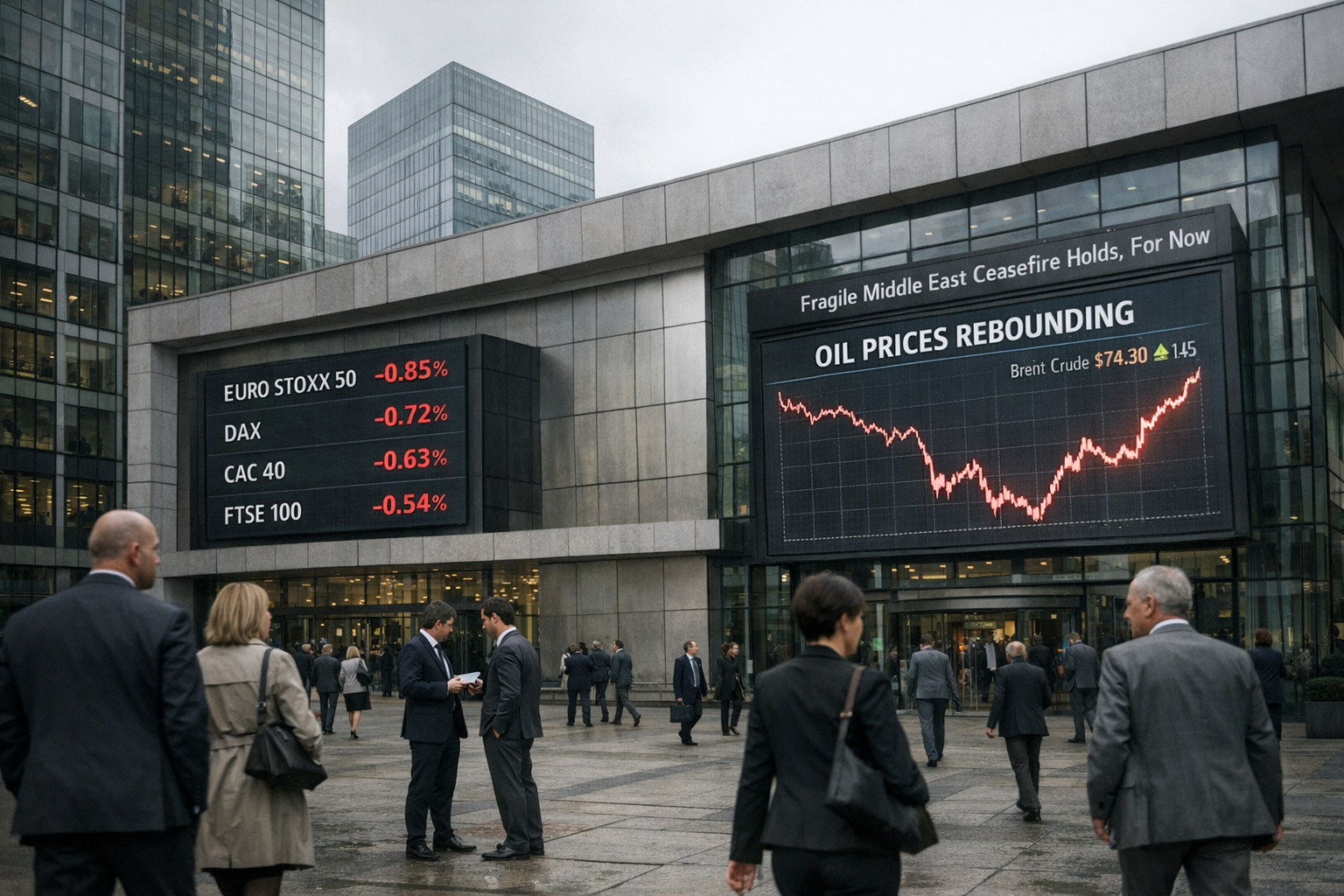
European stocks edged lower on Thursday, giving back a slice of the previous session’s powerful rally as investors began to question whether a newly announced ceasefire between the United States and Iran could survive its first serious strains.
The pan-European STOXX 600 was down about 0.2 percent by midday, with industrial shares among the weakest performers. The retreat followed a sharp relief rally on Wednesday, when European equities surged more than 3 percent in one of their strongest sessions in a year after news of the truce helped send oil prices tumbling.
That optimism appeared to be fading quickly. Crude prices rebounded on Thursday after the previous day’s steep drop, a sign that traders were again pricing in the possibility that tensions in the Middle East could flare anew and disrupt energy supplies.
The ceasefire, announced earlier this week, had been presented as a two-week pause meant to create room for diplomacy and reduce pressure on shipping lanes in the Gulf. For markets, the central issue has been the Strait of Hormuz, the narrow waterway through which a large share of the world’s oil passes. Any threat to traffic there can rapidly lift energy prices, stoke inflation fears and undermine the return of risk appetite that had briefly taken hold across global markets.
Investors had initially embraced the truce as a sign that the worst-case scenario — a drawn-out conflict involving damage to Gulf energy flows — might be avoided. That view helped propel stocks higher across Europe on Wednesday and eased fears of a renewed oil shock just as central banks are still struggling to bring inflation under control.
But the agreement has looked fragile almost from the outset. Market participants remain uncertain about whether all parties are aligned on the terms, whether related military actions elsewhere in the region fall within the scope of the deal and whether Iran will fully reopen, or continue to tightly manage, traffic through the Strait of Hormuz. Traders are also watching to see whether planned talks between Washington and Tehran actually take place and lead to something more durable than a temporary pause.
Those doubts matter well beyond the energy sector. Europe remains particularly sensitive to swings in oil and gas prices after years of grappling with inflation and supply disruptions. A renewed jump in crude could feed directly into transport and manufacturing costs, complicating the outlook for corporate earnings and for interest rates.
The market pullback on Thursday suggested that, for now, investors are unwilling to assume the geopolitical risk has passed. Relief, it seemed, had given way to a more familiar posture: cautious hope tempered by the recognition that in the Middle East, temporary calm can be quickly unsettled.