
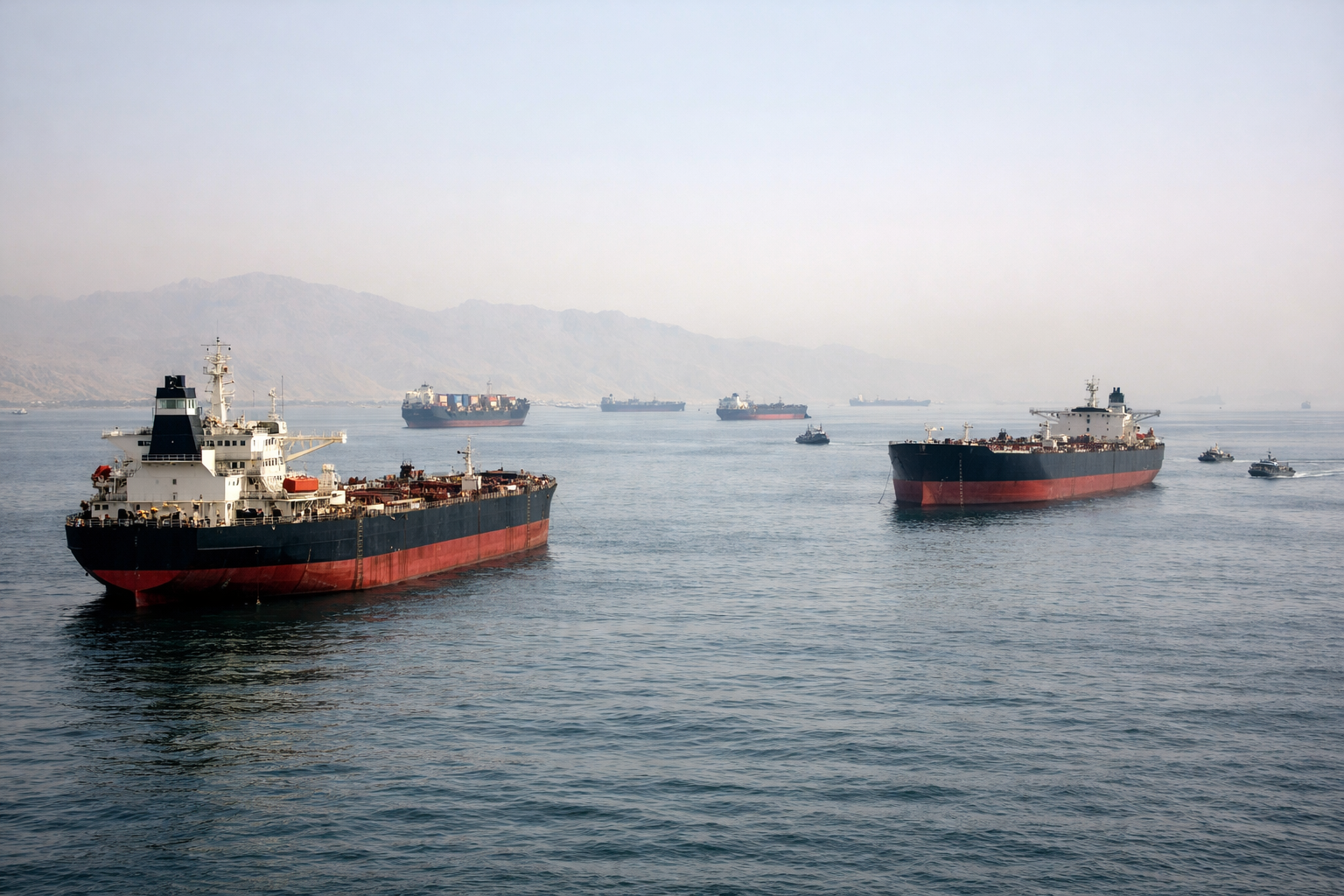
The two-week ceasefire between the United States and Iran was supposed to calm the world’s most important oil chokepoint. Instead, it has revealed how little a paper truce can do when tankers still are not moving freely, Saudi export routes are damaged and traders no longer believe that the Strait of Hormuz is truly open.
By Thursday, the agreement announced with fanfare on April 7 was already fraying. Iranian officials accused Washington of violating its terms. President Trump, while insisting that the United States was ready to enforce the deal, also warned that American forces would remain near Iran until a “real agreement” was honored. European governments, sensing both danger and opportunity, moved to reinforce the truce and press for unfettered shipping through Hormuz, including without tolls or other conditions.
But on the water, the reality was more sobering. Sultan Al Jaber, the head of Abu Dhabi’s state oil company, said plainly that the strait was “not open.” Passage, he suggested, remained contingent on Iranian permission and political leverage. Reports that Iran was considering charging ships to transit the waterway — possibly through cryptocurrency payments — underscored how far the situation remained from normal commerce.
That distinction has become the central fact of the crisis. A ceasefire may exist in diplomatic language, but the global economy is still responding to a disrupted shipping lane.
Oil Flows Still Constrained
Hormuz carries roughly a fifth of the world’s oil trade, making it one of the most consequential maritime corridors on earth. Even modest restrictions there can ripple quickly through energy markets, freight rates, inflation expectations and financial assets from Asia to Europe.
Traffic through the strait remains sharply reduced. Maritime reporting indicates that hundreds of loaded vessels are waiting and that around 20,000 seafarers remain stranded in the Gulf after weeks of danger and uncertainty. Some tanker crews have described conditions so unsafe that they would refuse to sail even if ordered to move.
The bottleneck has been worsened by damage beyond the strait itself. Saudi Arabia, which has sought to route more crude around Hormuz via its East-West pipeline, has also suffered attacks on key pipeline and production facilities. Those strikes have cut Saudi production capacity by about 600,000 barrels a day and reduced throughput on the bypass route by roughly 700,000 barrels a day, according to reporting on the disruption. In other words, even the alternatives to Hormuz have been weakened.
That helps explain why the oil market has remained unsettled even after the ceasefire announcement. Brent crude initially eased, then surged back as traders absorbed the practical reality that the shipping constraint had not been lifted. Spot prices moved above $120 a barrel in some trading, while benchmark prices pushed toward $100, reflecting fears that the disruption could last longer than diplomats had implied.
Markets Hear the Message
The unease was visible well beyond crude futures.
European stocks fell as investors weighed the fragility of the truce. In Asia, equity markets slipped and currencies came under renewed pressure, especially in economies heavily exposed to imported energy. Analysts in the region began drawing comparisons to earlier periods of oil-driven financial stress, including the Asian financial crisis of the late 1990s, though many argued that stronger reserves and more flexible exchange-rate systems should make a repeat less likely.
Bond markets also swung sharply. Government yields whipsawed as investors tried to reconcile sticky inflation data with the possibility of a prolonged energy shock. In the United States, Treasury yields hovered near recent highs, reflecting a market that now has to price both geopolitical risk and the prospect that higher oil prices could keep inflation elevated for longer than central bankers would like.
That concern is especially acute because the latest inflation readings in the United States were already stubborn before the ceasefire came under strain. A fresh oil spike would threaten to filter into transport, manufacturing and consumer prices just as the Federal Reserve is trying to judge whether price pressures are cooling.
Britain, Asia and Australia Feel the Squeeze
The immediate economic pain is spreading unevenly but widely.
In Britain, Prime Minister Keir Starmer has pointed directly to the Middle East crisis as a driver of higher energy costs, while London is preparing to argue that Hormuz must be reopened fully and kept toll-free. British officials also want the wider regional conflict — including fighting involving Lebanon — folded into any sustainable settlement, reflecting a growing recognition that flare-ups outside Iran’s borders can still determine whether the strait functions.
In Asia, the shock is landing hardest on import-dependent economies. India’s exporters are facing rising costs and renewed uncertainty. Across the region, policymakers are watching oil prices and shipping disruptions as closely as they are tracking the ceasefire itself.
Australia has offered one of the clearest pictures of the downstream impact. Fuel prices have surged, some service stations have run dry, reserve stocks have been tapped and road traffic in Sydney and Melbourne has dropped as households cut back on driving. Officials there have acknowledged that current shipping flows through Hormuz are far below what they would want to see.
A Ceasefire Entangled With a Wider War
Part of what makes the current truce so fragile is that it does not appear to stand on its own. Its viability is tied to a broader set of military and political disputes, including Israeli operations in Lebanon. Reports that Iran reclosed the channel after Israeli strikes there have reinforced the sense that Hormuz is now being used not simply as a bargaining chip in a U.S.-Iran standoff, but as leverage in a much wider regional confrontation.
That interconnection has drawn in other powers. Pakistan, which helped broker the current pause, is now hosting talks that diplomats hope can turn an emergency stopgap into something more durable. China is also seen as having played a role in nudging Tehran toward the ceasefire, enhancing Beijing’s image as an increasingly consequential diplomatic actor in the region.
For Europe, the crisis is reviving hard questions about maritime security, naval escorts and energy vulnerability. Officials have discussed ways to protect commercial shipping if diplomacy fails. But escort operations are politically sensitive and operationally complex, especially if Iran continues to insist on permit conditions or fees.
Why This Matters
What happens over the next several days may determine whether the world is facing a short-lived oil panic or the start of a deeper supply shock.
The most immediate test is whether talks scheduled for Saturday in Islamabad can produce terms that go beyond a temporary pause in fighting and address the mechanics of shipping: guaranteed passage, no tolls, no ad hoc permit system and credible assurances against attacks on tankers or infrastructure.
Until then, the market is treating the ceasefire as provisional in the most meaningful sense. Oil can be bought and sold on screens, but the global economy runs on whether cargoes can physically move. Right now, too many still cannot.
That is why the focus has shifted from declarations in capitals to conditions at sea. So long as Hormuz remains only partially accessible, and so long as Saudi bypass capacity is impaired, every new accusation of a ceasefire breach carries the potential to become a price spike, a supply shortage or a broader economic jolt.
The diplomatic achievement, such as it is, has bought time. It has not yet restored trust, trade or the passage of oil through the narrow waterway on which much of the world still depends.
Sources
Further reading and reporting used to add context:
- Strait of Hormuz remains all but closed, Trump demands Iran stop tolls
- https://apnews.com/article/e8af575b1ab8e82b46fb6ea4be1e185c
- European leaders seek to stabilize US-Israel ceasefire with Iran | AP News
- https://apnews.com/article/f2a2fafe3e1691b9f0be5e7d691a90d0
- https://apnews.com/article/54306933e129bf9a03ae620f87f5cde0
- https://www.axios.com/2026/04/07/oil-prices-plunge-us-iran-war-ceasefire-trump
- https://www.theguardian.com/business/2026/apr/09/oil-price-rises-as-markets-question-durability-of-middle-east-ceasefire-iran
- https://www.investing.com/analysis/brent-holds-risk-premium-as-hormuz-tanker-traffic-collapse-tests-supply-math-200676071
- https://en.wikipedia.org/wiki/2026_Iran_war_ceasefire
- https://thesoufancenter.org/intelbrief-2026-april-9/
- https://en.wikipedia.org/wiki/Economic_impact_of_the_2026_Iran_war
- https://en.wikipedia.org/wiki/2026_Strait_of_Hormuz_crisis
- https://www.riotimesonline.com/oil-brent-wti-inversion-hormuz-deadline-nfp/
- https://www.lloydslist.com/LL1156704/Second-ADNOC-tanker-transits-Strait-of-Hormuz-as-efforts-to-open-the-chokepoint-continue
- https://tankerbrief.com/briefs/2026-03-10-hormuz-day-10.html
- https://en.wikipedia.org/wiki/Operation_Muhafiz-ul-Bahr
- https://www.ad-hoc-news.de/boerse/ueberblick/brent-crude-surges-past-100-as-strait-of-hormuz-blockade-tightens-oil/68677067
- https://www.everbridge.com/wp-content/uploads/2026/03/Qatar_Warns_of_Major_Oil_Price_Spike_amid_Attacks_on_Gulf_Energy_Infrastructure_and_Shipping.pdf
- https://en.wikipedia.org/wiki/2026_Iran_war_fuel_crisis
- https://www.cnbc.com/2025/06/23/irans-parliament-approves-blocking-strait-of-hormuz.html
- https://www.cnbc.com/2025/06/24/oil-sheds-xxxx-as-iran-israel-ceasefire-eases-concerns-strait-of-hormuz-closure.html
- https://www.cnbc.com/2025/04/11/oil-prices-set-to-drop-for-a-second-week-as-us-china-trade-war-to-cut-demand.html
- https://www.cnbc.com/2025/03/20/oil-prices-rise-on-us-data-middle-east-tensions.html
- https://www.cnbc.com/2025/06/23/us-iran-crisis-shipping-groups-seen-avoiding-the-strait-of-hormuz.html
- https://www.cnbc.com/2025/06/22/oil-to-open-higher-as-us-strikes-on-iran-boost-supply-risk-premium.html
- https://www.cnbc.com/2025/06/17/oil-prices-rise-as-iran-israel-conflict-fans-supply-worries.html
- https://www.cnbc.com/2025/06/23/tankers-reversing-course-from-strait-of-hormuz-following-us-attack-on-iran-nuclear-sites.html
- https://www.cnbc.com/2025/04/21/oil-prices-fall-as-progress-in-us-iran-talks-eases-supply-concerns.html
- https://www.cnbc.com/2025/04/22/oil-prices-rise-with-equities-but-tariff-worries-persist.html
- https://www.cnbc.com/2025/06/25/oil-prices-today-israel-iran-trump-ceasefire.html
- https://www.cnbc.com/2025/06/20/brent-futures-down-nearly-2-after-us-delays-decision-on-direct-iran-involvement.html
- https://fm.cnbc.com/applications/cnbc.com/resources/editorialfiles/2012/05/03/2226650_goldman_sachs_superspike.pdf
- https://fm.cnbc.com/applications/cnbc.com/resources/editorialfiles/2025/07/17/Price_Gouging_Prevention_Act_of_2025.pdf
- https://fm.cnbc.com/applications/cnbc.com/resources/editorialfiles/2022/11/03/agletter.pdf
- https://fm.cnbc.com/applications/cnbc.com/resources/styles/skin/special-reports/pdfs/russian-active-measures.pdf
- https://fm.cnbc.com/applications/cnbc.com/resources/editorialfiles/2022/12/21/1671676058536-Gary_Wang_Plea_Agreement.pdf
- https://fm.cnbc.com/applications/cnbc.com/resources/editorialfiles/2012/05/03/2226560_052008Masters.pdf
- https://www.axios.com/2026/04/08/iran-ceasefire-oil-shipping-impact-prices
- https://www.lemonde.fr/en/economy/article/2026/03/09/oil-passes-100-a-barrel-following-strait-of-hormuz-blockage-and-middle-east-war_6751232_19.html
- https://apnews.com/article/24c4b439d2c6a5b571fea90e4d1227d8
- https://www.axios.com/2026/03/06/iran-bonds-inflation-treasuries
- https://newsquawk.com/headlines/newsquawk-us-market-wrap-stocks-surge-and-oil-tumbles-on-us-iran-ceasefire-08-04-2026
- https://www.icis.com/explore/resources/news/2026/04/08/11196067/tanker-traffic-through-strait-of-hormuz-halted-amid-israel-strikes-on-lebanon-fars
- https://markets.financialcontent.com/stocks/article/marketminute-2026-3-11-10-year-us-treasury-yield-climbs-to-419-as-inflation-fears-and-geopolitical-tensions-resurface
- https://www.bloomberg.com/news/articles/2026-03-05/treasury-yields-climb-to-three-week-high-as-inflation-fears-grow
- https://www.cnbc.com/2025/09/11/treasury-yields-inflation-data.html
- https://www.financialcontent.com/article/marketminute-2026-4-7-treasury-yields-climb-to-436-amid-geopolitical-uncertainty
- https://www.theguardian.com/world/2026/apr/08/middle-east-ceasefire-doubt-israel-lebanon-iran-oil-tankers/
- https://m.economictimes.com/news/international/us/rising-oil-prices-from-us-israel-and-iran-war-push-10-year-treasury-yield-above-4-what-it-means/amp_articleshow/128984133.cms
- https://uk.finance.yahoo.com/news/treasuries-rise-ceasefire-spurs-oil-013010676.html
- https://en.wikipedia.org/wiki/2026_Aramco_refinery_attack
- https://en.wikipedia.org/wiki/2026_Kharg_Island_attack
- https://www.justsecurity.org/135952/early-edition-april-9-2026/
- https://saudigazette.com.sa/article/659320/saudi-arabia/opec-agrees-to-raise-oil-output-by-206000-bpd-from-april
- https://apnews.com/article/21e634acba4c35801d28dfdbcc53824a
- https://saudigazette.com.sa/article/660268
- https://apnews.com/article/cb7fb9eb8d96c5f460e2876e4c108dcc
- https://apnews.com/article/7e3a7a4b86e966ba9b609e23825e4ccc
- https://www.bloomberg.com/news/articles/2026-03-11/saudi-arabia-ramped-up-oil-output-before-war-opec-data-show
- https://www.ksat.com/business/2025/03/04/saudi-oil-giant-aramco-reports-106-billion-profit-in-2024-down-12-on-lower-energy-prices/
- https://www.ksat.com/business/2026/03/01/opec-boosts-oil-production-after-attacks-on-iran-and-throughout-region/
- https://en.wikipedia.org/wiki/2026_South_Pars_field_attack
- https://www.aljazeera.com/news/2026/4/5/opec-agrees-to-hike-oil-output-warns-of-slow-recovery-after-attacks
- https://www.bloomberg.com/news/newsletters/2025-07-11/saudis-in-rare-opec-breach-by-lifting-oil-output-above-quota
- https://en.wikipedia.org/wiki/Abqaiq%E2%80%93Khurais_attack
- https://www.bloomberg.com/news/articles/2025-07-11/saudis-surged-oil-output-far-above-opec-quota-in-june-iea-says
- https://sg.finance.yahoo.com/news/opec-confirms-206k-barrel-day-051429153.html
- https://www.spglobal.com/energy/en/news-research/latest-news/crude-oil/011325-opec-cut-tapering-to-create-101-million-bd-oil-surplus-in-2026-saudi-think-tank
- https://www.tbsnews.net/world/iran-struck-saudi-arabia-oil-pipeline-just-hours-after-ceasefire-source-says-1406581
- https://apnews.com/article/72e8c9a29c2ba1fd761ee968f3d4e553
- https://www.huandroid.com/en/saudi-pipeline-247-million/
- https://houseofsaud.com/saudi-east-west-pipeline-full-capacity/
- https://finance.yahoo.com/sectors/energy/articles/saudi-oil-pipeline-damage-said-145726216.html
- https://enterpriseam.com/ksa/2026/03/29/this-morning-east-west-pipeline-reaches-full-7mn-bbl-d-capacity/
- https://www.reddit.com/r/oil/comments/1sgzxin/saudi_arabia_says_attacks_on_oil_facilities_have/
- https://za.investing.com/news/commodities-news/attacks-cut-saudi-oil-output-and-eastwest-pipeline-flow-state-news-agency-says-4205430
- https://www.albawaba.com/news/suspected-strikes-hit-saudi-red-sea-1625188
- https://pecosoperating.com/energy-under-siege/
- https://www.thenationalnews.com/business/energy/2026/03/02/iran-attacks-saudi-oil-qatar-gas//
- https://www.rbccm.com/en/insights/2026/03/middle-east-energy-crisis-stranded-assets
- https://www.reddit.com/r/Polymarket/comments/1sh00n7/saudi_arabia_oil_production_capacity_reduced_by/
- https://apnews.com/article/4b464b08aaf7220899526c0c6da4317d
- https://www.dawn.com/news/1985281/about-2000-vessels-20000-seafarers-stranded-in-strait-of-hormuz-imo-chief
- https://www.imo.org/en/MediaCentre/PressBriefings/pages/IMO-secretary-general-statement-strait-of-hormuz-seafarer-deaths-unacceptable.aspx
- https://www.imo.org/en/MediaCentre/PressBriefings/pages/IMO-calls-for-safe-passage-framework-in-Strait-of-Hormuz.aspx
- https://www.reutersconnect.com/item/maritime-industry-concerned-for-over-20000-seafarers-stranded-near-the-strait-of-hormuz/dGFnOnJldXRlcnMuY29tLDIwMjY6bmV3c21sX01UMUFOQURMMDAwWDBaR1VQ
- https://www.imo.org/en/MediaCentre/PressBriefings/pages/Fragmented-responses-are-no-longer-sufficient-IMO-SG-Strait-of-Hormuz.aspx
- https://www.ungeneva.org/en/news-media/news/2026/03/117257/no-precedent-seafarers-caught-war-zone-post-ww2-era
- https://apnews.com/article/82a9acb473837f1bf7a821d0c3f95205
- https://www.thenationalnews.com/news/mena/2026/03/05/un-warns-20000-sailors-and-thousands-of-cruise-passengers-stuck-in-arabian-gulf//
- https://www.thecatholictelegraph.com/apostleship-of-the-sea-20000-sailors-stranded-near-strait-of-hormuz-living-in-constant-anguish/106275
- https://ifsma.org/strait-of-hormuz-crisis-puts-seafarers-on-the-front-line-of-escalating-gulf-conflict/
- https://www.investing.com/news/analyst-ratings/bofa-says-oil-market-tightens-despite-ceasefire-on-tanker-traffic-93CH-4602494
- https://sana.sy/en/international/2307257/
- https://windward.ai/blog/march-9-maritime-intelligence-daily/
- https://en.wikipedia.org/wiki/Operation_Sankalp
- Attacks cut Saudi oil output and East-West pipeline flow, state news agency says By Reuters