
Islamabad Becomes the Center of a Fragile Peace Effort
Pakistan was moving ahead on Friday with plans to host high-stakes talks between the United States and Iran in Islamabad, pressing forward with the first face-to-face diplomatic test of a two-week ceasefire that halted six weeks of war but has already come under severe strain.
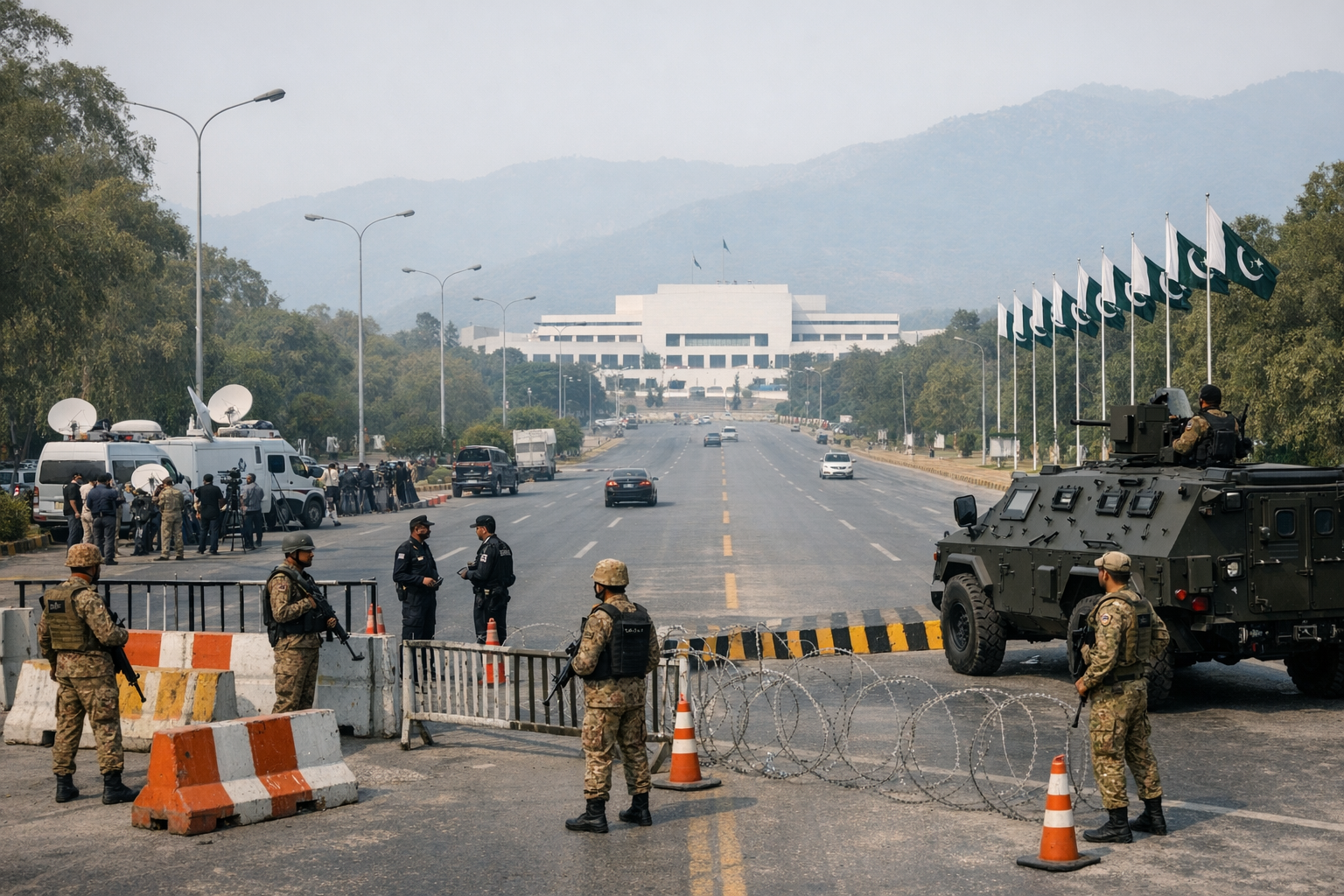
The streets of the Pakistani capital were under tight security, with the army deployed and much of the city effectively sealed off, underscoring both the symbolic weight and the political risk of the moment. Pakistani officials said the negotiations would proceed despite widening doubts over whether the truce announced earlier this week can survive continued fighting elsewhere in the region.
That uncertainty has been driven above all by Lebanon, where Israel and Hezbollah have kept up major exchanges even after the U.S.-Iran ceasefire was announced. Israeli officials have made clear they do not regard the truce as applying to Lebanon, and Prime Minister Benjamin Netanyahu has said Israel will continue striking Hezbollah. Those operations have become the clearest sign that the ceasefire may be less a regional settlement than a narrow pause between Washington and Tehran.
For Pakistan, the talks amount to its most consequential diplomatic intervention in years. For the region, they may determine whether the war’s current pause can be turned into a broader political process — or whether it collapses into another round of escalation that could again threaten shipping through the Strait of Hormuz and unsettle global energy markets.
A Truce With Unsettled Terms
The ceasefire emerged only after weeks of war, failed intermediary efforts and last-minute diplomacy. An earlier U.S. proposal transmitted through Pakistan had faltered. Iran then offered its own 10-point framework, which President Trump described as a workable basis for negotiation.
But even before delegates arrived in Islamabad, basic questions remained unresolved: whether Washington and Tehran were working from the same understanding of the deal, how any commitments would be sequenced, and what exactly Iran’s proposal requires on nuclear restrictions, sanctions relief, military deployments and maritime access.
The most immediate practical dispute concerns the Strait of Hormuz, the vital shipping lane through which a large share of the world’s oil and gas passes. Reopening the strait was central to the truce, yet officials and allies have offered conflicting accounts of whether Iran intends to demand fees or other conditions for safe passage. The White House has said its priority is reopening the waterway without limitations, while some European officials have argued that any arrangement must preserve free navigation.
That matters far beyond the Gulf. Even a temporary disruption in Hormuz can send tremors through oil markets, deepen inflation pressures and sharpen anxieties in import-dependent economies already strained by previous energy shocks.
Lebanon Complicates the Diplomatic Math
The most serious threat to the Islamabad process may lie outside the U.S.-Iran channel itself. Israeli strikes in Lebanon intensified after the truce announcement, and Hezbollah responded with rocket fire, exposing a core ambiguity that diplomats have yet to bridge: the scope of the ceasefire.
Pakistan and Iranian officials have at times spoken in terms suggesting a broader de-escalation. Israel has rejected that interpretation. The result is a diplomatic contradiction at the heart of the current moment — a ceasefire celebrated as a step away from regional war, even as one of the region’s most combustible fronts remains active.
That contradiction could prove decisive in Islamabad. If fighting in Lebanon worsens, Iran may harden its position on other issues, including Hormuz, sanctions and military posture. It may also deepen skepticism in Tehran about the value of making concessions while Israeli operations continue nearby.
The Trump administration has signaled that it wants to preserve the opening. The president said U.S. forces would remain near Iran until a “real agreement” was honored, coupling support for diplomacy with an unmistakable warning that military pressure had not disappeared. At the same time, Washington has indicated that talks involving Israel and Lebanon could take place next week, suggesting a parallel attempt to prevent the Lebanese front from overwhelming the broader negotiation.
Pakistan’s Opening, China’s Advantage
Pakistan’s role in securing the ceasefire has elevated its standing at a moment when middle powers are competing to show they can deliver diplomatic results in a fractured region. For Prime Minister Shehbaz Sharif’s government, the talks represent an opportunity to convert emergency mediation into a more durable role as an intermediary between antagonists that have little direct trust.
Islamabad’s leverage stems partly from geography and partly from necessity. A wider war next door would carry obvious risks for Pakistan’s economy, domestic stability and border security. The government had strong incentives to stop the fighting, but its success also reflects a broader vacuum: traditional Western-led diplomacy has struggled to contain regional crises, leaving space for other actors.
Among them, China may be the biggest strategic beneficiary. Beijing has been widely credited with nudging Tehran toward accepting the ceasefire, reinforcing a pattern in which China has sought to present itself as a pragmatic broker in the Middle East. For Beijing, even limited success carries outsized geopolitical value. It allows Chinese officials to argue that they can stabilize crises while Washington remains tied to military coercion and alliance politics.
That message resonates in Gulf capitals, where governments are increasingly trying to diversify their partnerships rather than rely exclusively on the United States.
Gulf States Reassess the Old Security Model
The war has also exposed the vulnerability of Gulf Arab states, many of which found themselves endangered by a conflict they did not control. American bases on their territory made them potential targets as Iran retaliated against U.S. and Israeli attacks, reviving an old regional dilemma: the very security arrangements meant to protect Gulf monarchies can also draw them into confrontation.
As a result, Gulf governments are reassessing their posture. Even if the ceasefire holds, officials across the region are likely to seek a broader mix of security partners while trying to protect economic modernization plans from future shocks. The calculation is increasingly less about choosing between Washington and its rivals than about insulating themselves from the consequences of great-power and regional conflict.
That shift helps explain why the Islamabad talks matter beyond the immediate bargaining between the United States and Iran. The negotiations are becoming a measure of whether the region can build a more stable framework — one that addresses not only nuclear and military questions, but also maritime security, proxy conflict and the limits of deterrence.
The First Test Comes Now
For now, the talks in Islamabad are best understood not as a breakthrough, but as a narrow opening surrounded by unresolved disputes. The ceasefire has stopped, at least temporarily, the direct U.S.-Iran fighting that threatened to spiral into a wider war. But it has not settled the terms of peace, clarified the relationship between the various fronts of the conflict, or answered who can enforce any agreement that emerges.
The immediate question is whether Pakistan can preserve enough momentum to keep Washington and Tehran engaged while violence in Lebanon continues and pressure mounts from regional actors with different priorities. The broader one is whether this pause can become the start of a political settlement, rather than a brief interval before a more dangerous confrontation.
In Islamabad, diplomacy is getting its chance. It is doing so, however, under the shadow of a war that has not fully stopped.
Sources
Further reading and reporting used to add context:
- https://apnews.com/article/46a82d3758b7d0df9ac6df7bd18f936a
- https://apnews.com/article/995a8b2126eef9949beae3066715ce60
- https://www.axios.com/2026/04/09/israel-lebanon-negotiations-ceasefire
- https://apnews.com/article/7760f88f183ed2a13a721057e31f3ce7
- https://apnews.com/article/9402965418687c634d4a157c966ec6ea
- https://www.axios.com/2026/04/07/iran-2-week-ceasfire-trump-pakistan
- https://www.theguardian.com/world/2026/apr/10/islamabad-pakistan-negotiations-iran-us
- https://www.aljazeera.com/news/2026/4/8/iran-says-talks-with-us-will-begin-in-pakistans-islamabad-on-friday
- https://www.aljazeera.com/news/2026/4/9/us-iran-talks-in-pakistan-whos-attending-whats-on-the-agenda
- https://www.theguardian.com/world/2026/apr/08/pakistan-us-israel-iran-ceasefire
- https://www.aljazeera.com/news/2026/4/9/israeli-attacks-on-lebanon-aimed-to-undermine-ceasefire-critics-say
- https://www.aljazeera.com/news/2026/4/2/pakistan-to-continue-with-iran-us-mediation-despite-obstacles
- https://www.aljazeera.com/features/2026/4/8/how-pakistan-managed-to-get-the-us-and-iran-to-a-ceasefire
- https://www.theguardian.com/world/2026/mar/31/pakistan-china-propose-five-part-peace-plan-middle-east
- https://www.dawn.com/news/1990069
- https://www.aljazeera.com/news/2026/4/8/world-reacts-to-brutal-israeli-attacks-on-lebanon-amid-us-iran-ceasefire
- https://www.aljazeera.com/opinions/2026/3/11/the-israel-hezbollah-ceasefire-was-built-to-fail
- https://en.wikipedia.org/wiki/United_Nations_Security_Council_Resolution_2817
- https://www.thenationalnews.com/news/gulf/2026/03/25/iran-war-spurs-gulf-towards-collective-deterrence/
- https://apnews.com/article/54306933e129bf9a03ae620f87f5cde0
- https://apnews.com/article/421ee64fdc9a5c26460df8119c7d1b3f
- https://www.axios.com/2026/04/06/iran-trump-peace-plan-ceasefire
- https://www.axios.com/2026/04/08/iran-ceasefire-questions-strait-lebanon
- https://www.whitehouse.gov/releases/2026/04/peace-through-strength-operation-epic-fury-crushes-iranian-threat-as-ceasefire-takes-hold/
- https://www.whitehouse.gov/releases/2026/03/peace-through-strength-president-trump-launches-operation-epic-fury-to-crush-iranian-regime-end-nuclear-threat/
- https://www.radio.gov.pk/08-04-2026/us-iran-agree-to-immediate-ceasefire-prime-minister
- https://apnews.com/article/be07c54139bcc70672bb33f0773ede6a
- https://apnews.com/article/26caaef651be1cb4d482b29adaa2d600
- https://www.radio.gov.pk/03-02-2026/pakistan-invited-to-participate-in-usiran-talks-in-turkiye-fo
- https://www.radio.gov.pk/02-04-2026/iran-us-express-confidence-in-pakistan-for-talks-fo
- https://en.dailypakistan.com.pk/08-Apr-2026/heres-irans-10-point-agenda-now-for-talks-with-us-in-pakistan
- https://pid.gov.pk/site/press_detail/32250
- https://www.iranintl.com/en/202603255820
- https://tribune.com.pk/story/2599196/pakistan-delivered-us-proposal-to-iran-senior-iranian-source-tells-reuters
- https://www.radio.gov.pk/currentaffairs/08-04-2026/pakistans-successful-diplomacy-us-suspends-attacks-on-iran
- https://en.wikipedia.org/wiki/2026_Iran_war_ceasefire
- https://en.wikipedia.org/wiki/2026_Iran_war
- https://www.whitehouse.gov/wp-content/uploads/2026/03/SAP-SJR104.pdf
- https://en.wikipedia.org/wiki/2026_attack_on_the_United_States_consulate_in_Karachi
- https://en.wikipedia.org/wiki/2025%E2%80%932026_Iran%E2%80%93United_States_negotiations
- https://www.na.gov.pk/uploads/documents/696e1dfd13190_929.pdf
- https://de.wikipedia.org/wiki/Verlauf_des_Irankrieges_2026
- Islamabad prepares to host historic negotiations between Iran and the US | US-Israel war on Iran | The Guardian
- What to know about the ongoing war between Israel and Hezbollah in Lebanon
- Peace Through Strength: Operation Epic Fury Crushes Iranian Threat as Ceasefire Takes Hold – The White House
- How Pakistan secured ‘biggest diplomatic win in years’ with Iran ceasefire | US-Israel war on Iran | The Guardian
- Iran rejects US ceasefire plan, issues its own demands as strikes land across the Mideast
- How Pakistan managed to get the US and Iran to a ceasefire | US-Israel war on Iran | Al Jazeera
- The Latest: Iran says it has accepted a 2-week ceasefire in the war
- Netanyahu announces negotiations with Lebanon after U.S. pressure