
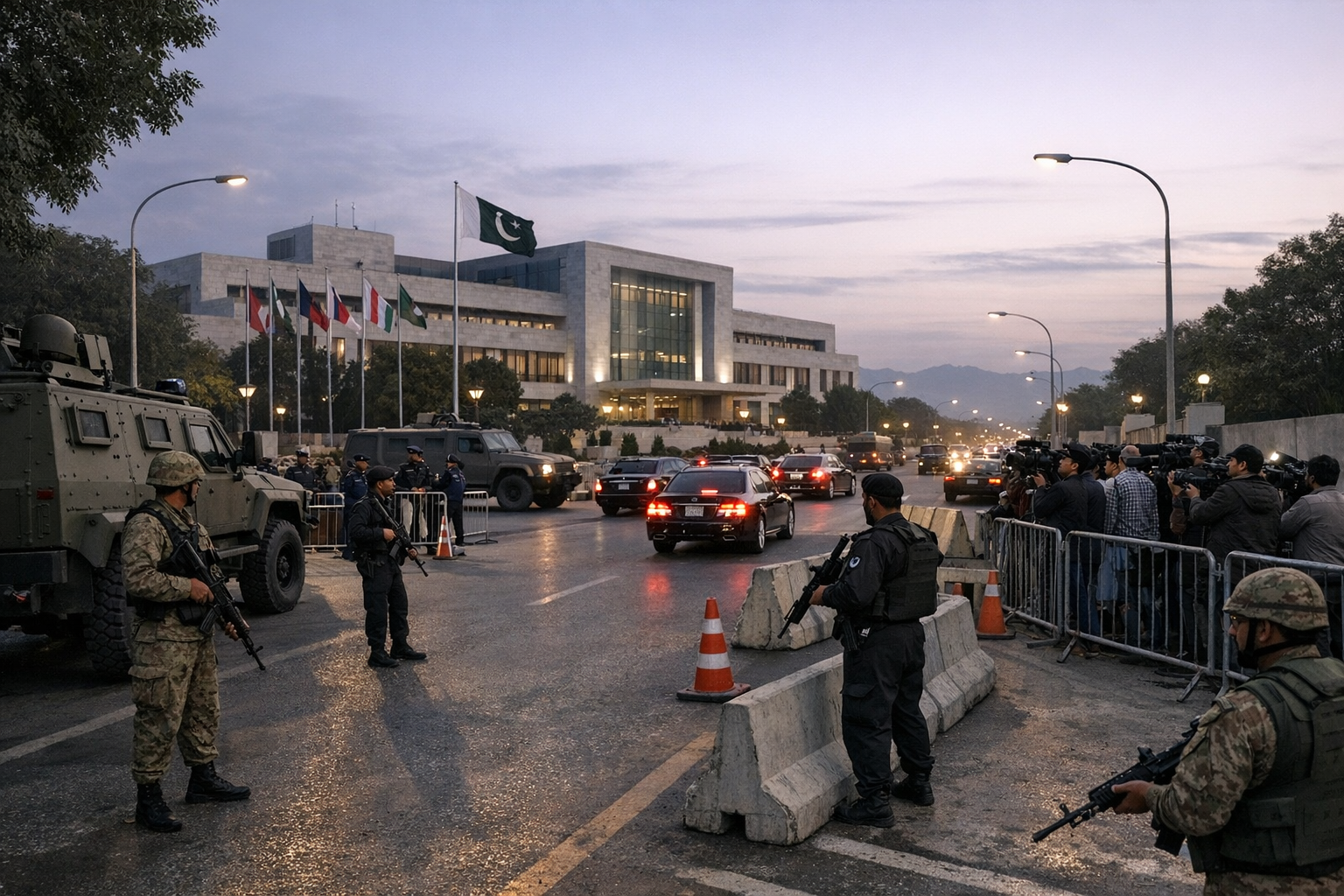
The ceasefire that halted six weeks of fighting between the United States and Iran was meant to open a path to wider diplomacy. Instead, as negotiators prepared to gather in Islamabad this weekend, it was already being tested on several fronts.
Pakistan, which helped broker the two-week truce announced on April 8, has put its capital under heavy security, deploying troops, restricting movement and pressing ahead with plans to host what officials there have cast as make-or-break talks. But even before the meetings begin, the parties most central to the crisis are offering competing accounts of what, exactly, the ceasefire covers — and whether it can survive the violence still unfolding elsewhere in the region.
At the center of the dispute is Lebanon.
Israel has continued striking Hezbollah positions, with Prime Minister Benjamin Netanyahu declaring there is “no ceasefire in Lebanon” and vowing to keep attacking the Iranian-backed militia “with full force.” Hezbollah, in turn, has kept up rocket fire. The fighting has underscored the fragility of an agreement that, while nominally between Washington and Tehran, was always shadowed by the question of whether Iran’s regional allies and partners would be included in any broader de-escalation.
That ambiguity now threatens to overtake the diplomacy itself.
President Trump, who has alternated between claiming success for the truce and warning that American forces would remain poised near Iran until a “real agreement” was honored, has suggested the ceasefire is contingent on more than a simple halt in direct hostilities. Tehran, for its part, has signaled that any durable arrangement would have to address the wider regional conflict and the terms of maritime access through the Strait of Hormuz, the narrow waterway through which a large share of the world’s oil and liquefied natural gas passes.
A pause, not yet a settlement
For now, the ceasefire remains in place in the narrowest sense: the threatened escalation between Washington and Tehran has been suspended. But diplomats and analysts across the region say the truce has not yet matured into a political framework capable of containing the multiple flashpoints orbiting it.
Iran’s negotiating position has been shaped by a 10-point proposal that formed the basis of the current pause. While full details remain contested, the broad outlines point to an Iranian effort to turn an emergency ceasefire into a structured negotiation over military restraint, sanctions pressure and regional security. American officials have publicly narrowed their emphasis to one urgent demand: the reopening of the Strait of Hormuz without tolls, fees or other restrictions.
That disagreement is not a technical side issue. It is one of the clearest signs that the parties are still far apart.
Iran has floated the idea of imposing charges or conditions on shipping through the strait, while the White House has insisted that passage must resume freely. Mr. Trump has at times muddied the message, even suggesting a joint U.S.-Iran arrangement around toll collection, only to have administration officials restate that unrestricted navigation is the priority.
Markets have, at least for the moment, taken the ceasefire as reason for relief. But the underlying vulnerability remains. Even limited interference in Hormuz can reverberate through energy prices, insurance costs and shipping routes far beyond the Gulf. For Gulf Arab states already rattled by the war and by Iran’s demonstrated ability to threaten nearby American bases, the issue has become part of a larger reassessment of how much security can still be outsourced to Washington.
Pakistan’s unexpected diplomatic role
That the next round of talks is taking place in Pakistan reflects one of the war’s more surprising consequences. Islamabad, long more associated with managing its own political and economic crises, has emerged as the principal intermediary between Washington and Tehran after weeks of intensive shuttle diplomacy.
Pakistani officials have described the ceasefire as one of the country’s biggest diplomatic achievements in years, the product of repeated calls, back-channel outreach and coordination with other regional players. The effort appears to have drawn on Pakistan’s ties across rival camps: its border and working relationship with Iran, its longstanding security connections with the United States, and its interest in preventing a wider regional war that could send economic and political shock waves across South Asia.
The stakes for Pakistan are not abstract. A deeper conflict threatened to upend trade, drive up energy costs and inject new instability into a region already under strain. Hosting the talks also gives Islamabad a chance to present itself as a credible broker at a moment when middle powers are increasingly trying to shape outcomes once left to Washington alone.
Yet Pakistan’s rise as mediator also highlights how crowded the diplomatic field has become.
China is widely seen as having encouraged Tehran to accept the ceasefire, reinforcing Beijing’s growing ambition to be viewed as a stabilizing force in the Middle East. Gulf states, too, are expected to hover around the Islamabad process, mindful that any agreement affecting Iran’s missile posture, maritime access or proxy networks will bear directly on their own security. The result is a negotiation shaped not only by the combatants, but by an expanding ring of outside powers seeking influence over what comes next.
Lebanon’s war intrudes
No issue better captures the limits of the current truce than Lebanon.
British officials have argued that Lebanon should be included in any ceasefire arrangement, and Prime Minister Keir Starmer said this week that Israel’s attacks there “shouldn’t be happening.” But Israel’s position has been explicit: whatever understandings were reached over Iran do not constrain its campaign against Hezbollah.
That distinction may be sustainable in Israeli political terms, but it is far harder to maintain diplomatically. Hezbollah is Iran’s most important regional ally, and Israeli strikes in Lebanon risk being interpreted in Tehran not as a separate theater, but as an extension of the same conflict the ceasefire was supposed to pause.
There are tentative signs of parallel diplomacy. A U.S. official said Israel and Lebanon are expected to hold talks in Washington next week, with discussions focused on Hezbollah and future security arrangements. Netanyahu has also ordered ministers to seek direct talks with Lebanon. But those contacts remain preliminary, and they come amid continuing exchanges of fire, not a settled calm.
Whether Lebanon is formally folded into the wider negotiations may now determine whether the Islamabad process can produce anything more durable than a countdown to the ceasefire’s expiration.
What happens in Islamabad
The immediate question is whether the weekend meetings can transform a short truce into agreed terms that all sides can claim to understand — and to some extent, to own.
That would require progress on at least three fronts: defining the ceasefire’s geographic and political scope; resolving, or at least shelving, the fight over Hormuz; and creating some mechanism to prevent events in Lebanon from collapsing the talks.
None of those tasks looks easy.
Washington wants proof that Iran will not use the pause to preserve leverage over shipping lanes or regroup militarily. Iran wants assurance that the ceasefire will not become a one-sided demand for restraint while Israel continues operations against its allies. Israel, meanwhile, appears intent on preserving freedom of action in Lebanon even as it leaves open the prospect of separate security talks.
For now, the ceasefire exists in that uneasy space between diplomacy and war: real enough to halt a wider conflagration, but not yet robust enough to contain the region’s overlapping conflicts.
That is why the Islamabad meetings matter beyond the immediate combatants. They will show whether a truce brokered in haste can evolve into a broader regional de-escalation — or whether the Middle East is merely passing through a brief intermission before the next rupture.
Sources
Further reading and reporting used to add context:
- https://www.axios.com/2026/04/09/israel-lebanon-negotiations-ceasefire
- https://apnews.com/article/995a8b2126eef9949beae3066715ce60
- https://apnews.com/article/46a82d3758b7d0df9ac6df7bd18f936a
- https://www.thedailybeast.com/us-admiral-trolls-trump-for-aya-toll-booth-funding-iran/
- https://www.axios.com/2026/04/09/iran-us-strait-of-hormuz-khamenei
- https://apnews.com/article/5c49b81c89bc694207db8e07ceba70ea
- https://www.theguardian.com/world/2026/apr/10/islamabad-pakistan-negotiations-iran-us
- https://www.theguardian.com/world/2026/apr/09/israel-bombing-lebanon-us-iran-ceasefire-condemnation/
- https://www.aljazeera.com/news/2026/4/8/netanyahu-says-us-iran-ceasefire-does-not-include-lebanon
- https://www.aljazeera.com/news/2026/4/8/iran-says-talks-with-us-will-begin-in-pakistans-islamabad-on-friday
- https://www.aljazeera.com/news/2026/4/9/us-iran-talks-in-pakistan-whos-attending-whats-on-the-agenda
- https://www.washingtonpost.com/world/2026/04/09/lebanon-beirut-attack-israel-hezbollah-ceasefire//
- https://www.aa.com.tr/en/middle-east/iran-limits-hormuz-shipping-demands-tolls-under-ceasefire-report/3898760
- https://rtvonline.com/english/international/usa/273592
- https://www.investing.com/news/world-news/iran-us-receive-plan-to-end-hostilities-immediate-ceasefire-source-says-4597767
- https://en.wikipedia.org/wiki/2026_Iran_war_ceasefire
- https://www.aljazeera.com/amp/news/2026/4/9/israels-netanyahu-ready-for-talks-with-lebanon-as-soon-as-possible
- https://www.ndtv.com/world-news/iran-us-ceasefire-no-tolls-can-be-imposed-for-crossing-hormuz-oman-contradicts-irans-demand-11328149?pfrom=home-ndtvworld_
- https://www.aljazeera.com/features/2026/4/8/how-pakistan-managed-to-get-the-us-and-iran-to-a-ceasefire
- https://www.reddit.com/r/WhatTrumpHasDone/comments/1sgu2h7/netanyahu_announces_negotiations_with_lebanon/
- https://apnews.com/article/7760f88f183ed2a13a721057e31f3ce7
- https://apnews.com/article/9402965418687c634d4a157c966ec6ea
- https://www.dawn.com/news/1990069
- https://www.aljazeera.com/news/2026/3/27/us-diplomat-marco-rubio-denounces-settler-violence-tolls-in-hormuz-strait
- https://www.arabnews.com/node/2635992/middle-east
- https://www.pakistantoday.com.pk/2026/04/09/politicians-laud-pakistans-diplomacy-in-us-iran-ceasefire//
- https://www.aljazeera.com/news/2026/4/2/pakistan-to-continue-with-iran-us-mediation-despite-obstacles
- https://www.washingtonpost.com/business/2026/04/08/iran-us-israel-trump-lebanon-april-8-2026/ef5e454a-3301-11f1-b85b-2cd751275c1d_story.html
- https://en.wikipedia.org/wiki/Operation_Muhafiz-ul-Bahr
- https://www.cbsnews.com/news/lebanon-israel-ceasefire-talks-us-washington/
- Islamabad prepares to host historic negotiations between Iran and the US | US-Israel war on Iran | The Guardian
- Netanyahu announces negotiations with Lebanon after U.S. pressure