
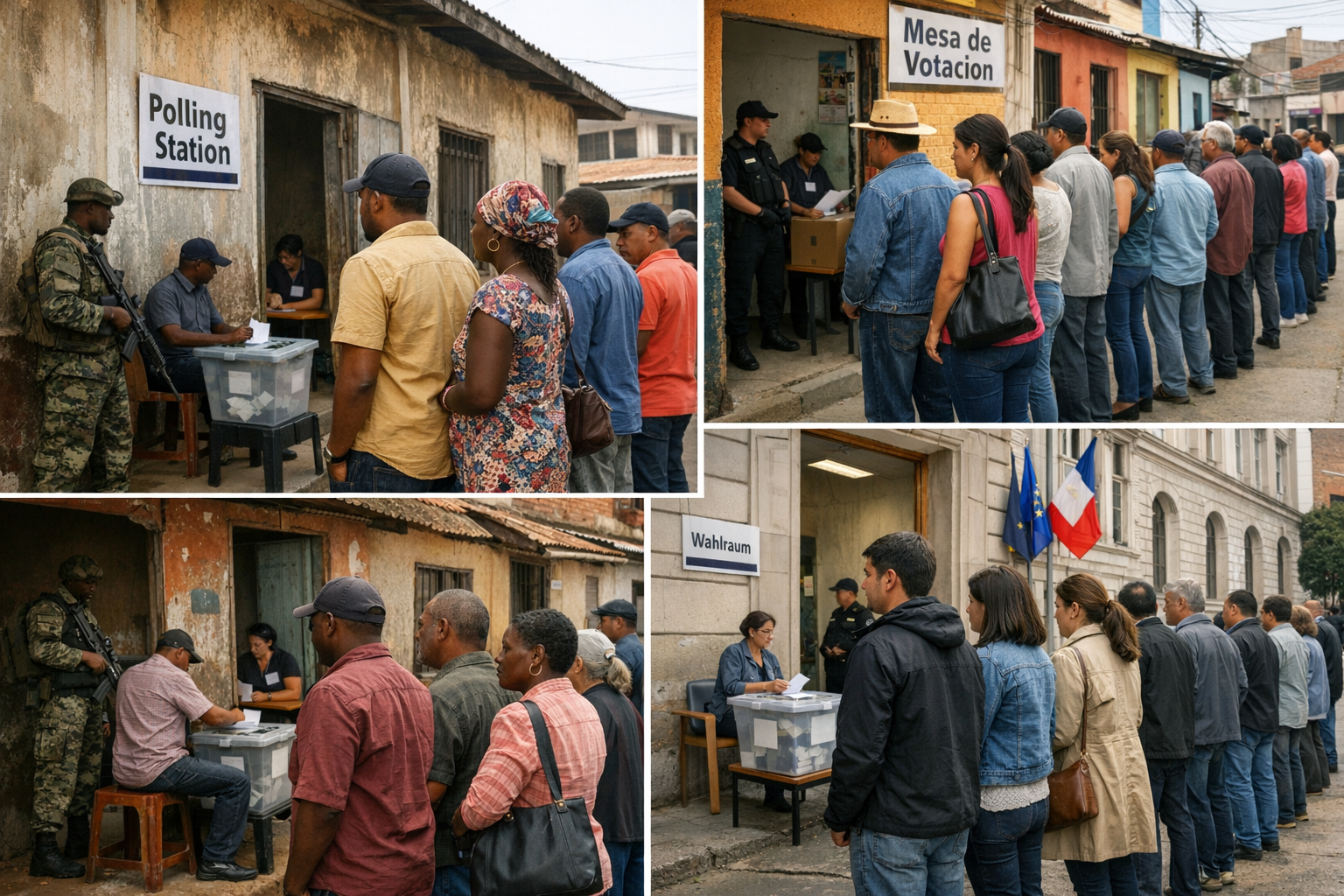
Three Elections, Three Tests of Democratic Resilience
Voters in Benin, Peru and Hungary went to the polls on Sunday in elections that, despite unfolding on different continents and under very different circumstances, shared a common theme: each was a test of whether political systems under strain can still deliver legitimacy, stability and peaceful change.
In Benin, the central question was succession after a decade under President Patrice Talon and a failed coup attempt just months ago. In Peru, it was whether a country battered by institutional breakdown, corruption scandals and rising crime could begin to escape a seemingly endless cycle of upheaval. In Hungary, it was whether Prime Minister Viktor Orbán, Europe’s longest-serving leader, could be unseated after 16 years in power by the strongest opposition challenge he has faced in more than a decade.
Taken together, the elections underscored how the mechanics of voting alone do not settle a deeper issue confronting democracies around the world: whether citizens believe the political system is open enough, fair enough and functional enough to reflect their will.
Benin’s Managed Succession
In Benin, the presidential vote came only four months after a thwarted coup attempt, lending unusual sensitivity to an election that otherwise appeared heavily tilted toward continuity.
Mr. Talon, a businessman-turned-president who has led the West African country since 2016, is barred from seeking another term after serving two five-year mandates. But while the ballot formally opens the way to a new president, the outcome has been widely seen as likely to preserve the existing order. Romuald Wadagni, the finance minister, entered the race as the clear favorite, backed by a political landscape that has narrowed sharply under Mr. Talon’s rule.
That narrowing was reinforced in January, when parliamentary elections left parties allied with the president controlling all 109 seats. Opposition forces failed to clear the threshold needed for representation, a result that deepened concerns among critics who say Benin, once regarded as one of West Africa’s more pluralistic democracies, has grown less competitive.
The question on Sunday was therefore not only who would win, but whether the process would be regarded as credible. For Benin’s supporters abroad and citizens at home, the election is a measure of whether a leadership transition can occur peacefully after the coup scare — and whether an orderly handover can ease tensions or simply mask a more constrained political arena.
That matters beyond Benin. West Africa has been shaken in recent years by coups, attempted coups and democratic backsliding. In that regional context, even a procedurally calm election can carry broader significance as a signal of whether constitutional succession still commands confidence.
Peru’s Search for a Way Out of Turmoil
If Benin’s vote looked like a controlled transition, Peru’s looked more like a cry of frustration from a country that has cycled through leaders with dizzying speed.
Peruvians voted for a president and a newly bicameral Congress in a race defined by fragmentation and distrust. About 27 million eligible voters were confronted with a field of 35 presidential candidates, an extraordinary number even by Peru’s often chaotic standards, along with a sprawling ballot for the country’s restored Senate and Chamber of Deputies.
The scale of the ballot reflected a deeper political disorder. Peru has had roughly nine presidents in 10 years, a period marked by impeachment battles, resignations, corruption investigations and recurring confrontations between the executive and legislature. That institutional churn has fed public exhaustion and weakened faith in nearly every major political actor.
At the same time, concerns over insecurity have mounted. Violent crime and organized criminal activity have become major voter anxieties, compounding long-running anger over graft and state dysfunction. The election unfolded in a country where many citizens are not so much choosing among inspiring alternatives as hoping, however skeptically, for a government capable of lasting.
Yet even before any votes are counted, Peru’s political math suggests more uncertainty ahead. With such a fractured field, a runoff appears likely. And beyond that lies the harder question: whether any eventual president can govern effectively in a system where public trust is low and Congress has often been a source of paralysis rather than stability.
The restoration of a bicameral legislature is intended in part to improve institutional balance. But structural redesign alone may not resolve the forces that have made Peruvian politics so combustible. The next administration is likely to inherit not only a security crisis and economic pressures, but also a public deeply doubtful that politics can solve either.
Hungary’s Defining Contest
In Hungary, the stakes were geopolitical as well as domestic.
Mr. Orbán, who has dominated Hungarian politics for 16 years and has become a central figure in Europe’s nationalist right, faced an election that appeared more competitive than any since he consolidated power. Polls had suggested he was trailing or in a close fight with Péter Magyar, a former member of the Fidesz establishment who emerged as the leader of the Tisza party and the vessel for an unusually energized opposition.
For years, Mr. Orbán has proved adept at turning Hungary’s political system to his advantage, reshaping institutions and electoral rules while building a loyal media and business ecosystem around Fidesz. Those changes helped make him appear nearly unassailable, even as he clashed repeatedly with the European Union over rule-of-law issues, cultivated closer ties with Moscow than many of his European counterparts and aligned himself with a broader transatlantic right.
That is why Sunday’s parliamentary election was being watched so closely in European capitals. A defeat for Mr. Orbán could alter Hungary’s posture toward the European Union, Russia and the United States, potentially ending years in which Budapest often acted as an internal dissenter within the bloc. It could also show that an entrenched illiberal leader can still be vulnerable at the ballot box.
But Hungary’s election also highlighted the difficulty of translating opposition momentum into power. Mr. Orbán was contesting the race under a system his party has helped shape over time, and even visible enthusiasm for Mr. Magyar did not guarantee enough seats to dislodge Fidesz. The election was not merely a referendum on the prime minister’s popularity; it was a test of whether electoral competition in Hungary still allows for a genuine transfer of power.
Different Ballots, Shared Questions
The three elections do not belong to a single political story. Benin is confronting the challenge of succession in a narrowed field after a failed coup. Peru is struggling to rebuild governability in a system battered by fragmentation. Hungary is facing the possibility — though not the certainty — of ending a long period of dominant-party rule.
Still, the votes share an underlying significance. In each case, the issue is not just who wins, but what kind of political order emerges afterward.
Will Benin’s transition be accepted as legitimate? Can Peru produce a president with enough authority and support to slow the country’s institutional unraveling? And if Hungary changes course, what would that mean for the balance of power inside Europe — and for the argument that leaders who steadily erode democratic constraints can nonetheless be removed through elections?
On Sunday, voters in all three countries were being asked to answer those questions in different ways. The results, and the ability of each system to absorb them, may prove as important as the campaigns that preceded them.
Sources
Further reading and reporting used to add context:
- https://apnews.com/article/1a4eb0ba6b94e0c80c3cd18bd36254ab
- https://apnews.com/article/a9b9aa92f143c8f534419ea2dd263953
- https://apnews.com/article/fcb93f87598e43d2b2ec598f18778001
- https://apnews.com/article/928262ae663d05a02879e6f2a57a2efb
- https://apnews.com/article/980a5ee78d1fed794dc6c9b90f9a1ce4
- https://theweek.com/world-news/hungary-election-global-right-orban-authoritarianism
- https://en.wikipedia.org/wiki/2026_Hungarian_parliamentary_election
- https://www.theguardian.com/world/2026/apr/10/peru-election-polls-instability
- https://www.aljazeera.com/news/longform/2026/4/11/peru-holds-presidential-election-amid-a-decade-of-political-tumult
- https://www.bloomberg.com/news/articles/2026-01-14/orban-challenger-solidifies-lead-before-hungary-s-april-election
- https://www.euronews.com/2025/12/07/benin-interior-minister-says-military-coup-attempt-foiled-by-loyalist-troops
- https://www.theguardian.com/p/x4tmjv
- https://www.washingtonpost.com/business/2026/01/18/benin-election-talon-coup-opposition-parliament/50a06936-f46a-11f0-9ceb-4c268b6e1369_story.html/
- https://www.reutersconnect.com/item/hungarian-parliament-building-ahead-of-the-election/dGFnOnJldXRlcnMuY29tLDIwMjY6bmV3c21sX01UMU5VUlBITzAwMEhISlQ1Ng?lastViewed=dGFnOnJldXRlcnMuY29tLDIwMjY6bmV3c21sX01UMU5VUlBITzAwMEhISzhXVQ&position=2
- https://www.hungarianconservative.com/articles/current/election-date-hungary-april-12/
- https://www.aljazeera.com/news/2026/1/11/benin-votes-in-key-parliamentary-local-polls-a-month-after-thwarted-coup
- https://www.theguardian.com/world/2025/dec/07/troops-and-warplanes-deployed-in-benin-after-failed-coup-attempt
- https://en.wikipedia.org/wiki/2026_Peruvian_general_election
- https://www.atlanticcouncil.org/dispatches/dont-count-orban-out-yet-hungarys-opposition-faces-an-uphill-battle-on-april-12/
- https://theweek.com/politics/hungary-viktor-orban-illiberal-democracy
- https://apnews.com/article/71b54205f00252ca7c466eb5407a2aa1
- https://en.wikipedia.org/wiki/2026_Beninese_presidential_election
- https://www.washingtonpost.com/business/2026/04/09/benin-presidential-election/53aced18-33d8-11f1-b85b-2cd751275c1d_story.html
- https://www.wavn.org/benin-clears-two-candidates-for-2026-presidential-election-opposition-bid-rejected/
- https://archive.vn/2025.12.24-163856/https%3A/www.bloomberg.com/news/articles/2025-12-24/peru-s-presidential-race-draws-34-hopefuls-elections-board-says
- https://www.isao-ltd.com/en/benin-2026-presidential-election-romuald-wadagni-named-majority-candidate/
- https://www.yahoo.com/news/articles/hungary-sets-parliamentary-elections-april-132830202.html
- https://www.csis.org/analysis/peru-2026-general-election-first-round-vote-must-knows
- https://www.washingtonpost.com/world/2026/03/15/hungary-orban-magyar-rival-rallies-election/b0b9cf4a-2059-11f1-954a-6300919c9854_story.html?itid=agg_ticker
- https://en.wikipedia.org/wiki/2026_in_Benin
- https://www.riotimesonline.com/latam-pulse-peru-blackout-banrep-petrobras/
- https://archive.ph/2025.12.24-222812/https%3A/www.reuters.com/world/americas/peru-record-34-candidates-are-presidential-hopefuls-amid-political-distrust-2025-12-24/
- https://eg2026.onpe.gob.pe/sobre-el-proceso/peruanos-en-el-extranjero/
- https://identidad.reniec.gob.pe/b/la-libertad-seria-la-tercera-region-con-mas-nuevos-votantes-para-las-elecciones-generales-2026
- https://identidad.reniec.gob.pe/b/mas-de-27-millones-de-peruanos-estan-habiles-para-sufragar-en-las-elecciones-presidenciales-2026
- https://static.valasztas.hu/onkval2002/esz/esz_en/phone_en.htm
- https://identidad.reniec.gob.pe/b/elecciones-regionales-y-municipales-2026-reniec-verifico-mas-de-132-mil-firmas-de-afiliados-a-organizaciones-politicas
- https://identidad.reniec.gob.pe/b/elecciones-generales-2026-109-mil-votantes-aun-mantienen-el-dni-de-menor-de-edad
- https://static.valasztas.hu/ujweb/foga.htm
- https://repositorio.jne.gob.pe/handle/123456789/797
- https://static.valasztas.hu/nepszav04/en/informaciok/gyik/gyik1.html
- https://portal.jne.gob.pe/portal_documentos/files/c05440a9-6215-44ab-9230-f474b79ae584.pdf
- https://portal.jne.gob.pe/portal_documentos/files/d2293376-92ba-4ce9-b29c-ed55a6a25ea1.pdf
- https://plataformahistorico.jne.gob.pe/Assets/Proyectos/754070.pdf
- https://www.web.onpe.gob.pe/modElecciones/elecciones/resultados2006/1ravuelta/onpe/general/rep_part_cont_det_gen.onpe?_cod_dpto=920000&_nomb_dpto=AMERICA
- https://factchecking.jne.gob.pe/verificaciones2026-cinco.html
- https://plataformahistorico.jne.gob.pe/Tmp/Proyectos/763070.pdf
- https://identidad.reniec.gob.pe/b/se-redujeron-las-cifras-de-fallecidos-y-de-cara-de-nino-en-el-padron-para-las-elecciones-de-2026
- https://www.onpe.gob.pe/modElecciones/elecciones/EG2026/Mat-Capacitacion/Cartilla-Personeros_Convencional_EG2026.pdf
- https://plataformahistorico.jne.gob.pe/Assets/Proyectos/744650.pdf
- https://apnews.com/article/634fa6ed255ad58ac639ddc97965bfed
- https://apnews.com/article/3a054035c8a6bc9ddc52d2cb5b583f41
- https://timbuktu-institute.org/index.php/toutes-l-actualites/item/1333-benin-a-parliament-without-a-countervailing-power
- https://www.aljazeera.com/news/2026/2/19/peru-appoints-new-president-after-jose-jeris-removal
- https://www.vanguardngr.com/2026/02/peru-picks-eight-president-in-10-years
- https://www.washingtonpost.com/world/2026/04/03/orban-hungary-opponent-magyar-election-eu-russia/433374be-2f57-11f1-aac2-f56b5ccad184_story.html
- https://www.washingtonpost.com/world/2026/03/21/hungary-election-interference-russia-orban//
- https://en.wikipedia.org/wiki/Congress_of_the_Republic_of_Peru
- https://www.washingtonpost.com/world/2026/04/09/peru-presidential-election-crime-fujimori-aliaga/a46669a8-33d5-11f1-b85b-2cd751275c1d_story.html
- https://www.washingtonpost.com/world/2026/02/14/hungary-orban-eu-russia-election/d8792e36-09a7-11f1-b196-5e1986b3575c_story.html/
- https://en.wikipedia.org/wiki/2026_Beninese_parliamentary_election
- https://en.wikipedia.org/wiki/Jos%C3%A9_Jer%C3%AD
- https://www.sociedadmedia.com/peru-paralyzed-nine-presidents-in-ten-years-with-elections-sunday-but-can-anyone-actually-govern/
- https://en.wikipedia.org/wiki/Presidency_of_Jos%C3%A9_Mar%C3%ADa_Balc%C3%A1zar
- https://havanatimes.org/news/peru-abruptly-changes-president-again/
- Benin votes for new president with finance minister favored to succeed Talon
- Hungary decides in a key election that could unseat populist Prime Minister Orbán
- Benin is holding an election for a new president as security worsens and critics denounce clampdown
- Don’t count Orbán out yet. Hungary’s opposition faces an uphill battle on April 12. – Atlantic Council