
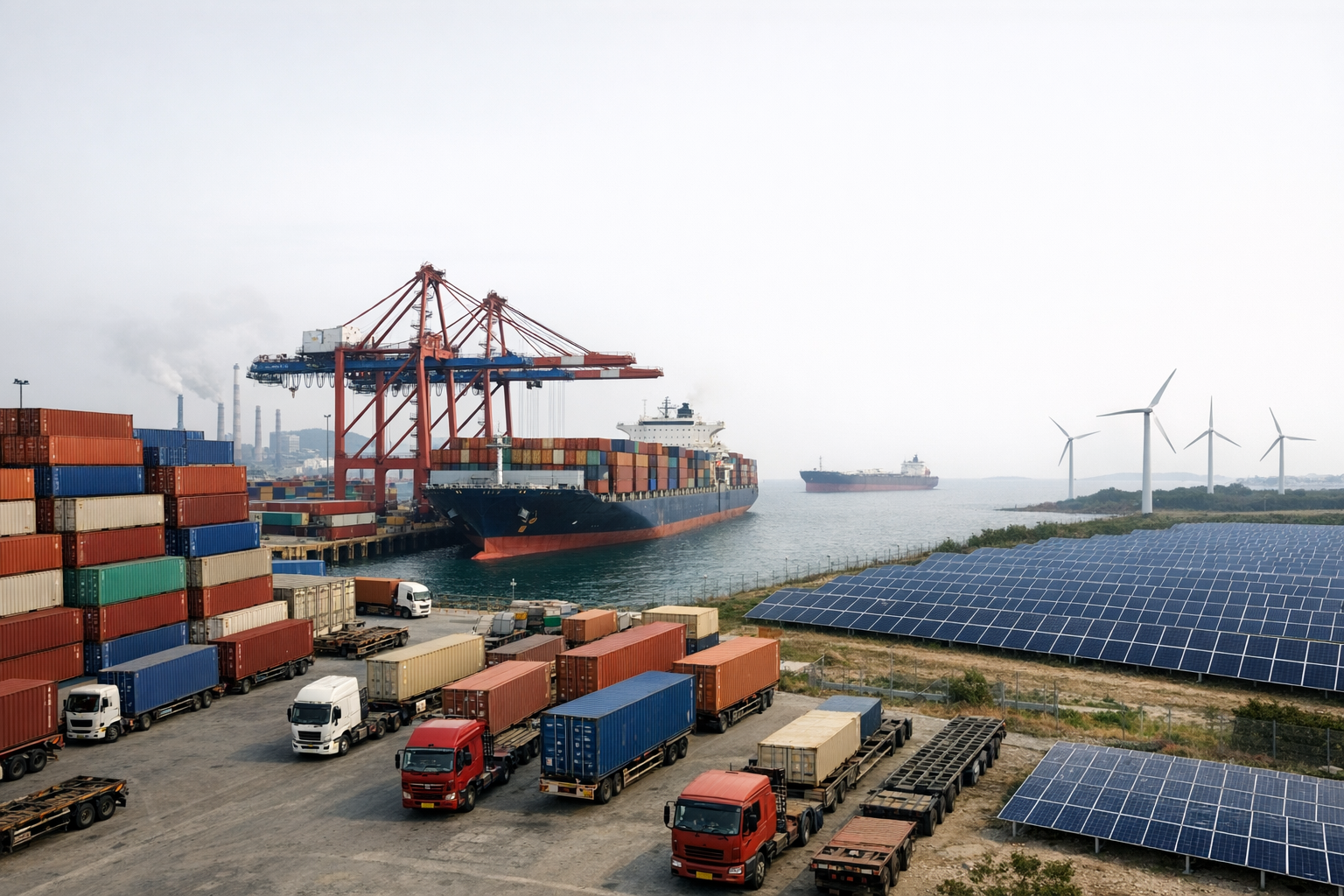
A Middle East War Ripples Across Asia
The economic shock from the war involving Iran is now spreading far beyond oil markets, reshaping trade, growth forecasts and energy policy across Asia.
Fresh data from three of the region’s largest economies — India, China and South Korea — suggest that what began as a geopolitical crisis in the Middle East is increasingly being absorbed into the basic calculations of Asian governments and businesses: how to ship goods, how to protect growth and how to secure power supplies in a world where imported fuel looks more vulnerable than it did just months ago.
In India, merchandise exports fell sharply in March as the conflict disrupted trade routes and hit shipments to the Middle East. In China, first-quarter growth came in stronger than many had expected, but officials and analysts warned that rising energy costs and weaker demand could make that resilience short-lived. In South Korea, the government has seized on the crisis to argue for a faster shift toward renewable energy, casting the war as evidence that dependence on imported fossil fuels has become a strategic liability.
Together, the developments show how the fallout from the conflict is being felt not only at the pump, but across supply chains, factory floors and national energy plans.
India’s Export Engine Stumbles
India said its merchandise exports in March fell 7.44 percent from a year earlier, to $38.92 billion, a decline officials linked in part to the war’s effect on regional trade. Shipments to the Middle East dropped as the conflict snarled commercial routes and raised costs for exporters already facing a fragile global recovery.
The hit is significant because India has been counting on external demand to support manufacturing and jobs, even as global trade has remained uneven. A disruption in the Middle East matters disproportionately for Indian exporters, not only because the region is an important market, but because it sits astride shipping corridors essential to the movement of goods and energy.
Higher freight and insurance costs are compounding the damage. For exporters, especially in sectors operating on thin margins, those increases can quickly turn viable orders into losses. Economists say that if the conflict drags on, the impact could spread beyond the most immediately exposed sectors and begin weighing more broadly on output and investment.
The setback also underscores a larger vulnerability for India: even when annual exports have held up better than feared, month-to-month shocks tied to conflict and logistics can derail momentum quickly.
China’s Solid Quarter, and a Darkening Outlook
China reported that its economy grew 5.0 percent in the first quarter from a year earlier, matching the upper end of Beijing’s official target range of 4.5 percent to 5 percent for 2026. On paper, the result offered some reassurance for policymakers trying to steady an economy already burdened by a prolonged property slump and weak domestic demand.
But the timing of the figure has made it look more like a snapshot of the economy before the full force of the latest external shock is felt.
The war has clouded the outlook for the rest of the year by threatening higher energy prices, softer external demand and renewed pressure on company profits. China, the world’s largest energy importer, remains highly exposed to instability in the Middle East. Even if Beijing has sought to position itself diplomatically as a critic of the conflict, its economy is not insulated from the costs.
Analysts have warned that the conflict may deliver China some short-term geopolitical openings while imposing longer-term economic pain. A sustained rise in fuel costs would come at an awkward moment, potentially squeezing manufacturers and consumers alike just as policymakers are trying to revive confidence. It could also further complicate Beijing’s effort to meet growth goals that were already modest by historical standards — the lowest official target range since the early 1990s.
That matters beyond China. If its growth slows more sharply later in the year, the effects would radiate through Asian supply chains and global commodity markets.
South Korea Turns Crisis Into Energy Argument
In South Korea, the war has prompted a more overt strategic response. The government has portrayed the Middle East crisis as a reason to accelerate what its energy minister has called a “fundamental energy transition,” with a stronger push into wind and solar power and a goal of reaching 100 gigawatts of renewable capacity.
For a country heavily dependent on imported fuels, the logic is straightforward: each new external shock strengthens the case for building more electricity generation at home.
That argument is gaining political force as the energy crisis in the Middle East exposes the risks of relying on distant producers and vulnerable shipping lanes. The government has moved to bring forward parts of its clean-energy agenda, while also increasing funding and urgency for domestic solar and wind deployment.
In places already using renewable projects as local revenue sources, the strategy is taking on a social dimension as well as an economic one. In Guyang-ri, a rural village southeast of Seoul, a one-megawatt solar installation has generated enough profit to help fund communal meals for residents, offering a small-scale example of how the energy transition is being sold not only as national security policy but as a tangible local benefit.
Still, South Korea’s response is not purely green. Officials have also taken near-term steps to bolster energy security through other means, including moving faster on some nuclear restarts. That reflects a practical reality likely to shape the region’s response more broadly: in a crisis, governments often pursue transition and emergency supply measures at the same time.
More Than an Oil Story
The broader lesson for Asia is that the war’s effects are no longer confined to headline crude prices. The conflict is feeding through into decisions about where goods can be shipped, whether factories remain profitable and how quickly countries try to rewire their energy systems.
The International Monetary Fund has already lowered its forecast for global growth in 2026, reinforcing the sense that the war has become a macroeconomic shock rather than a localized disruption. For Asian economies, which remain deeply tied to Middle Eastern energy supplies and shipping routes, the exposure is especially acute.
What happens next may depend largely on duration. If the conflict and associated disruptions ease, some of the current damage may prove temporary. If they persist, the consequences could become more structural: a longer export slump in India, weaker growth in China than first-quarter figures imply and a faster, if uneven, energy transition in South Korea and beyond.
In that sense, the war is beginning to force a deeper reassessment across Asia. The immediate problem is higher costs and disrupted trade. The longer-term question is whether this moment becomes the catalyst for lasting changes in how the region powers its economies and protects them from shocks that originate far from its shores.
Sources
Further reading and reporting used to add context:
- https://apnews.com/article/e1dbb6d542c6c1b17f99671f4dcc7d81
- https://apnews.com/article/2230f72863b20a902c6ad1373e688d33
- https://apnews.com/article/e3d8a239509abb50757f8c8d42fb32d8
- https://timesofindia.indiatimes.com/business/india-business/india-exports-fall-7-44-in-march-to-38-92-bn-amid-middle-east-disruption-trade-deficit-at-20-67-bn/articleshow/130281007.cms
- https://www.rediff.com/news/commentary/2026/apr/15/iran-war-indian-exports-fall-by-7.44-in-march/8200ab0f04855ee959fba337f76d3fe9
- https://www.ndtvprofit.com/economy/indias-march-trade-deficit-narrows-to-20-98-billion-as-imports-exports-decline-11360643
- https://www.businesstoday.in/amp/latest/economy/story/west-asia-war-indias-trade-with-region-down-pulls-down-exports-in-march-2026-525838-2026-04-15/
- https://apnews.com/article/1822006cd39ff43505fa9a47a4581a16
- https://indianexpress.com/article/business/indias-trade-deficit-eases-marginally-to-21-billion-in-march-amid-west-asia-crisis-goods-exports-up-by-1-in-fy26-10638968/
- https://www.independent.co.uk/asia/east-asia/south-korea-fuel-shortage-renewables-lee-jae-myung-b2949802.html
- https://www.brecorder.com/news/40414057/india-diesel-exports-to-se-asia-hit-7-year-high-in-march-due-to-iran-war-data-shows
- https://www.business-standard.com/amp/economy/news/fy26-exports-grew-despite-tariffs-but-impact-of-west-asia-war-looms-126041501554_1.html
- https://www.theguardian.com/world/2026/apr/16/south-korea-solar-power-renewables-revolution
- https://finance.yahoo.com/economy/articles/china-poised-q1-gdp-growth-083204978.html
- https://en.sedaily.com/news/2026/04/06/energy-transition-overly-tilted-toward-renewables-nuclear
- https://ieefa.org/resources/south-koreas-renewable-energy-pivot-can-mitigate-fossil-fuel-dependency-risks
- https://www.lemonde.fr/en/opinion/article/2026/04/02/it-is-far-from-certain-that-china-will-emerge-economically-victorious-from-the-current-chaos_6752031_23.html
- https://m.gov.kr/mw/AA020InfoCappView.do?CappBizCD=12600000001&HighCtgCD=A07004&tp_seq=
- https://english.motie.go.kr/eng/article/EATCLdfa319ada/1263/view
- https://www.gov.kr/mw/AA020InfoCappView.do?CappBizCD=15200000240&HighCtgCD=A03007&tp_seq=
- https://www.korea.net/Government/Current-Affairs/National-Affairs/view?affairId=2796&articleId=290296&subId=175&viewId=77023
- https://english.motie.go.kr/eng/article/EATCLdfa319ada/1008/view
- https://english.motie.go.kr/eng/article/EATCLdfa319ada/1977/view
- https://english.motie.go.kr/eng/article/EATCLdfa319ada/2110/view
- https://www.korea.net/koreanet/fileDown?fileName=Endeavors+for+Developing+Hyper-speed+Train+Technology.pdf&fileUrl=%2Fupload%2Fcontent%2Ffile%2Fac37da1cadb94f9f91a7a4d1c6065cc8_20250414133745.pdf
- https://www.korea.net/Government/Briefing-Room/Press-Releases?gov=A110503&pageIndex=8
- https://english.motie.go.kr/eng/article/EATCLdfa319ada/1976/view
- https://english.motie.go.kr/eng/article/EATCLdfa319ada/2100/view
- https://www.motie.go.kr/search/search.do?bbsPreQuery=text_idx%3D%27%ED%83%9C%EC%96%91%EA%B4%91%27+allwordthruindex&category=¤tPage=1&detailSearch=&end-date=&kwd=renewable+energy&pagePreQuery=text_idx%3D%27%ED%83%9C%EC%96%91%EA%B4%91%27+allwordthruindex&rowPerPage=10&site=main&start-date=&userPreQuery=text_idx%3D%27%ED%83%9C%EC%96%91%EA%B4%91%27+allwordthruindex+and+strv_idx+like+%27%2A%ED%83%9C%EC%96%91%EA%B4%91%2A%27
- https://intra.gov.kr/my/EgovPageLink.do?link=g4g_admin%2Flogin%2FAA060_cert_info
- https://www.korea.net/koreanet/fileDownload?fileUrl=pdfdata%2F2018%2F03%2FPyeongChang2018Tabloid6_en_0322.pdf
- https://www.korea.net/koreanet/fileDownload?fileUrl=pdfdata%2F2016%2F09%2FKOREAMagazine1610_en_0929.pdf
- https://www.motie.go.kr/open_content/upload/E_01_01/1265_1.pdf
- https://www.korea.net/koreanet/fileDownload?fileUrl=pdfdata%2F2017%2F09%2FKOREAMagazine1710_en_0929.pdf
- https://www.motie.go.kr/ftz/daebul/download/%EC%98%81%EB%AC%B8_%EC%9E%90%EC%9C%A0%EB%AC%B4%EC%97%AD%EC%A7%80%EC%97%AD%20%ED%99%8D%EB%B3%B4%EB%B8%8C%EB%A1%9C%EC%8A%88%EC%96%B4.pdf
- https://www.commerce.gov.in/wp-content/uploads/2026/03/PIB-Release-8.pdf
- https://trade-analytics.commerce.gov.in/public/
- https://static.pib.gov.in/WriteReadData/specificdocs/documents/2026/feb/doc202621776101.pdf
- https://static.pib.gov.in/WriteReadData/specificdocs/documents/2026/mar/doc2026315825201.pdf
- https://static.pib.gov.in/WriteReadData/specificdocs/documents/2025/mar/doc2025320523401.pdf
- https://www.pib.gov.in/PressReleasePage.aspx?PRID=2228785
- https://www.commerce.gov.in/trade-statistics/
- https://www.commerce.gov.in/major-achievements
- https://newindiasamachar.pib.gov.in/WriteReadData/Magazine/2026/Mar/M202603011.pdf
- https://www.pib.gov.in/PressReleaseIframePage.aspx?PRID=2020659
- https://www.pib.gov.in/PressReleasePage.aspx?PRID=2240674
- https://www.commerce.gov.in/about-us/divisions/export-products-division/export-promotion-marine-products/?hilite=%27ASEAN%27
- https://www.pib.gov.in/PressReleseDetailm.aspx?PRID=2234442
- https://www.commerce.gov.in/about-us/divisions/foreign-trade-territorial-division/foreign-trade-north-east-asia
- https://www.pib.gov.in/PressReleseDetailm.aspx?PRID=2219907&lang=1®=1
- https://www.pib.gov.in/PressReleseDetailm.aspx?PRID=2195990&lang=2®=3
- https://www.commerce.gov.in/international-trade/trade-promotion-programmes-and-schemes/international-trade-focus-lac/
- https://www.stats.gov.cn/english/PressRelease/202604/t20260416_1963326.html
- https://en.cppcc.gov.cn/2025-04/19/c_1088213.htm
- https://invest.teda.gov.cn/contents/1491/85670.html
- https://www.stats.gov.cn/english/PressRelease/202504/t20250416_1959313.html
- https://english.scio.gov.cn/pressroom/2026-01/26/content_118301853.html
- https://english.www.gov.cn/archive/statistics/202602/28/content_WS69a2dfc9c6d00ca5f9a09662.html
- https://www.lg.gov.cn/english/investinlonggang/industrialnews/content/post_12609206.html
- https://english.www.gov.cn/archive/statistics/202504/16/content_WS67ff43ccc6d0868f4e8f1bed.html
- https://english.www.gov.cn/archive/statistics/202507/17/content_WS687895e3c6d0868f4e8f43d7.html
- https://english.scio.gov.cn/pressroom/node_9016643.html
- https://english.shanghai.gov.cn/en-Latest-WhatsNew/20260305/844a5edf074348b3b5478fe102804fdb.html
- https://english.www.gov.cn/news/202504/17/content_WS6800637fc6d0868f4e8f1ceb.html
- https://www.stats.gov.cn/zs/tjwh/tjkw/tjqk/zgxxb/202601/P020260120308327358138.pdf
- https://www.stats.gov.cn/zs/tjwh/tjkw/tjqk/zgxxb/202601/P020260121321642878276.pdf
- https://www.stats.gov.cn/zs/tjwh/tjkw/tjqk/zgxxb/202601/P020260107311898676067.pdf
- https://www.pbc.gov.cn/en/3688229/3688353/3688356/5188141/2025080817502580217/2024070415211316142.pdf
- https://www.stats.gov.cn/zs/tjwh/tjkw/tjqk/zgxxb/202603/P020260304320532088933.pdf
- https://www.stats.gov.cn/zs/tjwh/tjkw/tjqk/zgxxb/202602/P020260228312119811159.pdf
- https://www.axios.com/2026/04/14/imf-iran-inflation-economy
- https://www.axios.com/2026/04/14/iran-war-global-economic-growth-damage-forecast
- https://www.financialexpress.com/policy/economy/goods-exports-fall-7-4-in-march-shipments-to-west-asia-down-68/4208575/
- https://www.goldmansachs.com/insights/articles/chinas-economy-is-forecast-to-grow-faster-than-expected-in-2026
- https://www.ajot.com/news/indias-trade-deficit-shrinks-as-us-exports-counter-mideast-woes
- https://www.enerdata.net/publications/daily-energy-news/south-korea-prepares-energy-countermeasures-amidst-middle-east-crisis.html
- https://www.investing.com/news/economic-indicators/india-trade-deficit-in-april-at-2642-billion-4048220
- https://www.bloomberg.com/news/articles/2026-03-11/south-korea-to-speed-up-nuclear-restart-amid-middle-east-crisis
- https://councilonstrategicrisks.org/2026/02/02/protecting-koreas-national-security-with-renewable-energy/
- https://en.wikipedia.org/wiki/2026_South_Pars_field_attack
- https://en.wikipedia.org/wiki/2026_Kharg_Island_attack
- National Economy Got off to a Good Start in the First Quarter
- India’s trade deficit shrinks as US exports counter Mideast woes | AJOT.COM
- India exports fall 7.44% in March to $38.92 bn amid Middle East disruption, trade deficit at $20.67 bn – The Times of India
- China poised for Q1 GDP growth rebound but Iran war dims 2026 outlook: Reuters poll