
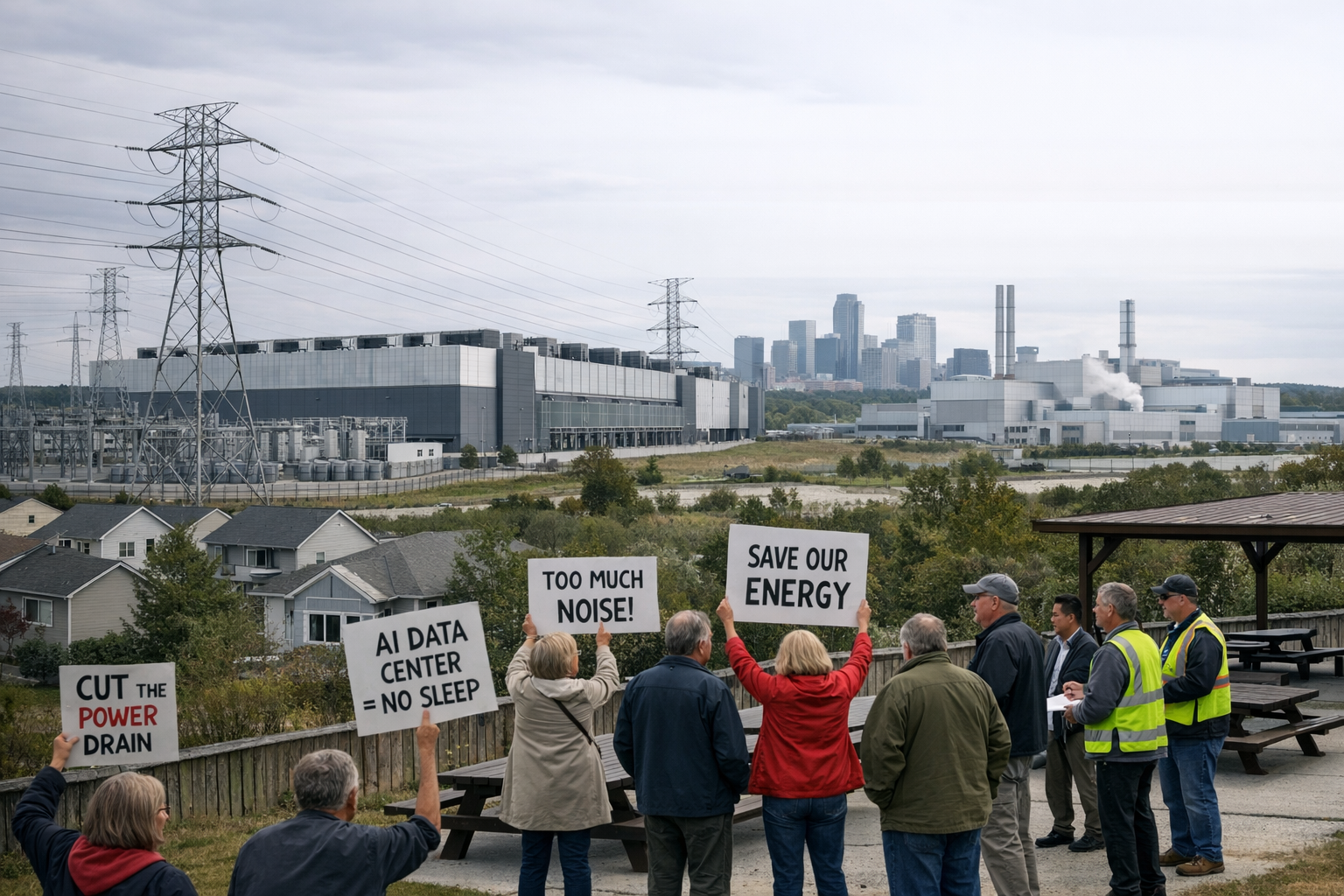
The artificial intelligence boom is widening — and meeting resistance
The race to dominate artificial intelligence is no longer confined to chatbots and software models. It is now playing out in semiconductor foundries, government corridors in London and in local political fights over the physical footprint required to power the industry.
That widening contest came into sharper view this week as Taiwan Semiconductor Manufacturing Company reported another surge in profit, fueled by demand for AI chips, while Anthropic signaled a broader push in Britain as governments compete to attract the world’s most valuable AI companies. At the same time, opposition to the data centers needed to run those systems is hardening, raising the prospect that public backlash could become a real brake on the industry’s growth.
Together, the developments underscore a central reality of the current AI moment: the boom is no longer just about who builds the best model. It is about who can secure chips, talent, policy influence, energy and public consent.
TSMC’s results show AI demand still running hot
TSMC, the world’s dominant contract chip manufacturer, said on April 16 that first-quarter net profit jumped about 58 percent from a year earlier to a record level, surpassing analysts’ expectations. The company also forecast stronger second-quarter revenue, another sign that spending on AI infrastructure remains robust despite broader concerns about how long the surge can last.
The company sits at the center of the AI supply chain, producing advanced semiconductors that underpin the accelerators used to train and run large AI models. Its latest results reinforced the degree to which the economics of the AI boom still rest on a hardware bottleneck: even as investors focus on flashy consumer applications, the largest and most reliable gains are still accruing to the firms supplying the picks and shovels.
TSMC had already signaled unusually strong first-quarter revenue and margins, reflecting sustained demand for cutting-edge manufacturing tied to AI chips and related systems. Its performance suggests that the appetite for high-end computing power remains intense, even as questions mount over whether the sector’s vast capital spending could eventually produce excess capacity.
For now, though, the numbers point in one direction. The AI buildout continues to enrich the companies that make its foundation possible.
Britain intensifies its courtship of AI labs
If chips are one front in the contest, geography is another.
Anthropic, one of the leading AI start-ups and a chief rival to OpenAI, has been expanding its presence in London and deepening ties with the British government. The company had already established a foothold in the country and in January announced a partnership connected to AI services for GOV.UK. Its latest move points to a broader U.K. expansion at a moment when Britain is trying to position itself as a favored home for frontier AI development.
That push comes as OpenAI has also expanded its London operations, sharpening the competition not only for engineers and researchers but also for political influence, regulatory access and prestige. For governments, attracting a company like Anthropic or OpenAI means more than jobs. It offers a chance to shape global AI governance, secure domestic expertise and stake a claim in an industry increasingly viewed as strategic.
Britain’s campaign to court American AI companies reflects a broader shift among governments that no longer see AI solely as a private-sector story. They are treating it more like critical infrastructure — something tied to national competitiveness, digital sovereignty and public services.
For Anthropic, a larger U.K. footprint could help diversify its talent base and strengthen relationships with policymakers at a time when questions about safety, regulation and government procurement are becoming central to the business of AI. But how far that expansion goes remains uncertain, particularly as defense-policy disputes and geopolitical tensions influence where leading labs choose to place staff, partnerships and eventually public listings.
The backlash moves from abstract concern to political risk
Yet while companies and governments rush to accelerate AI’s expansion, resistance to its physical infrastructure is becoming harder to dismiss.
In Maine, lawmakers approved a moratorium bill on large data centers, a sign that local unease over the industry’s rapid buildout is translating into concrete political action. Similar anxieties have been building for months around the country, centered on electricity demand, pressure on power grids, water use, noise and the effect that large industrial projects can have on nearby communities.
Polling from late 2025 found growing support for restricting data centers near residential areas, suggesting that skepticism about AI is not limited to abstract fears about job loss or misinformation. It is increasingly about the visible, localized costs of making the technology work.
That matters because AI’s future depends not only on better models and bigger investment rounds, but also on permits, transmission capacity and community acceptance. If data-center opposition spreads beyond local disputes into broader state or national restrictions, it could slow the construction of the computing infrastructure on which the industry’s ambitions depend.
Such resistance could also complicate the path to the public markets for major AI firms. Companies like Anthropic and OpenAI have been seen by investors as potential blockbuster listings. But if voters begin to associate AI less with innovation than with rising utility costs, strained grids and industrial sprawl, that shift in sentiment could weigh on valuations and become a flashpoint in coming elections.
Why this moment matters
The latest wave of developments suggests that AI’s next phase will be defined less by novelty than by scale — and by the frictions that scale creates.
TSMC’s profits show that demand for the hardware behind AI remains powerful. Anthropic’s moves in Britain show that countries are now competing to host and shape the industry’s leading players. And the backlash against data centers shows that the expansion of AI is beginning to collide with older constraints: land, water, power and politics.
For much of the past two years, the prevailing assumption in the technology industry was that enough capital and technical progress could bulldoze almost any obstacle. What is becoming clearer now is that AI, for all its digital mystique, is a profoundly physical business. It requires factories to make chips, office hubs to attract talent, government relationships to open doors and enormous facilities to supply computation.
That makes the industry more exposed than it once appeared — not only to market cycles, but also to the public’s willingness to live alongside the infrastructure that AI requires.
Sources
Further reading and reporting used to add context:
- https://apnews.com/article/624137ae5b2a5bfe9ca2ccfc648b5dc1
- https://www.itpro.com/business/business-strategy/openai-announces-first-permanent-london-office-in-uk-expansion-push
- https://www.eetimes.com/ai-fuels-tsmc-record-earnings-and-market-dominance/
- https://apnews.com/article/4708cedbec3c874ce3cb957799f12c50
- https://investor.tsmc.com/english/encrypt/files/encrypt_file/reports/2025-04/6580235c47b7b8f1056b071faa44d958c2c3ba04/1Q25EarningsRelease.pdf
- https://www.techi.com/tsmc-q1-2026-earnings-report/
- https://www.tomshardware.com/tech-industry/semiconductors/tsmc-very-nervous-about-ai-bubble-concerns-despite-another-record-setting-quarter-but-assured-of-demand-ceo-says-careless-investment-would-be-a-disaster-for-tsmc-for-sure-company-will-invest-usd52-usd56-billion-in-capex
- https://tech-insider.org/tsmc-q1-2026-revenue-35-billion-ai-chip-capex/
- https://www.investing.com/news/stock-market-news/tsmc-q1-profit-surges-60-beats-forecasts-3989732
- https://finance.yahoo.com/sectors/technology/articles/tsmcs-q1-revenue-jumps-35-053612040.html
- https://www.axios.com/2026/03/11/anthropic-dc-presence
- https://finance.yahoo.com/markets/stocks/articles/tsmc-record-q1-ai-revenue-070857272.html
- https://thefourthfactor.io/articles/2026-04-10-tsmc-q1-revenue-surge-ai-chip-demand.html
- https://www.cnbc.com/2025/01/16/tsmc-fourth-quarter-profit-beats-expectations-on-strong-ai-chip-demand.html
- https://www.insiderfinance.io/news/tsmc-q1-revenue-surges-on-ai-chip-demand
- https://uk.news.yahoo.com/ai-startup-anthropic-open-offices-095312820.html
- https://www.theguardian.com/technology/2026/feb/03/anthropic-ai-legal-tool-shares-data-services-pearson
- https://www.anthropic.com/news/gov-UK-partnership
- https://www.anthropic.com/news/sydney-fourth-office-asia-pacific
- https://www.anthropic.com/events/aws-summit-london
- https://www.anthropic.com/news/expanding-global-operations-to-india
- https://www.anthropic.com/events/agentic-ai-in-action
- https://openai.com/index/introducing-openai-london/
- https://www.anthropic.com/events/anthropic-partner-kickoff-2026
- https://www.anthropic.com/news/expanding-our-use-of-google-cloud-tpus-and-services
- https://www.anthropic.com/news/seoul-becomes-third-anthropic-office-in-asia-pacific
- https://www.anthropic.com/news/introducing-the-anthropic-national-security-and-public-sector-advisory-council
- https://www.anthropic.com/events
- https://www.anthropic.com/events/anthropic-at-google-cloud-next-2026
- https://cdn.openai.com/signals/openai-signals-global-report.pdf
- https://www-cdn.anthropic.com/files/4zrzovbb/website/bf04581e4f329735fd90634f6a1962c13c0bd351.pdf
- https://cdn.openai.com/pdf/small-business-jam-report-dec-2025.pdf
- https://assets.anthropic.com/m/588b34b02d864aca/original/Employee-Candidate-Privacy-Notice-UK-EU-CH-3-Feb-2025.pdf
- https://cdn.openai.com/global-affairs/openai-doe-rfi-5-7-2025.pdf
- https://cdn.openai.com/global-affairs/ostp-rfi/ec680b75-d539-4653-b297-8bcf6e5f7686/openai-response-ostp-nsf-rfi-notice-request-for-information-on-the-development-of-an-artificial-intelligence-ai-action-plan.pdf
- https://techcrunch.com/2026/02/25/the-public-opposition-to-ai-infrastructure-is-heating-up/
- https://sharedsapience.com/the-century-report-february-9-2026/
- https://en.wikipedia.org/wiki/Anthropic%E2%80%93United_States_Department_of_Defense_dispute
- https://sharedsapience.com/century-report/the-century-report-april-11-2026/
- https://www.majormatters.co/p/ai-data-center-backlash-community-opposition
- https://www.reddit.com/r/GenAI4all/comments/1sdsfti/half_of_the_ai_data_centers_planned_for_2026_are/
- https://techstartups.com/2026/04/03/top-tech-news-today-april-3-2026/
- https://en.wikipedia.org/wiki/AI_data_center
- https://www.reddit.com/r/Mag7shares/comments/1smxjo7/the_public_sours_on_ai_and_data_centers_as/
- https://en.wikipedia.org/wiki/Stargate_LLC
- https://www.reddit.com/r/TradingPlaybook/comments/1slpvqk/from_molotov_cocktails_to_data_center_shutdowns/
- https://en.wikipedia.org/wiki/AI_bubble
- https://techstartups.com/2026/04/13/top-tech-news-today-april-13-2026/
- https://www.ai-supremacy.com/p/mythos-bigai-datacenters-and-bottlenecks-anthropic-2026
- https://www.linkedin.com/pulse/ai-news-business-owners-march-29-april-4-2026-week-shut-mendiratta-fkbdc
- https://www.promptinjection.net/p/ai-llm-news-roundup-march-02-march-11-2026
- https://www.theneuron.ai/explainer-articles/around-the-horn-digest-everything-that-happened-in-ai-today-tuesday-april-14-2026/
- https://www.reddit.com/r/BlackberryAI/comments/1s43p6s/top_ai_bad_news_326/
- https://www.reddit.com/r/aiwars/comments/1sif4tb/ugh_what/
- https://www.singularitysoup.com/latest-ai-news-2026-03-28.html
- https://www.reddit.com/r/Futurology/comments/1sg0yzm/removed/
- https://malaysia.news.yahoo.com/live/tech-stocks-today-anthropic-sues-defense-department-over-ban-openais-robotics-leader-resigns-152722809.html
- https://apnews.com/article/aa63ba087d5ad53ab0735893646e7357
- https://apnews.com/article/637d07aca9e480294380be0da1d0a514
- https://pro.morningconsult.com/analysis/ai-data-center-energy-prices-november-2025
- https://www.bangordailynews.com/2026/04/06/bangor/bangor-government/bangor-data-center-moratorium/
- https://apnews.com/article/3d86c9296fe953ec0591fcde6a613aba
- https://www.washingtonpost.com/nation/2026/04/14/maine-bans-data-centers/
- https://www.maine.gov/housedems/news/maine-house-advances-sachs-bill-establish-moratorium-data-centers-0
- https://www.businesswire.com/news/home/20250522623557/en/70-of-Americans-Say-Theyd-Welcome-a-Nearby-Data-Center-If-Its-Built-Responsibly-Airedale-Survey-Finds
- https://theweek.com/politics/judge-anthropic-ai-pentagon
- https://pro.morningconsult.com/analysis/ai-data-center-construction-voter-polling-october-2025
- https://www.yahoo.com/news/articles/pentagon-opens-door-exempt-anthropic-222939632.html
- https://www.mainepublic.org/business-and-economy/2026-03-06/new-bill-would-temporarily-pause-data-center-development-in-maine
- https://www.axios.com/2026/03/06/pentagon-anthropic-amodei-apology
- https://www.techradar.com/pro/security/pentagon-may-sever-anthropic-relationship-over-ai-safeguards-claude-maker-expresses-concerns-over-hard-limits-around-fully-autonomous-weapons-and-mass-domestic-surveillance
- https://heatmap.news/politics/data-center-survey
- https://www.datacenterdynamics.com/en/news/maine-data-center-moratorium-bill-gets-house-approval-moves-to-senate/
- https://www.washingtonpost.com/technology/2026/02/24/pentagon-demands-ai-access/
- https://www.inquirer.com/business/data-centers-philadelphia-pros-cons-opposition-survey-20251215.html
- https://en.wikipedia.org/wiki/Project_Maven
- https://en.wikipedia.org/wiki/Pete_Hegseth
- https://en.wikipedia.org/wiki/Anthropic
- https://tomorrowsaffairs.com/pdf/7608/how-the-pentagon-banned-the-artificial-intelligence-it-used-to-wage-war.pdf
- https://apnews.com/article/8478be7d5e275dee43d9814ebb2a69d3
- https://www.axios.com/2026/02/26/anthropic-rejects-pentagon-ai-terms
- https://www.theguardian.com/technology/2026/mar/09/anthropic-artificial-intelligence-pentagon
- https://www.tomshardware.com/tech-industry/artificial-intelligence/anthropic-sues-pentagon-over-ai-blacklisting
- https://apnews.com/article/8599c65e6e0fe87869929d20ab5d600e
- https://www.anthropic.com/news/new-offices-in-paris-and-munich-expand-european-presence
- https://www.thenews.com.pk/latest/1397797-britain-woos-anthropic-after-us-defence-clash
- https://www.anthropic.com/news/economic-futures-uk-europe
- https://www.straitstimes.com/world/europe/britain-woos-anthropic-expansion-after-us-defence-clash-ft-reports//
- https://www.insightswire.com/news/19645/anthropic-invited-expand-london-after-us-supply-chain-designation
- https://uk.finance.yahoo.com/news/tech-stocks-today-anthropic-sues-defense-department-over-ban-openais-robotics-leader-resigns-152722809.html/
- https://www.wired.com/story/openai-expands-london-office-major-research-hub/
- https://uk.finance.yahoo.com/news/pentagons-ouster-anthropic-opens-doors-100306795.html/
- https://uk.news.yahoo.com/ai-lab-anthropic-sues-block-190600297.html
- https://en.wikipedia.org/wiki/Anthropic%27s_Responsible_Scaling_Policy
- https://en.wikipedia.org/wiki/Claude_%28language_model%29
- https://www.reddit.com/r/AiForBusinessesUK/comments/1s0jc01/were_opening_6_spots_on_the_anthropic_academy/
- https://finance.yahoo.com/sectors/technology/articles/britain-woos-expansion-effort-anthropic-042916627.html
- https://www.tbsnews.net/worldbiz/europe/britain-woos-anthropic-expansion-after-us-defence-clash-ft-1402921
- https://m.economictimes.com/tech/artificial-intelligence/britain-woos-expansion-effort-by-anthropic-after-us-defence-clash-report/amp_articleshow/130033754.cms
- https://www.channelnewsasia.com/business/britain-woos-anthropic-expansion-after-us-defence-clash-ft-says-6037361
- https://www.investing.com/news/stock-market-news/britain-woos-expansion-effort-by-anthropic-after-us-defence-clash-ft-says-4597582
- https://www.channelnewsasia.com/business/britain-woos-anthropic-expansion-after-us-defence-clash-report-6037361
- https://www.sepe.gr/en/it-technology/22710072/britain-woos-expansion-effort-by-anthropic-after-us-defence-clash-ft-says/
- https://www.daily-sun.com/business-print/867121
- https://economictimes.indiatimes.com/tech/artificial-intelligence/britain-woos-expansion-effort-by-anthropic-after-us-defence-clash-report/articleshow/130033754.cms/
- https://www.republicworld.com/tech/britain-woos-anthropic-expansion-after-us-defence-clash
- https://www.channelnewsasia.com/business/britain-woos-expansion-effort-anthropic-after-us-defence-clash-ft-says-6037361
- https://www.reddit.com/r/UKTechNews/comments/1sk7zks/openai_secures_first_permanent_london_office/
- https://arxiv.org/abs/2602.06249
- https://chronicleclub.in/storage/uploads/1775447534-business-standard.pdf
- https://www.londonchamber.co.uk/LCCI_Media/LCCI/Media/London%20Business%20Matters/2026/LBM-March-April-2026.pdf
- https://www.reddit.com/r/jobboardsearch/comments/1hgt9ui
- https://www.reddit.com/r/neoliberal/comments/1sdth32/uk_courts_anthropic_to_expand_in_london_after_us/
- https://www.reddit.com/r/singularity/comments/1smzu0i/anthropic_unveils_plans_for_major_uk_expansion/
- https://www.reddit.com/r/noticiones/comments/1smzc3w/anthropic_unveils_plans_for_major_uk_expansion/
- https://www.reddit.com/r/technology/comments/1sdvrr3/britain_woos_anthropic_expansion_after_us_defence/
- https://www.reddit.com/r/realtech/comments/1scwvv1/uk_courts_anthropic_to_expand_in_london_after_us/
- https://www.reddit.com/r/UKTechNews/comments/1se5261/uk_courts_anthropic_to_expand_in_london_after_us/
- https://www.reddit.com/r/technology/comments/1sjo8rx/uk_financial_regulators_rush_to_assess_risks_of/
- https://www.reddit.com/r/NBCauto/comments/1smzzbi/world_anthropic_unveils_plans_for_major_uk/
- https://www.reddit.com/r/unitedkingdom/comments/1scy2ap/britain_woos_anthropic_to_expand_after_clash_with/
- https://investor.tsmc.com/english/quarterly-results
- https://investor.tsmc.com/english/encrypt/files/encrypt_file/qr/phase4_reports/2025-04/9898ae6b80bda1f00a1387e52245ebd6e4d184ea/1Q25EarningsRelease_WoG.pdf
- https://investor.tsmc.com/english/financial-calendar
- https://investor.tsmc.com/english/quarterly-results/teleconference
- https://investor.tsmc.com/english/financial-reports
- https://investor.tsmc.com/english/encrypt/files/encrypt_file/qr/phase4_reports/2024-04/d75efa932f2bf088d80bca77ad62e69e13914c08/1Q24EarningsRelease_WoG.pdf
- https://investor.tsmc.com/chinese/quarterly-results/2026/q1
- https://investor.tsmc.com/english/encrypt/files/encrypt_file/reports/2026-01/3e49621566a3ca53bdf8aee2586929b666c17fd6/4Q25EarningsRelease.pdf
- https://investor.tsmc.com/schinese/financial-reports
- https://investor.tsmc.com/english/form/quarterly-results-physical-confe
- https://investor.tsmc.com/chinese/encrypt/files/encrypt_file/reports/2024-04/e19914dd320b6386af51d5ed27fa5c51af9c441e/1Q24EarningsRelease.pdf
- https://investor.tsmc.com/static/annualReports/2023/english/index.html
- https://investor.tsmc.com/english/encrypt/files/encrypt_file/reports/2025-07/d9d294ed46ca22c560a17eb060373bc35f2d464a/2Q25EarningsRelease.pdf
- https://investor.tsmc.com/english/shareholders-meeting/2026
- https://investor.tsmc.com/static/annualReports/2021/english/index.html
- https://investor.tsmc.com/schinese/financial-calendar
- https://investor.tsmc.com/schinese/quarterly-results/2025/q1
- Taiwan's chipmaker TSMC reports 58% jump in profit, warns about Iran war impacts
- TSMC 2026 Q1 Quarterly Results – Taiwan Semiconductor Manufacturing Company Limited