
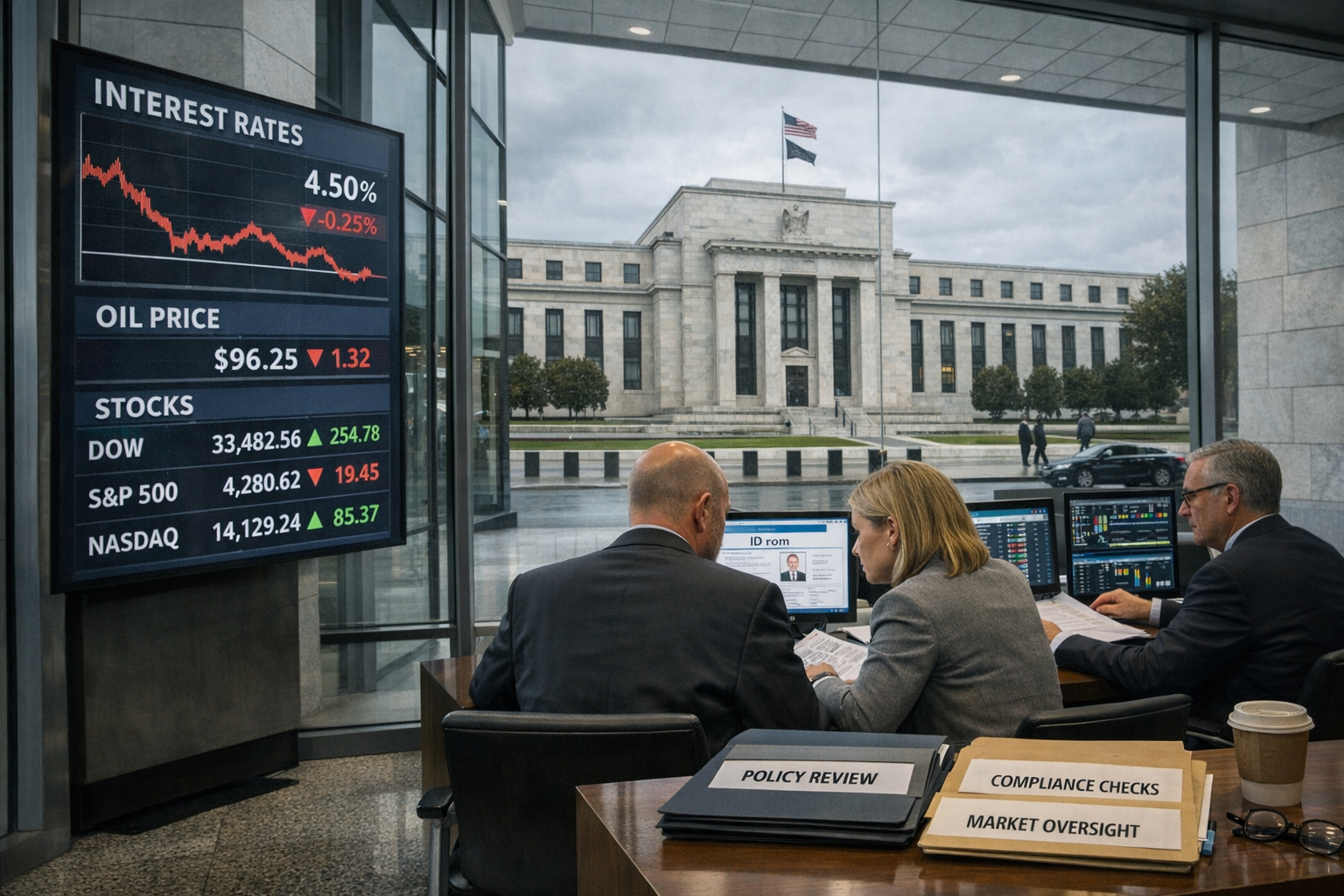
President Trump intensified his pressure campaign on several pillars of the American financial system this week, threatening to oust the head of the Federal Reserve, backing scrutiny of suspicious trading ahead of his own market-moving policy announcements and advancing a plan that would require banks to collect customers’ citizenship information.
Taken together, the moves amount to a widening assertion of executive power over institutions that have long been expected to operate with a degree of insulation from the White House: the central bank in setting monetary policy, regulators in safeguarding market fairness and banks in handling customer compliance.
The developments arrive at a moment when investors are already parsing the political risks surrounding economic policy, from interest rates to energy sanctions to the future reach of immigration enforcement through private financial institutions.
Trump Renews Threats Against Powell
On April 15, Mr. Trump said he would fire Jerome H. Powell, the Federal Reserve chair, if Mr. Powell did not leave on his own when his term as chair ends in mid-May. The threat reopened a battle that has shadowed Mr. Trump’s relationship with the Fed for years and again raised questions about the durability of central-bank independence under his administration.
The confrontation is more complicated than a standard leadership transition. Mr. Powell’s term as chair ends in May 2026, but his term as a member of the Fed’s Board of Governors runs until January 2028. That distinction matters because even if Mr. Trump installs a new chair, a central question is whether he can force Mr. Powell entirely out of the institution without a legally sufficient cause.
Mr. Trump has already selected Kevin Warsh, a former Fed official, to succeed Mr. Powell as chair. But the succession has been clouded by a separate administration-backed inquiry involving the central bank, adding pressure to Mr. Powell and complicating what in other circumstances might have been a routine handoff.
For markets, the dispute is not merely personal or procedural. The Fed’s credibility rests heavily on the perception that its decisions on inflation, employment and interest rates are insulated from direct political retaliation. Any serious attempt to remove a chair over policy disagreements could unsettle that assumption and feed concerns that monetary policy is becoming more openly subordinate to presidential demands.
Investigators Examine Trades Before Trump Announcements
At the same time, regulators are examining unusual oil-futures trading that occurred shortly before Mr. Trump’s policy statements in late March and early April on Iran, according to reports. Investigators are said to be seeking “Tag 50” identifiers from exchanges, a piece of trading data that can help determine who placed the orders.
The inquiry centers on whether traders may have acted on nonpublic information or benefited from leaks before announcements that had the potential to move energy markets. It is also possible that the activity, while aggressive, was legal. But the use of trader-identification data suggests investigators are trying to move beyond broad market patterns and identify specific individuals or firms behind the positions.
That matters because confidence in financial markets depends not only on economic fundamentals but on the belief that politically sensitive information is not being selectively exploited. If officials conclude that trading was informed by privileged access, the episode could widen into questions about internal controls around policy deliberations and the handling of market-sensitive government decisions.
The timing is especially delicate. Markets have become increasingly reactive to presidential social-media posts, public remarks and abrupt policy shifts. That has elevated the stakes around information security inside government and around anyone with advance visibility into sanctions, tariff plans or geopolitical announcements.
Treasury Pushes Banks Toward Citizenship Checks
In another significant shift, Treasury Secretary Scott Bessent said the administration is moving ahead with an executive order that would require banks to collect citizenship information from customers, and that the government expects the industry to comply.
Such a requirement would mark a notable expansion of existing customer-identification rules. Banks are already required under anti-money-laundering laws to verify core identity information when opening accounts. But current federal rules do not generally require them to determine or verify a customer’s citizenship status.
That distinction could prove consequential for both banks and customers. Financial institutions would need to build new compliance procedures, train staff, revise onboarding systems and determine what documents would count as proof. It remains unclear whether the requirement would apply only to new accounts or also to millions of existing customers, a choice that would dramatically alter the scope and cost of implementation.
The proposal also suggests a deeper integration of the banking system into the administration’s immigration agenda. Civil-liberties groups and industry officials are likely to scrutinize whether the policy could deter some consumers from using mainstream banks, push more activity into cash or less regulated channels, and create new privacy and discrimination concerns.
A Broader Pattern
The three developments involve distinct legal questions and different agencies. Yet they point in a common direction: a White House increasingly willing to test the boundaries between presidential authority and the operational independence of institutions that shape economic life.
In the Fed dispute, the unresolved issue is whether a president can remove a chair or governor absent clear cause. In the trading inquiry, the key question is whether suspicious market activity reflects criminal leaks, insider trading or merely well-timed speculation. In the banking plan, the uncertainty is whether the administration can impose citizenship checks through executive action alone or whether it would need a more formal rulemaking process.
Each issue carries consequences beyond Washington. Pressure on the Fed can alter borrowing costs and investor confidence. Doubts about market integrity can undermine trust in price formation and regulatory enforcement. New mandates for banks can reshape who accesses the financial system and how financial firms interact with the government.
For now, the immediate effect is heightened scrutiny. Investors, banks and legal observers are watching not just the substance of the administration’s actions, but whether longstanding institutional guardrails will hold under sustained political pressure.
Sources
Further reading and reporting used to add context:
- https://apnews.com/article/16f1777a974cf0dece60d78abe4eb973
- https://www.thedailybeast.com/murdoch-paper-wall-street-journal-trashes-donald-trumps-self-destructive-vendetta/
- https://www.thedailybeast.com/trump-goon-reveals-incoming-citizenship-banking-plot/
- https://apnews.com/article/b6148c8048dda538a6ca3b5a270fd09e
- https://apnews.com/article/4710172f1fd4d6493769ac0b81703c01
- https://www.washingtonpost.com/business/2026/04/15/trump-powell-threat/
- https://news.bloomberglaw.com/privacy-and-data-security/bessent-says-bank-citizenship-verification-order-is-in-process
- https://www.spokesman.com/stories/2026/apr/15/trump-threatens-to-fire-powell-if-he-doesnt-exit-f/
- https://nationaltoday.com/us/dc/washington/news/2026/04/15/regulators-probe-suspicious-trades-ahead-of-trumps-iran-announcement/
- https://en.wikipedia.org/wiki/Federal_investigation_into_Jerome_Powell
- https://www.realtor.com/news/real-estate-news/trump-fire-fed-chair-jerome-powell-april-2026/
- https://www.aljazeera.com/economy/2025/4/17/trump-says-fed-chair-powells-exit-cant-come-soon-enough
- https://thecudaily.com/treasury-secretary-says-rules-for-collection-of-citizenship-info-by-fis-remains-in-process/
- https://ritchietorres.house.gov/posts/rep-torres-demands-sec-and-cftc-investigate-suspicious-oil-futures-trade-made-ahead-of-trump-iran-announcement
- https://www.investing.com/news/stock-market-news/us-probes-suspicious-oil-trades-made-before-trump-iran-pivots-source-says-4616258
- https://en.wikipedia.org/wiki/Trump_v._Cook
- https://www.latintimes.com/treasury-chief-touts-plan-require-proof-citizenship-open-accounts-why-dont-we-know-whos-our-596572
- https://www.washingtonpost.com/business/2026/02/24/trump-banks-citizenship-status/
- https://en.wikipedia.org/wiki/Jerome_Powell
- https://apnews.com/article/5a6a4894573fab1dfd39f2baa7c05f25
- https://news.bloomberglaw.com/us-law-week/bessent-says-bank-citizenship-verification-order-is-in-process
- https://apnews.com/article/1ecda00f901360cc2b2f025bdde703d6
- https://www.semafor.com/article/02/24/2026/trump-administration-weighs-citizenship-requirement-for-bank-account-holders
- https://www.washingtonpost.com/business/2026/03/18/powell-trump-federal-reserve/
- https://www.semafor.com/article/04/13/2026/treasury-secretary-scott-bessent-us-should-wait-and-see-before-lowering-interest-rates
- https://www.lemonde.fr/en/economy/article/2026/01/30/trump-nominates-kevin-warsh-to-head-us-federal-reserve_6749974_19.html
- https://www.semafor.com/article/02/26/2026/inside-trumps-bid-to-involve-banks-in-immigration-agenda
- https://www.washingtonpost.com/business/2026/02/24/trump-banks-citizenship-status//
- https://en.wikipedia.org/wiki/Stephen_Miran
- https://www.yahoo.com/news/articles/could-banks-ordered-collect-citizenship-163030821.html
- https://energynews.oedigital.com/energy-markets/2026/04/09/some-trades-made-ahead-of-trumps-policy-changes-raise-questions
- https://www.aol.com/news/trump-eyes-fed-vacancy-early-165856776.html
- Trump threatens to fire Powell, won’t end Fed probe – The Washington Post
- Prosecutors sought access to Federal Reserve building as Trump threatens to fire Powell