
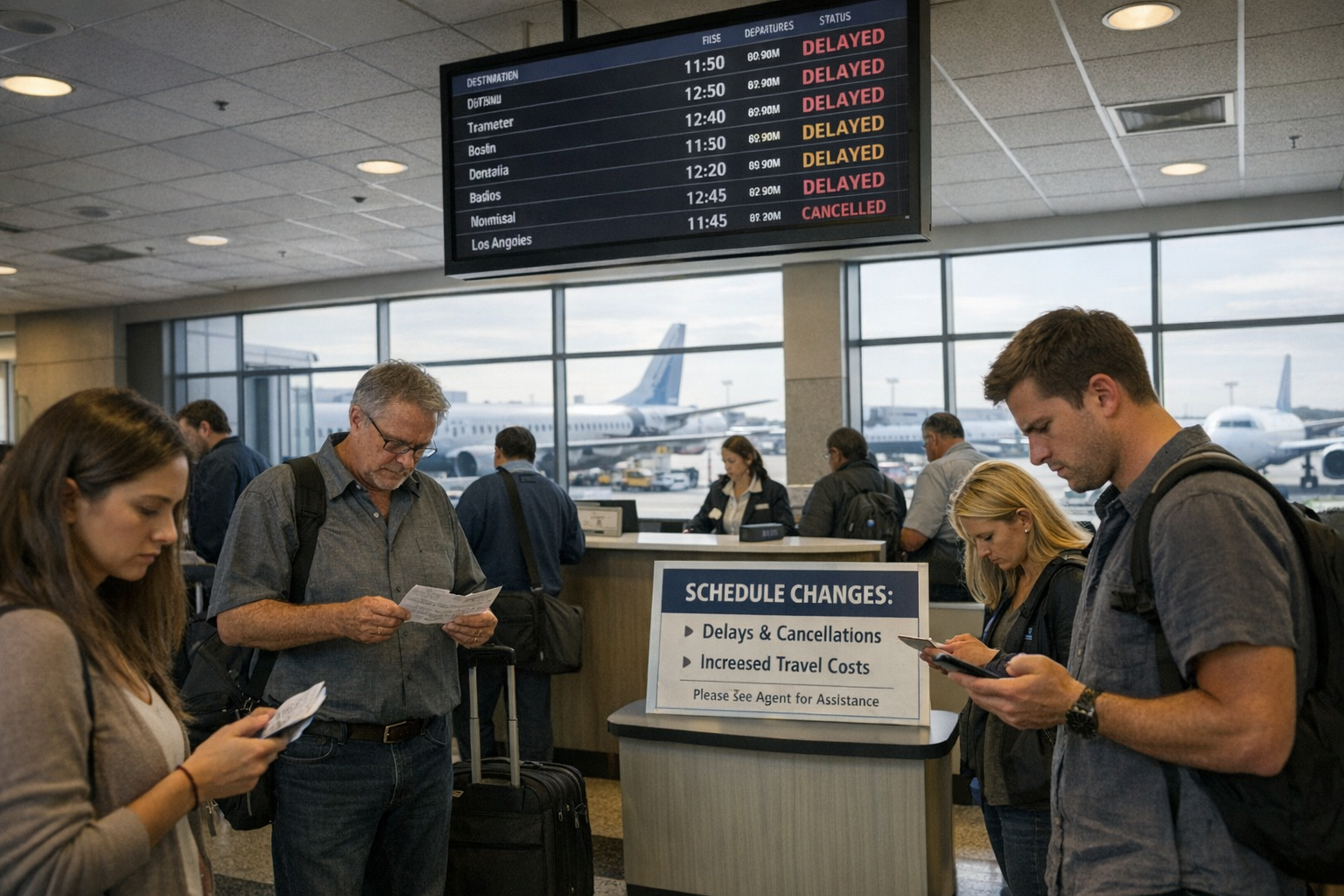
Fuel Shock Reaches the Departure Gate
The economic aftershocks of the war involving Iran are beginning to register in a more tangible place for consumers: summer travel plans.
Air Canada said it would suspend flights from Toronto and Montreal to New York’s John F. Kennedy International Airport from June 1 through Oct. 25, while continuing service to Newark and LaGuardia. The airline attributed the move to sharply higher fuel costs, saying jet-fuel prices had doubled since the conflict began. The route adjustment is one of the clearest signs yet that an energy shock initially felt in oil and shipping markets is now reshaping airline schedules and traveler choices.
In Britain, the pressure is showing up differently. Holiday operators say more people are inquiring about, and booking, domestic summer breaks, wary of possible flight cancellations, higher airfares and the prospect of wider disruption if aviation fuel supplies remain strained.
Together, the developments suggest that the conflict’s effect on global energy flows is no longer an abstract market story. It is becoming a kitchen-table calculation for families deciding whether to fly abroad and a balance-sheet problem for carriers already operating on thin margins.
A Chokepoint’s Global Reach
The immediate source of the turmoil has been the Strait of Hormuz, the narrow waterway through which roughly a fifth of the world’s traded oil passes. Disruption there has rattled global energy markets for weeks, pushing up the cost of crude and refined products, including jet fuel.
According to reporting by The Associated Press, jet fuel rose from about $99 a barrel in late February to as high as $209 in early April. The International Energy Agency’s executive director, Fatih Birol, warned that Europe had only “maybe six weeks or so” of jet fuel left if the disruption continued, underscoring the risk that supply stress could translate into broader cancellations.
Some of the immediate panic eased after Iran said on April 17 that the strait had reopened to commercial vessels, helping pull oil prices down from recent highs. But aviation fuel has remained well above prewar levels, and officials in Europe have cautioned that durable security for shipping has not yet been restored.
That uncertainty has left airlines and travelers planning for a summer in which the cost of flying may stay elevated even if the worst-case supply scenarios do not materialize.
Airlines Start to Trim
For airlines, fuel is often one of the largest operating costs, and sudden spikes can quickly turn marginal routes into unprofitable ones. That appears to be the calculation behind Air Canada’s decision to cut its JFK service while preserving flights to other New York-area airports.
Such moves may offer a preview of what comes next if fuel prices remain high: weaker or duplicative routes trimmed first, capacity shifted to stronger markets, and fares rising where airlines believe demand can absorb them.
The U.S. Energy Information Administration has said its April forecasts were shaped by the Hormuz disruption and associated outages, estimating that Gulf producers shut in 7.5 million barrels a day in March and 9.1 million barrels a day in April. Under those assumptions, Brent crude was expected to peak around $115 a barrel in the second quarter of 2026.
Even before any full-blown shortages, those price levels are enough to squeeze carriers. Airlines can hedge fuel costs or pass some increases on to passengers, but not instantly and not always completely. On short-haul leisure and competitive transatlantic routes, the room for error is limited.
British Travelers Look Closer to Home
In Britain, that squeeze is already influencing consumer behavior. Holiday park operators and domestic travel companies say they are seeing more interest from people considering vacations inside the United Kingdom rather than trips abroad.
The shift reflects a mix of practical and psychological concerns. Travelers are not only worried about paying more for flights; they are also increasingly anxious about whether those flights will operate as planned. Warnings about possible jet-fuel shortages, along with the visibility of route cuts and disruption elsewhere in Europe, have made the risks feel immediate.
For some families, the appeal of a domestic break is less about patriotism or nostalgia than predictability: a drive or train ride to a seaside town or holiday park may feel safer than booking flights that could be delayed, rerouted or canceled if energy markets seize up again.
That sort of substitution is precisely what economists look for when a geopolitical shock begins to spill into everyday spending. Households do not stop traveling altogether, but they alter where they go, how far they are willing to travel and how much uncertainty they are prepared to tolerate.
Why This Summer Matters
What makes this moment significant is not simply that fuel has become more expensive. It is that the increase is starting to change real-world decisions across the travel economy.
If the reopening of Hormuz holds and commercial traffic normalizes, the current disruption may prove temporary, with some airlines absorbing the hit and travelers adjusting around higher prices. But if the cease-fire frays and shipping restrictions return, more carriers could be forced to cut routes, raise fares or scale back summer schedules.
Iran was again signaling possible restrictions as the cease-fire neared expiration, according to reports on April 19, a reminder that the market calm remains fragile.
That leaves the industry in a tense holding pattern. Airlines must decide now how much capacity to fly in coming months, long before they know whether fuel markets will stabilize. Travelers, meanwhile, are being asked to commit money to summer plans in the face of uncertainty about both price and reliability.
For now, the early evidence is plain enough: a war-driven energy shock is no longer confined to oil terminals, tanker routes and commodities screens. It is beginning to reshape where people fly, whether they fly at all and how they plan to get away this summer.
Sources
Further reading and reporting used to add context:
- https://apnews.com/article/ab529b5f926a274ca7dc8ce3f1042b56
- https://apnews.com/article/0a637f98d588930f195f61cffe07d4f3
- Air Canada cuts summer flights to New York's JFK airport as fuel costs soar | AP News
- https://apnews.com/article/10518e69aecbb986c9118ff42ab0ca02
- https://www.axios.com/2026/04/17/hormuz-iran-oil-prices
- https://www.kiplinger.com/investing/stocks/dow-rises-868-points-amid-gulf-ceasefire-stock-market-today
- https://www.theguardian.com/business/2026/apr/19/britons-holiday-uk-summer-flights-iran-war
- https://www.theguardian.com/world/2026/apr/17/air-canada-suspending-flights-fuel-prices
- https://www.iru.org/news-resources/newsroom/war-pump-prices-still-way
- https://www.aol.com/articles/oil-prices-plunge-10-iran-134152765.html
- https://www.airhelp.com/en/flight-disruptions/jet-fuel-shortage-disrupts-uk-europe-flights-16042026/
- https://www.theguardian.com/world/live/2026/apr/17/middle-east-crisis-live-news-israel-lebanon-ceasefire-iran-war-us-latest-updates?filterKeyEvents=false&page=with%3Ablock-69e2f1048f08d396e256d9fc
- https://www.ogj.com/general-interest/economics-markets/article/55371760/oil-prices-decline-as-strait-traffic-resumes
- https://www.maritimenews.com/oil-prices-iran-war/iran-reopens-strait-hormuz-oil-prices-drop
- EIA Press Release (04/07/2026): Hormuz closure and related production outages are key drivers in EIA’s latest forecast
- https://uk.finance.yahoo.com/news/oil-prices-drop-sharply-global-142122745.html
- https://news.sky.com/story/mortgage-rates-inflation-latest-sky-news-money-live-blog-13040934
- https://www.aol.com/finance/oil-prices-plunge-iran-says-142808092.html
- https://en.wikipedia.org/wiki/2026_Strait_of_Hormuz_crisis
- https://en.wikipedia.org/wiki/Strait_of_Hormuz
- https://en.wikipedia.org/wiki/2026%E2%80%932028_world_oil_market_chronology
- https://en.wikipedia.org/wiki/Naval_blockade_of_Iran
- https://en.wikipedia.org/wiki/2026_Iranian_strikes_on_Oman
- Advice for travelers as the Iran war drives up fllight costs | AP News
- https://apnews.com/article/6e67fafd493861b3858de5548aa77703
- https://www.thedailybeast.com/trumps-war-sends-airlines-scrambling-in-mass-cancellations/
- https://www.aa.com.tr/en/us-israel-iran-war/air-canada-suspends-6-routes-citing-doubling-jet-fuel-prices-amid-iran-war/3910262
- https://www.theguardian.com/business/2026/apr/16/easyjet-profits-iran-war-bookings-fuel-prices-flights
- https://www.theguardian.com/business/2026/mar/23/easyjet-bookings-fall-iran-war-air-fare-rises-fuel-costs
- https://aviationweek.com/business-aviation/aircraft-propulsion/jet-fuel-prices-jump-april-2026-survey-shows
- https://www.investing.com/news/stock-market-news/easyjet-ceo-warns-ticket-prices-to-rise-as-iran-war-impacts-fuel-costs-93CH-4575395
- https://cincodias.elpais.com/companias/2026-03-23/easyjet-anuncia-nuevos-asientos-ultraligeros-y-una-subida-de-precios-para-verano-por-la-guerra-en-iran.html
- https://www.axios.com/2026/03/20/iran-war-flight-prices-air-travel-tips-cheaper
- https://www.ekathimerini.com/economy/1297852/uk-holiday-group-suspends-forecast-as-iran-war-hits-mediterranean-holiday-demand/
- https://www.airtraveler.club/news/air-canada-suspends-six-routes-fuel-prices/
- https://weather.airlines.org/dataset/argus-us-jet-fuel-index/
- https://www.itv.com/news/2026-04-02/flights-cancellations-begin-in-uk-due-to-impact-of-iran-war
- https://www.thenationalnews.com/business/aviation/2026/04/08/air-fares-to-surge-as-iran-war-drives-up-oil-prices/
- https://www.theguardian.com/travel/2026/apr/18/what-to-do-if-flights-cancelled-holidays-disrupted-iran-war-eu-ees
- https://www1.argusmedia.com/ArgusStaticContent/Resources/data/announcements/pdf/20260413jetfuel.pdf
- https://en.wikipedia.org/wiki/2026_Iran_war_fuel_crisis
- https://www.argusmedia.com/-/media/project/argusmedia/mainsite/english/documents-and-files/sample-reports/argus-jet-fuel.pdf?rev=1ca07079f9c343eea77f0ab2b9cece38
- https://www.flynaples.com/wp-content/uploads/New-Margin-Fuel-Price-Peak-Margin-03.31-04.06.26.pdf
- Iran doubles down on closing the Strait of Hormuz as the ceasefire nears expiration