
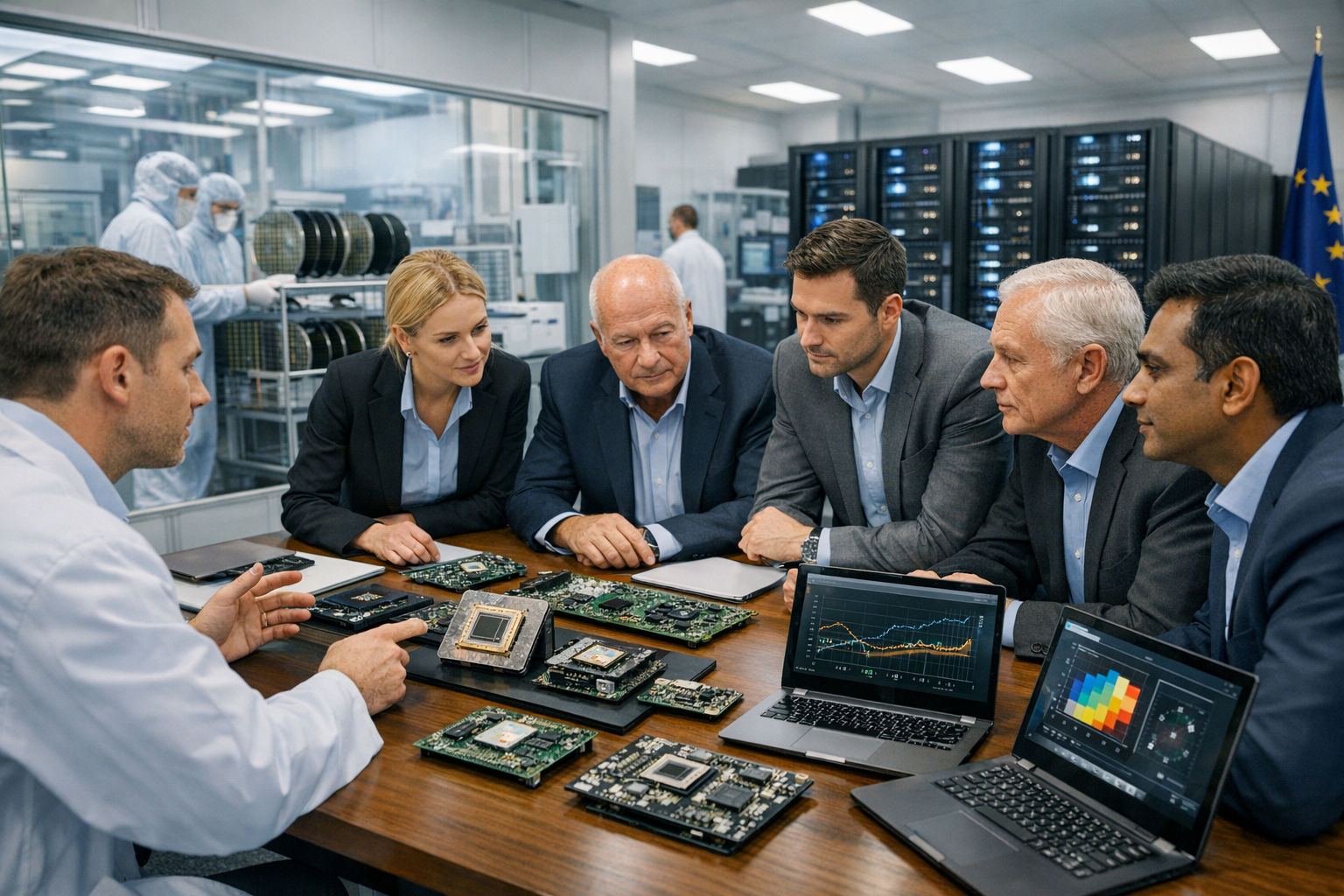
The rush to profit from artificial intelligence is no longer flowing to Nvidia alone.
A widening group of chip start-ups, particularly those promising cheaper and more power-efficient ways to run AI systems, is drawing fresh investor money as customers search for alternatives to Nvidia’s dominant graphics processing units. The shift suggests that the AI semiconductor boom is entering a new phase: broader, more competitive and potentially more fragile.
Globally, AI-chip start-ups have raised a record $8.3 billion in 2026, according to figures cited in recent reporting, underscoring how investors are increasingly willing to place bets beyond the industry’s central winner. In Europe, that momentum has become especially visible. Euclyd, a Dutch company focused on inference chips — the processors used to run trained AI models in real-world applications — said it is seeking at least €100 million to expand production. Another European player, Axelera AI, said in February that it had raised more than $250 million.
The surge in financing reflects a growing conviction that the next big opportunity in AI hardware may not come from trying to replicate Nvidia’s full product ecosystem, a task that would require immense capital and years of software development. Instead, many challengers are pursuing narrower targets: inference, edge deployment and energy efficiency.
A more crowded race
That strategy is a recognition of Nvidia’s enduring strength. The company remains the dominant supplier of AI accelerators used to train and run large models, supported not only by leading chips but also by a deeply entrenched software platform that has proved difficult for rivals to match.
But as AI moves from model-building to widespread deployment, the economics of running those systems are becoming harder to ignore. Inference workloads, which can consume vast amounts of computing power once AI applications are in production, are emerging as a particularly attractive niche for newcomers. Companies that can offer lower-cost, lower-power chips for those tasks may find an opening even if Nvidia keeps its hold on the high end of the market.
That is the promise being sold by many of the new entrants. Euclyd has argued that Europe needs more control over critical AI hardware, casting its pitch in strategic as well as commercial terms. Axelera, meanwhile, has promoted its AI acceleration technology while benefiting from a broader European push to build more sovereign computing capacity, including support tied to regional supercomputing initiatives.
Europe’s sovereignty push
The renewed investor interest also fits with a wider political mood in Europe, where governments and policymakers have become increasingly concerned that the infrastructure underpinning AI — from cloud platforms to semiconductors — is concentrated in too few American and Asian companies.
For European start-ups, that concern can be an advantage. The case for backing a domestic chip company is no longer only about financial return; it is also tied to industrial policy, supply-chain resilience and geopolitical autonomy. In that sense, the race to develop AI semiconductors has become part of a larger effort by Europe to secure a foothold in technologies that many governments now regard as strategically essential.
Still, turning that ambition into a viable chip business remains difficult. Designing advanced processors is expensive. Manufacturing them requires access to scarce foundry capacity. And even when prototypes work, scaling production and winning major customers can take years.
That is especially true for companies making bold efficiency claims before their products have been tested at scale. Euclyd’s proposed gains, for example, have yet to be widely validated in commercial deployment, and its first deliveries may not come until next year or later.
The gatekeepers still matter
Even as capital spreads to newer players, the fortunes of the AI-chip industry still run through a handful of critical suppliers.
Taiwan Semiconductor Manufacturing Company, the world’s dominant contract chipmaker, reported $35.9 billion in revenue for the first quarter of 2026 and forecast second-quarter sales of $39 billion to $40.2 billion, evidence that demand for advanced computing remains robust. ASML, the Dutch maker of the lithography machines needed to produce cutting-edge chips, reported €8.8 billion in first-quarter sales and lifted its 2026 sales outlook to between €36 billion and €40 billion.
Those results point to strong underlying demand across the AI supply chain. Yet investors have reacted with some restraint, a sign that enthusiasm for the sector is now colliding with elevated expectations. Strong earnings alone may no longer be enough to lift chip stocks if markets are already pricing in years of rapid expansion.
That tension may prove crucial in the months ahead. TSMC and ASML are often treated as bellwethers because nearly every serious AI-chip effort, from established giants to venture-backed start-ups, ultimately depends on manufacturing and equipment capacity they help control. If sentiment around those companies turns more cautious, it could ripple across the broader sector.
A boom with sharper edges
There are other reasons for caution. ASML has said demand remains strong and customers continue expanding capacity, but it has also warned that its 2026 outlook must account for possible export-control outcomes. That caveat is a reminder that geopolitics still hangs over the semiconductor business, where trade restrictions, national security rules and tensions between the United States and China can quickly alter the market.
The next question is whether today’s influx of money will produce durable competitors or simply a larger field of hopefuls. Many AI-chip start-ups are chasing the same themes — efficiency, inference, specialized workloads — but only a few are likely to secure the software support, manufacturing scale and customer trust needed to survive.
What is clear already is that the AI-chip story is becoming more complicated. Nvidia remains at the center, but the market around it is thickening, with new companies, new financing and new political priorities reshaping the field. For investors and customers alike, that means more choice than before — and more uncertainty about who will emerge when the boom moves from promise to proof.
Sources
Further reading and reporting used to add context:
- https://apnews.com/article/624137ae5b2a5bfe9ca2ccfc648b5dc1
- https://apnews.com/article/c62e3c9102f5ddd4969f3741235ea79d
- https://www.gurufocus.com/news/8800224/euclyd-seeks-100m-funding-to-compete-with-nvidia-in-ai-chip-market
- https://www.itpro.com/hardware/eu-inaugurates-nanoic-facility-for-next-generation-chips
- https://www.techradar.com/pro/asml-invests-usd1-5-billion-in-openais-european-rival-mistral-ai-to-accelerate-future-chip-design
- https://semiconductorsinsight.com/ai-chip-startups-2026-semicon-startups-weekly-issue-1/
- https://www.investing.com/news/stock-market-news/5-big-analyst-ai-moves-price-target-hikes-for-tsmc-sap-asml-upgraded-to-buy-4227151
- https://www.objectwire.org/tech/news/tsmc-asml-record-earnings-q1-2026-ai-chip-demand
- https://en.wikipedia.org/wiki/Axelera_AI
- https://en.wikipedia.org/wiki/Etched_%28company%29
- https://www.linkedin.com/pulse/tsmc-hits-61-profit-surgebut-chip-wars-heat-up-lewis-bertolucci-sru7c
- https://aicodeinvest.com/semiconductor-ai-industry-outlook-2026/
- https://www.mckinsey.com/industries/semiconductors/our-insights/the-next-era-of-semiconductor-value-creation
- https://www.linkedin.com/posts/cnbc-international_asian-chip-stocks-climbed-friday-lifting-activity-7417751964962308096-0B36
- https://www.berenberg.de/uploads/web/Asset-Management/News-EN/Spotlight/2025/Spotlight_Global-Equities-The-next-growth-phase-of-AI_2025-07-17-113506_ulzl.pdf
- https://www.ainvest.com/news/tsmc-earnings-beat-tactical-setup-chip-stocks-2601/
- https://www.asml.com/en/news/press-releases/2026/q1-2026-financial-results
- https://investor.tsmc.com/english/quarterly-results
- https://investor.tsmc.com/english/encrypt/files/encrypt_file/qr/phase4_reports/2026-04/bd8eb0403902fdea59a2f5e390e48d010b50edc9/1Q26%20EarningsRelease_WoG.pdf
- https://www.asml.com/en/en/investors/financial-results
- https://www.cnbc.com/2025/08/20/gates-nvidia-fieldai-robotics.html
- https://www.cnbc.com/2025/07/29/samsung-backs-ai-chip-startup-rebellions-ahead-of-ipo.html
- https://www.cnbc.com/2025/06/26/nvidia-shares-rally-overnight-lifts-asian-chip-stocks.html
- https://www.cnbc.com/2025/07/29/europe-sets-its-sights-on-multi-billion-euro-gigawatt-ai-factories.html
- https://investor.tsmc.com/english/encrypt/files/encrypt_file/reports/2026-04/1ae082559fd78636d9bed2355ce711fbd7be1bd4/1Q26%20Presentation%20%28E%29.pdf
- https://investor.tsmc.com/english/financial-calendar
- https://www.asml.com/en/investors/annual-report/2025/financials
- https://www.cnbc.com/2025/02/11/eu-says-ai-race-far-from-over-as-bloc-pledges-50-billion-euro-investment.html
- https://investor.tsmc.com/english/encrypt/files/encrypt_file/reports/2025-04/7630274eecc1197a4e3ea6a415f44a47204fe10a/TSMC%201Q25%20Transcript.pdf
- https://investor.tsmc.com/english/encrypt/files/encrypt_file/qr/phase4_reports/2026-04/9f060092ba29ff3630cfdaefd67774026195e135/1Q26ManagementReport.pdf
- https://www.cnbc.com/2025/06/12/chinas-racing-to-beat-us-chip-curbs-how-its-supply-chain-stacks-up.html
- https://www.cnbc.com/2025/07/07/ai-chip-startup-groq-expands-with-first-european-data-center.html
- https://investor.tsmc.com/english/encrypt/files/encrypt_file/reports/2026-01/51d09df96cd89ac19d65af39032b038dc2896a24/TSMC%204Q25%20Transcript.pdf
- https://www.tomshardware.com/tech-industry/artificial-intelligence/openai-raises-110-billion-in-largest-ever-private-tech-funding-round
- https://inforcapital.com/news/march-2026s-top-10-european-tech-deals-you-need-to-know-about/
- https://www.forbes.com/sites/jonmarkman/2026/02/10/nvidias-53-billion-investment-spree-on-ai-startups/
- https://news.crunchbase.com/venture/funding-picked-up-ai-led-europe-q1-2026/
- https://aifundingtracker.com/ai-startup-funding-news-today/
- https://mrkt30.com/europes-10-most-valuable-ai-startups-to-watch-in-2026/
- https://en.wikipedia.org/wiki/CoreWeave
- https://www.aibusinessreview.org/2026/03/12/us-capital-drives-european-ai-funding-record-2026/
- https://newmarketpitch.com/blogs/news/ai-chip-funding-news
- Eindhoven-based Euclyd targets €100 million funding round for AI chip expansion | NL Times
- https://en.wikipedia.org/wiki/Thinking_Machines_Lab
- https://en.wikipedia.org/wiki/OpenAI
- https://techfundingnews.com/biggest-dutch-startup-funding-rounds-2025/
- https://nltimes.nl/2025/12/07/eindhoven-start-euclyd-unveils-ai-chip-uses-100-times-less-energy
- https://qubit.capital/blog/europe-seed-weekly-funding-roundup-week-3-march-2026
- https://en.wikipedia.org/wiki/Starcloud
- https://www.reddit.com/r/Mag7shares/comments/1so5in3/nvidia_ai_chip_rivals_attract_record_funding_as/
- https://de.wikipedia.org/wiki/XAI
- https://table.media/assets/briefings/security/documents/20260325_docs_2026-european-deep-tech-report.pdf
- https://www.reddit.com/r/Startups_EU/comments/1r62aho/weekly_startinvestment_repot/
- https://aisecwatch.com/
- https://creati.ai/ai-news/2026-04-17/nvidia-ai-chip-rivals-record-funding-competition/
- https://www.marketbeat.com/instant-alerts/filing-bxm-wealth-llc-has-2524-million-position-in-nvidia-corporation-nvda-2026-04-18/
- Nvidia AI chip rivals attract record funding as competition heats up
- https://worldalert.org/
- https://www.marketbeat.com/instant-alerts/filing-braun-stacey-associates-inc-has-20807-million-position-in-nvidia-corporation-nvda-2026-04-18/
- https://investorshub.advfn.com/stock-market/NASDAQ/radyne-corp-mm-RADN/stock-price
- https://www.advfn.com/stock-market/NASDAQ/TRNC/financials
- https://www.advfn.com/stock-market/KOSDAQ/115440/news
- https://blog.donweb.com/noesfake-5-noticias-tech-que-parecen-joda-pero-pasaron-posta/
- https://ca.advfn.com/options/NYSE/LCII/LCII250815P00085000/quote
- https://ca.advfn.com/options/NASDAQ/URNJ/URNJ250815P00022000/quote
- https://www.benzinga.com/markets/earnings/26/04/51828287/advanced-chip-equipment-maker-asml-says-it-can-accommodate-export-controls
- https://finance.yahoo.com/markets/stocks/articles/tsmc-q1-2026-earnings-record-121456920.html
- https://www.investing.com/news/stock-market-news/tsmc-shares-fall-amid-profittaking-after-record-q1-earnings-4619716
- https://coincentral.com/tsmc-tsm-crushes-q1-estimates-so-why-is-the-stock-falling/
- https://www.bloomberg.com/news/articles/2025-04-16/nvidia-supplier-stocks-drop-on-latest-china-export-restrictions
- https://fortune.com/2025/07/16/asml-cannot-confirm-growth-in-2026-wiping-out-30-billion/
- https://finance.yahoo.com/news/asml-stock-rises-after-earnings-beat-as-ceo-says-deepseek-will-drive-ai-chip-demand-higher-134704766.html
- https://www.investing.com/news/stock-market-news/wall-st-futures-rise-as-tsmc-sparks-semiconductor-rally-financial-earnings-on-deck-4449024
- https://www.ainvest.com/news/tsmc-shares-fall-4-45-pre-market-investor-caution-builds-earnings-report-2601/
- https://www.fxleaders.com/news/2026/04/16/tsmc-q1-revenue-raises-to-35-9b-but-stock-falls-on-slow-mfg-expansion-despite-brighter-outlook/
- https://finance.yahoo.com/news/asmls-third-quarter-bookings-above-051227435.html
- https://www.tomshardware.com/tech-industry/asml-workers-still-in-the-dark-seven-weeks-after-1700-management-cuts-announced
- https://www.tomshardware.com/tech-industry/semiconductors/asml-is-prepared-for-chinas-rare-earth-export-controls-finance-head-says-company-has-stock-thanks-to-long-lead-times
- https://www.techi.com/tsmc-q1-2026-earnings-report/
- https://www.reddit.com/r/ASML/comments/1sfl1xn/asml_stock_drops_as_us_considers_tighter_china/
- https://www.reddit.com/r/StocksTool/comments/1snritj/tsmc_profits_surge_58_banks_smash_q1_while/
- https://www.reddit.com/r/TSMC/comments/1sn1vvm/tsmcpostearnings_surge_or_buy_the_rumor_sell_the/
- https://axelera.ai/news/axelera-ai-secures-more-than-250-million-funding-on-global-commercial-growth
- https://tech.eu/2025/03/06/axelera-ai-raises-61-6m-and-unveils-high-performance-ai-chiplet/
- https://www.eetimes.com/axelera-raises-250m-in-largest-eu-semi-round-ever/
- https://axelera.ai/news/axelera-ai-raises-68-million-series-b-funding-to-accelerate-next-generation-ai
- https://finance.yahoo.com/news/european-ai-chip-startup-axelera-181608416.html/
- https://www.bloomberg.com/news/articles/2025-08-21/samsung-backed-chipmaker-axelera-ai-looks-to-raise-150-million
- https://www.unite.ai/axelera-ai-raises-more-than-250-million-in-new-funding-round-to-scale-edge-ai-infrastructure/
- https://community.axelera.ai/product-updates/axelera-ai-looking-back-on-2025-1184
- https://finance.yahoo.com/news/uk-chipmaker-fractile-plans-136-000558180.html/
- https://greekcitytimes.com/2026/02/27/greek-diaspora-startups-axelera-ai-250m-funding-2026/
- https://axelera.ai/eu-funding
- https://polyn.ai/wp-content/uploads/2025/07/Silicon-100_2025.pdf
- https://www.rothschildandco.com/siteassets/publications/rothschildandco/global_advisory/2026/geu/mar—edition-48/geu-48-march.pdf
- https://en.wikipedia.org/wiki/European_High-Performance_Computing_Joint_Undertaking
- https://www.americanactionforum.org/print/?url=https%3A%2F%2Fwww.americanactionforum.org%2Finsight%2Fthe-next-phase-of-ai-technology-infrastructure-and-policy-in-2025-2026%2Fai-funding%2F%3Fprint
- https://ieu-monitoring.com/wp-content/uploads/2025/11/Startups_driving_Europes_AI_transformation_2i1aD0ZaWmHHvZSMKSdpYOjI_121507.pdf
- https://www.reddit.com/r/jobboardsearch/comments/1mcd7hu
- https://www.reddit.com/r/u_Greekcitytimes/comments/1rfr7vw/greek_diaspora_startups_axelera_ai_secures_250m/
- https://www.aixtron.com/investoren/publikationen/ir-praesentationen/2025/AIXA%20FY-2025%20Results%20Presentation.pdf
- https://www.reddit.com/r/BlackberryAI/comments/1rg99ny/open_ai_print/
- https://riscv-europe.org/summit/2025/media/proceedings/2025-05-13-RISC-V-Summit-Europe-09h15-GALLO-slides.pdf