
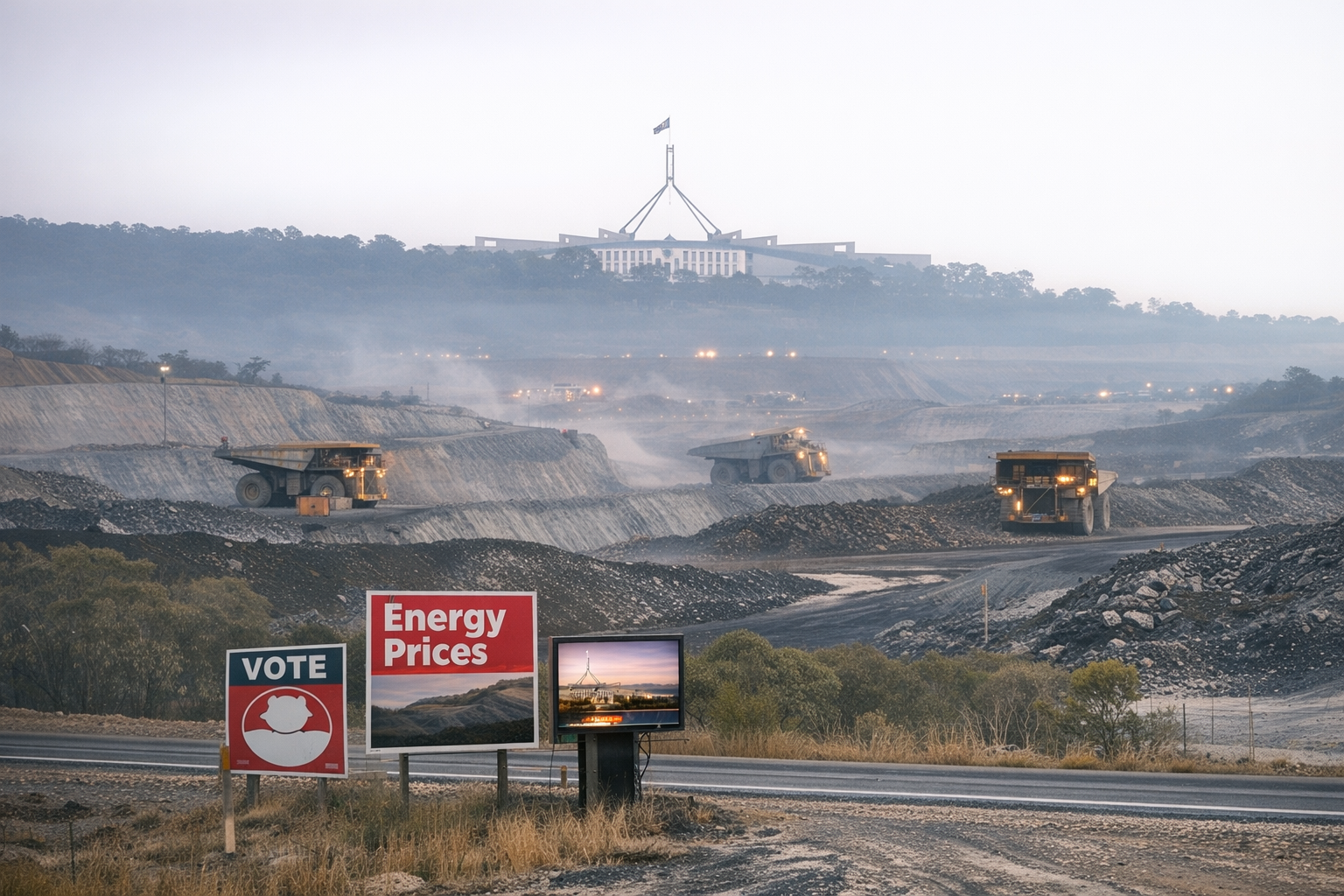
A coal campaign network and rising mine emissions put Australia’s climate politics under a harsher light
Australia’s debate over energy and climate policy has been thrust into a new phase of scrutiny, as fresh election funding disclosures and newly released emissions data sharpen questions about the power of the coal industry in both politics and regulation.
On one front, disclosures show that Energy for Australians, a group that described itself during the 2025 federal election as an independent, community-based association, was funded entirely by Coal Australia, an industry lobby representing major coal producers. On another, government data indicates that emissions from Australian coal mines rose in the last financial year even under the Albanese government’s flagship industrial climate policy, with most coal mines exceeding their facility baselines and turning to offsets or other compliance mechanisms.
Taken together, the developments present an uncomfortable picture for a government that has sought to portray itself as both more transparent and more ambitious on climate than its predecessor: coal interests remain deeply embedded in the political fight over energy prices, while methane-heavy mine emissions are still climbing inside a system designed to force them down.
Funding disclosures reopen questions about “independence”
Annual disclosure returns published by the Australian Electoral Commission have cast new light on election-period campaigning by third parties, a part of Australian politics that has increasingly drawn attention for its ability to influence voters without formally being part of a political party structure.
The filings show that Energy for Australians received A$1,083,061 from Coal Australia and reported A$803,495 in electoral spending. During the campaign, the group ran ads on Meta urging voters to “switch off Labor,” framing the contest around electricity prices and energy policy.
The arrangement is likely to intensify criticism from transparency advocates and political opponents who say such groups can create the appearance of broad grassroots sentiment while being financed by concentrated industry interests — a practice often described by critics as astroturfing.
Coal Australia has rejected that characterization. But the disclosures have nonetheless revived broader concerns about whether Australia’s rules governing third-party political campaigning adequately tell voters who is behind the messages flooding their feeds during an election.
The timing matters. The AEC data, published in February and covering transactions from July 2024 through June 2025, offers the clearest official accounting yet of money moving through election-adjacent campaigns during the period leading up to and including the federal contest. It also lands amid longstanding calls in Parliament, including from Senate inquiries, for tighter transparency around political influence exercised outside the party system.
A flagship climate policy, but coal emissions are still rising
At the same time, the Albanese government is facing new pressure over whether its central industrial emissions policy is working as intended in one of the country’s most politically sensitive sectors.
Data released by the Clean Energy Regulator for 2024-25 shows that emissions covered by the Safeguard Mechanism fell overall to 132.8 million metric tons of carbon dioxide equivalent. The scheme, overhauled in 2023, applies to Australia’s largest industrial facilities and is meant to reduce emissions over time by imposing declining baselines on each site.
In aggregate, the program still appears highly compliant: 205 of 208 covered facilities met the deadline, and companies surrendered 13.4 million units to do so. Some facilities also used flexibility provisions, including borrowing, trade-exposed adjustments and multi-year monitoring.
But beneath those headline figures, the coal sector is moving in the opposite direction. Emissions from coal mining increased in 2024-25, and they rose faster than production, suggesting a worsening in emissions intensity rather than merely an expansion in output. Analysis of the regulator’s data found that roughly 80 percent of coal mines emitted above their site baselines and relied on offsets or other flexibilities to remain compliant.
That matters because coal mine pollution is heavily driven by methane, a greenhouse gas that traps far more heat than carbon dioxide over the short term. Cutting methane emissions is widely seen by climate scientists as one of the fastest ways to slow warming in the near future. If mine methane continues to rise while facilities technically comply on paper, critics argue, the credibility of the policy is at risk.
Compliance on paper, pressure in practice
The Safeguard Mechanism was one of the centerpieces of Labor’s climate agenda after taking office, and its redesign in 2023 was intended to turn what had been a weak framework into a genuine constraint on industrial pollution. The government argued that steadily declining baselines, backed by trading and offset rules, would deliver meaningful reductions while preserving investment certainty.
The latest data suggests the answer may depend on where one looks.
Across the economy, the scheme is delivering formal compliance and some aggregate emissions reduction. But in coal mining, where methane measurement is complex and abatement can be costly, the policy’s flexibility is coming under increasing scrutiny. Environmental groups and some policy analysts say offsets and other compliance tools may be masking deterioration at the facility level, allowing one of the most emissions-intensive sectors to postpone real operational cuts.
That tension is likely to become more politically charged as Australia tries to reconcile its climate commitments with its continued role as one of the world’s largest coal exporters. For years, successive governments have defended the coexistence of ambitious emissions targets and an expanding fossil fuel industry by arguing that domestic climate policy and export markets are separate matters. The latest disclosures and emissions figures make that separation harder to sustain.
Why this matters now
The twin revelations land at a sensitive moment for the Albanese government. Cost-of-living concerns and electricity prices remain potent political issues, making energy messaging especially powerful during elections. At the same time, Labor has sought to maintain support from climate-conscious voters while avoiding a frontal clash with the resources sector, which remains economically influential and politically organized.
The funding disclosures suggest the coal industry’s role in shaping that debate may be more direct and coordinated than campaign audiences were led to believe. The emissions data, meanwhile, raises questions about whether the government’s most important emissions-cutting policy is producing real-world improvement in the sectors where reductions are hardest and most urgent.
Both issues may now feed into looming policy fights. There is uncertainty over whether the government will pursue tougher disclosure rules for third-party campaign groups, despite repeated calls for greater transparency. And in climate policy, the Clean Energy Regulator has flagged a review of baseline settings and other design features for 2026-27 — a process that could become a focal point for arguments over whether coal mines should face tighter limits on offsets and stronger pressure to cut methane at source.
For now, the new evidence does not show that Australia’s climate framework is failing across the board, nor does it prove improper conduct in election campaigning. But it does underscore a deeper vulnerability in the country’s politics: even as Australia claims progress on emissions and democratic accountability, the coal industry continues to exert influence in ways that are increasingly difficult to ignore.
Sources
Further reading and reporting used to add context:
- Safeguard data | Clean Energy Regulator
- ‘Independent’ group Energy for Australians that ran anti-Labor ads received more than $1m from coal lobby | Energy | The Guardian
- https://cer.gov.au/markets/reports-and-data/quarterly-carbon-market-reports/quarterly-carbon-market-report-december-quarter-2025/australian-environmental-markets
- https://www.spglobal.com/energy/en/news-research/latest-news/energy-transition/041526-surrenders-rise-58-in-australias-safeguard-mechanism-for-2024-25-smc-use-up
- https://region.com.au/safeguard-mechanism-bringing-down-carbon-emissions-clean-energy-regulator-finds/958416/
- https://www.theguardian.com/australia-news/2026/feb/05/australia-2025-election-donors-mining-clive-palmer
- https://cer.gov.au/news-and-media/media/2025/february/latest-report-shows-australian-government-schemes-working-to-reduce-emissions
- https://aec.gov.au/
- https://climateintegrity.org.au/latest/coal-and-gas-2025-election-donations
- https://www.abc.net.au/news/2025-02-03/aec-reveals-donors-to-politicians-and-political-parties/104890444
- https://carbonly.ai/blog/safeguard-mechanism-2026-changes
- https://www.envirolink.org/2026/02/04/coal-industry-lobby-secretly-funded-3-9-million-attack-campaign-against-climate-friendly-australian-political-candidates/
- https://en.wikipedia.org/wiki/Domestic_Gas_Reservation_Scheme_Australia_2027
- https://www.parliament.wa.gov.au/publications/tabledpapers.nsf/displaypaper/4211043c579487be019e362948258db8000062e0/%24file/tp-1043.pdf
- https://en.wikipedia.org/wiki/Jason_Falinski
- https://energyresourceinsights.com/wp-content/uploads/2022/12/Safeguard-mechanism-report-221219.pdf
- https://en.wikipedia.org/wiki/Clean_Energy_Finance_Corporation
- https://www.reddit.com/r/OpenAussie/comments/1qtjdj7/coal_industry_and_gina_rinehart_the_biggest/
- https://www.greenpeace.org.au/static/planet4-australiapacific-stateless/2024/01/c6e2105b-dirty-power-burnt-country_report_final.pdf
- https://en.wikipedia.org/wiki/Select_Committee_on_Nuclear_Energy
- https://www.aec.gov.au/Parties_and_Representatives/financial_disclosure/guides/donors/
- https://www.aec.gov.au/Parties_and_Representatives/annual-returns.htm
- https://aec.gov.au/FADReform/factsheets/annual-returns.htm
- https://www.aec.gov.au/Parties_and_Representatives/financial_disclosure/forms/files/2024/annual-donor-disclosure-return-organisations-2023-24.pdf
- https://www.aec.gov.au/Parties_and_Representatives/financial_disclosure/guides/files/2025/Financial%20Disclosure%20Guide%20for%20Annual%20Donors%202024-25.pdf
- https://www.aec.gov.au/Parties_and_Representatives/financial_disclosure/forms/associated.htm
- https://transparency.aec.gov.au/AnnualDonor/ReturnDetail?returnId=82589
- 2024-25 annual financial disclosure return information published today
- https://transparency.azure.aec.gov.au/AnnualDonor
- https://emailfooter.aec.gov.au/Parties_and_Representatives/financial_disclosure/forms/donors-election-forms.htm
- https://emailfooter.aec.gov.au/Parties_and_Representatives/compliance/files/Compliance%20review%20report%20%E2%80%93%202018-19%20-%20Construction%2C%20Forestry%2C%20Maritime%2C%20Mining%20and%20Energy%20Union.pdf
- https://transparency.aec.gov.au/ClientEntity/EntityDetail?clientIdentifier=18051&clientType=organisationdonor
- https://aec.gov.au/Enrolling_to_vote/Enrolment_stats/national/
- https://www.aec.gov.au/Parties_and_Representatives/financial_disclosure/guides/donors/files/donors-2023-24.pdf
- https://www.aec.gov.au/About_AEC/Publications/annual-report/files/aec-annual-report-2024-25.pdf
- https://aec.gov.au/Enrolling_to_vote/Enrolment_stats/
- https://transparency.aec.gov.au/AnnualDonor
- https://transparency.aec.gov.au/ReferendumDonor/ReturnDetail?returnId=66965
- https://transparency.aec.gov.au/ReferendumDonor/ReturnDetail?returnId=67774
- https://transparency.aec.gov.au/Donor/ReturnDetail?eventId=31496&returnId=80329
- https://transparency.aec.gov.au/ReferendumDonor/ReturnDetail?returnId=67484
- https://transparency.aec.gov.au/AnnualDonor/ReturnDetail?returnId=83219
- https://transparency.aec.gov.au/ClientEntity/EntityDetail?clientIdentifier=29205&clientType=general
- https://transparency.aec.gov.au/AnnualSignificantThirdParty/ReturnDetail?returnId=66370
- https://transparency.aec.gov.au/ReferendumDonor/ReturnDetail?returnId=67581
- https://transparency.aec.gov.au/ClientEntity/EntityDetail?clientIdentifier=29004&clientType=general
- https://transparency.aec.gov.au/AnnualDonor/ReturnDetail?returnId=82818
- 2024–25 Safeguard Mechanism data insights