
A Fragile Truce Faces Its Sharpest Test Yet
The month-old ceasefire between the United States and Iran came under its most serious strain yet after the two sides exchanged fire in and around the Strait of Hormuz, a confrontation that jolted oil markets, unsettled investors across Asia and underscored how precarious calm in the Gulf has become.
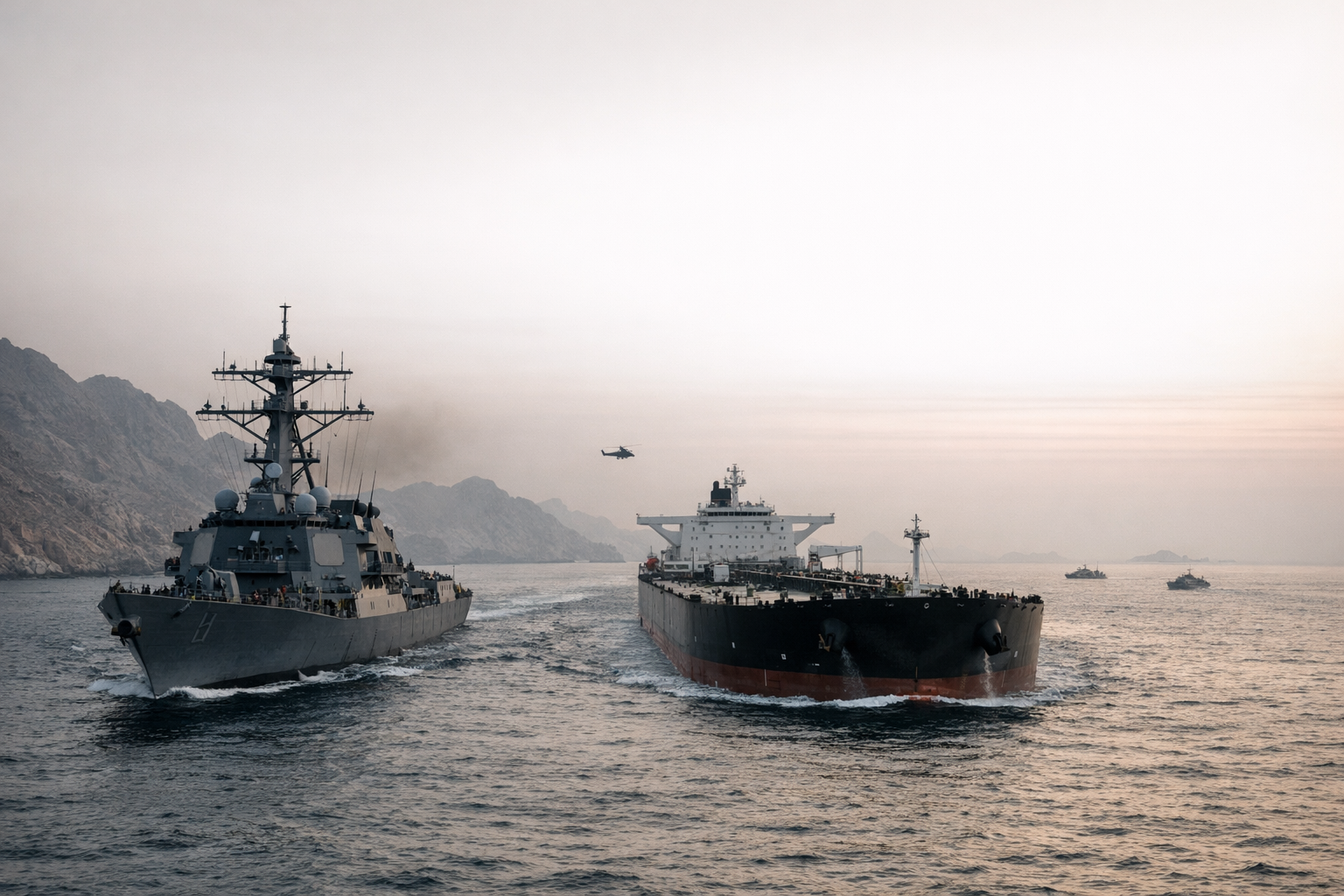
The clash late Thursday involved some of the most concrete military action since the truce took effect in early April. According to U.S. Central Command, Iranian forces launched missiles, drones and small boats at three American destroyers transiting the strait, the narrow waterway through which a significant share of the world’s seaborne oil passes. The American ships were not hit, CENTCOM said, and U.S. forces responded with what it described as “self-defense strikes” on Iranian military sites.
Iran offered a starkly different version, accusing Washington of breaking the ceasefire first by striking ships and civilian areas and portraying its own actions as retaliation. Neither account could be independently verified, leaving the immediate trigger for the confrontation in dispute even as the broader consequences were already rippling outward.
President Trump and other U.S. officials insisted publicly that the ceasefire remained in force. Iranian state television also signaled that the situation had returned to normal. But the exchange laid bare how easily the truce can be shaken in the Gulf’s most sensitive corridor.
A Chokepoint at the Center of the Crisis
Few places carry greater strategic weight than the Strait of Hormuz. The narrow passage links the Persian Gulf to global markets, and even limited military action there can send immediate shock waves through energy prices, shipping insurance and investor sentiment.
That is what happened again after Thursday’s exchange. Brent crude climbed back above $100 a barrel as traders weighed the possibility that hostilities around the waterway could intensify or further disrupt shipping. Asian markets mostly fell on Friday, reflecting anxiety that what had been treated in recent weeks as a contained postwar standoff might be sliding toward a broader confrontation.
The renewed volatility is especially significant because the ceasefire had never fully stabilized the waterway. The truce was announced in Washington on April 7 and took effect in the region the next day, but it left the central disputes between the two countries unresolved. Reuters has reported that the strait has been virtually shut since the war began on Feb. 28, a severe constraint on commerce that has heightened pressure on governments, shippers and energy markets alike.
In Washington, officials have tried to project continuity rather than collapse. This week the United States began “Project Freedom,” a naval escort operation intended to help reopen Hormuz to commercial traffic. American officials have also said Iran has repeatedly harassed commercial vessels and U.S. forces since the ceasefire began, though those encounters had previously remained below the threshold that Pentagon officials said would trigger a return to major combat.
Thursday’s exchange appeared to move closer to that line than any previous incident.
Conflicting Claims, Unresolved Risks
The central question — who fired first — remains unanswered. That uncertainty matters not only for assigning blame, but also for determining whether the latest clash will be treated as a violation grave enough to unravel the truce.
For now, both governments appear to be trying to preserve some room for de-escalation, even while accusing the other of bad faith. Washington’s insistence that the ceasefire is still intact suggests that the Trump administration is reluctant, at least for the moment, to declare the arrangement dead. Tehran, too, has paired its accusations with signals that it does not want the encounter to spiral immediately into full-scale war.
But the underlying tensions have only grown more dangerous. The United States is now actively escorting shipping through a passage that Iran has long viewed as central to its leverage. Iran, for its part, must decide whether it will tolerate that effort or continue testing it. Each new interception, warning shot or retaliatory strike increases the odds of a miscalculation.
That danger extends beyond Washington and Tehran. Gulf states have already been on alert, and the longer instability persists around Hormuz, the greater the chance that commercial crews, neighboring countries or third-party naval forces could be drawn into a widening conflict.
Why This Moment Matters
What makes the latest exchange particularly consequential is not simply that shots were fired, but that they were fired after both sides had spent weeks portraying the ceasefire as bruised but intact. The truce was meant to prevent exactly this kind of encounter at the most combustible point in the region.
Instead, the episode has exposed a ceasefire that may exist politically but only weakly on the water.
If the latest clash is ultimately treated as another contained breach, the truce may limp on, punctuated by periodic confrontations and continued disruption to shipping. If either side decides the threshold has been crossed, however, the incident in the Strait of Hormuz could come to be seen not as an isolated flare-up but as the beginning of the ceasefire’s collapse.
For markets, shipping companies and governments dependent on Gulf energy flows, that ambiguity is itself destabilizing. For the United States and Iran, it leaves the same unresolved question that has haunted the ceasefire from the start: whether diplomacy can still produce a broader settlement before the next exchange of fire becomes harder to contain.
Sources
Further reading and reporting used to add context:
- https://www.axios.com/2026/05/07/us-iran-hormuz-strait-fire-exchange
- https://apnews.com/article/73fd3ca47f6c19a736993b45310afcac
- https://apnews.com/article/6490db55a65880a61a6233eff7acc68b
- https://www.thedailybeast.com/peace-president-trumps-ceasefire-gets-blown-up-in-dramatic-escalation/
- Asian stocks retreat as attacks threaten the shaky Iran ceasefire | AP News
- https://www.axios.com/2026/05/05/iran-strait-hormuz-operation-trump-warning
- https://www.centcom.mil/MEDIA/PRESS-RELEASES/Year/2026/
- https://www.theguardian.com/world/live/2026/may/07/middle-east-crisis-iran-trump-us-negotiations-deal-war-peace-proposal-hormuz-latest-news-updates?filterKeyEvents=false&page=with%3Ablock-69fcfb688f08ff0171035417
- https://www.navytimes.com/news/pentagon-congress/2026/05/05/pentagon-says-iran-ceasefire-holds-despite-exchanges-in-strait-of-hormuz/
- https://www.washingtonexaminer.com/policy/defense/4553239/centcom-denies-iran-claim-damage-us-warship-strait-of-hormuz/
- https://www.centcom.mil/MEDIA/Statements/Statements-Vie/
- https://www.centcom.mil/
- https://www.centcom.mil/MEDIA/Transcripts/Article/4477143/adm-brad-cooper-centcom-commander-conducts-a-media-conference-call/
- https://www.aljazeera.com/news/2026/5/5/us-iran-ceasefire-holds-despite-hormuz-standoff-pentagon-chief-hegseth
- https://www.globalsecurity.org/military/ops/project-freedom.htm
- https://en.wikipedia.org/wiki/2026_Iran_war_ceasefire
- https://www.defensenews.com/news/pentagon-congress/2026/05/05/us-iran-launch-new-attacks-as-they-wrestle-for-control-of-gulf-waters/
- https://www.twz.com/news-features/first-ships-transit-strait-of-hormuz-under-new-u-s-protection-plan
- https://www.cbsnews.com/amp/news/pete-hegseth-dan-caine-iran-war-update-strait-of-hormuz-pentagon/
- https://en.wikipedia.org/wiki/2026_Strait_of_Hormuz_crisis
- https://www.moneycontrol.com/news/business/markets/oil-prices-fall-4-as-fragile-us-iran-ceasefire-holds-two-ships-pass-through-strait-of-hormuz-13909777.html
- https://www.brecorder.com/news/40419674/oil-prices-slide-3-as-fragile-us-iran-ceasefire-holds-ship-passes-through-strait-of-hormuz
- https://whtc.com/2026/04/08/us-crude-futures-rise-after-settling-previous-session-with-biggest-fall-in-six-years/
- https://ca.marketscreener.com/news/oil-eases-on-signs-us-is-loosening-iranian-closure-of-strait-of-hormuz-ce7f58dfdd80ff22
- https://www.brecorder.com/news/40415326/oil-tumbles-below-100-after-trump-announces-two-week-ceasefire
- https://www.investing.com/news/stock-market-news/european-shares-dip-as-fresh-usiran-clashes-rattle-risk-sentiment-4657872
- https://www.moneycontrol.com/world/oil-gains-4-as-fragile-ceasefire-hormuz-restrictions-keep-supply-risks-elevated-article-13884582.html
- https://www.axios.com/2026/04/07/oil-prices-plunge-us-iran-war-ceasefire-trump
- https://www.axios.com/2026/04/12/oil-prices-surge-trump-iran-blockade
- https://www.marketscreener.com/news/oil-rises-as-us-iran-deal-remains-elusive-ce7f58deda89f127
- https://www.axios.com/2026/04/19/oil-prices-us-iran-war-strait-hormuz-ship-seized
- https://www.lse.co.uk/news/global-markets-stocks-edge-up-oil-prices-continue-pullback-on-peace-optimism-6lgqqho8xqgtk0e.html
- https://www.moneycontrol.com/news/business/markets/stocks-dip-oil-choppy-as-us-iran-peace-deal-remains-elusive-13912280.html
- https://www.investing.com/news/stock-market-news/oil-dives-stocks-surge-as-trump-agrees-twoweek-ceasefire-4601841
- https://www.thedailybeast.com/pentagon-pete-insists-ceasefire-holds-as-shots-fired/
- https://www.axios.com/2026/05/05/iran-war-trump-hormuz-ships-peace-talks
- https://apnews.com/article/1e5055b74f935a4b9a73ea2c1b636a44
- https://apnews.com/article/fb9532308885dd260bf8f44353d51b0a
- https://www.investing.com/news/commodities-news/us-not-looking-for-a-fight-with-temporary-operation-to-protect-ships-from-iran-pentagon-chief-says-4658872
- https://www.ajot.com/news/us-not-looking-for-a-fight-with-temporary-operation-to-protect-ships-from-iran-pentagon-chief-says
- https://m.investing.com/news/commodities-news/us-not-looking-for-a-fight-with-temporary-operation-to-protect-ships-from-iran-pentagon-chief-says-4658872?ampMode=1
- https://en.wikipedia.org/wiki/2026_Iran_war
- https://www.al-monitor.com/originals/2026/05/pentagon-chief-ceasefire-iran-not-over
- https://www.arabnews.com/node/2642415/middle-east
- https://en.wikipedia.org/wiki/Operation_Project_Freedom
- https://wsau.com/2026/05/05/us-not-looking-for-a-fight-with-temporary-operation-to-protect-ships-from-iran-pentagon-chief-says/
- https://en.wikipedia.org/wiki/2026_United_States_naval_blockade_of_Iran
- Iran says peace talks would be ’unreasonable’ following Israeli strikes By Reuters
- https://english.aaj.tv/news/330458296
- https://www.axios.com/2026/05/02/trump-iran-strikes
- https://apnews.com/article/fdc6d2ae9396377919c967746fa9996b
- https://apnews.com/article/b70f88f5aeef24e3c3e139c52f79c6fe
- https://www.theguardian.com/world/live/2026/may/07/middle-east-crisis-iran-trump-us-negotiations-deal-war-peace-proposal-hormuz-latest-news-updates?filterKeyEvents=false&page=with%3Ablock-69fc91668f0826d5279e7da0
- https://www.theguardian.com/world/live/2026/may/07/middle-east-crisis-iran-trump-us-negotiations-deal-war-peace-proposal-hormuz-latest-news-updates?filterKeyEvents=false&page=with%3Ablock-69fcaa408f08ff017103509f
- https://www.theguardian.com/world/live/2026/may/07/middle-east-crisis-iran-trump-us-negotiations-deal-war-peace-proposal-hormuz-latest-news-updates?filterKeyEvents=false&page=with%3Ablock-69fc93cd8f089ae78b6e4ce6
- https://www.theguardian.com/world/live/2026/may/07/middle-east-crisis-iran-trump-us-negotiations-deal-war-peace-proposal-hormuz-latest-news-updates?page=with%3Ablock-69fc3fcd8f0875fd2951c605
- https://www.cbsnews.com/live-updates/iran-war-trump-progress-peace-deal-strait-of-hormuz/
- https://www.theguardian.com/world/live/2026/may/07/middle-east-crisis-iran-trump-us-negotiations-deal-war-peace-proposal-hormuz-latest-news-updates?page=with%3Ablock-69fc981e8f089ae78b6e4d1a
- https://www.pbs.org/newshour/show/as-attacks-on-oil-sites-continue-trump-dismisses-ceasefire-says-iran-is-finished
- US says Iran ceasefire holds despite exchange of fire; UAE under attack – Internazionale
- https://www.internazionale.it/ultime-notizie-reuters/2026/05/05/ceasefire-with-iran-is-not-over-pentagon-s-hegseth-says
- https://www.washingtonpost.com/business/2026/05/05/trump-hegseth-iran-strait-pope/fe079b02-4880-11f1-a119-857cd2bf4fd4_story.html
CENTCOM Protects U.S. Warships Transiting Strait of Hormuz > U.S. Central Command > Press Release View